
 Thabo Nkosi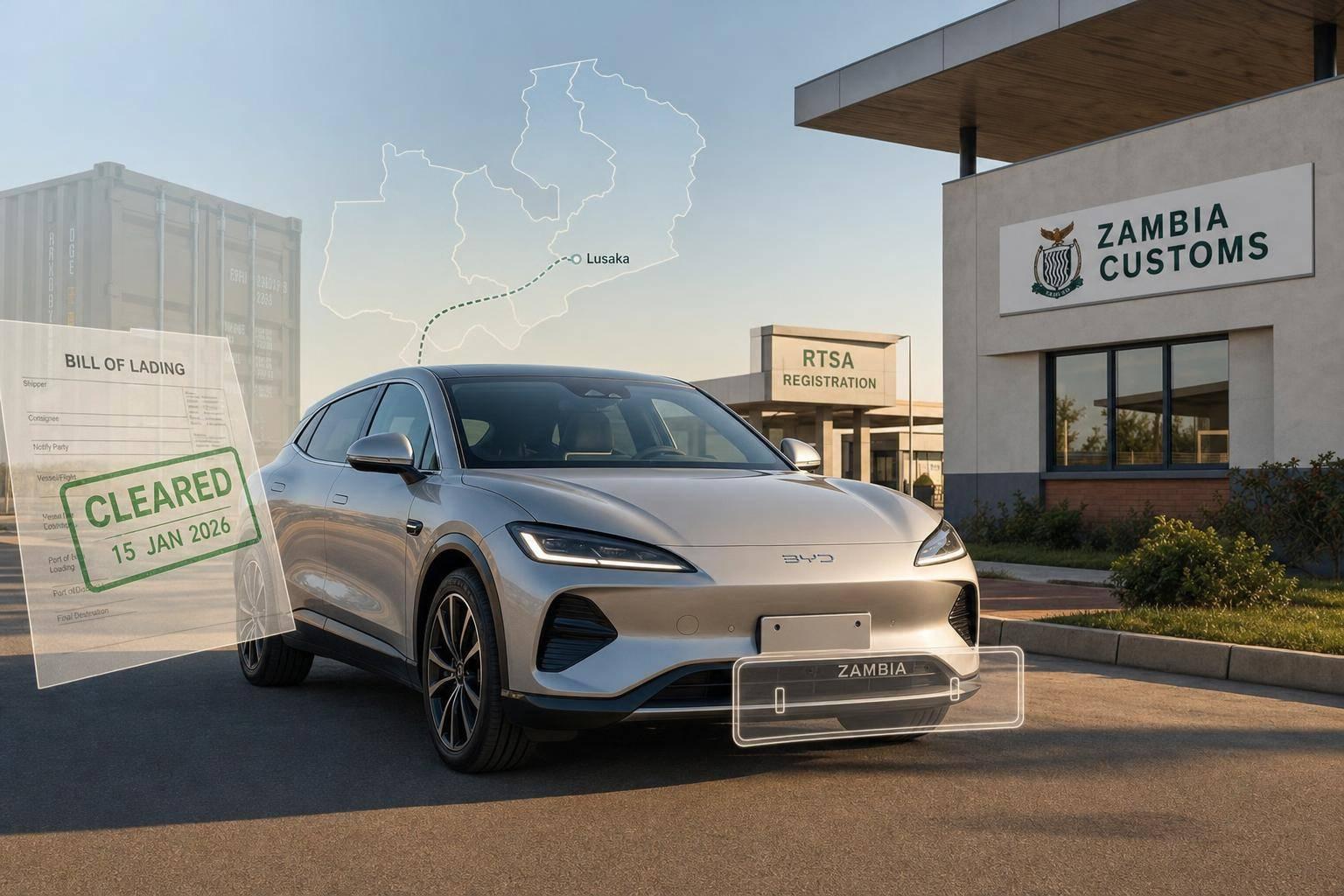
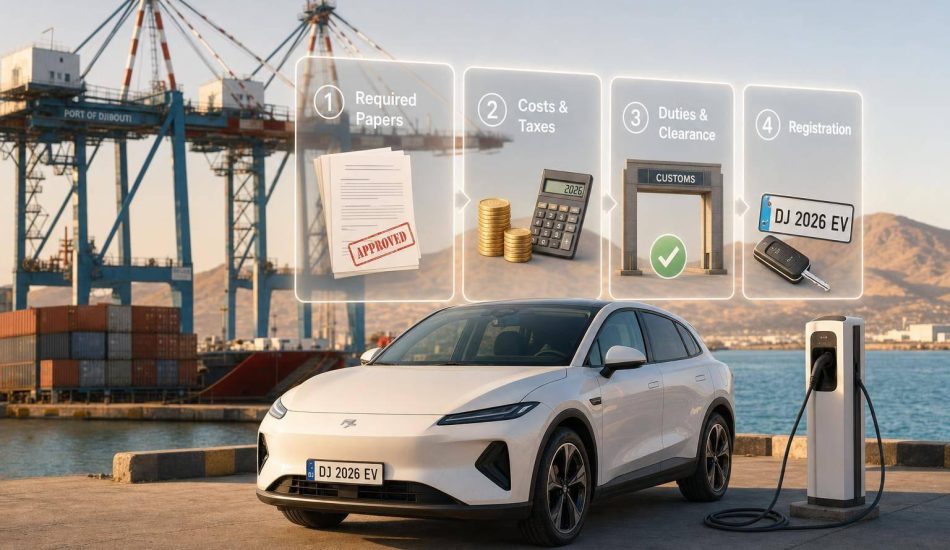
If you import a 100% electric car into Zambia in 2026, you may pay 0% customs duty and 0% VAT on the vehicle itself. But your total bill still includes freight, marine insurance, port fees, clearing, inland transport, RTSA registration, road tax, plates, and insurance.
If I were planning this import, I’d check four things before paying a seller:
- Is it a true BEV? Hybrids do not get the same tax treatment.
- Is it right-hand drive? Left-hand drive units are usually not allowed.
- Is it over 5 years old? Older vehicles can face a 20% surtax.
- Do all papers match? Invoice, VIN, battery details, shipping papers, and TPIN must line up.
The cost gap can be big. A used budget EV may land around $12,000 to $17,500. A mid-range family EV may land around $28,000 to $39,000. A premium EV may end up around $50,000 to $72,000. On a $25,000 CIF electric car, local import-related charges can still add about $1,250 to $3,000, even with the tax break.
Here’s the short version of what I’d plan for:
- Buy price + freight + marine insurance = CIF
- Customs review through ZRA
- ASYCUDA filing at least 5 days before arrival
- Agent fees, port handling, and inland haulage
- RTSA inspection, registration, plates, and road tax
- At least third-party insurance before use
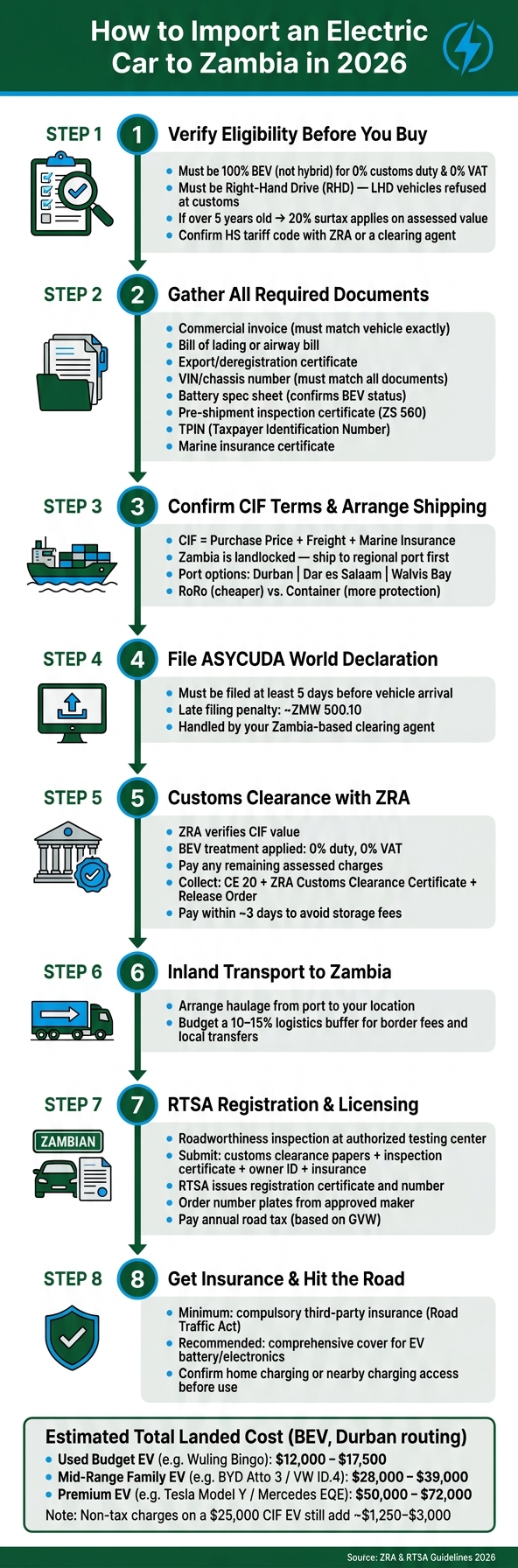
How to Import an Electric Car to Zambia in 2026: Step-by-Step Cost & Process Guide
Why You Should NOT Import Hybrid Electric Vehicles from Japan To Zambia
sbb-itb-99e19e3
Quick Comparison
| Vehicle type | Customs duty | VAT | Age rule | Main cost result |
|---|---|---|---|---|
| BEV (100% electric) | 0% | 0% | 20% surtax if over 5 years old | Lowest import tax bill |
| Hybrid / PHEV / HEV | Varies by class | Varies | 20% surtax if over 5 years old | Mid-level cost |
| Petrol / diesel | 25% on CIF | 16% on taxed value | 20% surtax if over 5 years old | Highest cost |
Bottom line: I’d only move forward after confirming BEV status, RHD compliance, age, CIF terms, and every document needed for customs and RTSA. That’s how you avoid extra fees, storage charges, and tax surprises.
2. Check Zambia’s 2026 EV Import Rules Before You Buy
Tax rules for BEVs, hybrids, and conventional cars
In Zambia, 100% BEVs are exempt from customs duty and VAT. Hybrids and conventional vehicles don’t get the same treatment, so the tax gap can be large.
| Vehicle Type | Customs Duty | Excise and other taxes | VAT | Levies | Landed-cost impact |
|---|---|---|---|---|---|
| BEV (100% electric) | 0% (exempt) | 0% (exempt) | 0% (exempt) | 0% (exempt) | Lowest |
| Hybrid (HEV/PHEV) | Reduced by tariff class | Varies | Varies | Varies | Moderate |
| Conventional (petrol/diesel) | 25% on CIF | 20%–30% by engine size | 16% on cumulative value | Applicable | Highest |
For hybrids and modified EVs, ZRA classification decides how excise and levies are handled.
For conventional imports, customs duty is charged on CIF. Excise then depends on engine size, and VAT is applied to the total after duty and excise.
That means the badge on the car doesn’t tell the whole story. A plug-in hybrid (PHEV) may be treated differently from a mild hybrid at customs, and the wrong tariff code can make your tax bill much higher. Before you put down a deposit, confirm the exact HS tariff code and expected tax category with a Zambian clearing agent or the Zambia Revenue Authority (ZRA).
After that, check the rules on right-hand drive, vehicle age, and inspection before you send any money.
Vehicle eligibility: drive configuration, age, and condition
Zambia drives on the left, so only right-hand drive (RHD) vehicles are allowed for import. Left-hand-drive units are generally refused entry, with narrow exceptions for specialized vehicles such as ambulances or fire engines. So if a seller is pushing a left-hand-drive EV, that’s a red flag. It likely won’t clear customs.
Zambia does not have a fixed age ban, but vehicles older than five years face a 20% surtax on assessed value. On paper, an older used EV can look like a bargain. In practice, once you add the age surtax, shipping risk, battery health issues, inspection trouble, and higher repair bills, the math can change fast.
Used vehicles must pass a pre-shipment roadworthiness inspection to ZS 560 before export.
Battery condition also affects customs valuation and RTSA registration.
Documents to collect before you pay and ship
Missing paperwork can slow clearance and add storage charges. Customs uses these documents to clear the vehicle without delay.
- Commercial invoice – supports customs valuation and must match the vehicle exactly
- Bill of lading or airway bill – proof of shipment and ownership transfer
- Insurance certificate – required for transit and clearance
- Export/deregistration certificate – confirms the vehicle was legally deregistered in the country of origin
- VIN/chassis number – must match across all documents
- Battery spec sheet – helps confirm the vehicle is a BEV and supports tariff classification
- TPIN (Taxpayer Identification Number) – required for the ZRA clearance process
- Pre-shipment inspection certificate – required for used vehicles from applicable origins
The battery spec sheet needs extra care. Customs may use it to confirm whether the vehicle qualifies as a BEV, so any missing detail or mismatch can delay clearance and put the tax exemption at risk. If the battery has been replaced or modified, make sure that is documented before shipping.
Once the tax class and documents are sorted, the next step is shipping and clearance.
3. Step-by-Step Process to Import an EV into Zambia
Choose the car, confirm CIF terms, and arrange shipping
Once the vehicle meets Zambia’s import rules, the process moves through three parts: shipping, clearance, and registration.
Start with the car itself. Pick an EV that fits your budget and the way you plan to drive in Zambia. Pay close attention to battery size, driving range, and whether the car makes sense for local charging access.
Before sending payment, check whether the quote is FOB or CIF. That detail matters because Zambia uses CIF for customs valuation, which means the invoice total has a direct effect on the tax calculation.
Ship to a regional port and move the car to Zambia
Zambia is landlocked, so the vehicle won’t arrive straight into the country by sea. It first comes into a regional port, then travels overland into Zambia. Common options include Durban, Dar es Salaam, and Walvis Bay.
The best route often comes down to four things:
- Sea freight cost
- Inland haulage cost
- Transit time
- Clearance speed
RoRo often costs less, while container shipping gives the car more protection.
Clear customs, pay charges, and collect the vehicle
Once the car reaches port, the clearing agent begins customs pre-clearance.
In most cases, a Zambia-based clearing agent handles the declaration, valuation, payment, and release process. The declaration must be filed in ASYCUDA World at least 5 days before arrival. Miss that deadline, and you may face a penalty of about ZMW 500.10.
From there, ZRA checks the CIF value, applies the current BEV treatment, and assesses any remaining fees. It’s smart to set aside money for inspection, agent, and port charges as separate items. Before collection, make sure you have the CE 20, ZRA Customs Clearance Certificate, and release order in hand.
| Stage | Key Party | What Happens |
|---|---|---|
| Pre-clearance | Clearing agent / ZRA | File the vehicle declaration in ASYCUDA World before arrival. |
| Valuation and assessment | ZRA | ZRA verifies the CIF value and applies the current BEV treatment. |
| Payment and release | Buyer / agent | Pay assessed charges and receive the release order. |
| Collection | Clearing agent / transporter | Arrange final delivery to your location in Zambia. |
After that, the next step is RTSA registration.
4. Calculate the Total Landed Cost of an Electric Car
Once the customs side is sorted out, it’s time to see if the deal still makes sense on paper.
Full cost breakdown: purchase price, freight, taxes, clearance, and registration
The total landed cost is the full amount you need to get the car from the seller to Zambia. It starts with the CIF value: purchase price, freight, and marine insurance. From there, you add taxes and local charges.
For qualifying BEVs, the tax side is much lighter. That means the final price is driven mostly by CIF plus local fees. With a conventional car, duty, excise, and VAT can all apply, which pushes the landed cost much higher.
| Category | Line Item | BEV Status | Typical Range |
|---|---|---|---|
| CIF Base | Purchase price + freight + marine insurance | Base cost | Varies |
| Tax Items | Customs duty | 0% exempt for BEVs | $0 |
| Tax Items | Excise duty | Reduced or exempt for BEVs | Varies |
| Tax Items | Import VAT | 0% exempt for BEVs | $0 |
| Tax Items | Carbon/environmental levy | Often exempt or reduced for BEVs | Varies |
| Non-Tax Items | Port handling and storage | Mandatory | Varies |
| Non-Tax Items | Clearing agent fees | Mandatory | Varies |
| Non-Tax Items | Inland transport (port to Zambia) | Mandatory | Varies |
| Non-Tax Items | RTSA registration certificate | Mandatory | Local fees (charged in ZMW) |
| Non-Tax Items | Road tax | Mandatory | Local fees (charged in ZMW) |
| Non-Tax Items | Fitness test & inspection form | Mandatory | Local fees (charged in ZMW) |
| Non-Tax Items | Number plates | Mandatory | Varies |
| Non-Tax Items | Initial insurance | Mandatory | Varies |
Sample import budgets for three EV types
A rough budget gets much easier once you plug CIF into the cost stack above. The examples below assume Durban port routing and include CIF, shipping, inland haulage, clearance, and registration.
A used budget EV like a Wuling Bingo may come in at a CIF of about $10,000 to $15,000. After logistics and registration, the total landed cost is about $12,000 to $17,500.
A mid-range family EV like a BYD Atto 3 or VW ID.4 may land at a CIF of about $25,000 to $35,000. After the extra costs are added, the total landed cost is about $28,000 to $39,000.
A premium EV like a Tesla Model Y or Mercedes-Benz EQE may start at a CIF of about $45,000 to $65,000+. After logistics and registration, the total landed cost is about $50,000 to $72,000.
The pattern is pretty clear. Shipping, clearance, and registration can still add a few thousand dollars above CIF, but the BEV exemption keeps the final figure well below what a similar conventional car would cost once taxes are added.
How to decide whether importing is worth it
The landed cost tells only part of the story. To decide if importing makes financial sense, compare that number with what it would cost to own a conventional car over the same period.
Look at the full ownership picture:
- Fuel savings
- Lower maintenance
- Battery health
- Charging access
Battery condition is the biggest risk with a used EV import. Before paying, ask for a battery diagnostic that shows state of health and remaining capacity. If the battery is badly degraded, real driving range can drop a lot. And if replacement is needed, the cost can wipe out the savings fast. For a new EV, check whether the battery warranty transfers to Zambia.
Charging access matters just as much. Lusaka and the Copperbelt have a growing charging network, but outside those areas, you need a clear plan. Home charging or a nearby steady option should be in place before the car arrives.
With the landed cost mapped out, the next step is RTSA registration, plates, and insurance.
5. Register the EV in Zambia and Avoid Common Mistakes
RTSA registration, plates, road tax, and insurance
Once customs releases the car, move fast on RTSA registration and licensing. Try to finish the inspection and registration within a few days of customs clearance so you don’t get hit with storage fees.
The process usually goes like this. First, take the EV to an authorized testing center for a roadworthiness inspection. They check the basics like brakes, lights, tires, and the car’s structure. For EVs, inspectors may also check the battery and high-voltage parts. After the vehicle passes, submit your customs clearance papers and inspection certificate to RTSA, along with owner ID and a valid insurance certificate. RTSA then issues the registration number and certificate. You use those to order plates from an approved maker.
Road tax is a yearly fee based on GVW, and it’s separate from registration. So don’t treat it like a one-time charge. Zambia also requires at least compulsory third-party insurance under the Road Traffic Act. If you’re bringing in an imported EV, comprehensive cover is often a smart move. A damaged battery or fault in the electronic systems can cost a lot more than repairs on a gas or diesel car.
Most extra costs at this stage come from slow follow-up, missing documents, or the vehicle being put in the wrong category.
Common mistakes that raise import costs
A few errors can make your import bill climb fast: misclassifying the vehicle, missing the 5-day ASYCUDA pre-clearance window, or guessing too low on inland haulage. Those can lead to reassessment, penalties, and storage fees. After customs assessment, importers usually have about three days to pay duties before storage charges start.
Budget for the full chain of costs, not just customs:
- Haulage
- Border fees
- Local transfers
- Storage
It’s also smart to add a 10%–15% logistics buffer.
Key points to confirm before you place an order
Before you place an order, make sure the vehicle can get through both customs and RTSA checks without drama. That means confirming BEV eligibility, right-hand-drive compliance, age rules, charging fit with Zambian standards or a compatible charging adapter, and a full set of papers that match up, including the invoice, deregistration papers, and VIN documents.
When those details line up, your landed-cost math becomes much more solid. You can total everything from CIF to customs, inland haulage, registration, plates, road tax, and first-year insurance, then decide if the import works for your budget.
FAQs
How can I prove a car is a true BEV?
To confirm a vehicle is a true Battery Electric Vehicle (BEV), get a pre-shipment inspection that checks battery health. That should cover battery capacity, charging performance, and thermal management.
Then cross-check the vehicle’s battery capacity and model details against the purchase agreement and the customs declaration. For used imports, ask for:
- A verifiable auction grade sheet
- A live video walk-around
- Official manufacturer documentation
What if my EV is over 5 years old?
Zambia generally does not enforce an age limit on used EV imports, so you can still bring one in.
That said, condition checks can be tighter. If you’re importing a used EV, especially from Japan, get a JEVIC inspection/certificate to confirm the car’s roadworthiness, age, and specs. Also make sure the vehicle matches your declaration exactly. If the details don’t line up, you could face delays, extra charges, or penalties.
How long does the full import process usually take?
It depends. ASYCUDA World pre-clearance needs to be done at least 5 days before arrival, and final customs clearance at the Zambian border has to be completed before registration and inspection can begin.
Most delays usually come from shipping transit time, border and customs processing, road conditions, plus possible storage or other hold-ups.