
 Thabo Nkosi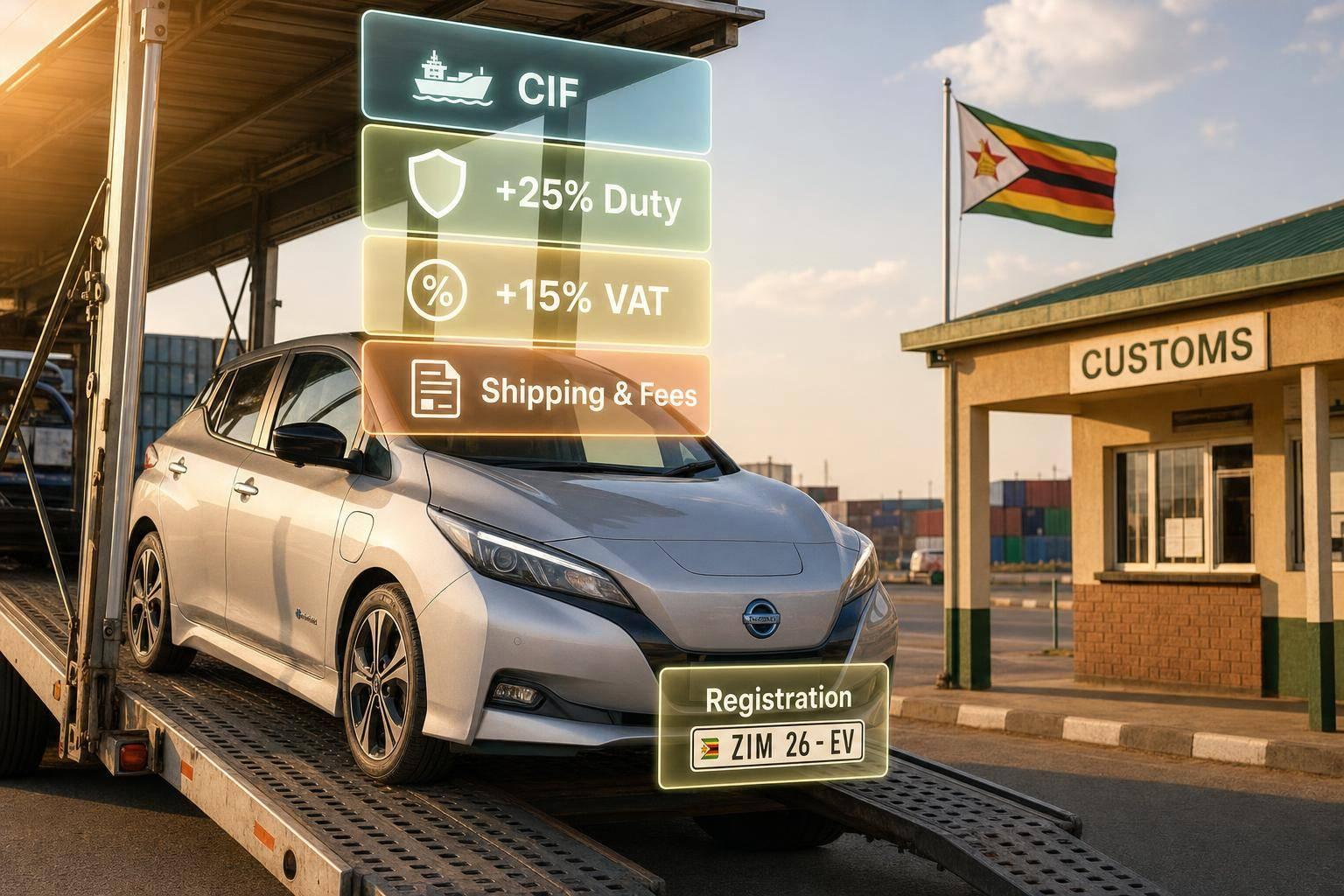
Importing an EV into Zimbabwe in 2026 usually costs far more than the sale price. I’d budget for CIF value + 25% customs duty + 15% VAT + shipping + clearing + registration before I send any money.
Here’s the short version:
- Fully electric vehicles now face 25% duty instead of 40%
- VAT is 15%
- The car must usually be right-hand drive
- A used vehicle must usually be under 10 years old from the date of manufacture
- You’ll deal with ZIMRA for customs and CVR/VID/VTS for road use paperwork
- A missing document can lead to storage fees, delays, or a blocked release
A simple tax example:
- CIF/VDP: $10,000
- Duty at 25%: $2,500
- VAT at 15% on $12,500: $1,875
- Total tax: $4,375
That means a $10,000 import value can turn into a much bigger final bill once freight, agent fees, inland transport, plates, insurance, and registration are added.
For a rough budget, the article’s examples land at about:
- 2018 Nissan Leaf: $13,491
- 2023 BYD Dolphin: $22,974
Before I buy, I’d check 3 things first:
- Age rule – under 10 years old at customs clearance
- Steering – right-hand drive
- Paperwork – invoice, export papers, bill of lading, freight and insurance proof, ID, and police clearance where needed
Then I’d move in this order:
- Confirm the EV qualifies
- Work out full landed cost
- Send documents for pre-clearance with ZIMRA
- Pay duty and VAT
- Collect customs release papers
- Get police clearance, inspection if needed, insurance, and CVR registration
- Fit plates before road use
If I wanted one takeaway, it’s this: the cheapest EV on paper is not always the cheapest EV to land and register in Zimbabwe.
Check Whether Your EV Qualifies for Import
Before you send money overseas, make sure the exact EV you want to buy can legally enter Zimbabwe. This check comes first for a reason: if the car doesn’t qualify, customs can stop it.
There are three main checks that decide if the EV can come in.
Vehicle Age, Right-Hand Drive, and EV Classification
Under SI 54 of 2024, as amended by SI 111 of 2024, Zimbabwe blocks most used vehicles that are 10 years old or more from the date of manufacture. The narrow exceptions apply only to deceased estates, returning diplomats, and qualifying immigrants with an import licence.
That date matters more than many buyers think. Zimbabwe uses the exact date of manufacture, not the first registration date. So don’t rely on the registration book alone. Check the chassis plate, manufacturer records, or the auction sheet instead. The car must still be under 10 years old at the moment ZIMRA clears it.
The next hard rule is steering position. Zimbabwe requires right-hand drive vehicles. Left-hand drive imports are generally not allowed for normal road use, aside from limited exceptions for specialized vehicles.
If you’re importing an EV, the same age and steering rules still apply. Being electric doesn’t give it a separate pass on those checks.
Which Authorities Handle Customs and Registration
Once the vehicle passes the entry checks, you’ll deal with a few different offices from arrival through registration.
| Authority | Role in the Process |
|---|---|
| ZIMRA (Zimbabwe Revenue Authority) | Assesses and collects customs duty and VAT, processes the customs declaration, and issues the Customs Clearance Certificate (CCC). |
| Border and port officials | Manage entry and inspection at borders and ports, and coordinate with ZIMRA on pre-clearance. |
| VID (Vehicle Inspection Department) | Handles vehicle fitness checks and vehicle safety checks. |
| CVR (Central Vehicle Registry) | Handles first registration and issues the registration book and number plates; requires police clearance, identity, proof of residence, and the ZIMRA duty receipt. |
Since mid-2024, vehicles must be registered and issued number plates before release at certain border posts. In practice, that means the ZIMRA and CVR steps now happen side by side. So don’t put the car on public roads until customs release and registration are both done.
Once you’ve cleared eligibility, the next job is to work out duty, VAT, shipping, and clearing costs.
sbb-itb-99e19e3
Calculate Your Full Landed Cost: Duties, VAT, Shipping, and Clearing
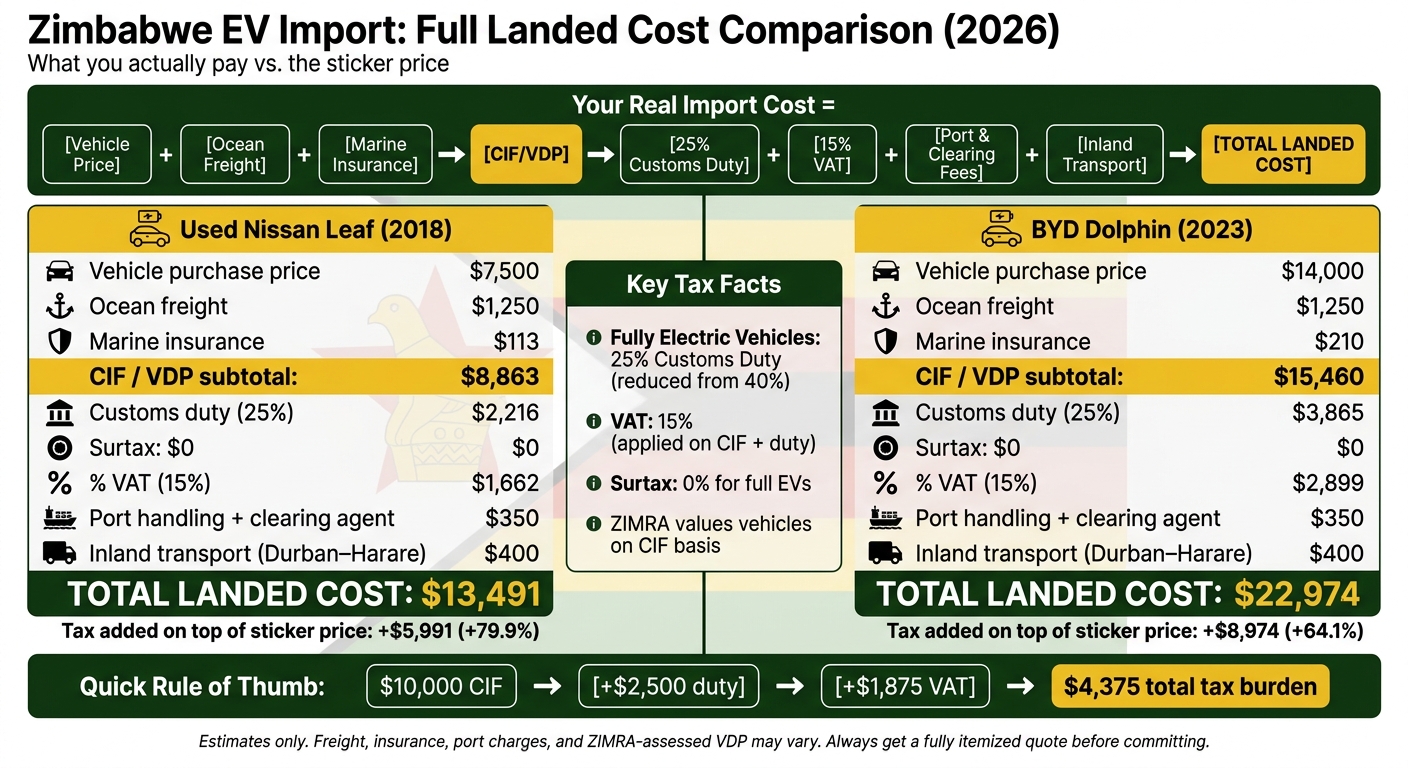
Zimbabwe EV Import Cost Breakdown: Nissan Leaf vs BYD Dolphin (2026)
Budget from landed cost, not the sticker price. That’s how you avoid nasty surprises. Once you’ve worked out the full number, the next move is getting your customs paperwork in order.
How ZIMRA Calculates Duty and VAT on an Imported EV
ZIMRA values imported private vehicles on a CIF basis: vehicle cost, freight, and insurance. That amount, along with charges that apply before the vehicle enters Zimbabwe, becomes the Value for Duty Purposes (VDP). ZIMRA then uses that figure as the starting point for customs duty and VAT.
For fully electric vehicles, customs duty is 25% and surtax is 0%. VAT is 15%, charged on the taxable amount, which is CIF/VDP plus customs duty and any surtax.
Here’s a simple example:
- CIF/VDP: $10,000
- Customs duty (25%): $2,500
- Surtax: $0
- VAT base: $12,500
- VAT (15%): $1,875
- Total tax charges: $4,375
One thing to watch: ZIMRA can reject an invoice if the value looks too low and assess the EV using comparable market prices. So it’s smart to use an invoice that lines up with what you actually paid.
Other Costs Buyers Often Overlook
Duty and VAT are only part of the bill. The extra charges can shift your budget by a lot.
Freight for a compact EV often lands around $800 to $1,500, depending on the route. Marine insurance is usually a small share of the vehicle’s value, often about 1% to 2%.
Port handling and storage can also catch people off guard. Some ports give you only a short free-storage window before demurrage starts. In some cases, that window can be as little as four days, while other ports may allow seven to 14 days. After that, daily charges can pile up fast, especially when billed in USD.
You’ll also want to set aside money for a clearing agent. A licensed agent handles the customs entry, paperwork, inspections, and release process. Fees often run about $150 to $300 per vehicle. Then add inland transport from the port or border to your destination city, plus any exchange-rate swings if freight or service charges are billed in another currency.
Landed Cost Examples: Nissan Leaf vs. BYD Dolphin
Use the examples below as a budget check. They show how duty, VAT, and logistics can change the final number.
| Cost Component | Used Nissan Leaf (2018) | BYD Dolphin (2023) |
|---|---|---|
| Vehicle purchase price | $7,500 | $14,000 |
| Ocean freight | $1,250 | $1,250 |
| Marine insurance | $113 | $210 |
| CIF / VDP | $8,863 | $15,460 |
| Customs duty (25%) | $2,216 | $3,865 |
| Surtax (0% – full EV) | $0 | $0 |
| VAT (15% on CIF + duty) | $1,662 | $2,899 |
| Port handling + clearing agent fee | $350 | $350 |
| Inland transport (Durban–Harare) | $400 | $400 |
| Estimated total landed cost | $13,491 | $22,974 |
These are planning estimates only. Freight rates, insurance, port charges, inland transport, and ZIMRA’s assessed VDP can all shift the final amount. Always ask for a fully itemized quote before you commit. If the numbers still work, move on to customs paperwork and release.
Gather your Documents and Clear the EV Through Customs
Once your budget is set, paperwork becomes the make-or-break part of the import. A car can be paid for, shipped, and sitting at the border, but without the right documents, it goes nowhere. Get everything lined up before shipment so you don’t get hit with border delays or storage fees.
Documents Required Before and at Arrival
Once you know your landed cost, the next step is clearing the car through customs. ZIMRA requires a set of documents for private motor vehicle imports, and missing or mismatched paperwork can delay or block clearance.
The required documents are:
- Invoice or sale agreement showing the actual purchase price
- Export certificate or logbook from the country of origin
- Bill of lading or waybill
- Freight statement showing the shipping cost
- Insurance statement covering the shipment
- Importer’s passport or national ID
- Police clearance certificate (SARPCCO) for vehicles imported from Southern Africa; it must match the vehicle’s chassis and engine numbers.
If you’re importing under a rebate or exemption, include the rebate letter as well. Add any conformity certificate required by the exporting country.
Bring the originals and one full copy set. ZIMRA, the clearing agent, and CVR may each ask for copies. Check that the VIN/chassis number, engine number, model, year, and color match across every document. If the invoice says one thing and the title or shipping papers say another, clearance can stall or the declaration can be rejected.
When this file is clean and complete, the process tends to move much faster.
Customs Clearance Steps from Shipment to Vehicle Release
Follow this sequence to avoid storage fees. If you skip a step or file late, the vehicle can end up sitting in a transit shed while charges keep adding up.
1. Hire a licensed clearing agent early
Use a licensed clearing agent to file the declaration and handle ZIMRA liaison. If the import is coming through Beitbridge, this matters even more. A good agent helps make sure the paperwork is presented correctly and fast enough to avoid processing delays.
2. Submit documents for pre-clearance before the vehicle arrives
Send scanned documents early so ZIMRA can assess duty before arrival. For Beitbridge imports, the dedicated pre-clearance emails are [email protected] and [email protected].
3. Receive the duty assessment, pay, and collect release documents
Once ZIMRA processes the declaration, you will receive the duty assessment. After you pay the assessed duty and taxes, ZIMRA issues the CCC and Form 49. These are the documents that release the vehicle from the border post or transit shed.
Keep the route, destination, and shipping documents consistent.
After release, the next step is first registration with CVR.
Register the EV in Zimbabwe and Make It Road Legal
After ZIMRA releases the vehicle, the final admin step is registering it with the Central Vehicle Registry (CVR) so it can get number plates and be used legally on public roads. In practice, first registration usually goes through police clearance, then VID inspection if needed, and then CVR registration. Don’t sit on this after customs release. The VTS clearance window is short, so it helps to move fast.
Documents and Fees for First Registration with CVR
CVR usually won’t handle a first registration unless your paperwork is complete. For an imported EV, that document pack will usually include:
- A completed CVR application form
- ZIMRA clearance papers, such as the Bill of Entry or Customs Clearance Certificate, plus duty and VAT receipts
- The foreign registration or deregistration document
- The original purchase invoice or sale agreement
- A national ID or passport
- Proof of residence
- An original insurance cover note
- Police clearance from VTS
- A VID roadworthiness certificate, if required
- If someone is applying for you: a power of attorney or affidavit, plus the agent’s ID
You should also budget for first registration, number plates, the license disk, and a small admin charge. For planning purposes, first registration costs $50. Number plates usually run about $30 to $70 per pair, the license disk is about $40 to $100 per year, and the admin fee is usually around $5 to $15. It’s smart to check the current fee schedule with CVR before paying anything.
One detail can trip people up: the VTS police clearance certificate is valid for 14 days. Try to line it up with your other appointments so it doesn’t expire before your CVR filing date.
Step-by-Step: From Customs Release to Number Plates
Use the sequence below to get from customs release to number plates with fewer holdups. The cost figures here are planning ranges based on current 2026 guidance, so check the latest amounts with CVR, VID, and your insurer before paying.
| Step | Authority | Timeframe | Estimated Cost |
|---|---|---|---|
| Obtain police clearance from VTS | Vehicle Theft Squad (VTS) | 1–3 business days | ~$5–$20 |
| Arrange VID roadworthiness inspection, if required | Vehicle Inspection Department (VID) | 1–5 business days | ~$30–$70 |
| Purchase third-party insurance | Licensed insurer or broker | Same day to 1 day | ~$60–$150/quarter |
| Submit CVR application and pay fees | Central Vehicle Registry (CVR) | 1–3 business days | ~$50 registration + ~$30–$70 plates + ~$40–$100 license disk |
| Receive registration book, plates, and license disk | CVR | Same day to 2 days after payment | Included above |
If your documents are ready and match across the board, it’s often possible to move from customs release to full registration in about 5 to 14 business days. The usual snags are missing papers, document mismatches, long VTS queues, and plate stock issues at the CVR office.
If you want to save time, handle the VID inspection and insurance in parallel instead of waiting to do one after the other. That simple move can shave days off the process.
Once the plates are fitted and the license disk is displayed, the vehicle is legal for road use. At the registration stage, double-check that CVR records the propulsion type as electric.
Conclusion: Plan Your Budget and Follow the Right Process
If you’ve followed the earlier steps, the last part comes down to budget and timing. Importing an EV to Zimbabwe in 2026 is cheaper only when you plan for the full landed cost: CIF, 25% duty, 15% VAT, shipping, and clearing fees.
Before you buy, make sure the car is right-hand drive, under 10 years old, and fully electric. Once that’s checked, shift your attention to the paperwork. Pre-clear with ZIMRA before shipment. Have your customs and CVR documents ready before the car arrives so you don’t get hit with delays or storage fees.
After customs release, complete CVR registration right away so the EV can be driven legally. That order helps you avoid delays, storage fees, and registration issues.
FAQs
Can I import a left-hand-drive EV into Zimbabwe?
Yes. Zimbabwe allows both right-hand-drive and left-hand-drive EVs, as long as the vehicle meets basic technical safety standards. That includes things like working lights, reliable brakes, and sound structural integrity.
The vehicle also needs to meet other import rules, including age limits and EV eligibility checks during customs clearance.
What happens if my EV turns 10 years old before customs clearance?
If your EV turns 10 before customs clearance in Zimbabwe, it will usually no longer qualify for import. Under Statutory Instrument 54 of 2024, Zimbabwe limits imported EVs to vehicles under 10 years old.
That can lead to a refused customs entry or a delay, unless you fall under an exemption. To lower the risk, make sure your import paperwork is complete and that the vehicle is cleared while it still falls within the allowed age limit.
How can I avoid storage fees and customs delays?
Plan for a realistic transit time, and get everything in place before the EV arrives. Fill out all ZIMRA customs forms with care. Even small mistakes can slow things down, especially if the declared value, vehicle specs, or electric powertrain details don’t match across documents.
Work closely with your shipping company and customs broker so the paperwork can be sent in and checked without delay. It also helps to keep backup documents on hand and stay in touch during customs processing and inspection.