
 Thabo Nkosi
Yes – importing an EV to Cameroon in 2026 can make sense, but only if you price the full landed cost first, confirm the car is a full battery EV, and make sure you can charge at home on 230 V / 50 Hz power. The main tax break is for new, unregistered BEVs: a 50% cut in the taxable base and 0% excise duty, while VAT stays at 19.25%.
If I were doing this myself, I’d make the decision based on five checks:
- Tax status: new BEVs get the best treatment in 2026; used EVs often do not
- Battery condition: target 85%+ SoH; treat 80% as the floor
- Charging fit: Type 2 AC charging works best for Cameroon
- Shipping plan: choose RoRo for lower cost or container for more protection
- Paperwork and timing: customs errors at Douala can lead to delays and extra port charges
Here’s the short version of what matters most:
- Start with CIF: car price + freight + insurance
- Then add customs duty, 19.25% VAT, port fees, broker fees, and inland transport
- For EVs with FOB above 1,000,000 CFA, you’ll need an Import Declaration and AVI
- CIVIC costs 29,813 CFA per vehicle
- Clearance at Douala often takes about 10–15 days
- A sample new EV at $18,000 can end up around $23,000–$24,500 after shipping, fees, registration, and home charging setup
A quick side-by-side view:
| Checkpoint | What I’d verify first | Why it matters |
|---|---|---|
| Tax | New vs. used EV status | Changes the tax bill |
| Vehicle | VIN, battery health, recall status | Cuts the risk of buying a bad unit |
| Charging | 230 V / 50 Hz and Type 2 fit | Home charging is the main setup |
| Shipping | RoRo vs. container | Affects cost and vehicle protection |
| Customs | Broker review before payment | Helps avoid file problems at Douala |
| Registration | Customs clearance, insurance, inspection | Needed before plates |
Bottom line: if you can confirm the EV qualifies for the 2026 rules, the battery is still in good shape, and your home can support charging, importing may be worth the cost. If any one of those three fails, the deal can go bad fast.
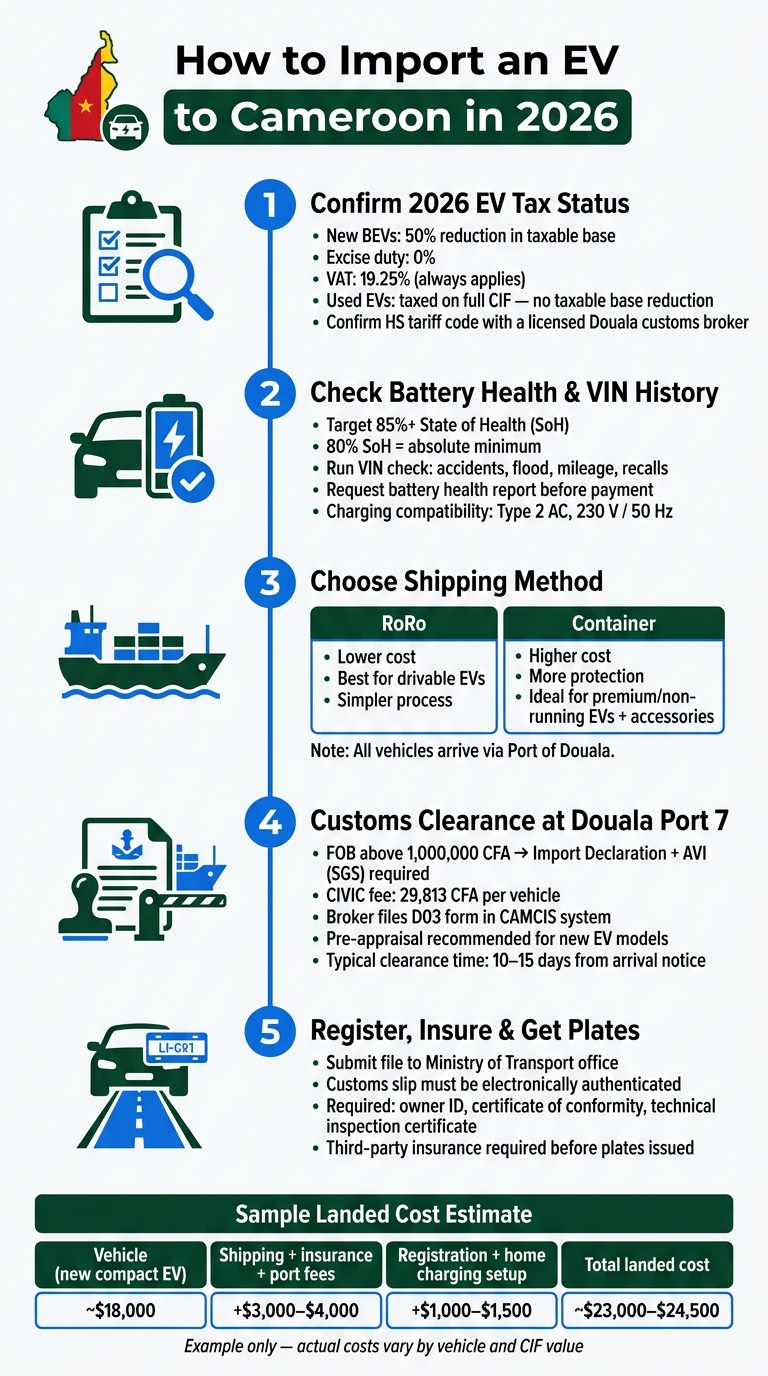
How to Import an Electric Car to Cameroon in 2026: Step-by-Step Process
1. Check Cameroon’s 2026 EV Import Rules Before You Buy
Check Cameroon’s 2026 tax treatment before you send money to the seller. This matters more than most buyers expect. The vehicle’s classification decides the duty, excise, and VAT you’ll pay at import.
EV incentives, customs duty, excise, and VAT in 2026
The big change in 2026 is the 50% cut in the taxable base for qualifying new electric vehicles. In plain English, customs duty is charged on only half of the vehicle’s CIF value, not the full amount.
Here’s what that looks like in practice: if the CIF value is $25,000, a qualifying new EV is taxed on $12,500 before duty is applied. A gasoline car with the same CIF is taxed on the full $25,000.
Excise duty is 0% for qualifying EVs. VAT stays at 19.25% and is charged at customs on the customs value, plus duty, plus any applicable charges.
The exact customs duty rate depends on the vehicle’s HS tariff code and its CEMAC Common External Tariff classification. That’s why it’s smart to confirm the current rate with a licensed customs broker in Douala before you buy. A small classification mistake can change the tax bill in a big way.
Which vehicles qualify and what documents sellers must provide
Only fully electric BEVs qualify for the incentive. Plug-in hybrids and mild hybrids are a different story, so get broker confirmation before you move ahead.
The 50% taxable-base cut applies to new, unregistered EVs. Used EVs are usually taxed on full CIF. That can catch buyers off guard. A vehicle advertised abroad as a demo unit or ex-rental may still be treated as used by Cameroonian customs, even if the odometer reading is low. The 0% excise treatment for used EVs should also be checked for that specific vehicle.
Confirm the HS code before you buy. A pure BEV is not treated the same way as a plug-in hybrid.
Before payment, get the seller to provide:
- Commercial invoice – must show buyer and seller names, full vehicle description, VIN, sale price, currency, and payment terms. This is the main basis for customs valuation.
- Title or certificate of origin – for new cars, a manufacturer’s certificate of origin; for used cars, the registration certificate from the export country.
- Export certificate or export declaration – shows the vehicle is legally leaving the origin country.
- VIN and VIN report – a third-party VIN check can show prior accidents, mileage issues, or salvage history, which can affect both risk and declared value.
- Battery and service records – state-of-health data and service history help support a realistic declared price and can save you from buying a car with hidden battery wear.
- Purchase contract or bill of sale – useful if customs asks you to support the declared transaction value.
Send scans of all documents to your customs broker before payment. That way, the broker can review the file early and flag any problem while you still have room to walk away.
Once the tax treatment is confirmed, the next step is checking battery health, VIN history, and charging fit before shipping.
sbb-itb-99e19e3
2. Choose the Right EV for Cameroon and Check Its Condition
Battery health, VIN checks, and model suitability
A cheap EV can cost you more later if the battery is worn out. The number to watch is State of Health (SoH), which shows how much usable battery capacity is left.
Put usable range ahead of badge appeal, especially if you’ll mostly charge at home. A well-known brand won’t help much if the battery has lost too much capacity. If you can, look for 85%+ SoH. Treat 80% as the minimum.
Before you send money, ask the seller for a battery-health report from an OBD scanner or a dealer battery report. No report? Then ask for a photo showing the car at a full charge, and compare that displayed range with the model’s original EPA- or WLTP-rated range. It’s not perfect, but it gives you a decent reality check.
You should also run a VIN history check. This can help confirm:
- accident history
- flood damage
- mileage mismatch
- salvage or rebuilt title
- open recalls
Open recalls matter. They can create safety risks and may make insurance or technical inspection in Cameroon harder to deal with.
Charging compatibility with Cameroon’s 220–240 V, 50 Hz power supply
Cameroon uses 230 V, 50 Hz mains electricity, with Type C and Type E outlets. Type F plugs also fit Type E sockets. That means many European-spec EVs built for 220–240 V, 50 Hz single-phase AC will work well there, as long as the home’s wiring and grounding are correct.
North American cars can be trickier. In many cases, you’ll need a Type 1/J1772 adapter or a different wallbox to make home charging work properly.
Because public fast charging in Cameroon is still limited, home charging will be your main setup in most cases. So don’t treat your house wiring as an afterthought. Have a qualified electrician check the wiring, breakers, and earthing before anything is installed. Most homes were not set up for the steady load that EV charging puts on a circuit.
Here’s a simple view of the main charging options and how they fit Cameroon’s power supply:
| Charger Type | Voltage / Frequency | Connector | Typical Output | Home Setup Notes |
|---|---|---|---|---|
| Portable EVSE ("granny" charger) | 230 V / 50 Hz | Type C/E outlet via adapter | Low-power AC charging | Dedicated, grounded socket only |
| Home wallbox (AC Level 2) | 230 V / 50 Hz, single-phase | Type 2 | 3.7–7.4 kW | Requires dedicated circuit and professional installation |
| Public AC charger | 230 V / 50 Hz | Type 2 | 7.4–22 kW | Limited availability in Cameroon |
| DC fast charger | High-voltage DC | CCS or CHAdeMO | High-power DC charging | Very scarce locally; not a reliable daily option in 2026 |
Bottom line: choose EVs with Type 2 AC charging and a 230 V / 50 Hz-compatible onboard charger if you want the smoothest fit with Cameroon’s power system.
Using EV24.africa to source EVs and plan delivery
EV24.africa can help you compare EV specs, battery data, and delivery options before you buy. Once you’ve picked the model, the next step is shipping documents and port planning.
3. Ship the EV to Cameroon and Prepare for Customs
RoRo vs. container shipping to Douala
After you buy the EV, you’ll need to pick a shipping method. At this stage, the car and paperwork should already be confirmed, so the choice comes down to logistics.
Both options arrive through the Port of Douala, Cameroon’s main entry point for imported vehicles. Customs clearance is handled mainly at Douala Port 7 and the "Parc Auto" area. Use the same VIN and purchase details from the inspection file. That sounds basic, but it matters. If the VIN on the shipping papers doesn’t match the rest of the file, customs can stop the process and take a closer look.
RoRo is the lower-cost, simpler option. The vehicle is driven onto the vessel and driven off when it arrives. This works well for a used EV that runs normally and doesn’t need extra protection.
Container shipping costs more, but the vehicle stays enclosed during transit. That helps limit weather exposure and rough handling. If you’re shipping a higher-priced EV, a non-running unit, or you want to load charging equipment and spare parts in the same shipment, a container usually makes more sense.
Here’s the short version:
- RoRo: lower cost, simpler, best for drivable EVs
- Container: higher cost, more protection, better for premium or non-running EVs, and can include chargers, parts, and accessories
Documents needed for shipping and customs filing
Get the file done before the vehicle leaves port of origin. That’s one of the easiest ways to avoid delays and storage charges in Douala. Every document should match on the key details: VIN, buyer, seller, model year, vehicle description, and declared value. Even one small VIN typo can lead to a document review and slow the whole clearance process.
Add the seller documents from Section 1 to your shipping file, then include these shipping papers:
- Bill of Lading – shows the shipper, consignee, vessel, and cargo; customs will check it early against the VIN and invoice
- Packing list – shows any accessories or charging equipment shipped with the vehicle
- Insurance certificate – supports the shipping and customs file
- Commercial invoice
- Title or prior registration document
- Certificate of origin
For EVs with an FOB value above 1,000,000 CFA, you’ll need an Import Declaration and an Attestation de Vérification à l’Importation (AVI) from SGS. You’ll also need to pay for CIVIC (vehicle identification verification), which costs 29,813 CFA per vehicle and must be paid before your customs declaration is filed.
Send scanned copies of every document to your Commissionnaire en Douane Agréé (CDA), or licensed customs broker, before the ship arrives. That gives them time to start filing in CAMCIS in advance. The shipping line must file the vessel manifest in CAMCIS up to 48 hours before arrival. If your broker is still waiting on documents after the vessel docks, storage fees can start piling up fast.
With the shipping file in place, the next move is customs valuation and clearance planning.
4. Calculate Landed Cost, Clear Customs, and Register the Car
How CIF value, taxes, and port fees add up to the true landed cost
With the shipping file ready, the next step is to turn the invoice into a full landed-cost estimate. Start with CIF: the FOB price + sea freight to Douala + marine insurance. Customs duty is charged on CIF, and VAT is charged on CIF plus duty.
For qualifying new EVs, the 50% taxable-base cut stays in place through 2026. Excise duty remains 0%. VAT still applies at 19.25%.
That means your working budget should cover more than just the car and freight. You also need room for:
- CIF
- Duty
- VAT
- Port handling
- Verification
- Broker fees
- Inland transport
Some fixed charges show up often. These commonly include port handling of about 160,000 XAF, an import verification tax of about 30,000 XAF, and a baseline clearing-agent fee of about 16,000 XAF.
The table below shows the 2026 tax treatment for EVs.
| Vehicle Type | Excise Duty | Taxable Value | Key Advantage |
|---|---|---|---|
| New EV | 0% (exempt) | 50% reduction through 2026 | No excise; reduced taxable base |
| Used EV | 0% (exempt) | Standard base; verification fee applies | No excise; lower running costs |
Customs clearance steps at the port
Once the vessel arrives in Douala, clearance follows a set sequence. Your Commissionnaire en Douane Agréé (CDA) handles most of the process, but it helps to know what happens at each stage so you can track the file and spot delays early.
Your broker files the formal customs declaration, usually a D03 form, at Douala Port 7, which is the main office for vehicle clearance. Customs then reviews the declaration, checks the stated value, and inspects the vehicle.
If the declared CIF seems too low or too high compared with customs reference values, customs may reassess it. This is where a pre-appraisal can save time and stress. Before the formal declaration, you submit documents such as the invoice, bill of lading, and original registration papers from the exporting country. Customs officers then agree on a value ahead of time. For newer EV models, where battery value can shift the price quite a bit, this step is often worth it.
Once the value is confirmed, customs calculates the duties and fees, a step often called liquidation. Payment is made through a bank or the customs revenue office, and then customs issues a release order. When the paperwork is complete and there are no issues, clearance usually takes 10–15 days from arrival notice to port exit.
After the car is released, the job moves to registration, insurance, and plates.
Registration, insurance, technical inspection, and number plates
Getting the vehicle out of the port is only part of the process. Before it can legally drive on roads in Cameroon, it must be registered, insured, and cleared through technical inspection.
The registration file is submitted to the regional or departmental Ministry of Transport office. One point matters a lot here: the customs slips must be electronically authenticated before a registration certificate, or carte grise, can be issued.
At this stage, the file shifts away from shipping documents and toward road-use documents.
| Stage | Item / Document |
|---|---|
| Registration & Road Use | Authenticated customs clearance slip (verified online) |
| Registration & Road Use | Owner ID (national ID or passport) |
| Registration & Road Use | Certificate of conformity |
| Registration & Road Use | Technical inspection certificate |
| Registration & Road Use | Third-party motor insurance policy |
| Registration & Road Use | Registration application form and fees |
| Registration & Road Use | Issued Cameroonian number plates |
There’s a clear dependency here: plates require insurance, and registration requires authenticated customs clearance.
Conclusion: Is Importing an EV to Cameroon Worth It?
It comes down to who’s buying the car and which EV they’re importing. Cameroon’s 2026 EV incentives open a real window, but the decision still hinges on a few plain things: battery health, charging access, and total landed cost.
A simple checklist can save you a lot of time. Before you buy, verify:
- Battery health
- VIN history
- Charging fit
- Full landed cost
- Annual mileage
Here’s what that can look like in practice. Say a buyer imports a new compact EV priced at about $18,000. Shipping, insurance, and port fees could add roughly $3,000–$4,000. Then registration and an initial charging setup might add another $1,000–$1,500. That puts the total landed cost at about $23,000–$24,500.
For someone driving 15,000–20,000 km per year and charging at home without problems, that can be a sensible long-term buy.
But cost isn’t the whole story. Charging is the deal-breaker. If you can’t charge the car dependably, the math falls apart. Home charging matters most, since public charging is still limited in Cameroon.
You also need to move with timing in mind. Verify the current Finance Law and clear customs before the incentive period ends. That’s the deadline that matters most, not the purchase date.
If you can verify the car, charge it at home, and handle the full landed cost, importing may be worth it. If you can’t, the risk is probably bigger than the savings.
FAQs
How do I know if my EV qualifies for the 2026 tax break?
In Cameroon, the 2026 tax break applies only to brand-new EVs.
Under the current rules, new EVs are exempt from the 12.5% excise duty. They also get a 50% reduction in taxable value during the 24-month period that started on 01/01/2025.
Used EVs don’t qualify for the 50% rebate. And whether the EV is new or used, all required documents must be in order for customs clearance, including the Certificate of Conformity.
Can I import a used electric car to Cameroon?
Yes. Cameroon allows used electric vehicle imports, but there’s a firm age limit: the vehicle must be 8 years old or less.
Used EVs also don’t get the same tax break as new EVs. Unlike new electric vehicles, they do not qualify for the 50% reduction in taxable value. Instead, they must pay an Import Verification Tax of CFA 29,813 ($48).
There are also two basic entry rules every importer needs to follow:
- The vehicle must be left-hand drive
- The vehicle must pass an SGS pre-shipment inspection and get a Certificate of Conformity before it arrives at the Port of Douala
That last part matters more than it may seem. If the paperwork isn’t sorted before shipment, things can get messy once the vehicle reaches port.
What do I need at home to charge an imported EV?
You’ll need private parking, a steady power supply, and the right charging gear. For most people, home charging makes the most sense, so it’s best to install a Level 2 wall charger.
Before you install anything, have a qualified electrician inspect your home’s electrical setup. That step helps you see whether your system can handle the charger safely.
Your EV also needs to match the charger’s voltage and charging standard. In some cases, an adapter can help. But for better speed and day-to-day ease, a dedicated home setup is usually the better choice.