
 Thabo Nkosi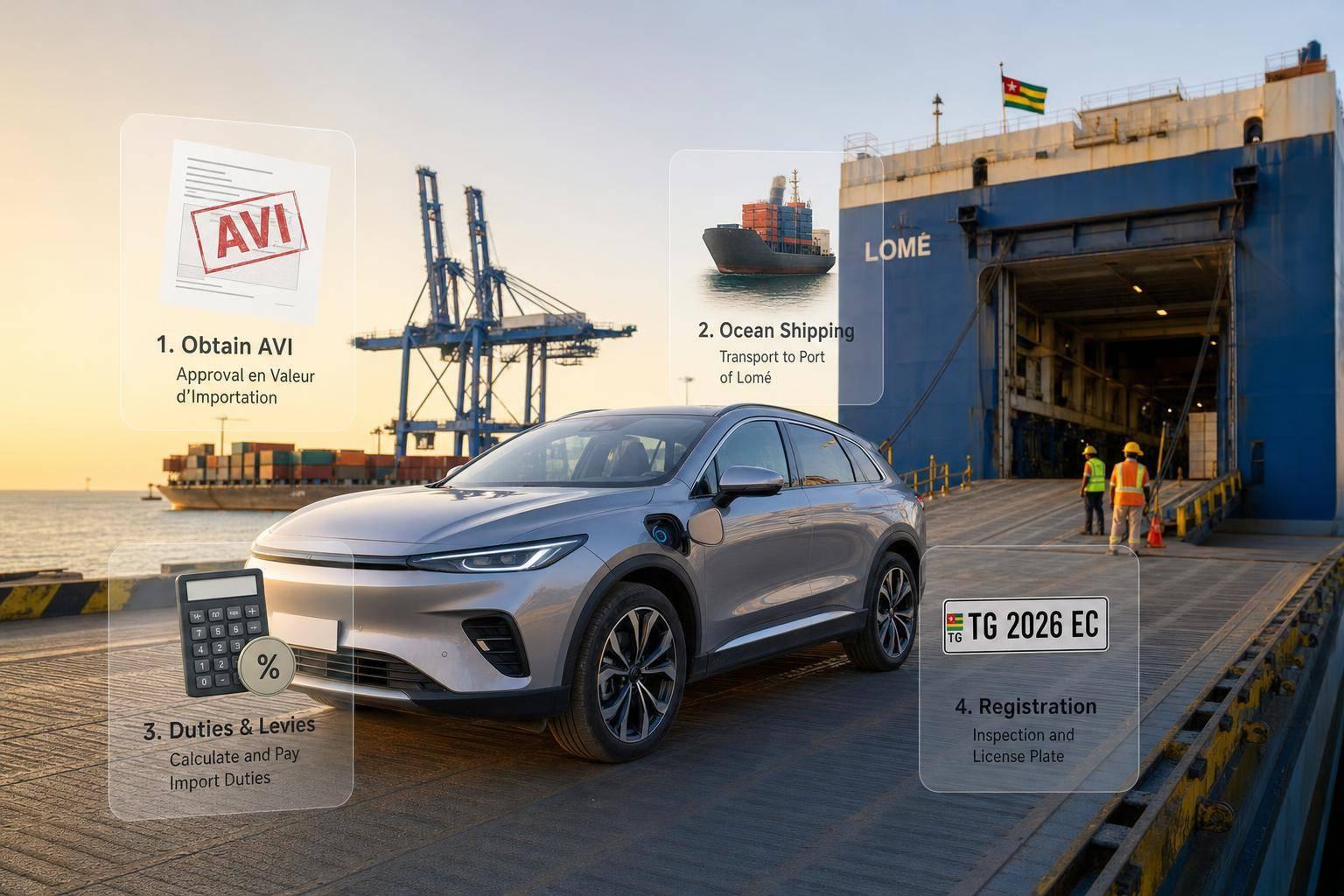
If you import a 100% battery-electric car to Togo in 2026, you usually pay 0% customs duty and 0% VAT. But you still need to budget for freight, insurance, 2.5% in levies, port charges, broker fees, and registration. And if the car is used, it will usually need to be 2018 or newer because of Togo’s 8-year age limit.
Here’s the short version:
- Only full BEVs get the full tax break
- Hybrids and plug-in hybrids do not get the same treatment
- CIF value drives the tax math: car price + freight + insurance
- You still pay 1% statistical fee, 0.5% ECOWAS levy, and 1% UEMOA levy
- You need a pre-shipment AVI inspection
- Clearance runs through the Port of Lomé
- Registration comes after customs release, insurance, and inspection
A simple example: if your EV’s CIF value is $21,200, your extra import levies may be about $530, then you add port and broker costs. In the sample case from the article, the total landed cost comes to about $22,230.
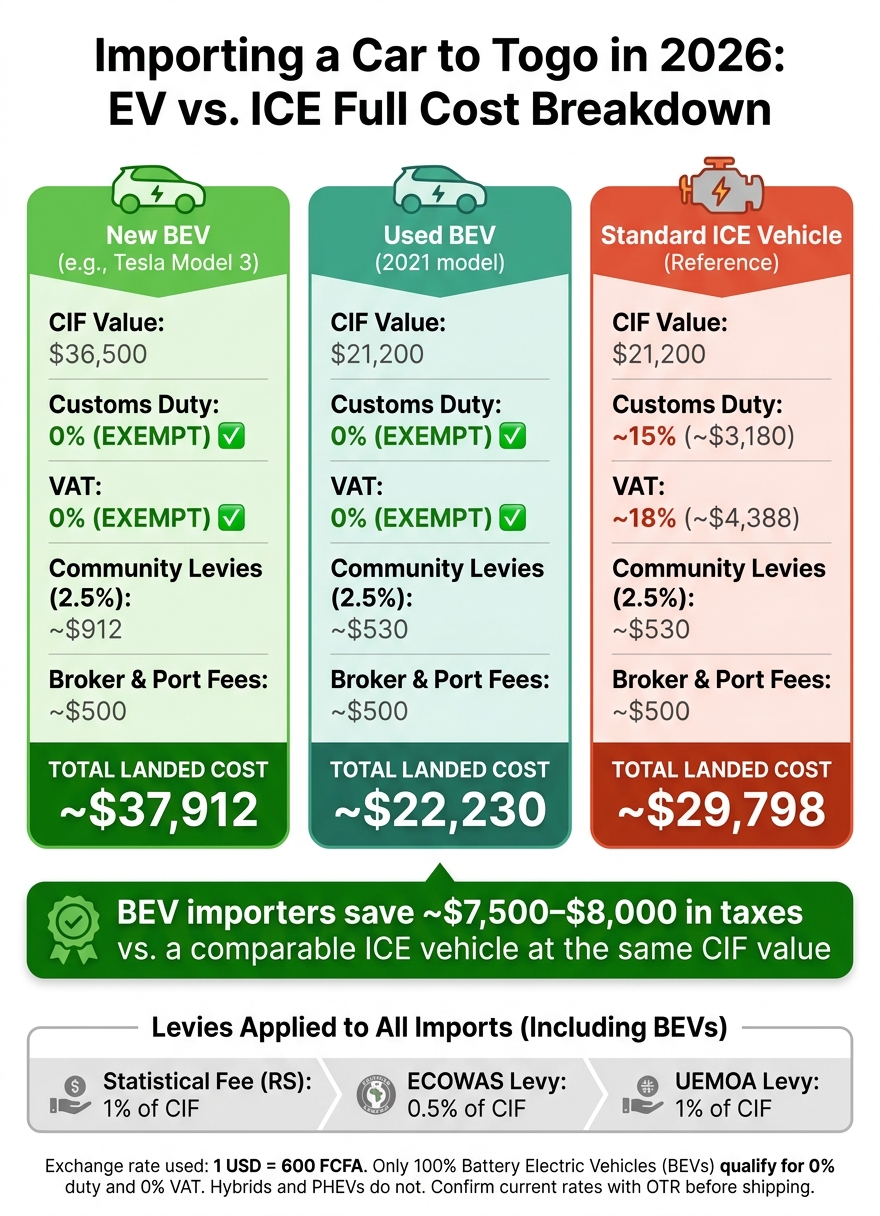
Importing an EV vs. ICE Car to Togo in 2026: Full Cost Breakdown
SHOULD I SHIP MY CAR THROUGH TOGO 🇹🇬🇹🇬
sbb-itb-99e19e3
Quick comparison
| Item | 100% BEV | Hybrid / PHEV | ICE car |
|---|---|---|---|
| Customs duty | 0% | May vary | Usually charged |
| VAT | 0% | May vary | Usually 18% |
| Levies | 2.5% of CIF | Usually apply | Usually apply |
| Age limit for used passenger cars | Usually 8 years max | Usually 8 years max | Usually 8 years max |
| AVI inspection | Required | Required | Required |
What I’d do first: check the model year, confirm the car is a full BEV, get the CIF estimate, and verify the current rule with OTR before paying the seller. That keeps your budget from falling apart after the car reaches Lomé.
Below, I break down the costs, shipping choices, customs steps, and registration process in plain English.
1. Check Togo’s 2026 EV Import Rules Before You Ship
EV approval requirements, vehicle age limits, and origin rules
Before you pay a seller or book shipping, check three things first. In Togo, imported passenger vehicles face an 8-year age limit. So if you’re bringing in a BEV in 2026, it generally needs to have been built in 2018 or later.
The car also needs an inspection from an OTR-approved body such as SGS, Bureau Veritas, or Cotecna so you can get the AVI certificate. That step matters. It plays a big part in whether the BEV clears customs and what tax treatment applies.
There’s another point that can change the math: only 100% battery-electric vehicles (BEVs) get full exemptions from customs duties and VAT. Hybrids, including plug-in hybrids, may get partial reductions, but they do not get the same full exemption.
If the vehicle comes from an ECOWAS member state, ECOWAS origin can affect levy treatment. That’s why it’s smart to confirm the latest position with the OTR before shipping. Once those basics check out, you can move on to the full landed-cost estimate.
How CIF valuation sets the base for duties and taxes
In Togo, customs uses the CIF value – cost, insurance, and freight to the Port of Lomé – as the base for duties, taxes, and community levies. Put simply, CIF is the number customs starts with.
Customs also reviews declared prices against model-year reference values to stop undervaluation. So if a deal looks too cheap on paper, that can trigger extra scrutiny.
| Tax / Fee | Rate | Calculation Base |
|---|---|---|
| Customs Duty (DD) | 10%–20% (0% for BEVs) | CIF Value |
| VAT | 18% (0% for BEVs) | CIF + DD |
| Statistical Fee (RS) | 1% | CIF Value |
| ECOWAS Levy | 0.5% | CIF Value |
| UEMOA Levy | 1% | CIF Value |
These rates shape the landed-cost estimate in the next section.
Where EV incentives may lower your import tax bill
Togo exempts 100% BEVs from VAT and customs duty. That can make a big difference to your final import cost.
Still, rules can shift. Before you commit to a purchase, confirm the current tax treatment directly with the OTR.
2. Calculate Your Full Landed Cost: Price, Shipping, Duties, and Taxes
The landed-cost formula for an EV imported to Lomé
Start with CIF: purchase price, inland transport, ocean freight, and insurance.
For a 100% BEV, customs duty and VAT are 0%. On top of CIF, set aside 2.5% for the remaining levies, then add broker and port fees. That gives you a working estimate of your total cost before you book shipping.
Cost breakdown examples for a new EV and a used EV
Here’s what that looks like with real numbers. These examples use an exchange rate of 1 USD = 600 FCFA.
Example 1 – New EV (e.g., a Tesla Model 3 shipped from Europe):
- Purchase price: $35,000 (21,000,000 FCFA)
- Freight and insurance: $1,500 (900,000 FCFA)
- CIF value: $36,500 (21,900,000 FCFA)
- Community levies (2.5%): $912 (547,500 FCFA)
- Broker and port fees: $500 (300,000 FCFA)
- Total landed cost: ~$37,912 (22,747,500 FCFA)
Example 2 – Used EV (2021 model, shipped from Europe):
- Purchase price: $20,000 (12,000,000 FCFA)
- Freight and insurance: $1,200 (720,000 FCFA)
- CIF value: $21,200 (12,720,000 FCFA)
- Community levies (2.5%): $530 (318,000 FCFA)
- Broker and port fees: $500 (300,000 FCFA)
- Total landed cost: ~$22,230 (13,338,000 FCFA)
The difference between the new and used EV examples is about $15,000. Most of that comes from the vehicle price and shipping cost, not from taxes. Both imports get the same 0% duty and 0% VAT treatment.
Comparison table: new vs. used, ECOWAS vs. non-ECOWAS, with vs. without EV abatements

This table makes the math easier to scan. The ICE example is there as a benchmark, so you can see what the BEV exemptions remove from the bill.
| Scenario | CIF Value | Customs Duty | VAT | Levies (2.5%) | Broker Fees | Total Landed Cost |
|---|---|---|---|---|---|---|
| New BEV, non-ECOWAS (e.g., Tesla Model 3) | $36,500 | 0% (exempt) | 0% (exempt) | ~$912 | ~$500 | ~$37,912 |
| Used BEV, non-ECOWAS (2021 model) | $21,200 | 0% (exempt) | 0% (exempt) | ~$530 | ~$500 | ~$22,230 |
| Standard ICE, non-ECOWAS (reference) | $21,200 | ~15% (~$3,180) | 18% (~$4,388) | ~$530 | ~$500 | ~$29,798 |
ECOWAS origin changes paperwork more than total cost for a 100% BEV and does not change the total BEV tax burden. Confirm the current position with the OTR before shipping.
Figures assume 1 USD = 600 FCFA and use the rates listed above.
Put side by side, a BEV importer avoids about $7,500 to $8,000 in taxes versus a similar ICE vehicle with the same CIF. That’s the direct tax edge a BEV gets at the same import value.
With the landed cost mapped out, the next move is getting the EV to Lomé and through customs.
3. Ship the EV to Lomé and Clear Customs
RoRo vs. container shipping for electric cars
Once you’ve worked out the cost, the next job is getting the EV to Lomé and clearing it without losing time at the port.
The two main shipping options are RoRo and container shipping. RoRo is cheaper, but the vehicle stays exposed on deck. Container shipping costs more, but the car travels inside a sealed container with full protection.
For Europe-to-Lomé routes, shipping usually runs $415–$700 by RoRo and $800–$1,200+ by container.
| Shipping Method | Typical Cost (USD) | Protection Level | Transit Practicality | Best Use Case |
|---|---|---|---|---|
| RoRo | $415 – $700 | Low (exposed on deck) | High (driven on/off) | Budget imports, operable used EVs |
| Container | $800 – $1,200+ | High (sealed box) | Moderate (crane-loaded) | New EVs, high-value models like Tesla or BYD |
Here’s the simple rule: if the EV can be driven, RoRo may make sense if you’re trying to keep costs down. If it isn’t drivable, or if you’re shipping a new or high-value model, container shipping is usually the better fit.
Transit from major European ports to Lomé usually takes 3–5 weeks.
Documents needed for shipping and customs clearance
A missing paper can turn into port storage fees fast. It’s smart to have the full file ready before the vessel arrives.
| Document | What It Is |
|---|---|
| Bill of Lading (BoL) | Carrier’s shipment document |
| Commercial Invoice | Original purchase document showing the price in the currency of origin |
| Export Certificate / Title | Ownership document from the origin country (e.g., V5C for the UK, Fahrzeugbrief for Germany) |
| Certificate of Conformity / AVI | Pre-shipment inspection report issued by SGS, Bureau Veritas, or Cotecna |
| Customs Declaration (D15) | Filed by your transitaire via the Sydonia system |
| Importer ID | Personal ID or RCCM number for professional importers |
The AVI is mandatory. Without it, customs clearance stops. And this inspection has to be done in the country of origin, not after the car lands in Togo, so it needs to be scheduled before shipment.
Customs steps at the Port of Lomé
Customs clearance at the Port of Lomé runs through Togo’s Sydonia system. Your licensed transitaire handles the filing, but it helps to know what happens so you can follow the timeline and spot delays early.
The process usually goes like this: your transitaire files the customs declaration in Sydonia, OTR agents review the documents, the vehicle is physically inspected at the port, duties and taxes are assessed and paid, and then OTR issues the Bon à Enlever (BAE). That’s the release document that allows the EV to leave the port. In most cases, the BAE is issued 5–15 business days after arrival.
The main cost trap here is port demurrage, or storage fees, which start once the free period ends. That’s why timing matters. Have every document ready before the vessel arrives, and respond to the arrival notice right away.
A licensed transitaire in Lomé usually charges $165–$500 (100,000–300,000 FCFA). That fee can save you money if it helps you avoid paperwork mistakes, delays, or extra port charges.
Once the BAE is issued, the EV is ready for registration.
4. Register Your Imported EV in Togo for Legal Road Use
Registration documents, plates, and the carte grise process
Once customs releases the EV, head to DTRF to start registration and get plates. If you already have the Bon à Enlever (BAE), you’re ready for the next step with the Direction des Transports Routiers et Ferroviaires (DTRF), the office that issues the carte grise. After customs release, DTRF completes the vehicle’s civil registration.
Your file should include the BAE, purchase invoice, AVI, ID or RCCM, valid Togolese auto insurance in the owner’s name, and the export title. The insurance needs to be issued before you file at DTRF, and it must be in the owner’s name. You’ll also pay the registration fee during the DTRF filing step, before plates are issued. If the file is complete, DTRF can issue the carte grise and approve plate installation. DTRF then closes out the file and issues the Togolese plates.
Technical inspection and road-use requirements
Before the carte grise can be finalized, the vehicle must pass the required technical inspection, or visite technique. The EV is only legal for road use after all four steps are done: registration, insurance, inspection, and plate issuance.
How to avoid common clearance and registration delays
Most delays come down to document errors. If the VIN, mileage, or equipment details don’t match across the purchase invoice, pre-shipment inspection report, customs declaration, Bill of Lading, and export title, registration can stall. The safest move is simple: check every document against the vehicle before it ships.
Another common problem is a missing AVI file approval. If that approval isn’t in place, DTRF processing stops.
| Registration Delay Trigger | What Goes Wrong | How to Prevent It |
|---|---|---|
| Vehicle details do not match across documents | Registration can be delayed | Match every document to the vehicle before shipping |
| Missing or invalid AVI / Certificate of Conformity | Customs clearance and DTRF processing are blocked | Obtain the inspection report from an approved body before shipment |
| No Togolese insurance at DTRF | Registration cannot be completed | Buy local auto insurance in the owner’s name before filing |
Conclusion: Build an Accurate Budget and Import Your EV the Right Way
Importing an EV to Togo in 2026 is manageable when you handle each step in the right order. Start by making sure the vehicle qualifies before you commit to the purchase: it needs to be 2018 or newer and 100% electric. If you skip that check, your budget can go sideways fast. It also makes sense to confirm the latest OTR rules before sending payment, since incentives and age limits can change.
Once the vehicle checks out, move straight to your landed-cost estimate. Build that number from the CIF value – the purchase price, freight, and insurance – because customs uses it as the base for the full calculation. For a 100% electric vehicle, the government charges that remain are:
- 1% statistical fee
- 0.5% ECOWAS levy
- 1% UEMOA levy
After the budget is set, lock in shipping and customs paperwork. Book the pre-shipment inspection with an approved body before the car leaves the country of origin. That inspection leads to the Certificate of Conformity (AVI), which is required at the Port of Lomé. You’ll also want a licensed transitaire ready to file the D15 in Sydonia, with every document lined up before the vessel arrives. If not, daily port storage fees can start stacking up.
With the right vehicle, the right paperwork, and the right timing, you can keep costs under control and clear registration without delays.
FAQs
What if my EV is older than 8 years?
If your EV is more than 8 years old, Togo will usually restrict its import for personal use. In plain terms, passenger cars older than 8 years are generally not allowed under the standard import process.
For 2025, EVs made in 2017 or later are usually eligible. Before you move ahead, check for any exceptions with the OTR and make sure you follow the required prior approvals and documentation for EV imports.
Can I import a used EV without an AVI?
No. For used cars, you need an AVI or a similar verification certificate. Without it, customs clearance is blocked.
Used EVs face one more step. Togo requires joint pre-approval from the Ministry of Environment and the Ministry of Trade before customs clearance. If that approval isn’t in place, clearance can’t move forward.
How much extra should I budget beyond CIF?
Beyond the CIF value, you’ll need to set aside money for a few extra costs that come with bringing the vehicle into Togo.
- Shipping to Lomé: $1,202.00–$1,429.00
- BESC fee: $175.00
- Local administrative and registration fees: $1,500.00–$2,500.00
As of October 2024, EVs in Togo are exempt from import duties and VAT. That can trim the total cost in a meaningful way.
That said, some port-related charges may still apply, including pier fees. And timing matters here. If your customs paperwork is handled promptly, you’re less likely to get hit with storage fees at the port.