
 Thabo Nkosi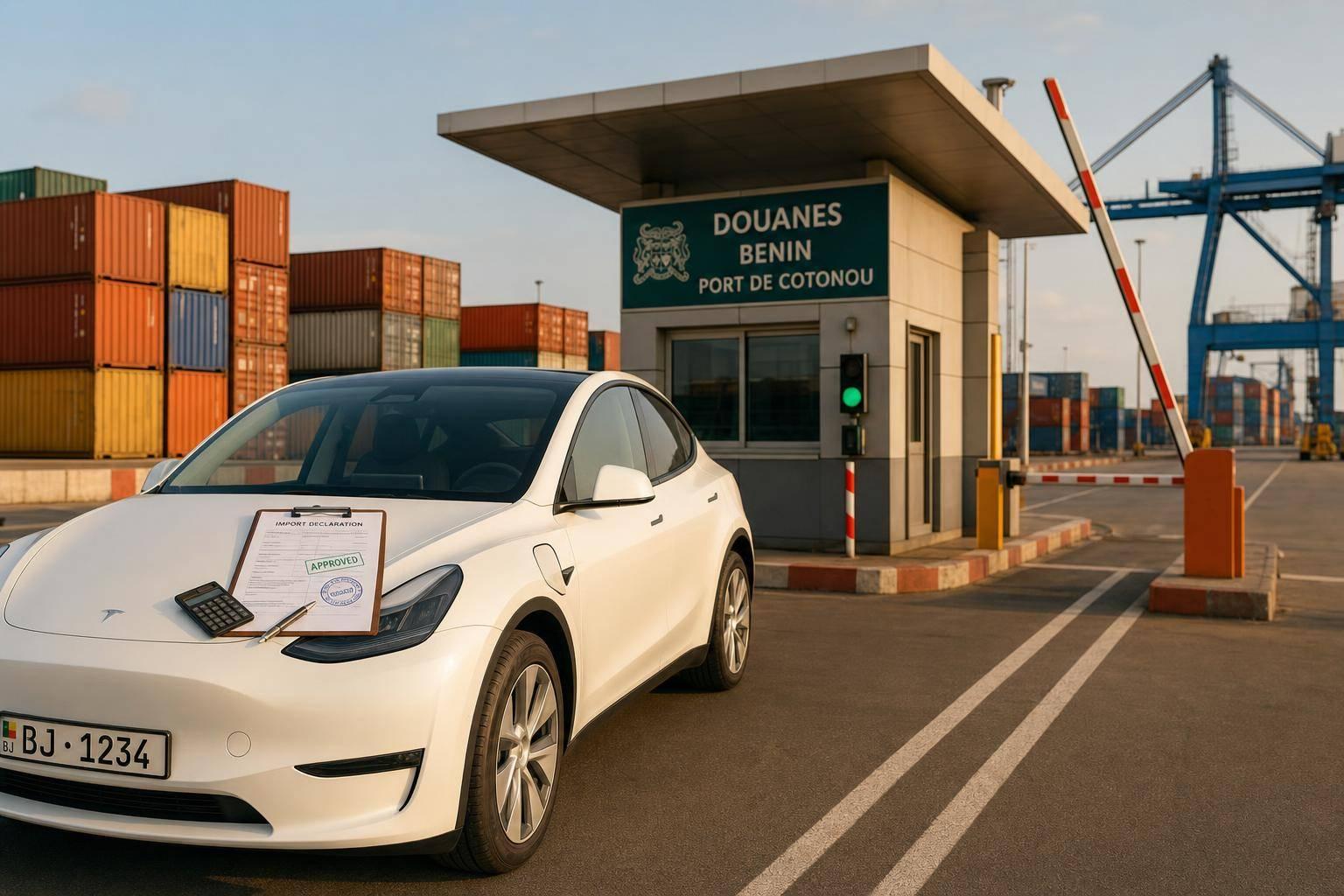
If you import a fully electric car into Benin in 2026, you can pay 0% VAT and 0% customs duty if the vehicle is listed as a 100% electric BEV on all papers. That can cut thousands from your import cost, but you still need to pay shipping, port fees, broker fees, and any storage costs if clearance stalls.
Here’s the short version: I’d first make sure the car is a BEV only, then check battery health (about 75%–80% SoH or more), charging port fit for Benin’s 220–240 V / 50 Hz setup, and whether the car suits local roads. After that, I’d build my budget around the CIF value – for example, $18,500 + $1,200 freight + $150 insurance = $19,850 CIF – then line up every document before the car ships.
What matters most:
- BEVs get the tax exemption
- Hybrids and plug-in hybrids do not get the full exemption
- Customs looks at CIF: cost + insurance + freight
- The VIN and vehicle details must match on every document
- Port handling, broker, inland delivery, and demurrage can still add up
- A broker is usually needed to clear the car in Cotonou
- After clearance, you still need inspection, registration, plates, and insurance
Quick Comparison
| Item | Fully Electric Car (BEV) | Gasoline/Diesel Car |
|---|---|---|
| VAT | 0% | Applies |
| Customs duty | 0% | Applies |
| Port handling | Applies | Applies |
| Broker fees | Applies | Applies |
| Storage/demurrage | Applies if delayed | Applies if delayed |
| Inland delivery | Applies | Applies |
Bottom line: the tax break is the big win, but the import still works only if the car qualifies, the paperwork is clean, and the port process moves without delay.
sbb-itb-99e19e3
1. Import Basics and Choosing an Eligible EV
Before you wire money to a seller overseas, make sure the EV can legally enter Benin and makes sense for local roads and charging. Start with the basics: eligibility, condition, and whether the car fits day-to-day driving in Benin. After that, look closely at battery health, charging fit, and ground clearance.
Which electric cars can be imported into Benin
Benin allows both new and used EVs that meet its import rules. That includes passenger cars such as compacts, sedans, and luxury models, plus light commercial vehicles like vans and small trucks. One point matters a lot here: the car must be a battery-electric vehicle (BEV), not a plug-in hybrid or regular hybrid, because Benin’s exemption applies only to fully electric models.
If you’re buying a used EV, check the vehicle’s age, mileage, ownership title, and general condition against Benin’s import rules. Benin drives on the right, so a left-hand-drive vehicle is usually the safer and easier pick. It’s also smart to stay away from salvage, rebuilt, or flood-damaged cars. Those vehicles can lead to extra inspections, slow down registration, or create insurance headaches.
One small detail can turn into a big port problem: the VIN. Make sure it matches across the invoice, export certificate, and bill of lading. If those numbers don’t line up, customs clearance can stop cold, and storage fees may start piling up.
How to check battery health, charging compatibility, and road suitability
For a used EV, battery state of health, or SoH, is the big technical check. Ask for a diagnostic report that shows SoH as a percentage of the battery’s original capacity. You can also read battery data straight from the battery management system (BMS) with a Bluetooth OBD-II adapter and a model-specific app. For example, LeafSpy works for the Nissan Leaf, while Car Scanner supports many other brands. A good target is 75%–80% SoH or higher for daily use. Below that, usable range can drop fast, especially in hot weather.
Charging fit matters too. Benin’s grid runs on 220–240 V / 50 Hz, and much of the early charging setup uses Type 2 AC connectors and CCS2 DC ports. European vehicles usually fit this setup well. North American models often come with Type 1 (J1772) AC and CCS1 DC ports, so check that point with care. Older Japanese EVs with CHAdeMO DC charging can still work, but they line up less well with newer charging networks. Also check the onboard AC charger. It should support at least 7 kW, and 11 kW is a better fit if you plan to charge often.
Road fit is easy to overlook, but it matters. Some EVs are built for smooth pavement and don’t handle speed bumps, potholes, or rough stretches outside Cotonou very well. That’s where ground clearance comes in. Crossovers and SUVs with more ride height tend to cope better with mixed road conditions. If the car will be used for taxis, ride-hailing, or delivery work, put fast DC charging and strong heat management near the top of your list.
A short filter list can save you from chasing the wrong car:
- BEV only
- 75%–80% SoH or higher
- Type 2 / CCS2 fit, or a clear charging plan
- At least 7 kW AC charging
- Enough ground clearance for local roads
Using EV24.africa to compare models and find import-ready listings
EV24.africa lists both new and used EVs and shows the details buyers usually need up front: battery capacity, range, charging port type, model year, mileage, and condition. Its Compare Listings feature lets you line up models side by side by range, body type, and charging fit before you choose.
If you want a hands-off route, pick Delivered Duty Paid (DDP). Under DDP, EV24.africa handles sourcing, shipping, customs clearance, and local registration for you. If you’d rather manage shipping and customs on your own, choose Free on Board (FOB). Before you lock in a listing, you can also speak with an EV24 expert through WhatsApp or live chat to confirm stock, condition reports, and which export documents the seller can provide.
Once you have a shortlist, the next step is to work out customs value, taxes, and the total landed cost.
2. Customs Duties, Taxes, and Total Landed Cost
How customs value an imported EV
Benin values imported EVs using CIF: cost, insurance, and freight. Customs uses that CIF figure to calculate import charges, so this is the number your budget should revolve around.
Here’s a simple example: a $18,500 purchase price, $1,200 freight cost, and $150 insurance cost add up to a $19,850 CIF. That figure is your budget anchor before you move ahead with the purchase.
If the landed-cost math doesn’t work at this stage, stop before shipment. It’s much easier to walk away early than deal with extra charges later. And don’t try to lowball the CIF on paper. Underdeclared CIF can lead to reassessment, penalties, and delays. Use the actual invoice, plus written freight and insurance quotes.
Cost lines to include in your import budget
Qualifying BEVs are exempt from customs duty and VAT in Benin. Even so, your landed-cost budget still needs to cover every other line item that shows up around the shipment.
| Charge | Basis | When Paid |
|---|---|---|
| Vehicle purchase price | Agreed price with seller | Before shipment |
| Pre-shipment inspection | Service provider quote | Before shipment |
| Ocean freight | Route, carrier, vehicle size | Before or at departure |
| Marine insurance | Insurance quote | Before shipment |
| Customs duty and VAT | 0% for qualifying BEVs | Upon arrival |
| Port handling / terminal fees | Port of Cotonou tariffs | Upon arrival |
| Customs broker / clearing agent | Service agreement | Upon clearance |
| Storage and demurrage | Per day after free period | If clearance is delayed |
| Inland delivery | Distance from Cotonou to destination | Post-clearance |
So even in a best-case BEV import, landed cost still includes freight, insurance, port handling, broker fees, and inland delivery. Tax relief helps a lot, but it doesn’t make the shipment free. The next step is making sure the invoice, shipping documents, and customs description all match the vehicle.
How EV taxes compare with gasoline and diesel imports
Qualifying BEVs clear the border with 0% customs duty and VAT. That’s a big gap compared with gasoline and diesel vehicles. ICE imports usually face a combined duty, excise, and VAT burden of about 45% to 52% of CIF. On that same $19,850 CIF, that works out to roughly $28,800 to $30,200 before local fees.
There’s one catch: the exemption only applies if the vehicle is listed and classified correctly as 100% electric across all shipping and customs paperwork. Hybrids may get partial reductions, but they do not qualify for the full exemption. It’s smart to confirm the tariff classification with your customs broker before the vehicle ships.
| Charge Category | Fully Electric Vehicle (BEV) | Gasoline / Diesel Vehicle (ICE) |
|---|---|---|
| Customs duty and VAT | 0% – Exempt | Applies |
| Port handling | Standard fees apply | Standard fees apply |
| Broker / clearing fees | Applies | Applies |
| Storage and demurrage | Applies if clearance is delayed | Applies if clearance is delayed |
| Inland delivery | Applies | Applies |
Even with the full exemption, leave some room in the budget for surprises. Demurrage, re-inspection fees, or broker correction charges can still show up if customs questions the vehicle’s classification or declared value.
Once you know the landed cost, gather the documents that back up the declared value and EV classification. Next, gather the paperwork that proves value, origin, and EV status before the car ships.
3. Required Documents and Pre-Arrival Preparation
Core documents needed to import an electric car
Get your paperwork in order before the vehicle ships. That one step can save you from delays, storage charges, and extra correction work at Cotonou.
Why does this matter so much? Because customs will use this same file to check the car’s CIF value and confirm that it qualifies as an EV. In plain English: your documents shape both the import process and the landed cost.
Your file should cover:
- ownership
- shipping
- origin
- EV specifications
- importer identity
- Benin customs tracking
Every document should show that the vehicle is 100% electric. If that detail is missing or unclear, customs may question the car’s status. A clearing agent will often handle the Bordereau de Suivi de Cargaison (BSC), but don’t assume it’s done. Confirm it before departure.
These are the records customs relies on to verify the EV’s value and eligibility.
Conditional paperwork to check before the vehicle ships
Some documents only come up in certain cases, but it’s smart to check them early instead of scrambling later.
- Lithium-ion battery or DG paperwork – needed by the shipping line before loading
- Power of attorney – lets a customs broker act for you
- Proof of payment – supports the declared value if customs questions the invoice
- Inspection or conformity documents – show roadworthiness, battery health, or regulatory compliance when asked for
Document checklist to prevent port delays
Before loading, make sure the VIN, buyer name, and vehicle value match across the invoice, bill of lading, title, and customs paperwork. Small mismatches can turn into a big headache at the port.
Ask the seller and shipping line for digital copies of every document before shipment. That gives you time to catch errors early, when fixes are still simple. If the paperwork is incomplete or inconsistent, you could end up paying storage fees, demurrage, and document correction costs.
| Document | Purpose | Status | Provider | When to Secure |
|---|---|---|---|---|
| Commercial Invoice | Proves purchase price for customs valuation | Mandatory | Seller/Dealer | Before shipment |
| Bill of Lading (BoL) | Contract of carriage and proof of cargo ownership | Mandatory | Shipping Line | After loading |
| Vehicle Title / Registration | Proves ownership and vehicle specifications | Mandatory | Seller / Export Authority | Before shipment |
| Certificate of Origin | Confirms where the EV was manufactured | Mandatory | Manufacturer/Seller | Before shipment |
| Technical Data Sheet | Details battery capacity and EV specs for tax exemption | Mandatory | Manufacturer | Before shipment |
| Passport / Government ID | Identifies the importer of record | Mandatory | Buyer | At start of process |
| Bordereau de Suivi de Cargaison (BSC) | Benin’s cargo tracking note | Mandatory | Importer / Agent | Before arrival |
| Power of Attorney | Authorizes a customs broker to act on your behalf | Mandatory (if using broker) | Importer | Before arrival |
| Battery / Dangerous Goods Declaration | Safety documentation for lithium-ion battery transport | Conditional | Manufacturer / Shipper | Before shipment |
| Certificate of Conformity | Confirms the vehicle meets Benin’s standards | Conditional | Manufacturer / Inspector | Before arrival |
| Proof of Payment | Backup for declared value | Conditional | Buyer / Bank | Before shipment |
| Inspection Certificate | Confirms roadworthiness and battery health | Conditional | Third-party Inspector | Before loading |
Mark the vehicle as a 100% electric vehicle on every document. Once the file is complete, the next move is customs clearance and port release.
4. Customs Clearance in Benin: Arrival, Release, and Registration
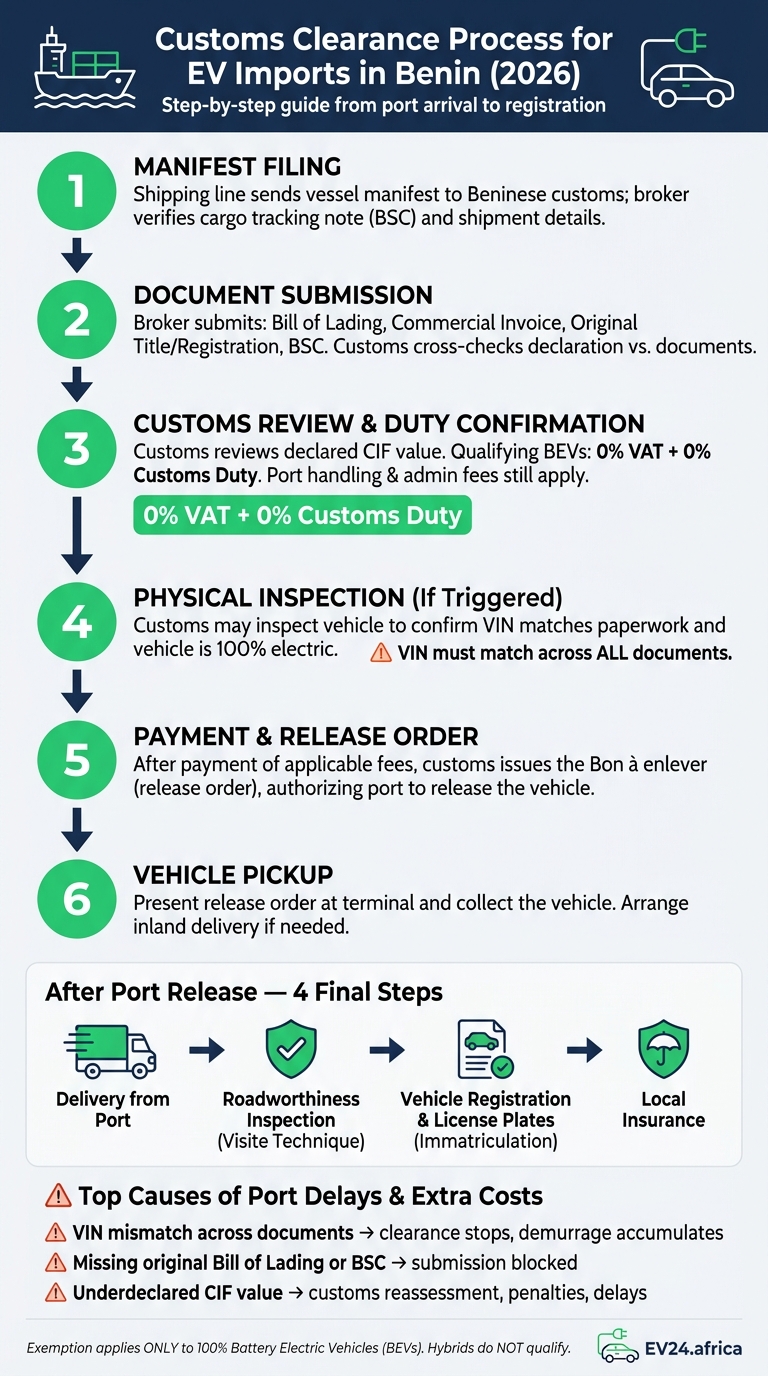
How to Import an Electric Car to Benin: Step-by-Step Process & Cost Breakdown
Step-by-step clearance process at the port
Once your file is ready, the clearance process begins as soon as the vessel arrives in Cotonou. At this stage, a licensed customs broker isn’t optional. It makes the whole process far smoother.
Here’s how it usually goes:
- Manifest filing – The shipping line sends the vessel manifest to Beninese customs. Your broker then checks that the cargo tracking note and shipment details have been filed correctly.
- Document submission – Your broker submits the main file: Bill of Lading, commercial invoice, original title/registration, and cargo tracking note. Customs then compares the declaration with the shipment documents.
- Customs review and duty confirmation – Customs reviews the declaration and checks the declared value. If that value seems too low, they may challenge it. Qualifying BEVs owe no VAT or customs duty. That said, port handling fees, shipping line charges, and admin fees still need to be paid.
- Physical inspection (if triggered) – Customs may inspect the vehicle to confirm the VIN and make sure it is 100% electric. They’ll match the VIN on the car to the VIN on the paperwork.
- Payment and release order – After payment, customs issues the release order (Bon à enlever), which allows the port to release the vehicle. This is the moment when the shipment stops piling up avoidable port charges.
- Vehicle pickup – Present the release order to the terminal and collect the vehicle.
One small paperwork issue can gum up the works. Missing original documents, especially the Bill of Lading, the cargo tracking note, or the original title/registration, are some of the most common blockers here. And once delays start, storage charges follow.
Post-clearance delivery, registration, and insurance
After release, move fast into delivery, inspection, and registration. You can either pick up the vehicle at the port or arrange inland delivery to your destination.
The order is simple: release → inspection → registration → insurance.
First, the vehicle must pass a roadworthiness inspection (visite technique). If the car’s charging connector doesn’t match local standards, shipping the correct adapter with the vehicle can save time and avoid delays. After the inspection is passed, register the vehicle with the relevant Beninese authority (immatriculation), get your license plates, and arrange local insurance.
Hold on to every stamped document. That paper trail matters more than most people expect.
Final checklist to avoid storage, demurrage, and correction costs
Before the vessel arrives, make sure your broker has the original documents, your funds are ready, and all declared values match across the file.
In plain English, the declared value on the commercial invoice, Bill of Lading, and customs declaration should be the same. If those numbers don’t line up, customs may start a valuation review, and that can slow clearance and add extra cost.
FAQs
How do I prove a car is a 100% electric BEV?
To qualify for tax and customs duty exemptions in Benin, the vehicle must be a 100% electric Battery Electric Vehicle (BEV).
In plain English, that means the car runs only on a rechargeable battery and an electric motor. It must have no internal combustion engine and no hybrid setup of any kind.
Your import documents also need to state this clearly. If the paperwork doesn’t confirm the vehicle’s BEV status, it may not meet local rules for the exemption.
What costs should I expect besides taxes?
Besides taxes, set aside money for admin and shipping costs too. These usually include:
- Shipping fees, whether you use RoRo or a container
- The fixed $175 CTN fee
- Port handling, document processing, and registration fees
You might also have to pay demurrage if your vehicle sits at the port past the free storage window. That charge is often estimated at 3% of the cargo value.
What can delay EV customs clearance in Benin?
The main causes are missing or incomplete documents, especially the required Intention d’Importation (IDI), along with other paperwork needed for local compliance.
Delays also happen when duties or taxes above XOF 500,000 aren’t paid electronically within 3 days. When that deadline is missed, a 3% daily late fee kicks in. On top of that, wrong manifest details or skipped admin steps can put clearance on hold and lead to extra storage costs.