
 Thabo Nkosi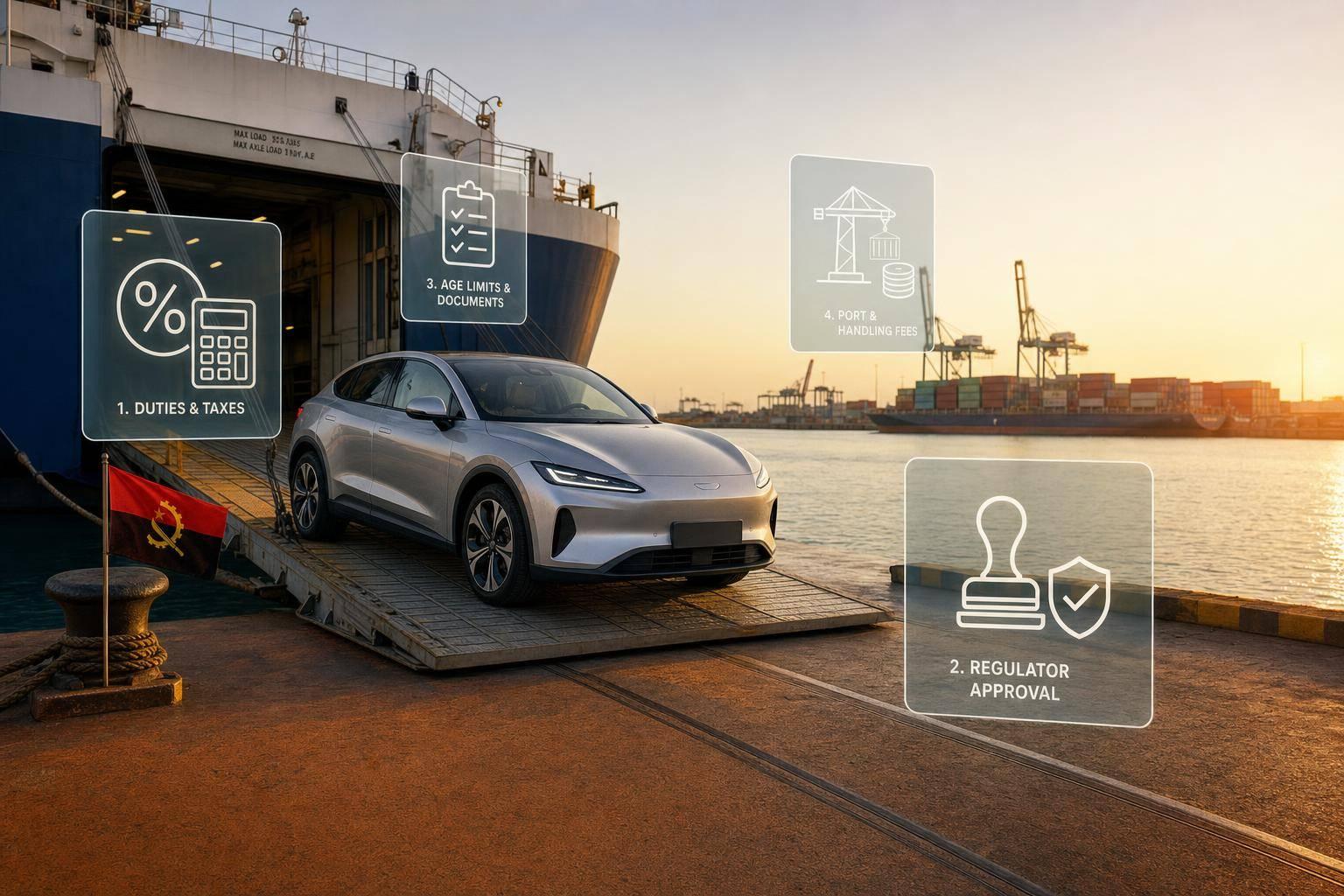
Importing an EV into Angola can add thousands of dollars beyond the car price. If I were planning this in 2026, I’d check 3 things first: the car’s age limit, ANTT approval, and whether customs will apply the EV tax cuts.
Here’s the short version:
- I need to budget for more than the vehicle price: shipping, insurance, customs duty, IVA at 14%, port fees, broker fees, inland delivery, and registration
- Angola gives pure EVs a 50% cut on customs duty and motor vehicle tax (IVM) through 2032
- IVA is charged on CIF + customs duty, so a lower duty can trim IVA too
- A used EV can be blocked if it is too old at arrival
- If I ship before getting ANTT authorization, I risk storage charges, delays, or refusal
- At Luanda’s DP World terminal, storage is free for the first 5 days, then fees can start from about $5.00 per ton per day
- If clearance starts more than 30 days after arrival, a 5% fine on CIF may apply
The article also shows how to estimate total landed cost in U.S. dollars. One sample new EV goes from a $35,000 purchase price to about $52,290 landed. A sample used EV with $22,000 CIF lands at about $28,234.
What I’d focus on before buying:
- Confirm the EV is within Angola’s age rule
- Check the model is homologated and approved by ANTT
- Make sure the invoice and customs filing mark the car as electric with the right HS code
- Match the VIN, make, model, and year across every document
- Keep a 10%–15% buffer for storage, extra checks, and port-side VAT
Quick Comparison
| Item | New EV Example | Used EV Example |
|---|---|---|
| Starting value | $35,000 purchase price | $22,000 CIF |
| Import duty | $7,460 | ~$1,100 |
| IVA | $4,476 | ~$3,234 |
| Other fees | ~$1,860 | ~$1,900 |
| Estimated landed cost | ~$52,290 | ~$28,234 |
If I wanted one takeaway from this guide, it would be simple: check eligibility first, price the full landed cost second, and ship only after approval is in place.
sbb-itb-99e19e3
Import Rules, EV Incentives, and Eligibility in Angola
Before you buy or ship an EV, check three things: the vehicle’s age, ANTT approval, and whether it qualifies for Angola’s tax cuts. Miss one, and customs can stop the shipment or push your total cost up fast.
Start with the age limit and ANTT approval. Those two can block clearance before taxes even enter the picture.
Vehicle Age Limits, ANTT Approval, and Who Can Import

Angola sets age limits for used vehicles based on the type of vehicle and the date it arrives in the country:
- Used light passenger vehicles: generally 5–6 years old at arrival, counted from first registration
- Heavy vehicles: 8–10 years
- Motorcycles: 3 years
Customs enforces these limits. If a vehicle is too old, it can be refused entry, and the importer may have to pay for its return or disposal.
That detail matters more than it may seem. You should calculate the vehicle’s age based on its expected arrival date in Angola, not the date you bought it. A car that looks eligible at purchase can slip past the limit by the time it lands. If the vehicle is close to the cutoff, it’s smart to either pick a newer model or move fast on inspection and shipping.
To prove the vehicle’s age, you’ll need:
- the original registration document from the exporting country showing the first registration date
- a manufacturer’s certificate or VIN report confirming the model year
Age isn’t the only gatekeeper. ANTT (Agência Nacional dos Transportes Terrestres) must approve the import before you file anything with customs. On top of that, the brand and model must be homologated, meaning officially approved for use on Angolan roads.
If you ship a vehicle without ANTT approval or homologation, customs can refuse it, delay release, or leave you with a car you can’t legally register. That’s a headache no one wants. It’s better to check with ANTT or a licensed customs agent before you buy, so you know whether the model is already approved or whether that process still needs to happen.
There’s one more rule for the importer. If you’re not licensed in the vehicle trade, you must include a declaration from a licensed company that will provide after-sales technical support for the imported vehicle.
Taxes and Incentives That May Lower EV Import Costs
Once the vehicle clears the eligibility rules, taxes shape your landed cost. The EV incentive cuts customs duty first, and that lower duty then reduces the IVA base too.
| Tax | Basis | EV Rate |
|---|---|---|
| Customs Duty | CIF value | 50% of standard duty |
| IVA (VAT) | CIF + customs duty | 14% standard rate |
| Motor Vehicle Tax (IVM) | Vehicle category | 50% reduction |
| Customs Emoluments | CIF value | Around 2% |
Here’s why that matters: IVA is charged on CIF plus customs duty. So when customs duty drops, IVA drops a bit too. It’s a layered tax break, not just a single cut.
Under Angola’s tax code, pure EVs get a 50% reduction in customs duty and IVM through 2032. But customs won’t apply that cut automatically just because the car is electric. The vehicle has to be declared under the correct EV HS code, and the filing needs support from the manufacturer’s technical specification sheet.
If a battery-electric vehicle is classified under a generic motor vehicle code instead, customs may apply the standard duty and tax rates rather than the EV reductions.
With the rules and tax treatment pinned down, the next step is to add up the purchase price, shipping, customs charges, and port costs.
How to Calculate the Total Landed Cost of an EV in Angola
Once you’ve confirmed the car is allowed in, the next job is the math. Calculate the landed cost in this order: CIF, taxes, port charges, and registration.
That order matters. These costs stack on top of each other, and if you skip even one, your budget can fall apart before the vehicle even leaves the port.
Cost Components from Vehicle Purchase to Port Release
Start with CIF. That means:
CIF = vehicle price + freight + insurance
After that, add the main taxes and fees:
- Import duty, using the EV reduction already noted above
- Customs emoluments of around 2% of CIF
- Stamp duty of around 3% of CIF
- IVA (VAT) of around 14%
Then come the port-side costs. These usually include port and terminal handling charges, scanning or inspection fees, and, if clearance drags on, storage fees. That’s where things can get expensive fast. A delay of just a few days can add storage and demurrage charges.
You’ll also want to budget for your customs broker (despachante) fee, often around 0.5% to 2% of CIF. After that, add inland delivery from Luanda to your city, plus registration, license plates, and any technical inspection fees to get to a more complete landed-cost estimate.
Landed Cost Examples for a New EV and a Used EV
The examples below show how the formula works for both a new EV and a used EV that meets the rules. Since Angola’s tariff treatment can change, check the live rates with a licensed customs broker before you buy.
Example 1 – New EV (illustrative case)
A buyer purchases a new EV for $35,000 and pays $2,000 for ocean freight and $300 for marine insurance. That gives a CIF of $37,300.
Using the rates in this example:
- Import duty: $7,460
- Customs emoluments: $746
- Stamp duty: $448
- IVA: $4,476
Then add about $600 for port and terminal charges, $560 for broker fees, $300 for inland delivery, and $400 for registration and plates.
Estimated total landed cost: approximately $52,290 – about 49% above the original vehicle price.
Example 2 – Compliant used EV
This example assumes the vehicle already meets Angola’s age limit and ANTT approval rules.
For a compliant used EV, a simple landed-cost example uses a CIF of $22,000. With the EV duty reduction applied, import duty comes to about $1,100. Add about $3,234 for IVA, $1,500 for port and clearing fees, and $400 for registration and plates.
Estimated total landed cost: approximately $28,234.
The table below compares the two cases side by side:
| Factor | New EV | Used EV (4 years old) |
|---|---|---|
| Base value used in example | $35,000 purchase price | $22,000 CIF |
| Import duty | $7,460 | ~$1,100 |
| IVA | $4,476 | ~$3,234 |
| Other fees after taxes | ~$1,860 | ~$1,900 |
| Estimated total landed cost | ~$52,290 | ~$28,234 |
Figures are illustrative and rounded. Port charges, brokerage, and registration costs can vary by shipment and location, so a broker should confirm the live rates before you commit.
Once you have the estimated total landed cost, the next step is matching the documents to the shipment.
Step-by-Step Import Process: From Buying the EV to Angola Registration
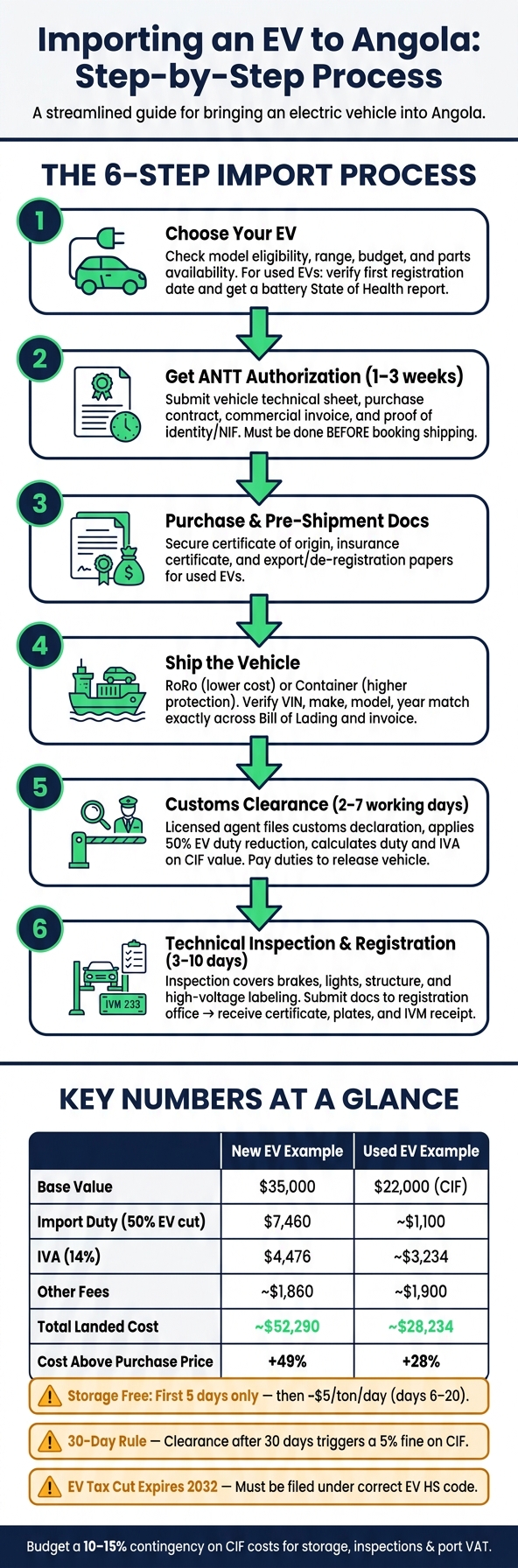
How to Import an Electric Car to Angola: Step-by-Step Cost & Process Guide
Once you know the landed cost, follow this order: eligibility, approval, purchase, then shipment.
Steps 1 to 3: Choose the EV, Buy It, and Get Pre-Shipment Approvals
Start with the basics: what do you need the car to do? Think about range, budget, and how you plan to use it day to day. Then check that the model makes sense for service and parts support.
If you’re buying a used EV, double-check the first registration date before paying. It’s also smart to ask for an independent battery State of Health report. That one document can save you from a bad surprise later.
After you pick the model, the main pre-shipment task is getting your documents together and securing ANTT authorization before the customs declaration. For the approval request, prepare:
- vehicle technical sheet
- purchase contract
- commercial invoice
- proof of identity or NIF
Processing usually takes 1 to 3 weeks.
Steps 4 to 6: Ship the Vehicle, Clear Customs, and Register It
For most standard passenger EVs, RoRo shipping is usually the lower-cost route. Container shipping gives you more protection, which can make sense for higher-priced vehicles or if you want to send accessories with the car.
At this stage, document matching matters a lot. Before the ship arrives, make sure the bill of lading, invoice, and VIN line up perfectly. Review the Bill of Lading before departure and confirm that the VIN, make, model, year, consignee name, and port of discharge match your other papers. A tiny error here can lead to a customs query and extra storage fees.
Once the shipping line sends the arrival notice, your licensed customs clearing agent handles the next part. The agent files the customs declaration, applies any EV tax reduction you qualify for, and works out the final duty and IVA from the CIF value. Customs clearance usually takes 2 to 7 working days. Registration then adds 3 to 10 days.
If your paperwork is missing something or the details don’t match, storage and demurrage charges can pile up fast. That’s why it helps to send the full document set to your agent before the vessel arrives. After duty and IVA are paid, the agent gets release from the port and the vehicle can leave the terminal.
After customs, the vehicle goes through a technical inspection. This covers brakes, lights, structure, and high-voltage labeling. Once the vehicle passes, you submit the documents to the registration office and receive the registration certificate, number plates, and motor vehicle tax receipt.
Document Checklist from Purchase to Registration
Track each document by stage. It’s one of the simplest ways to avoid delays and storage fees.
| Stage | Individuals | Companies |
|---|---|---|
| Purchase | Passport, NIF, proof of address, commercial invoice, proof of payment | Certificate of incorporation, NIF, corporate authorization, commercial invoice, proof of payment |
| Pre-Shipment | ANTT authorization, certificate of origin, vehicle technical sheet | Same as individual, plus any import license or sector-specific license if applicable |
| Shipping | Bill of Lading, booking confirmation, insurance certificate, export registration papers for used EVs, de-registration proof | Same as individual |
| Customs | Customs declaration (DU), any required cargo filing, proof of address, duty and IVA payment receipts | Same as individual, plus corporate resolution identifying the legal representative |
| Registration | Customs clearance certificate, inspection report, registration certificate, motor vehicle tax receipt | Same as individual |
With the process laid out, the main issue left is delay: missing details, document mismatches, and fees that could have been avoided.
How to Avoid Delays, Extra Charges, and Compliance Problems
Common Mistakes That Increase Import Costs
Once you know the base landed cost, the next place money slips away is usually delays and paperwork mistakes. And those costs are often avoidable.
Do not book shipping before you have ANTT authorization in hand. If the car shows up without it, customs can hold the vehicle, and storage fees start almost at once.
You also need to check the current ANTT age limit before the vehicle ships. If the car falls outside the allowed limit, it can be rejected, and the buyer is left paying re-export costs.
Document accuracy matters more than most people expect. The invoice should clearly identify the car as electric, and the VIN must match exactly across the bill of lading, customs declaration, and all other paperwork. A single wrong EV label or a VIN mismatch can wipe out the duty savings and slow down release. The same goes for under-declaring the vehicle’s value. Customs may reassess the value at a higher amount, then charge back duties and penalties. In more serious cases, they can seize the vehicle.
Port fees can also snowball if clearance drags on. At Luanda’s DP World terminal, storage is free for the first 5 days. After that, the charges increase in stages:
- About $5.00 per ton per day for days 6–20
- About $10.00 per ton per day for days 21–30
- About $12.50 per ton per day after 30 days
For heavy vehicles, there may also be an extra surcharge of around 60%. And if clearance starts more than 30 days after arrival, a 5% fine on the CIF value may apply. On top of that, 14% VAT applies to port-related charges, including storage, detention, demurrage, and import/export services.
Final Planning Checklist and Key Takeaways
A short pre-shipment check can save a lot of hassle later:
- Confirm age eligibility under the current ANTT rule for that vehicle category.
- Get ANTT authorization before booking shipping, with the correct VIN, model year, and EV designation.
- Match all core details across every document: VIN, make, model, year, propulsion type, and declared price.
- Label the vehicle as electric on the commercial invoice and include the right HS code so customs applies the proper duty category.
- Send the full document set to your clearing agent before the vessel departs.
- Set aside a contingency budget of 10%–15% of your estimated CIF-based costs for storage, extra inspections, courier fees for document fixes, and VAT on port charges.
Compliance starts before the car ever leaves port: pick the right vehicle, get approval first, and keep every document aligned.
FAQs
Do hybrids qualify for Angola’s EV tax cuts?
Angola’s current tax incentives – including the 50% cut in import and vehicle taxes – appear to target fully electric vehicles.
Right now, the rules do not clearly state that hybrids or plug-in hybrids are included. So if you’re looking at a hybrid model, there’s no clear sign yet that it gets the same tax break.
Based on the wording that’s available, eligibility seems tied to:
- a fully electric propulsion system
- the required technical and environmental certifications
In plain English: the tax cut looks geared toward EVs, not hybrid or plug-in hybrid vehicles.
What if my EV fails the age limit check on arrival?
In Angola, importing vehicles more than three years old is generally not allowed. If your EV arrives and doesn’t pass the age-limit check, customs may treat it as non-compliant. That can lead to delays, added customs issues, or even refusal of entry.
To avoid that headache, check the vehicle’s manufacturing date and confirm customs eligibility before you ship it.
Can I import an EV myself, or do I need a licensed agent?
Yes, you can handle the import process on your own. But Angola’s vehicle import rules can be tough to sort through.
That’s why working with an experienced professional is a smart move. It can help you stay compliant and avoid costly mistakes, paperwork delays, and surprise charges.
A licensed customs agent or specialized import service can also take care of key parts of the process, including:
- Duty and tax payments
- Required documents
- Customs coordination