
 Thabo Nkosi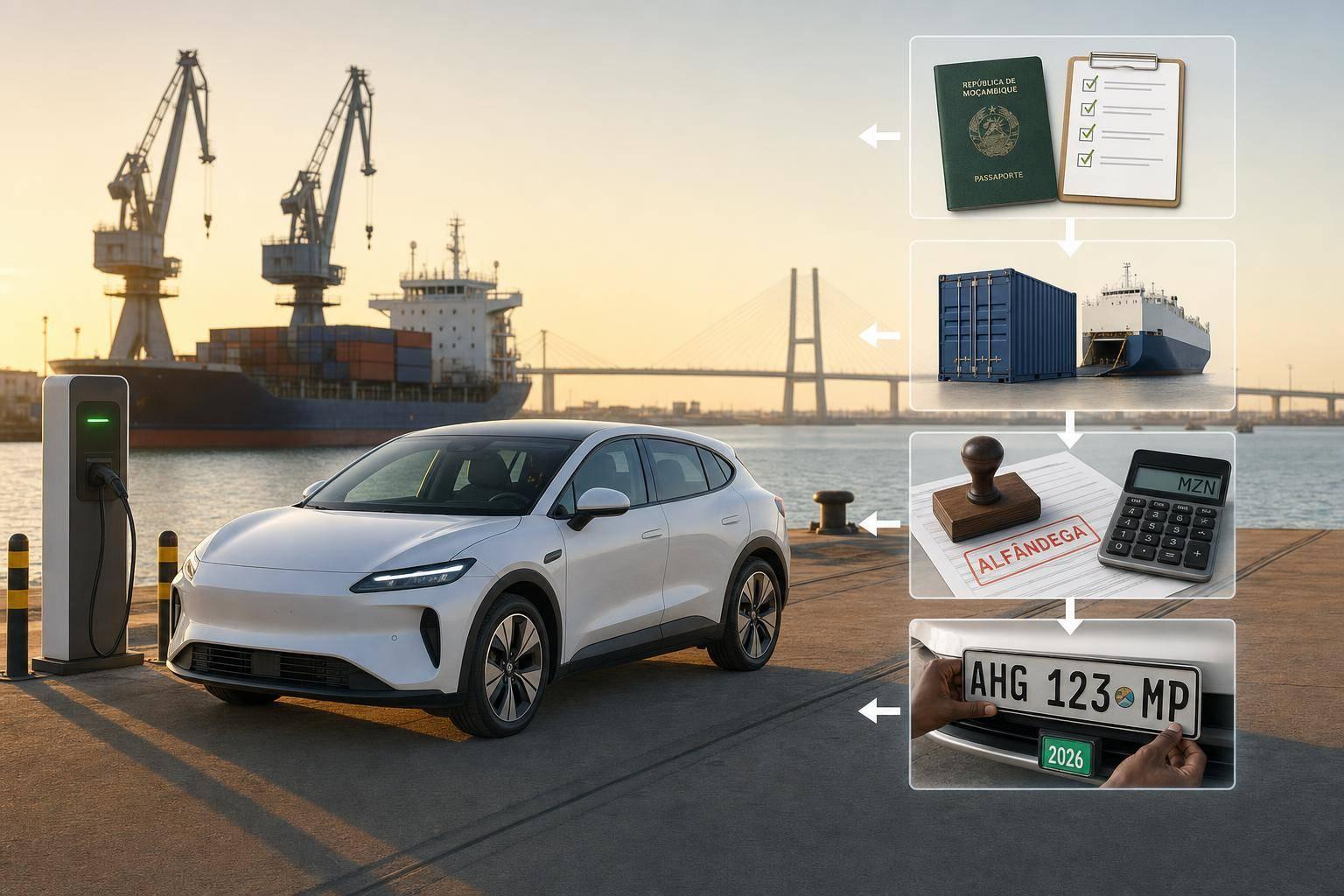
If I were importing an EV to Mozambique in 2026, I’d check four things first: legal entry, paperwork, shipping, and total landed cost. The car price is only one part of the bill. I’d also plan for freight, port fees, customs charges, registration, and insurance. And if the import value is over $500, I’d expect to need an import license.
Here’s the short version:
- Make sure the car is a full battery EV, not a hybrid.
- For used EVs, get the Intertek pre-shipment inspection before loading.
- Check battery health before paying, because repair costs can be high.
- Use CIF for customs planning, not just the seller’s price.
- Ask about SADC or COMESA origin, since import duty may be 0% in some cases.
- Plan for INATRO registration after customs release.
- Buy compulsory third-party insurance before driving.
- Add a 10% to 15% cash buffer for delays, storage, or extra port costs.
A few numbers stand out. The guide notes an example with 283,794 MZN CIF, 113,517 MZN import tax, and 100,000 MZN port costs, for a total of 497,311 MZN. It also lists an initial INATRO registration fee of 2,980 MZN and an extraordinary inspection fee of 1,590 MZN when that check is required.
Before I send money, I’d want this file ready:
- Commercial invoice
- Bill of sale
- Title or registration
- Deregistration paper for a used car
- Bill of lading or air waybill
- Intertek certificate for used EVs
- Battery report for used EVs
- Lithium-ion battery transport declaration
- ID, NUIT, and company papers if needed
- Power of attorney if a broker will clear the car
One more point: RoRo is often cheaper, but container shipping gives more protection. If the EV is not drivable, container shipping is usually the better fit.
So the main takeaway is simple: don’t judge the deal by the sticker price. I’d confirm that the EV can enter Mozambique, that the documents match the car exactly, that the carrier accepts the battery rules, and that the total cost still works after tax, port, and registration fees.
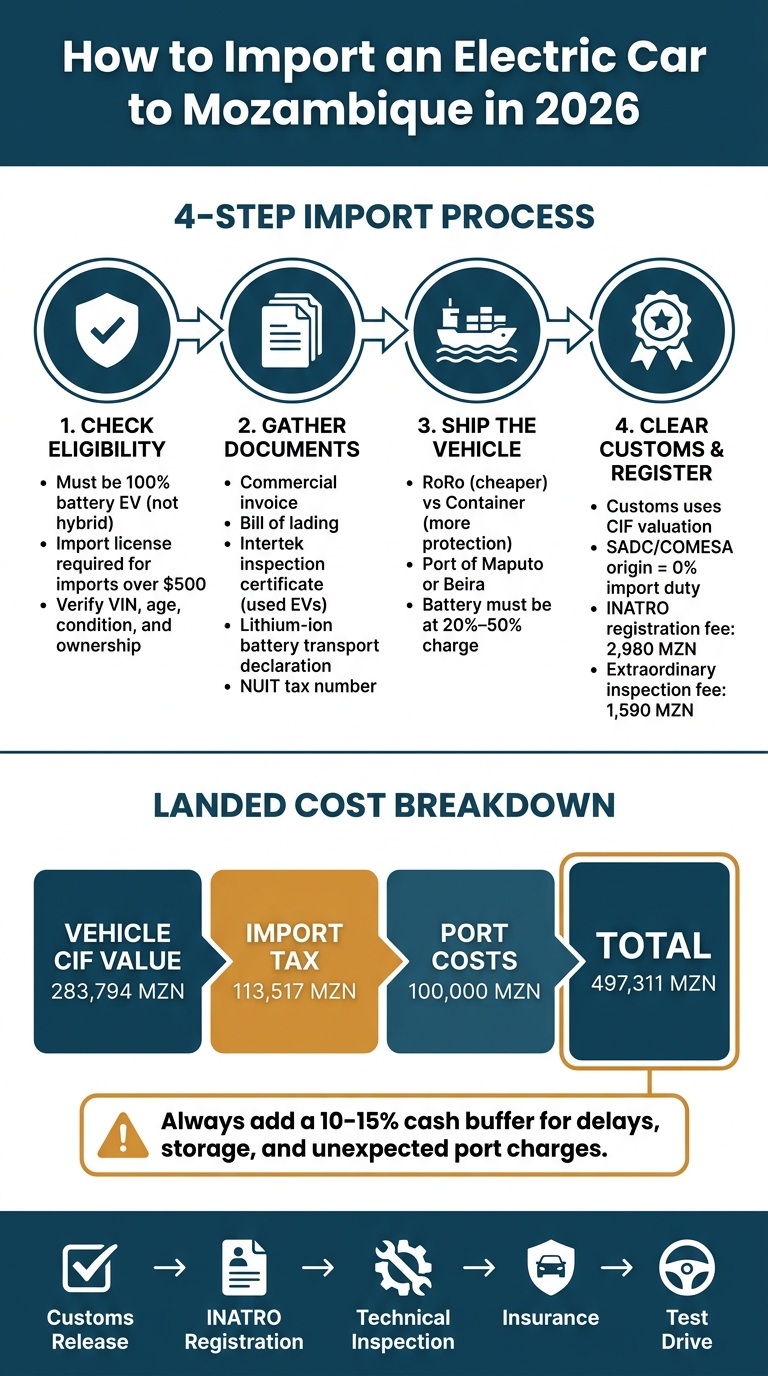
How to Import an Electric Car to Mozambique: 4-Step Process & Cost Breakdown
Step 1: Check whether the EV can be legally imported
Confirm vehicle type, age, condition, and ownership status
First, make sure the car is fully electric, not a hybrid. Then check the VIN, vehicle age, condition, and ownership records against the import file.
This part matters more than it may seem. If even one detail doesn’t match, you can run into customs problems or delays when it’s time to register the car. If the paperwork and the vehicle details don’t line up, stop there and sort it out before moving ahead.
If you’re buying a used EV, make sure it can pass the required pre-shipment inspection before you send payment.
Verify importer status and local compliance requirements
Your paperwork will change based on whether you’re importing the EV as an individual or through a company.
For imports over $500, the license must show:
- Country of origin
- Departure port
- Arrival port
- Total payment amount and currency
If you’re importing through a company, you’ll also need the business registration and tax identification number. It’s smart to check all of this before placing the order, so the license application doesn’t get held up over missing documents.
Check charging and battery practicality before buying
Pick Type 2 or CCS if you want broader charging compatibility. Put simply, choose a charging standard that fits the setup you plan to use at home and on public chargers.
If you’re buying used, ask for a battery health certificate or a diagnostic report before you finalize payment. That’s one of those steps people sometimes skip, then regret later.
Also, choose a range that can handle your longest regular trips with some buffer for detours or delays.
Once the car clears these checks, gather the shipping and ownership documents before you book transport.
sbb-itb-99e19e3
Step 2: Gather all documents before the vehicle ships
Core documents for customs and ownership
Once the EV clears the eligibility check, get your paperwork together before you book freight.
Build the full document file while the vehicle is still with the seller. That file should include the commercial invoice, bill of sale, title or registration, and, for used vehicles, the deregistration certificate. Add a pro forma invoice as a price reference. The bill of lading or air waybill should show the chassis number, make, model, year, and buyer name. Those details need to match the invoice and title exactly.
This is one of those small things that can turn into a big headache. A single VIN error or name mismatch can hold up release at customs. You should also add your passport or national ID, NUIT, company documents, and a power of attorney if a broker will handle clearance for you.
Vehicle compliance and inspection paperwork
You’ll also need the inspection and battery papers squared away before loading.
Add the Intertek inspection certificate for any used EV. Include a battery-condition report from a workshop or service center that shows battery health and any diagnostic codes. It also helps to take date-stamped photos of the VIN plate, odometer, and exterior before loading, then keep them in the file.
Because EVs use large lithium-ion batteries, the shipper must provide a lithium-ion battery transport declaration. Without it, the carrier may refuse the shipment.
Documents checklist table
Use this checklist to spot missing items before shipping. Don’t book transport until every document has been received and checked.
| Document | Who Issues It | When Needed | What It Prevents |
|---|---|---|---|
| Commercial invoice | Seller/exporter | Before loading | Valuation disputes and duty miscalculation |
| Bill of sale / purchase contract | Seller/exporter | Before loading | Ownership disputes and unclear transaction terms |
| Pro forma invoice | Seller/exporter | Before loading | License rejection due to missing price reference |
| Original title / registration certificate | Origin-country vehicle authority | Before loading | Ownership disputes and registration refusal |
| Deregistration / cancellation certificate | Origin-country vehicle authority | For used vehicles, before loading | Customs doubts about prior registration status |
| Bill of lading / air waybill | Shipping line or carrier | At booking and port arrival | Cargo identification problems and release delays |
| Intertek pre-shipment inspection certificate | Intertek (origin country) | Before loading | Fines or vehicle seizure at Port of Maputo |
| Battery-condition report (used EVs) | Qualified workshop or manufacturer service center | Before loading | Undisclosed battery degradation and valuation disputes |
| Lithium-ion battery transport declaration | Shipper / exporter | At booking | Carrier refusal or shipping delay |
| Buyer passport or national ID | Importer | Before loading | Identity mismatches on customs declarations |
| NUIT (tax number) | Mozambican tax authority | Before loading | Blocked duty payments and registration delays |
| Certificate of origin | Exporter, with Chamber of Commerce authentication if required | Before loading | Incorrect duty application or origin disputes |
| Company registration documents | Company registrar | Before loading, for business imports | Customs doubts about importer legitimacy |
| Power of attorney to customs broker | Importer (buyer) | Before arrival | Agent unable to act on your behalf at customs |
Step 3: Choose a shipping method and prepare for port arrival
Once the paperwork is done, it’s time to book freight and pick the arrival port. This part matters more than it might seem. Your shipping method shapes the total cost, the delivery timeline, and how smoothly the car gets through the port.
Select a shipping method and arrival port
You’ll usually choose between Roll-on/Roll-off (RoRo) and container shipping. RoRo is the lower-cost option. Container shipping costs more, but it gives the car more protection.
With RoRo, the car is driven onto the vessel and secured on deck. That makes it a good fit for drivable used EVs. Container shipping keeps the vehicle sealed off from weather, port handling, and theft. It’s often the better pick for a new or high-value EV. It also makes sense if you’re shipping more than one vehicle or sending charging equipment in the same load.
For most shipments, use the Port of Maputo. Beira is also a common entry point on some routes. Before you book, make sure the port lines up with the shipping route.
After that, check the battery transport rules for that shipment. This is one of those details you don’t want to leave until the last minute.
Battery shipping rules and pre-arrival checks
Because EVs use lithium-ion batteries, they fall under dangerous-goods rules. That means the shipment has extra requirements beyond normal vehicle transport.
Most carriers want the battery at 20%–50% state of charge, but the exact limit can vary. Confirm it with the carrier before loading. If you’re using RoRo, the car must be drivable. If it isn’t running, you’ll need to ship it in a container.
It also helps to send your Step 2 document file to your customs broker before the vehicle arrives. That gives them time to prefile customs paperwork and cut the risk of storage charges. A small step here can save a lot of hassle once the car reaches port.
Shipping method comparison table
Use the table below to match the shipping method to the vehicle and budget.
| Feature | Roll-on/Roll-off (RoRo) | Container Shipping |
|---|---|---|
| Typical use case | Budget-conscious buyers; drivable used EVs | Luxury or new EVs; multiple vehicles; non-running units |
| Protection level | Lower – exposed to elements and port handling | High – sealed inside a container, protected from weather and theft |
| Cost profile | Generally the most affordable option | More expensive due to container rental and handling fees |
| Battery handling | Vehicle must be drivable; battery must have enough charge to drive on and off the vessel | Can accommodate non-running vehicles and allows spare parts or charging equipment to ship with the car |
Step 4: Clear customs, pay import costs, and register the car
Once shipping is done, your broker can start clearance as soon as the EV arrives. At that point, customs comes first. You need customs release before you can register the car or use it on the road.
Customs clearance and import cost calculation
In most cases, the shipping line sends an arrival notice a few days before the vessel berths. Your customs broker then submits the declaration through Mozambique’s Single Electronic Window using the shipping and ownership documents already on file.
Mozambique customs values the vehicle using CIF. For used vehicles, officers may also compare the declared value with market references. If the file gets flagged, customs can request a physical or documentary inspection to confirm the VIN, the car’s condition, and whether it matches the declaration.
Import duty, VAT, and other fees depend on the vehicle type, where it comes from, and the rules in force in 2026, so it’s smart to confirm the rates with a licensed customs broker. Vehicles from SADC or COMESA member states may qualify for 0% import duty under regional trade agreements. That can change the math in a big way, so check origin before you buy.
After valuation and any inspection are done, payment is usually made through an authorized bank or electronic channel. Customs then issues the release order, or verbete alfandegário. Before the vehicle can leave the port, you’ll also need to pay any storage and handling charges billed by the terminal operator.
Once the release is in hand, the next stop is INATRO for registration and then insurance.
Registration, plates, insurance, and road readiness
Registration goes through INATRO (Instituto Nacional de Transportes Rodoviários). In general, you’ll need:
- the verbete alfandegário
- proof of customs duty and tax payment
- the commercial invoice
- the certificate of origin
- your ID documents
INATRO then issues the registration number and certificate. For light vehicles, the initial registration fee is 2,980 MZN. If an extraordinary inspection is required, that fee is 1,590 MZN.
Used vehicles or cars that fall outside normal specs may need a technical inspection. That check covers safety items and EV-related parts.
Before the car goes on the road, you must buy compulsory third-party liability insurance from a Mozambican insurer. Extra cover can also make sense, especially for the battery, charging gear, and repair work that may cost more than a standard claim.
Landed-cost breakdown table and final checklist
Use the table below to map out the full landed cost before you send final payment.
| Cost Component | What to budget for |
|---|---|
| Vehicle purchase price | The negotiated price of the EV before shipping |
| Freight and marine insurance | International transport to Mozambique |
| Customs value (CIF) | The base customs value used for taxation |
| Import duty | Depends on vehicle type, origin, and any EV incentive |
| Excise (if applicable) | Additional tax on certain vehicle categories |
| VAT | Applied to the taxable import value |
| Port handling, storage, and scanning | Charged by the port and terminal operator |
| Customs processing and broker fees | Fees for declaration and clearance support |
| Inspection costs | Any documentary or physical inspection charges |
| Registration, plates, and technical inspection | INATRO fees and any required technical inspection |
| Mandatory insurance | Third-party liability cover before road use |
One Mozambique example lists a CIF value of 283,794 MZN, import tax of 113,517 MZN, port costs of 100,000 MZN, and a total after taxes of 497,311 MZN. Treat that as a rough planning marker, not a quote. Then swap in live numbers from your freight forwarder, customs broker, terminal operator, and insurer.
Before the first drive, make sure the basics are done:
- Customs release order issued
- All duties, VAT, and port charges paid
- INATRO registration submitted
- Technical inspection completed if required
- Compulsory third-party insurance active
- Charging cable, plug, and software settings checked
- Short test drive completed before regular use
It also helps to budget for two timelines: one where clearance moves fast, and one where it drags. That buffer can save you from a cash crunch right when the car is ready for release.
Conclusion: Confirm the numbers and paperwork before you import
Don’t pay for the car until you’ve checked eligibility, paperwork, shipping, and landed cost. Those are the four items that matter most, and skipping any one of them can turn a simple import into a mess.
First, make sure the EV is fully electric, compliant, and practical to use in Mozambique before you buy. Only 100% battery electric vehicles qualify for the exemption, not hybrids. Once that part is clear, move straight to the document file.
Next, make sure all customs and ownership documents are complete before shipment. If the file is missing something, that problem usually shows up at the worst time. When the paperwork is in order, shipping becomes the next point to check.
Before booking, confirm carrier acceptance and any battery state-of-charge limits. Then, before you send payment, lock in the total cost.
Calculate landed cost with a 10%–15% buffer and verify the figure with a local broker.
When eligibility, documents, shipping, and costs are confirmed ahead of time, the import process is far less risky.
FAQs
Can I import a hybrid EV into Mozambique?
Yes. You can import a hybrid vehicle into Mozambique.
Most of the available guidance focuses on battery-electric vehicles. But it does not point to any specific ban on hybrids.
That means your hybrid should follow the same general import rules as other vehicles. In most cases, that includes:
- A valid commercial invoice
- A bill of lading
- An import license for vehicles valued above $500
How long does EV customs clearance usually take?
In Mozambique, clearing customs is usually just the start. After the vehicle reaches the port, the full customs and paperwork process often takes several weeks to finish, especially if you’re importing for the first time.
The usual slowdowns come from paperwork, inspections, customs review, and other port hold-ups. And those delays can pile on extra costs, including port storage charges.
What costs are most often missed when budgeting?
Buyers often focus on the vehicle price and miss how fast the extra costs pile up.
Some of the most common ones are shipping, marine insurance, and VAT. And here’s the part that catches people off guard: VAT may be charged on the full CIF value, which can include freight and levies, not just the car itself.
There are other costs that slip through the cracks too. These often include pre-shipment inspections, clearing agent fees, port handling, registration, and climate-related modifications.
It also makes sense to leave room for the unexpected. A 10% to 15% buffer can help cover storage fees, customs penalties, or delays that show up at the worst time.