
 Thabo Nkosi
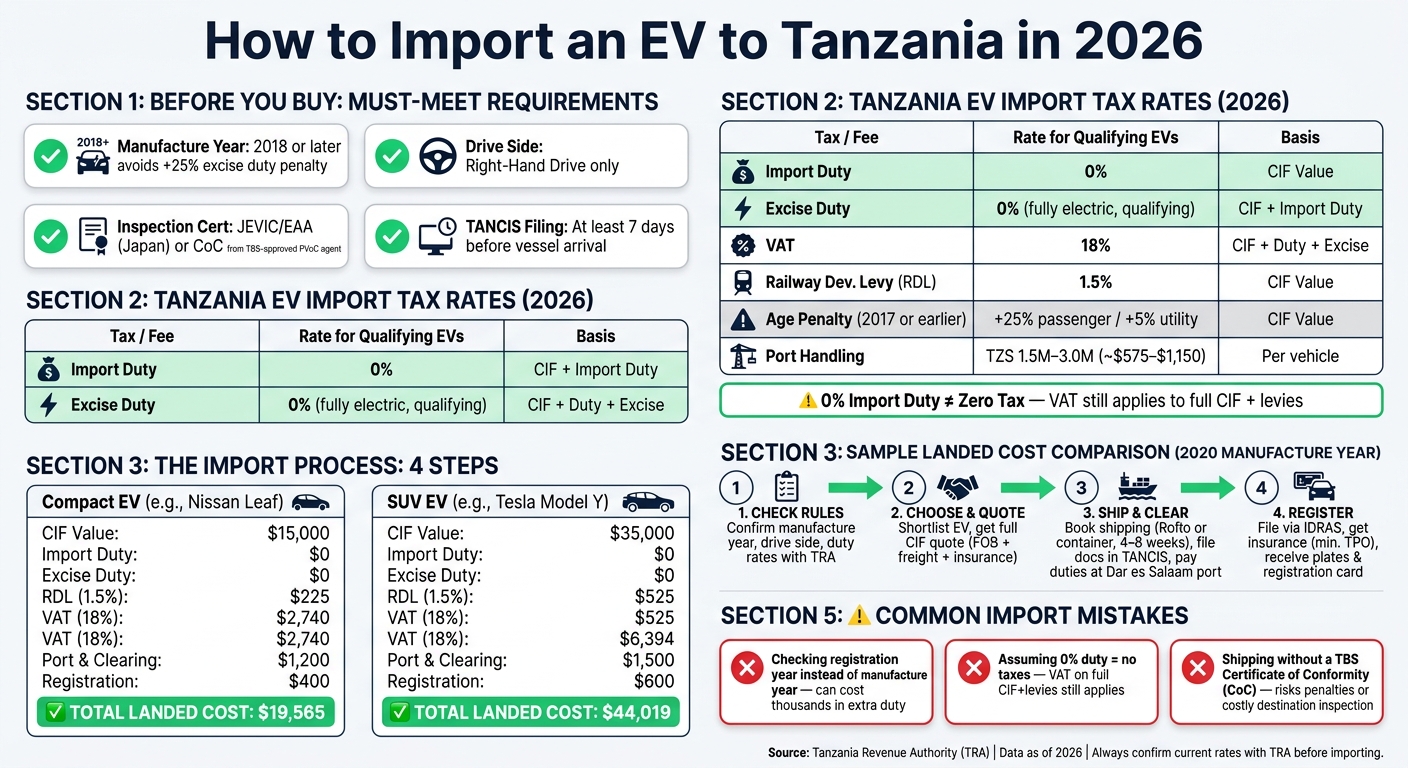
Importing an EV into Tanzania in 2026 comes down to four things: age, documents, CIF, and taxes. If the car was made in 2018 or later, is right-hand drive, has the required inspection papers, and you budget for VAT, RDL, port charges, clearing, and registration, the process is much easier to plan.
Here’s the short version:
- Fully electric cars can get 0% excise duty, but that does not mean zero tax.
- You still need to budget for VAT at 18% and RDL at 1.5% of CIF.
- If a passenger car was made in 2017 or earlier, it can face an extra 25% excise duty.
- Tanzania requires right-hand-drive vehicles.
- Used imports need the right inspection paperwork, such as JEVIC/EAA for Japan-sourced vehicles and a CoC from a TBS-approved agent.
- Your costs are based on CIF: car price + freight + insurance.
- Port handling at Dar es Salaam is often around TZS 1,500,000 to TZS 3,000,000 or about $575 to $1,150.
- Transit often takes about 4 to 8 weeks.
- A sample landed cost can be about $19,565 for a compact EV and about $44,019 for a larger SUV EV.
The big mistake I’d avoid is checking the first registration year instead of the manufacture year. In Tanzania, that one detail can change your tax bill by thousands of dollars.
If I were planning an import, I’d first confirm the car’s build year, then get a written CIF quote, line up a licensed clearing agent, and file the paperwork in TANCIS at least 7 days before arrival. That gives me the clearest picture of the total cost before I send any money.
This guide breaks down the process from buying and shipping to customs, registration, and final delivery.
How to Import an EV to Tanzania in 2026: Step-by-Step Cost & Compliance Guide
Step 1: Check Tanzania’s EV Import Rules Before You Buy
Check Tanzania’s import rules before you pay a deposit. A low price can look great at first, but it doesn’t help much if the car can’t clear Tanzanian import requirements. When something is wrong after shipment, clearance can slow down and costs can climb fast.
EV Duty Rates, Tax Relief, and Levies
Under the 2024 Finance Act, fully electric vehicles may qualify for excise duty exemptions. The other taxes are then worked out from the vehicle’s CIF value.
| Tax / Fee | Rate for EVs | Calculation Base |
|---|---|---|
| Import Duty | 0%–10% | CIF Value |
| Excise Duty | 0% for qualifying fully electric vehicles; confirm model treatment with TRA | CIF + Import Duty |
| VAT | 18% | CIF + Duty + Excise |
| 8-Year Age Penalty | +25% for passenger cars; 5% for utility vehicles, if manufactured in 2017 or earlier | CIF Value |
| Port Handling | TZS 1,500,000–3,000,000 | Per vehicle |
When you estimate CIF-based taxes, the order matters. One wrong input can throw off the whole total. That’s why it’s smart to confirm current rates directly with the Tanzania Revenue Authority (TRA) before sending money.
Vehicle Eligibility: Drive Side, Age, and Inspection
Tanzania only allows right-hand-drive vehicles for registration. That point alone can save you from buying the wrong car.
Age also matters. In 2026, EVs manufactured in 2017 or earlier trigger an extra 25% excise duty for passenger cars and 5% for utility vehicles. Use the export certificate to confirm the manufacture year, and check the manufacture year on that document, not the registration date.
Used imports also need pre-shipment inspection checks. If the vehicle comes from Japan, you need a JEVIC or EAA certificate. On top of that, every import, no matter where it comes from, needs a Certificate of Conformity (CoC) from a TBS-approved PVoC agent. If the vehicle arrives without a valid CoC, you may face penalties or pay for destination inspection costs.
Documents to Confirm Before Shipment
Before the car ships, make sure these documents are in place so customs clearance doesn’t get stuck at Dar es Salaam:
- Commercial Invoice – used by TRA to establish the CIF value for tax calculation
- Export / Deregistration Certificate – proves legal export and shows the manufacturing year
- Bill of Lading – your shipping contract and proof of ownership in transit
- Certificate of Conformity (CoC) – issued by a TBS-approved PVoC agent
- JEVIC or EAA Certificate – required for vehicles imported from Japan
- EV specifications – battery capacity in kWh and charging connector type
- Taxpayer Identification Number (TIN) – needed to file the Import Declaration Form (IDF) through TANCIS
Lodge your customs documents in TANCIS at least 7 days before the vessel arrives at Dar es Salaam. That early window gives your CFA time to spot errors and fix them before the ship gets in.
With the paperwork sorted, the next move is to compare EV options, suppliers, and CIF quotes before you buy.
sbb-itb-99e19e3
Step 2: Choose the EV, Supplier, and Shipping Plan
How to Pick an EV for Tanzanian Conditions
Start with the basics: ground clearance, battery behavior in heat, and range that covers your longest regular trip.
That matters in Tanzania, where roads can shift from smooth city streets to rougher stretches pretty fast. Stop-and-go driving also puts different demands on an EV than steady highway use. So don’t pick based on looks or brochure range alone.
Use these models as a starting point for your shortlist:
| Model | Best Use Case | Approx. Range |
|---|---|---|
| Leapmotor T03 | Urban commuting | 300 km |
| BYD Atto 3 | Urban + semi-rural roads | 420 km |
| MG4 Electric | Mixed terrain | 435 km |
| Hyundai Kona EV | City + intercity travel | 480 km |
| Tesla Model 3 | Long-distance driving | 500+ km |
Also check the connector type before you go any further. The car needs to match the charging setup you’ll actually use, whether that’s local public charging or a home charger. If power on your route isn’t steady, it makes sense to plan for home charging or a solar backup.
Once you’ve found a car that fits your roads, distance, and charging setup, the next step is simple: compare suppliers and pin down the shipping cost.
Using EV24.africa to Source and Compare EVs
EV24.africa lists more than 200 electric car models that fit the Tanzanian market, including BYD, Tesla, Hyundai, Leapmotor, and Geely.
You can narrow the list by:
- Battery range
- Charging time
- Mileage
- Model year
- Price in USD
- Full vehicle specs
That makes it easier to line up options that match both your budget and the way you drive.
Request a Full CIF Quote Before You Commit
After you’ve shortlisted the vehicle, ask for the full CIF breakdown in writing before you pay any deposit.
Get the CIF quote to Dar es Salaam first. A proper quote should spell out:
- FOB vehicle price
- Ocean freight
- Marine insurance
- Destination charges, such as port handling and clearing fees
Shipping method matters too. RoRo is usually the lower-cost option for a running vehicle. Container shipping is often a better fit for high-value or non-running EVs. In both cases, expect transit to Dar es Salaam to take about 4 to 8 weeks.
With the EV picked and the CIF quote fixed, you’re ready to move on to shipment documents and customs clearance.
Step 3: Ship, Clear Customs, and Register the Car in Tanzania
Prepare Your Shipment and Import Documents
Once the CIF quote is set, the next move is the clearance paperwork. After shipping is booked, put together the full clearance file. The exporter must provide the JEVIC/EAA inspection certificate, CoC, export certificate, and deregistration certificate. You, or your agent, must file the IDF, invoice, bill of lading, and authorization letter in TANCIS.
Be careful with the battery size listed in kWh. That number needs to match across the invoice and conformity documents. If it doesn’t, you can run into classification issues, and that can affect any duty treatment that applies.
File the IDF and the rest of the clearance documents in TANCIS before the vehicle arrives. That helps you avoid wharfage or storage charges.
Customs Clearance and Tax Payment at Port
Once the documents are filed, TRA can assess the taxes and clear the vehicle for release. In Tanzania, all imports must go through a licensed Clearing and Forwarding Agent (CFA) using TANCIS.
TRA checks the CIF value using the invoice and bill of lading, and that becomes the tax base. From there, TRA applies import duty, VAT, and any excise duty that fits the vehicle’s specs and CIF value.
At Dar es Salaam, port handling charges usually fall between TZS 1,500,000 and TZS 3,000,000, based on the size of the vehicle.
After all duties, taxes, and port charges are paid, TRA issues the Tanzania Single Administrative Document (TANSAD) and a Customs Release Order.
Registration, Insurance, Plates, and Delivery
After customs release, move straight to registration and insurance. Registration goes through TRA’s IDRAS platform. You’ll need your TIN, the TANSAD, the Customs Release Order, the original export/cancellation certificate, and the TBS Roadworthiness Certificate.
Before registration or any road use, you must get motor insurance. At a minimum, that means Third-Party Only (TPO) cover. If the EV is new or high-value, comprehensive cover is a smart pick.
Once the insurance is in place and the registration fees are paid, TRA assigns the registration number and issues the registration card and number plates.
Step 4: Calculate Your Total Import Cost and Avoid Common Mistakes
Full Cost Breakdown for a Tanzania EV Import
Once you’ve worked out CIF, duties, and clearance, the next step is simple: add up the full landed cost before you buy. This is where many buyers get caught off guard.
In Tanzania, the final cost stacks up in layers. It starts with the car price, freight, and insurance. Then come the CIF-based taxes, port charges, clearing fees, registration, and last-mile delivery.
| Item | What It Covers | Typical Rate or Basis | Who Charges It |
|---|---|---|---|
| Car price (FOB) | The cost of the car itself | Market price | Supplier |
| Freight | Ocean shipping to Dar es Salaam | Varies by route and method | Shipping line |
| Insurance | Cargo coverage during transit | Policy-based | Insurer |
| Import Duty | Basic import tax | 0% for fully electric vehicles | TRA |
| Excise Duty | Luxury/environmental tax | 0% for fully electric vehicles | TRA |
| Railway Dev. Levy (RDL) | Infrastructure levy | 1.5% of CIF | TRA |
| VAT | Value Added Tax | 18% of (CIF + Duty + RDL) | TRA |
| Customs processing fee | Documentation fee | ~$150 (fixed) | TRA |
| Port Handling Fees | Offloading and storage at port | TZS 1,500,000–3,000,000 | Tanzania Ports Authority |
| Clearing Agent Fee | Licensed CFA professional service | ~$300–$500 (negotiable) | Clearing Agent |
| Registration and plates | Initial vehicle registration | TRA registration fees | TRA |
One detail matters more than it may seem: VAT is not charged on the car price alone. It applies to the CIF amount plus levies, which means freight and insurance push the tax base up too.
Sample 2026 Landed Cost Estimates for Popular EV Models
The figures below use hypothetical numbers to show how costs can shift between a smaller EV and a larger one. Both cases assume a 2020 manufacture year and arrival through Dar es Salaam Port.
The formula stays the same for every vehicle: CIF + levies + port charges + clearing fees + registration.
| Component | Compact EV (e.g., Nissan Leaf) | SUV EV (e.g., Tesla Model Y) |
|---|---|---|
| CIF Value | $15,000 | $35,000 |
| Import Duty (0%) | $0 | $0 |
| Excise Duty (0%) | $0 | $0 |
| RDL (1.5% of CIF) | $225 | $525 |
| VAT (18%) | $2,740 | $6,394 |
| Port and clearing (est.) | $1,200 | $1,500 |
| Registration (est.) | $400 | $600 |
| Total Landed Cost | $19,565 | $44,019 |
That spread tells the story. The final bill is driven mostly by CIF, VAT, port charges, clearing fees, and registration.
Common Mistakes and a Pre-Import Checklist
One of the biggest mix-ups is confusing the manufacture year with the first registration year. They are not the same thing. In 2026, passenger cars manufactured in 2017 or earlier face a 25% penalty excise duty, even if the vehicle was first registered in 2018. So don’t rely on the registration date alone. Check the export certificate or auction sheet before you commit.
Another mistake is thinking 0% import duty means no tax bill. It doesn’t. VAT still applies to the full CIF-plus-levies amount, and that can add thousands of dollars to the cost.
There’s also the paperwork trap. If the vehicle ships without a TBS Certificate of Conformity, you could face heavy penalties or costly destination inspections. That’s the kind of issue that turns a good deal into a headache.
Before the vehicle leaves the origin country, go through this list:
- [ ] Manufacture year confirmed as 2018 or later (check the export certificate, not the registration document)
- [ ] JEVIC or EAA roadworthiness certificate obtained for Japanese-sourced used vehicles
- [ ] TBS Certificate of Conformity (CoC) secured from a TBS-approved PVoC agent
- [ ] Commercial Invoice and Bill of Lading in hand
- [ ] Battery specifications confirmed for registration and cost estimates
- [ ] Licensed Clearing and Forwarding Agent (CFA) appointed
- [ ] TIN active and linked to your current phone number and email address
- [ ] Budget confirmed to include VAT, RDL, port charges, clearing fees, registration, and delivery
Conclusion: Plan Your EV Import Around Compliance, CIF, and Registration
Once you’ve checked the rules, picked the car, and cleared customs, the last job is simple: work out the full landed cost before you commit.
Importing an EV into Tanzania in 2026 is manageable if you verify the rules, get a full CIF quote, file your documents before shipment, and budget all the way through registration and delivery.
The CIF value sits at the center of Tanzania’s customs tax calculations. That means your CIF quote is what you should use to estimate duty, VAT, excise, and your total landed cost.
You should also verify the manufacture year and secure the Certificate of Conformity before shipment. Those two checks can help you avoid penalties and inspection delays that are easy to prevent.
It also helps to appoint a licensed Clearing and Forwarding Agent early and lodge documents in TANCIS at least 7 days before arrival.
With the paperwork in place, the final budgeting step should cover the full 4- to 8-week import window. Build your numbers around CIF, duty, VAT, port handling, clearing, registration, and delivery. If you confirm compliance first, the process is far more predictable.
FAQs
How do I verify the manufacture year?
Check the vehicle’s official export documents, not the registration year. Tanzania’s 8-year import age limit is based only on the year of manufacture.
If you’re buying from a Japanese auction, confirm the year on the auction sheet before you buy. When the vehicle arrives, customs will physically check that year against your paperwork, along with the VIN, make, and model.
What if my EV arrives without a CoC?
If your electric vehicle arrives in Tanzania without a Certificate of Conformity (CoC), customs won’t release it.
The PVoC process is mandatory, and it has to be completed by an authorized inspection agency before shipping. If that document is missing, the vehicle can face major penalties plus a more expensive destination inspection.
To avoid delays, make sure your exporter gets the CoC in place before the vehicle is shipped.
Can I import a left-hand-drive EV?
No. Tanzania does not allow the import of left-hand-drive vehicles.
Because the country drives on the left, imported EVs must be right-hand drive to meet local safety and technical standards.
This is one detail you need to check before you buy. If the vehicle doesn’t comply, it can’t be legally registered for use on Tanzanian roads.