
 Thabo Nkosi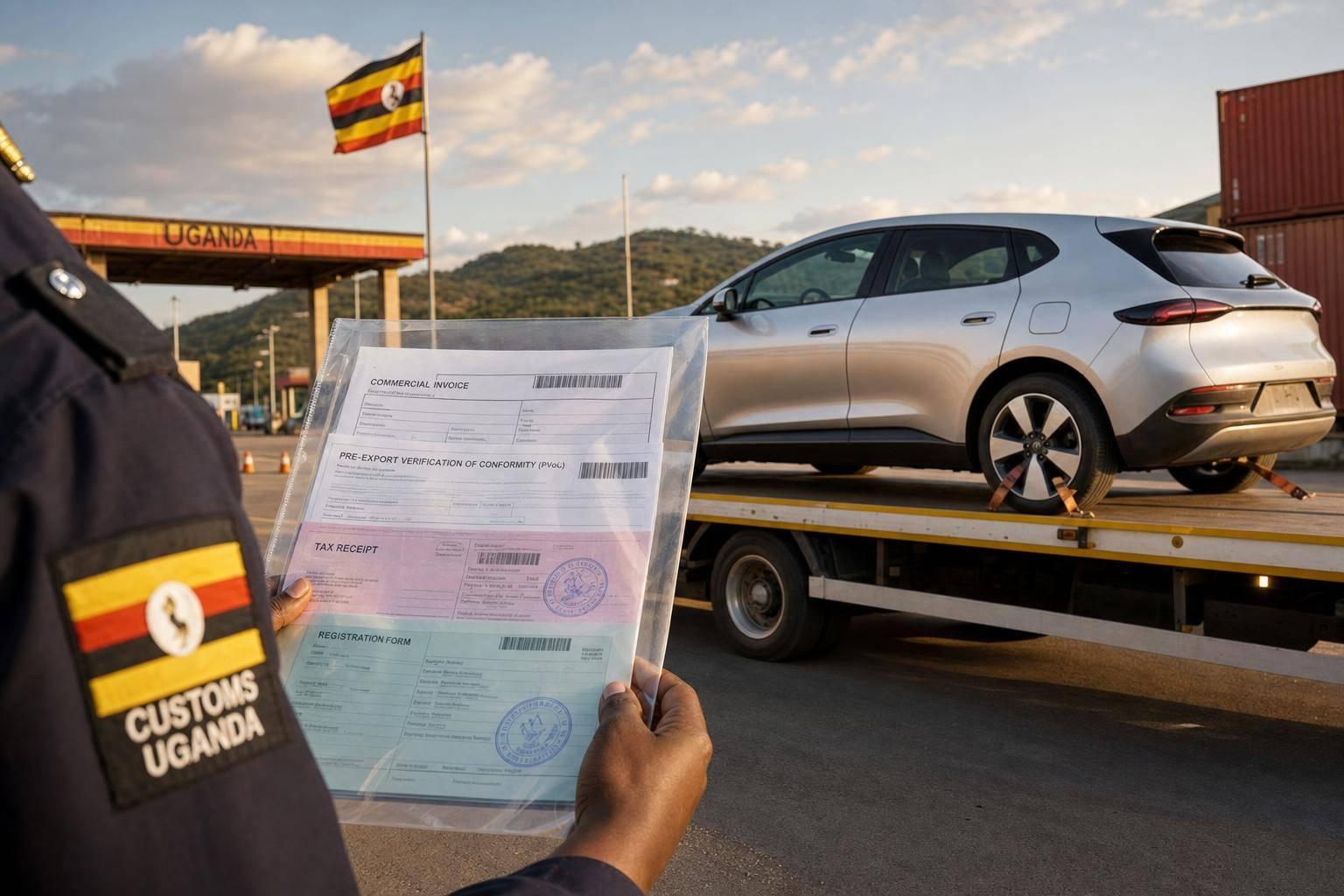
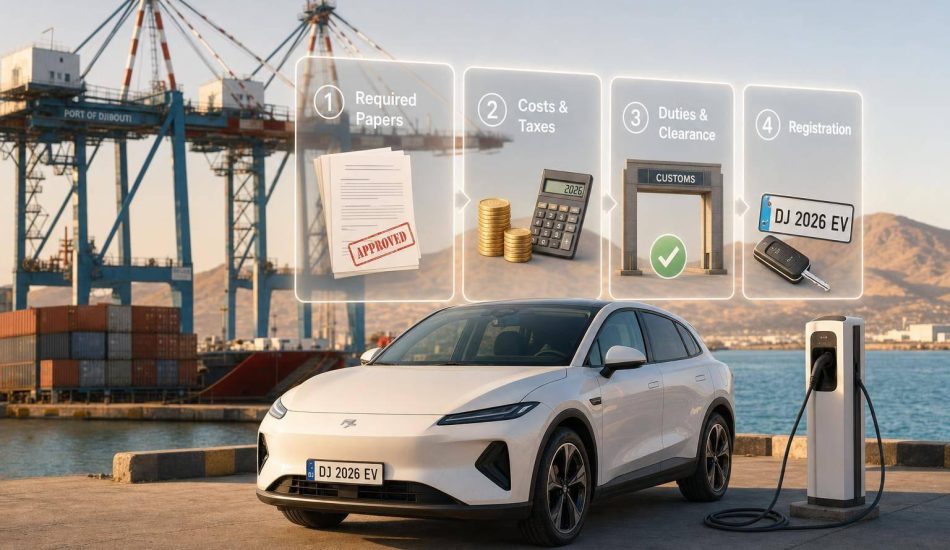
If I import an EV into Uganda in 2026, I should plan for far more than the car price. The main charges in this article add up to 25% import duty, 18% VAT, 6% withholding tax, and 1.5% infrastructure levy, mostly based on CIF value. I also need to check the 15-year age limit, get a PVoC certificate, clear customs through URA, and finish registration, plates, and insurance before driving.
Here’s the short version:
- I can import a passenger EV only if it is 2011 or newer in 2026
- A used EV needs a Pre-Export Verification of Conformity (PVoC) before shipment
- Taxes are mostly charged on CIF = car price + shipping + insurance
- I should also budget for:
- clearing agent fees
- port handling and storage
- inland transport
- number plates and insurance
- For a used EV, I should check battery health and aim for 80% SoH or more
- I need documents to match the VIN/chassis number exactly, or clearance can slow down
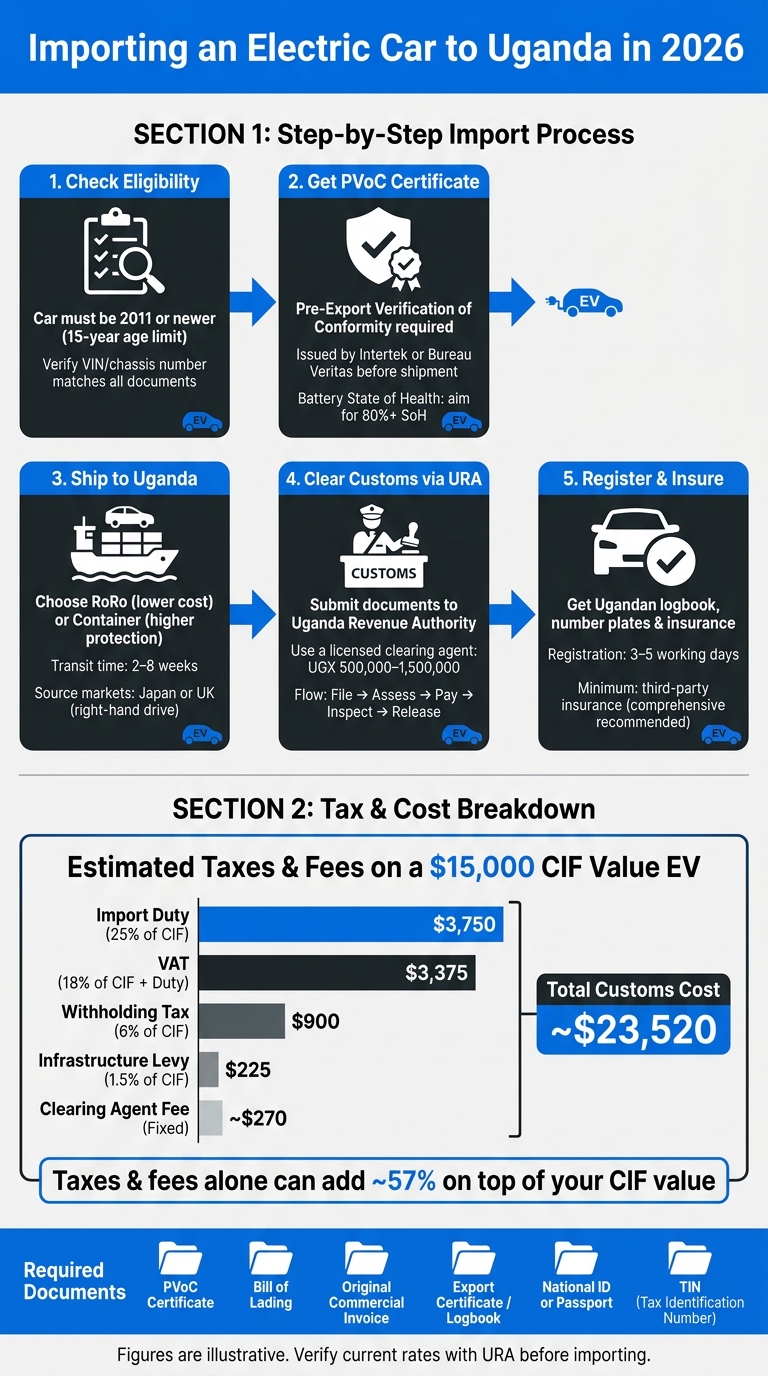
A simple example from the article shows that a car with $15,000 CIF can reach about $23,520 total customs cost before port and inland delivery. That means taxes and fees alone can add about 57%.
If I want to avoid extra charges, I should do four things first: confirm the car qualifies, confirm the tax estimate, get the export papers right, and line up customs clearance before the car arrives.
How to Import an Electric Car to Uganda in 2026: Step-by-Step Cost & Process Guide
EV adoption stalls as import taxes return
sbb-itb-99e19e3
Check Uganda’s 2026 Import Rules Before You Buy
Before you send money to an overseas seller, make sure the car fits Uganda’s import rules. If you buy the wrong vehicle, fixing that mistake can get expensive fast.
Confirm the EV Meets the 15-Year Age Limit and Inspection Rules
Uganda allows imported passenger vehicles that are up to 15 years old. That means a car imported in 2026 must be 2011 or newer. Check the manufacture year using the chassis number (VIN), then match it against the title and registration papers. Don’t just take the seller’s word for it.
Used EVs imported from abroad also need a Pre-Export Verification of Conformity (PVoC) certificate before shipment. Authorized agencies such as Intertek or Bureau Veritas inspect the vehicle before export and issue the PVoC certificate. Before you pay, make sure this document will be included in the paperwork you receive.
For used EVs, battery condition is a big deal. A car can meet the rules and still be a bad buy if the battery is worn down. As a practical benchmark, aim for 80% State of Health or higher.
If the vehicle clears those checks, you can move on to the seller and shipping plan with a lot more confidence.
Understand Which Taxes Apply to Electric Cars in 2026
After you confirm the car is eligible, the next step is figuring out the full tax bill. Uganda applies a 25% import duty to fully electric vehicles. Most of the charges are based on CIF, which means the purchase price plus shipping and insurance.
Here are the main taxes and fees:
| Tax / Fee | Rate |
|---|---|
| Import Duty (EVs) | 25% of CIF value |
| VAT | 18% of (CIF + import duty) |
| Withholding Tax | 6% of CIF value |
| Infrastructure Levy | 1.5% of CIF value |
| Environmental Levy | UGX 100,000–UGX 1,000,000 |
Those costs can stack up fast, so it’s smart to run the numbers before you commit.
Choose a Compliant EV and Arrange Shipping to Uganda
Compare Source Markets, EV Condition, and Battery Checks
Once the EV meets Uganda’s import rules, the next step is simple: buy from a source market and choose a shipping path that won’t trip you up at clearance.
Japan and the UK are common source markets because they supply right-hand-drive EVs. Before sending money, check the model year, confirm the charge port, and ask for a full history report. That report helps flag flood damage, odometer rollback, and major accidents.
It also helps to pick a model that fits how cars are used on Ugandan roads. Range matters, but so do ground clearance and parts support.
| Model | Typical Range | Suitability |
|---|---|---|
| Nissan Leaf | ~270 km | Best for city driving and parts availability |
| BYD Atto 3 | ~420 km | High ground clearance for mixed road conditions |
| MG ZS EV | ~320 km | Balanced SUV for performance and affordability |
| Toyota bZ4X | Varies | Premium option with trusted local after-sales support |
Uganda’s AC charging standard is Type 2, while DC fast charging usually uses CCS or CHAdeMO connectors. That detail matters more than many buyers expect. If the port type doesn’t line up, charging can become a headache from day one. So confirm the vehicle’s port type before you commit to the purchase.
After the car and its paperwork check out, move on to shipping and export paperwork before the vehicle leaves the source country.
Pick a Shipping Method and Arrange Export Documents
Most buyers choose between RoRo (Roll-on/Roll-off) and container shipping. RoRo costs less and suits most standard passenger EVs. Container shipping costs more, but it gives better protection for higher-value vehicles. Transit time usually runs from 2 to 8 weeks, depending on where the vehicle is coming from.
| Feature | RoRo | Container |
|---|---|---|
| Cost | Lower | Higher |
| Protection | Exposed to elements | Sealed, high protection |
| Handling | Driven on and off the ship | Crane-loaded in a sealed box |
| Best For | Standard passenger EVs | High-value EVs or multiple units |
Before the vehicle ships, gather every export document. These papers need to match the car exactly, or customs may hold up clearance. You need:
- The PVoC certificate
- The bill of lading
- The original commercial invoice
- The export certificate or logbook from the source country’s transport authority
- A copy of your national ID or passport
Get all of these before departure.
Clear Customs in Uganda and Calculate the Full Landed Cost
Prepare the Customs File and Submit the Required Documents
When your EV reaches Mombasa or Dar es Salaam, customs clearance starts. If your export papers are already in order, the next step is URA clearance and tax assessment. At this stage, it makes sense to work with a licensed clearing agent. Most agents charge UGX 500,000 to UGX 1,500,000 and take care of document submission, URA system processing, and tax assessment for you.
It’s smart to have the customs file ready before the vehicle arrives. That can help you avoid storage charges at the port. Along with the full shipping file, you’ll need your TIN, ID or passport, and battery or vehicle spec documents.
For used EVs, include:
- Battery capacity
- Battery SoH
URA clearance usually follows this flow: file submission, tax assessment, payment, inspection, and release. For used EVs, inspectors may also check battery condition.
Break Down Import Duty, VAT, and Other Likely Charges
Each charge is based on CIF, which means the vehicle price plus shipping and insurance. Since Uganda’s EV tax treatment can shift, check the current URA position before the car is shipped.
| Charge Type | Rate / Method | Applies to EVs? |
|---|---|---|
| Import Duty | 25% of CIF value | Yes |
| VAT | 18% of (CIF + Import Duty) | Yes |
| Withholding Tax | 6% of CIF value | Yes |
| Infrastructure Levy | 1.5% of CIF value | Yes |
| Environmental Levy | UGX 100,000–UGX 1,000,000 (varies by specs) | Yes |
| Clearing Agent Fee | UGX 500,000–UGX 1,500,000 | Yes |
On top of that, you should expect port handling and storage fees at Mombasa or Dar es Salaam. Those costs depend in part on how fast the vehicle is cleared.
Worked Examples: Estimating Total Landed Cost
Here’s a simple example for a mid-range EV with a CIF value of $15,000. These numbers use an exchange rate of $1 = UGX 3,750.
| Charge Type | Rate / Method | Est. Amount (USD) | Est. Amount (UGX) |
|---|---|---|---|
| CIF Value | Purchase + Shipping + Insurance | $15,000 | ~UGX 56,250,000 |
| Import Duty | 25% of CIF | $3,750 | ~UGX 14,062,500 |
| VAT | 18% of (CIF + Duty) | $3,375 | ~UGX 12,656,250 |
| Withholding Tax | 6% of CIF | $900 | ~UGX 3,375,000 |
| Infrastructure Levy | 1.5% of CIF | $225 | ~UGX 843,750 |
| Clearing Agent Fee | Fixed professional fee | ~$270 | ~UGX 1,000,000 |
| Total Customs Cost | Sum of all above | ~$23,520 | ~UGX 88,187,500 |
These figures are hypothetical and for illustrative purposes only. Port handling, storage, and road transport from the port to Uganda are not included and will add to the total.
In this example, taxes and fees add about $8,520, or about 57%, before port handling and inland transport. After payment is made and the EV is released, the next step is registration.
Register the EV in Uganda and Get It Road-Ready
Once URA releases your EV after customs, you’re on the last legal stretch. Registration is the step that gets you a Ugandan logbook and number plates. Without those, the vehicle can’t be driven on public roads.
Submit Registration Documents and Pay Plate and Logbook Fees
After release, your clearing agent will usually handle the registration file. In most cases, they’ll need:
- Customs clearance entry
- PVoC certificate
- Proof of ownership
- Your National ID or passport
URA then processes the file, issues the logbook in your name, and assigns Ugandan number plates.
Complete Insurance, Plate Fitment, and Delivery to Your Location
Before the EV touches a public road, it must have at least third-party insurance. That’s the legal minimum in Uganda. If you’re bringing in a high-value EV, though, basic cover may not be enough. It’s smart to get comprehensive insurance and check that the policy covers the battery and the vehicle’s electronics. Many private insurers can set this up the same day.
Once insurance is active and the plates are fitted, the EV is legal to drive. If it’s still sitting at a bonded warehouse or border point, your clearing agent or a transporter can move it inland to your location. The price and delivery time depend on distance and road conditions.
| Step | Responsible Agency | Required Document / Action | Typical Timing |
|---|---|---|---|
| Registration Application | URA | Customs clearance entry, PVoC certificate, proof of ownership, National ID or passport | 3–5 working days |
| Insurance Acquisition | Private insurer | Third-party policy at minimum; confirm EV battery and electronics coverage | Same day |
| Plate Fitment | URA / Bonded Warehouse | Proof of registration and payment | 1–2 days |
| Final Delivery | Owner / Transporter | Valid logbook and insurance sticker | Varies by distance |
Conclusion: Key Steps, Costs, and Documents to Get Right
Importing an EV into Uganda in 2026 is pretty straightforward when you handle each step in the right order: check eligibility, ship the car with the right paperwork, clear customs, and then register it.
The first number to pin down is CIF, because that’s what most of your charges will be based on. Expect:
- 25% import duty
- 18% VAT on CIF plus duty
- 6% withholding tax
- 1.5% infrastructure levy
- environmental, clearing, and registration fees
Those charges shape your total landed cost.
Before you file for registration, have these documents ready:
- PVoC certificate
- bill of lading
- original purchase invoice
- National ID or passport
If you’re buying a used EV, ask for a battery SoH report. In practice, 80% or higher is a good target.
It also helps to use a licensed clearing agent, make sure every document matches the VIN, and confirm the tax figures before the vehicle ships. Check the VIN, verify the tax estimate, and complete registration before driving.
FAQs
How much cash should I budget beyond the car price?
Beyond the purchase price, you also need to budget for required import and registration costs.
These include:
- 25% import duty on the customs-assessed value
- 18% VAT
- 6% withholding tax
- 1.5% infrastructure levy
You should also set aside extra money for related fees. Shipping and insurance usually cost $2,500–$4,500, while clearing and forwarding often adds $500–$1,500. On top of that, there are pre-export inspection costs and roughly UGX 700,000–714,300 for digital number plate registration.
What happens if the EV is older than 15 years?
Uganda strictly enforces a 15-year age limit on imported vehicles, based on the year of manufacture. If an EV is more than 15 years old, it is not allowed in.
Customs checks the manufacturing date using the chassis number and official documents. If the vehicle is past the limit, it will not meet Uganda’s entry rules.
Can I import an EV without a PVoC certificate?
No. Uganda requires a PVoC certificate under the UNBS PVoC program for imported vehicles to clear customs.
If you do not have the required CRW/COC from the PVoC program, the vehicle may face a 15% surcharge on CIF plus destination inspection fees.