
 Thabo Nkosi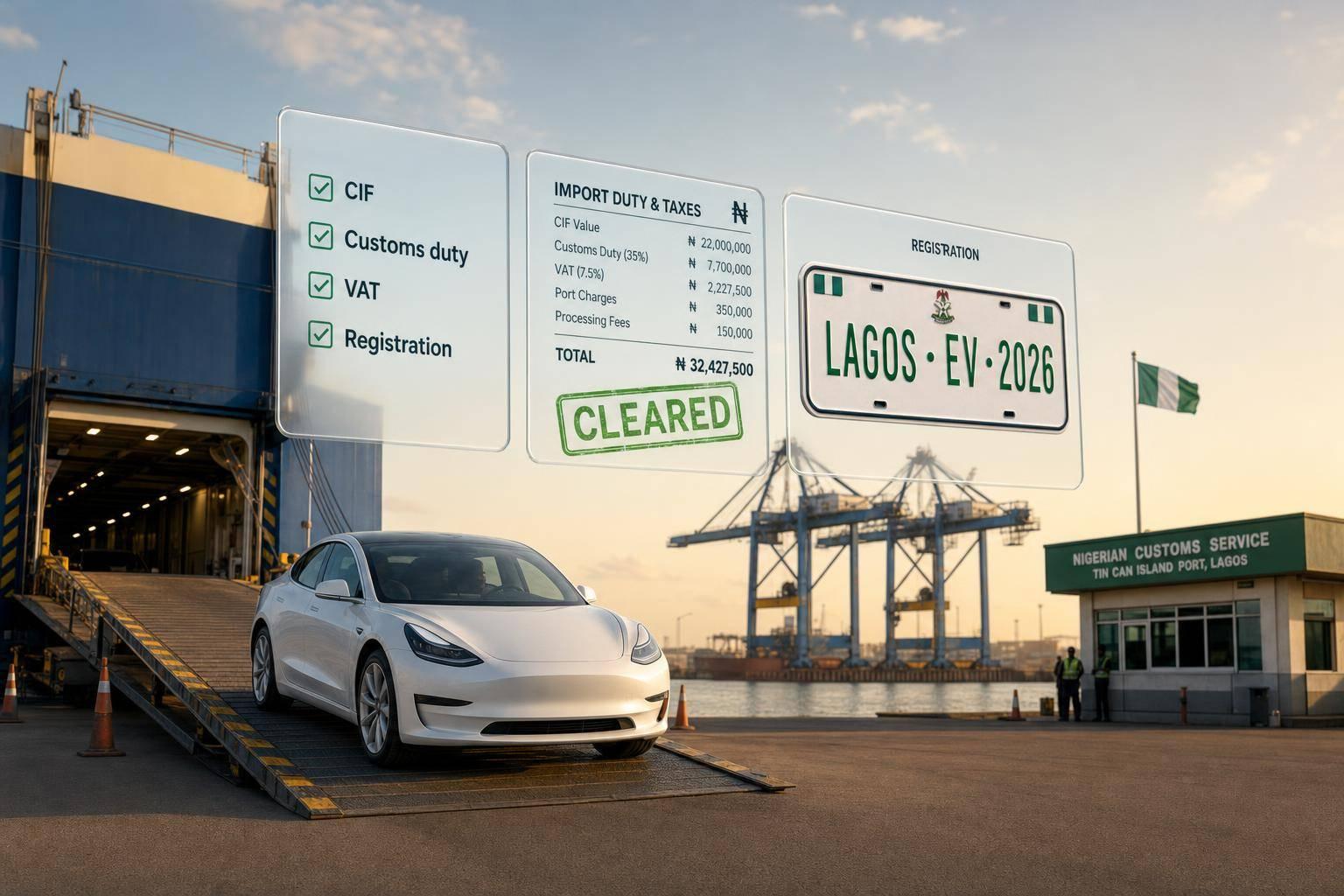
If you import a battery-electric car into Nigeria in 2026, your main cost pieces are CIF, customs charges, port and clearing fees, and registration. Under current rules, many EVs get 0% VAT, 0% Green Tax, and a lower import duty than fuel cars.
Here’s the short version:
- You need the car to qualify as a battery-electric vehicle under HS Code 8703.80
- The car must meet Nigeria’s 10-year age limit: 2016 model year or newer in 2026
- Your customs bill is built on CIF: cost + insurance + freight
- For many EVs, the charge stack includes:
- 10%–20% import duty
- 15% NAC levy
- 7.0% surcharge
- 0.5% ETLS
- 0% VAT
- 0% Green Tax
- You also need to budget for:
- port fees
- clearing agent fees
- FRSC and state registration
- insurance
- roadworthiness inspection
- Main paperwork includes:
- TIN
- e-Form M
- PAAR
- Bill of Lading
- commercial invoice
- VIN records
- release documents after clearance
A simple planning formula is: Landed cost = CIF + customs charges + port fees + clearing + registration. In the article’s sample cases, estimated landed cost comes to about $54,522 for a Tesla Model 3 RWD, $40,832 for a BYD Atto 3, and $36,725 for a Leapmotor C11.
Here’s a quick view of the import side:
| Item | Battery-electric vehicle |
|---|---|
| Import age limit | 2016 or newer |
| Customs base | CIF |
| Import duty | 10%–20% |
| NAC levy | 15% |
| Surcharge | 7.0% |
| ETLS | 0.5% |
| VAT | 0% |
| Green Tax | 0% |
The key point: if you get the VIN, HS code, Form M, and PAAR right before shipping, you lower the risk of delays, extra charges, and registration problems after arrival.
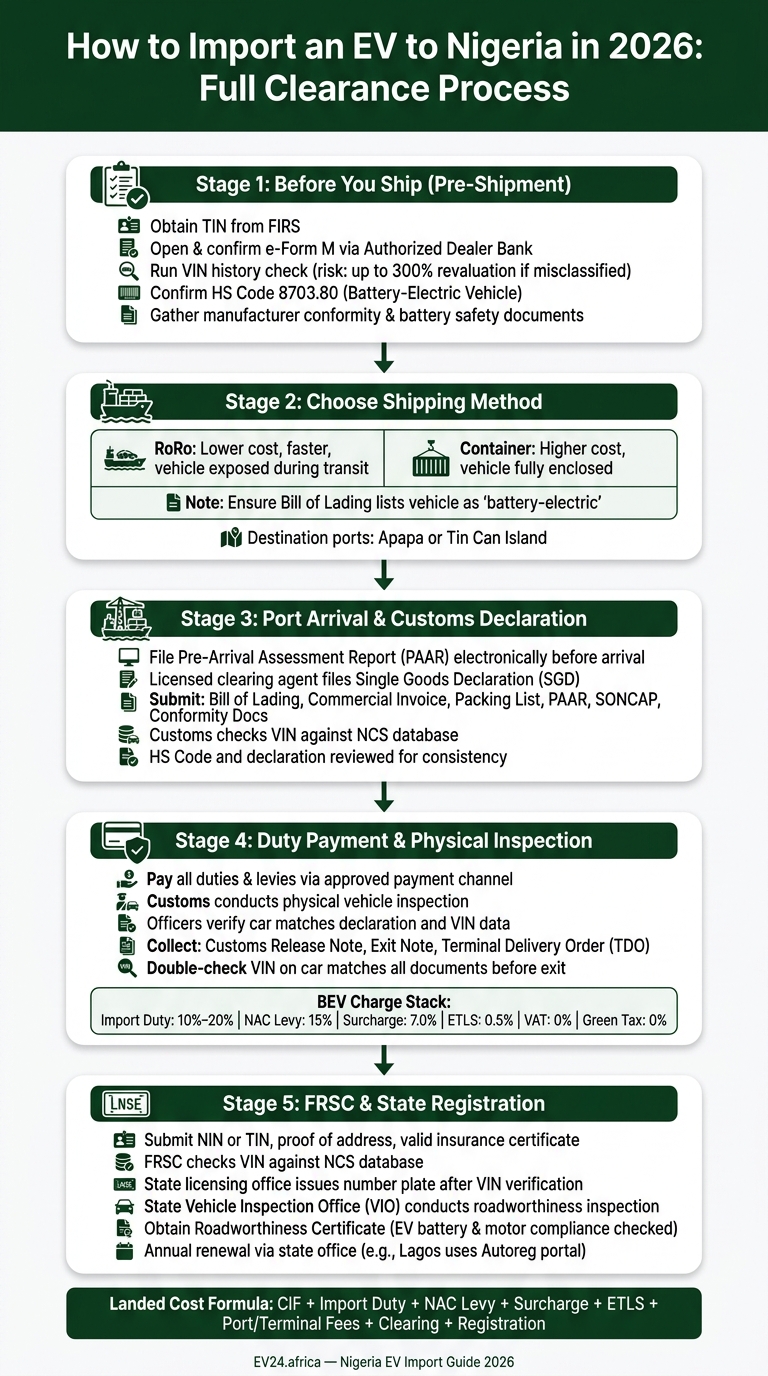
How to Import an Electric Car to Nigeria in 2026: Step-by-Step Process
1. Nigeria’s 2026 EV Import Rules and How Landed Cost Works
In April 2026, the Federal Government cut the combined tariff on fully built passenger cars from 70% to 40%. Battery-electric vehicles, or BEVs, get extra relief: lower duty, 0% VAT, and no Green Tax. That matters because landed cost is more than the sticker price. It includes the vehicle price, shipping, customs charges, port costs, clearing, and registration.
1.1 Which EVs Qualify for Import Incentives and Which Do Not
Pure battery-electric vehicles classified under HS Code 8703.80 get the lowest duty rates, plus VAT and Green Tax exemptions. Hybrids and other non-qualifying vehicles face higher standard rates. That classification has a direct effect on your tax bill, which then shapes your total landed cost and shipping budget.
There’s also one rule that applies across the board: Nigeria’s 10-year age limit. As of 2026, only vehicles from model year 2016 or newer can be imported. It’s smart to check the VIN before shipping, since Nigeria Customs uses a VIN valuation system that can change duty assessments.
Here’s how the main charges compare:
| Tax/Levy Component | Battery-Electric (BEV) | Hybrid / Non-Qualifying |
|---|---|---|
| Import Duty | 10%–20% | 20%–35% |
| NAC Levy | 15% | 15%–20% |
| VAT | 0% (Exempt) | 7.5% |
| Green Tax (IAT) | 0% (Exempt) | Varies by engine size |
| Surcharge (SUR) | 7.0% | 7.0% |
| ETLS | 0.5% | 0.5% |
Once you know whether the vehicle qualifies, the next big piece is the customs base and the shipping route you choose.
1.2 The Main Cost Lines: CIF, Customs, Port Charges, Clearing, and Registration
Nigeria Customs calculates duty on CIF – cost, insurance, and freight – so the purchase price, freight charge, and insurance all shape the customs bill. From there, charges stack in this order: Import Duty at 10%–20% for BEVs, NAC Levy at 15%, Surcharge at 7%, and ETLS at 0.5%.
And customs isn’t the end of it. You’ll also need to account for terminal handling fees, clearing agent fees, and registration costs like number plates, FRSC fees, state roadworthiness inspection, and insurance. If port agencies overlap in the process, clearance can slow down and storage fees can pile up. That’s why a budget buffer isn’t just nice to have. It helps keep surprises from blowing up your numbers.
Those costs tie straight into clearance, and clearance depends on getting your paperwork lined up before the vehicle leaves port of origin.
1.3 Shipping Method: RoRo vs. Container
The two main ways to ship into ports like Apapa or Tin Can Island are Roll-on/Roll-off (RoRo) and container shipping. RoRo costs less and usually moves faster, but the vehicle stays exposed during transit. Container shipping costs more, though it keeps the vehicle in an enclosed space for the full trip.
There’s a simple way to think about it: RoRo is the budget play, while a container is the safer box.
Whichever option you pick, ask your freight forwarder to make sure the Bill of Lading lists the vehicle as battery-electric. That detail can help Customs apply the right exemptions.
Once the shipping method is set, clearance moves into the next stage: VIN checks, HS code classification, and import paperwork.
sbb-itb-99e19e3
2. Step-by-Step Import and Customs Clearance Process
Customs clearance starts before the vehicle ships. Every document you file affects duty, delays, and release time. Those filings also shape how Customs values the EV, so clean paperwork can change both your delay risk and your total cost.
2.1 Before You Ship: VIN Checks, HS Code, Form M, and Compliance Papers
Start by getting a TIN from FIRS. Then open and confirm the e-Form M through an Authorized Dealer Bank before shipment.
Next, run a VIN history check before the vehicle ships. This matters more than many buyers expect. If a vehicle is missing from Customs records or is misclassified in the database, Customs can revalue it. In some cases, that revaluation can be as high as 300%.
You also need to confirm that the vehicle is classified under HS Code 8703.80 for battery-electric vehicles. Keep the manufacturer conformity documents and battery safety documents ready as well. These papers help support the EV classification and the tax treatment tied to it.
Once these documents are lined up, the port-side declaration tends to move much more smoothly.
2.2 At the Port: PAAR, Customs Declaration, SONCAP, and VIN Inspection
Before the vehicle arrives, process the Pre-Arrival Assessment Report (PAAR) electronically. PAAR is a required filing that states the vehicle’s value and specifications, and it starts customs processing early.
When the vehicle arrives, your licensed clearing agent files the SGD along with the Bill of Lading, commercial invoice, packing list, PAAR, and any required SONCAP or conformity documents. Customs then checks the VIN against its database and reviews the declaration for consistency.
If the VIN details or HS code are wrong at this point, the release process stops until Customs clears up the mismatch.
2.3 Payment, Physical Examination, and Vehicle Release
After assessment, pay the duties and levies through the approved payment channel. Once payment is confirmed, Customs sends the vehicle for physical inspection. Officers check that the car matches the declaration and the VIN data. At this stage, make sure the declaration still matches the EV’s HS code and VIN data.
After inspection, collect the Customs Release Note, Exit Note, and Terminal Delivery Order (TDO).
Before driving the vehicle out, check that the VIN on the car matches every document in your file. A mismatch here can delay exit and trigger another round of verification.
Here’s a quick reference for the documents needed at each stage:
| Stage | Required Documents |
|---|---|
| Before Shipping | TIN, Proforma Invoice, Insurance Certificate, e-Form M (confirmed via an Authorized Dealer Bank), VIN History Report |
| Arrival and Declaration | Bill of Lading, Commercial Invoice, Packing List, PAAR, Single Goods Declaration (SGD), SONCAP, Manufacturer Conformity Documents, Battery Safety Documents |
| Release and Exit | Proof of Duty/Levy Payment, Terminal Delivery Order (TDO), Customs Release Note, Exit Note, Gate Pass |
Use a licensed clearing agent to reduce HS code, PAAR, and VAT-exemption errors.
With the vehicle cleared, the next step is turning these assessed charges into a full landed-cost estimate.
3. How to Calculate the Full Landed Cost of an EV in Nigeria
Landed cost is the full amount you pay to get an EV from seller to road. That means the purchase price, freight, customs, port charges, clearing, and registration all rolled together.
3.1 A Landed Cost Formula Buyers Can Reuse
Here’s the simple version buyers can use:
Landed cost = CIF + import duty + NAC levy + surcharge + ETLS + port/terminal fees + clearing + registration
One thing helps EV buyers here: EVs are exempt from VAT and Green Tax. That can shrink the total bill compared with bringing in an ICE vehicle.
Use this formula as a planning tool before shipment so you’re not judging a car by sticker price alone.
3.2 Cost Scenarios for Specific EV Models
The examples below use a 20% duty rate, the full levy stack, and about $2,500 for port, clearing, and registration. These are planning estimates for buyers comparing EV options before shipment, not final invoices. Actual figures can move based on the Customs VIN valuation.
| EV Model | Est. CIF Value | Customs & Tax Total (~36.9% of CIF) | Port, Clearing & Registration | Est. Landed Cost |
|---|---|---|---|---|
| Tesla Model 3 RWD | $38,000 | $14,022 | $2,500 | $54,522 |
| BYD Atto 3 | $28,000 | $10,332 | $2,500 | $40,832 |
| Leapmotor C11 | $25,000 | $9,225 | $2,500 | $36,725 |
The Leapmotor C11 is a good example of how a lower CIF value can lead to a lower final landed total, even when the customs stack follows the same pattern.
Before you commit, check your estimate against current customs and freight quotes.
3.3 Tools and Portals to Cross-Check Your Numbers
Before paying a deposit, cross-check your numbers with:
- a customs duty calculator
- a freight quote
- a duty calculator
Next, prepare the documents needed to register the cleared vehicle with FRSC and your state licensing office.
4. Registering Your Imported EV With FRSC and State Licensing Offices
Clearing customs gets your EV into Nigeria. It does not make the car legal to drive on public roads.
To do that, you still need to register the vehicle with the Federal Road Safety Corps (FRSC) and your State Motor Vehicle Administration Agency (MVAA). This step is mandatory and comes after customs clearance. The path also depends on how you got the EV. If it was a private import, you’ll usually need to handle the customs file yourself. If you bought from a dealer, the customs side is often already sorted.
4.1 Documents Needed After Customs Clearance
Once you have the release note, registration starts with paperwork.
You’ll need your National Identification Number (NIN) or Tax Identification Number (TIN), proof of address such as a utility bill, and a valid insurance certificate. Insurance must be in place before the FRSC can issue your vehicle license.
4.2 FRSC Registration, VIN Checks, and Plate Number Issuance
After that, the VIN is checked against the customs record before plate numbers are issued.
The Vehicle Identification Number (VIN) connects your customs file to your registration record. During registration, the FRSC checks the VIN against the Nigeria Customs Service (NCS) database to confirm that the vehicle cleared customs. Before you leave the port, make sure your clearing agent uploaded the VIN correctly to the NCS system. A small typo here can turn into a headache later. If the VIN was entered wrongly at the customs stage, registration can stall, or the vehicle may be treated as a different model, which can change the fees.
Once the VIN matches the customs record, the state licensing office can issue your number plate after VIN verification.
4.3 State Inspection, Roadworthiness Certificate, and Annual Renewals
Once plates are issued, the state office moves to roadworthiness inspection.
Your state’s Vehicle Inspection Office (VIO) must inspect the EV in person before it can issue a Roadworthiness Certificate. For EVs, inspectors look closely at battery safety and motor compliance. You’ll need this certificate for annual license renewal.
The process can vary by state. In Lagos, for example, the automated Autoreg portal is used for vehicle license and roadworthiness fee payments, which can cut down on manual processing delays. If you’re registering in another state, check whether that state has a similar digital payment system. Annual renewal still goes through the state office after VIO inspection and payment of the required fees.
5. How EV24.africa Can Help You Plan Your Nigeria EV Import
Once you’ve worked through the rules and your landed-cost math, the next step is simple: use the listing details to narrow your choices and check your budget. EV24.africa can help you shortlist eligible EVs and put together a landed-cost estimate that’s grounded in the numbers.
5.1 Review EV Specs That Matter for Import Planning
EV24.africa lists vehicles from brands including Tesla, BYD, Leapmotor, and Hyundai, along with model-level specs. Those details can help you check whether a vehicle fits Nigeria’s EV and age rules before you commit to buying it.
Start by checking that the listing shows a battery-electric drivetrain. That gives you a clear way to verify the car is a true BEV before shipment. It’s also smart to cross-check the VIN in the listing against the VIN your clearing agent will use in the PAAR.
After you confirm the EV fits Nigeria’s import rules, use the listed price as the base for your landed-cost estimate.
5.2 Use Listed Prices and Delivery Support to Build a Budget
Treat the listed price as your starting purchase value. Then add freight and insurance, followed by the import charges: 10%–20% import duty, the 15% NAC levy, the 7.0% surcharge, and the 0.5% ETLS levy.
EV24.africa also offers delivery coordination. That can help you estimate shipping costs earlier, which makes it easier to lock in your freight numbers before you calculate total landed cost.
Conclusion: From EV Selection to Nigerian Registration
Once the costs, paperwork, and clearance steps are done, the final stretch is making the car legal to drive in Nigeria. Start by checking the VIN against the Nigeria Customs Service database. Then submit the e-Form M through an Authorized Dealer Bank before shipment and file the Pre-Arrival Assessment Report (PAAR) before arrival. The vehicle should be classified under HS Code 8703.80, and you’ll want to double-check that the VAT and Green Tax exemptions are applied the right way. If either one is missed, duty charges can come in higher than expected.
After Customs clears the vehicle, the next move is FRSC and state registration before the car goes on the road. From there, get the state roadworthiness certificate and keep up with yearly renewals to stay road-legal.
From choosing the EV to handling shipping, customs, and registration, each step feeds into one result: a legal, ready-to-drive vehicle on Nigerian roads. Good prep can save time, stress, and extra cost.
FAQs
How do I confirm an EV qualifies for Nigeria’s tax breaks?
Check that the EV meets the age rule: it must be 2015 or newer.
Nigeria offers exemptions from 7.5% VAT, the Import Adjustment Tax, and the ECOWAS Trade Levy. But in practice, these waivers aren’t always applied the same way at the port.
There’s another catch. Official tariff books don’t clearly spell out EV duty rates. So before you ship the car, confirm how your vehicle will be classified with the Nigeria Customs Service or a licensed clearing agent before import.
What causes customs delays or extra charges?
In Nigeria, customs delays and extra charges often come down to three things: paperwork mistakes, missing documents, and port congestion.
Some of the most common problems are:
- Incorrect VIN details
- Mismatches between the Bill of Lading and Commercial Invoice
- Missing SONCAP certification
There’s another snag too. Delays can happen when duty calculations are challenged due to VIN-based valuation or the wrong vehicle classification.
To cut the risk, make sure your Form M and PAAR details are correct from the start, work with an experienced customs broker, and pay through the Nigeria Customs Service online system so you have a clear payment record.
How much should I budget beyond the car price?
Beyond the vehicle price, you’ll also need to budget for a stack of import costs.
That usually includes:
- Shipping: $800–$2,500
- Marine insurance: 0.5%–1.5%
- Customs duty: 10%–20%
- NAC levy: 15%
Then come the clearance and port-related charges. These can add up fast, especially if you’re not prepared.
- Terminal handling: $150–$300
- Examination: $50–$100
- Clearing agent fees: $500–$1,200
- Documentation: $200–$500
- Inland transport: $200–$800
- Possible storage or demurrage charges if clearance is delayed
It’s easy to focus on the car’s sticker price and miss these extras. But they’re part of the deal, and in some cases, they can add a few thousand dollars to your total cost.