
 Thabo Nkosi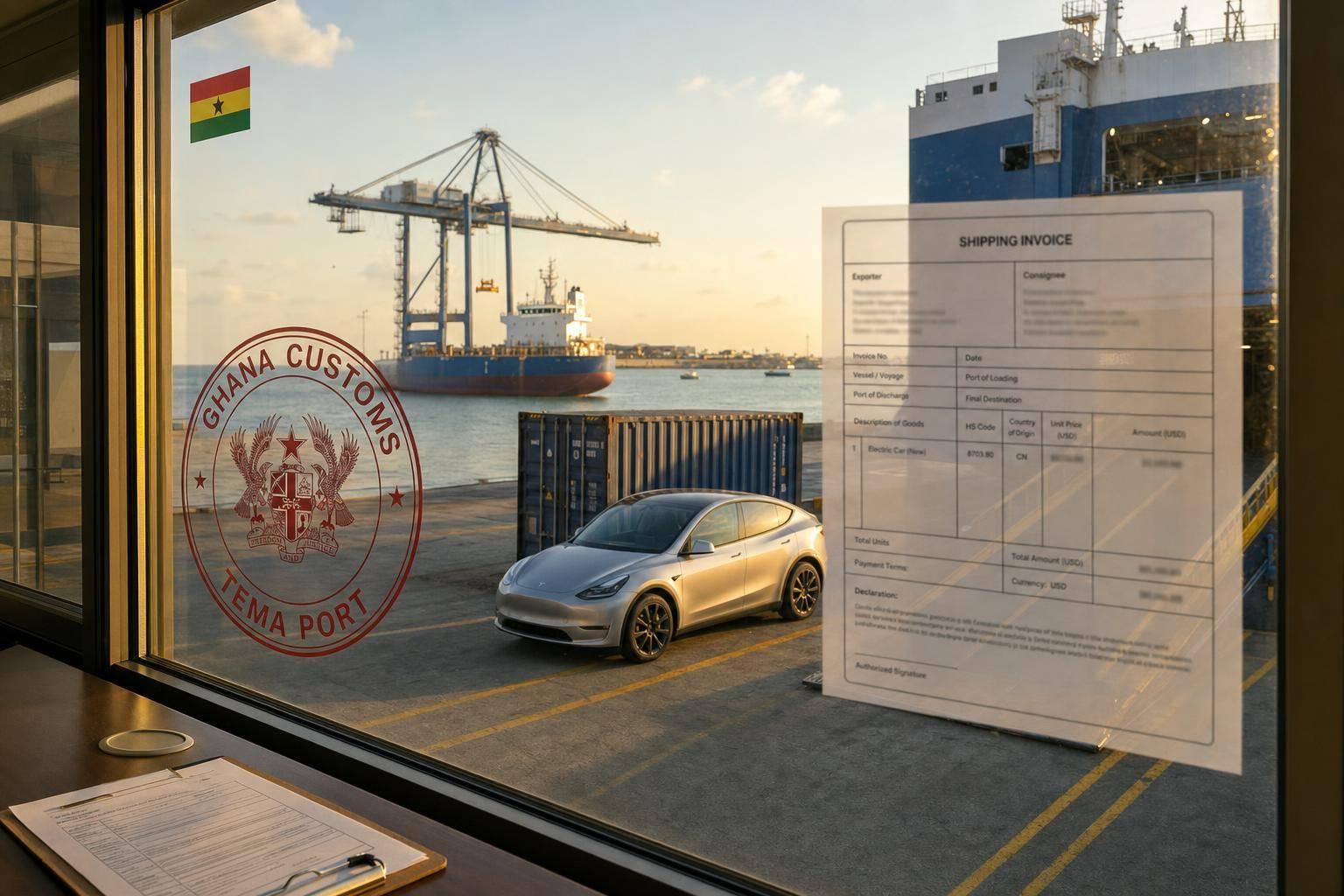
If I import a private EV into Ghana in 2026, I should plan for taxes and fees that can add about 30% to 50% of CIF on top of the car price. That means a used EV priced near $9,500 can end up closer to $17,000+ landed, while a higher-priced EV can pass $60,000 after freight, tax, port, and registration costs.
Here’s the short version:
- Most private EV imports do not get the 8-year duty waiver
- I still need to budget for import duty, VAT, NHIL, GETFund, and other levies
- My key cost base is CIF = cost + insurance + freight
- Used EVs can face overage penalties if they are too old
- I need matching documents, battery records, and the right EV classification
- After customs, I still pay for clearing, inland delivery, DVLA registration, plates, and insurance
A few points can make or break the deal before I buy:
- Check the model year
- Confirm any tax relief in writing
- Get a battery health report
- Match the VIN across all documents
- Estimate the full landed cost, not just the sale price
If I want the simple answer, it’s this: importing an EV to Ghana is possible, but the sticker price is only the start. The article walks through eligibility, shipping, customs, taxes, overage risk, and final DVLA registration so I can price the deal before I send money.
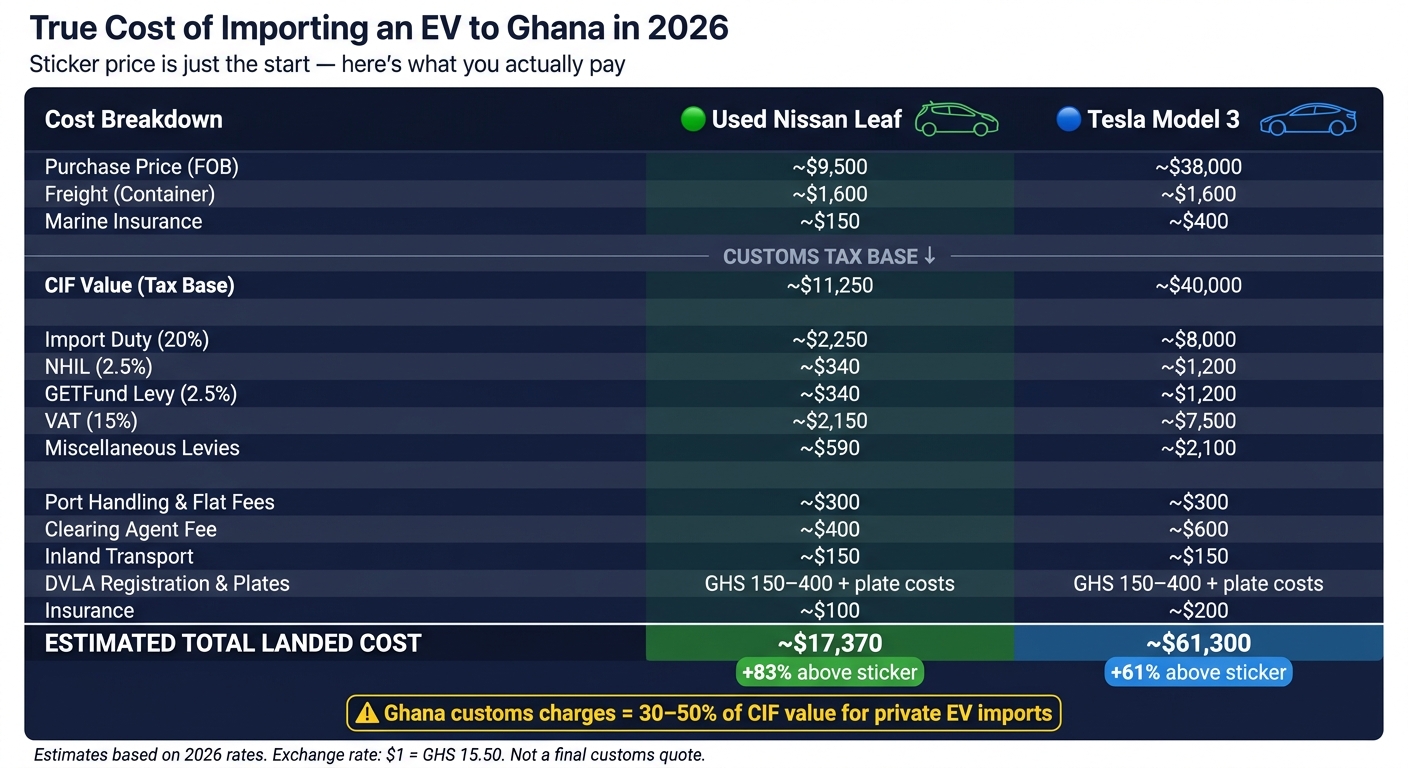
True Cost of Importing an EV to Ghana in 2026: Nissan Leaf vs Tesla Model 3
1. Check EV Import Eligibility Before You Buy
Who can import an EV into Ghana
Private individuals, registered businesses, dealers, and eligible returning residents can legally import an electric vehicle into Ghana. To do that, you’ll need a valid government ID, an active TIN, and a Bill of Lading that lists you as the named importer. Returning residents must also provide proof of residence abroad and their re-entry dates. Businesses and dealers often need an active Customs Client Code to file declarations.
There’s another rule that matters before the car even leaves the port of origin. Under Ghana Standard GS 4510:2022, no person or entity may import a used motor vehicle without first registering with the Ghana Standards Authority (GSA) and submitting the required pre-shipment due diligence report and supporting documents before shipment.
Once you know who is importing, the next step is to check whether the EV itself can get any duty relief before you send payment.
Which electric cars may qualify for EV incentives
This part affects your landed cost right away. If a vehicle qualifies for relief, your tax bill may change. If it doesn’t, you’ll likely pay the full set of charges.
Ghana’s current EV incentive framework is aimed mainly at public transport fleets and registered EV assembly companies. For most private EV imports, it’s safer to budget for standard import duty, VAT, and levies unless you have written relief from the GRA or the Ministry of Trade.
It also helps to pin down the customs classification before you buy. BEVs and hybrids are not taxed the same way, so confirm the HS code early. A small mistake here can throw off your cost estimate.
If the car won’t get any relief, age and condition matter even more. They can affect duty, customs valuation, and what the vehicle may be worth later if you decide to sell it.
Used vehicle age, condition, and standards checks
With used EVs, the sticker price is only part of the story. Age, battery condition, and vehicle history can all shape what you end up paying and whether clearance goes smoothly.
Ghana’s used vehicle import rules include age-based penalties, and those rules apply to used EVs too, not just ICE vehicles. That means you should check the model year and first registration date against Ghana’s current age thresholds before you commit.
Before buying, review the basics carefully:
- Run a full VIN history check to confirm ownership records, title status, accident history, and odometer readings.
- Get a battery State of Health (SoH) report. Lower battery capacity can limit day-to-day use in Ghana and may also affect customs valuation.
- Confirm the vehicle is right-hand drive and that the charging port and connector fit local charging options.
- Keep battery diagnostics and service records, since they can help during valuation and inspection.
Once those checks are done, you’re in a much better spot to gather the paperwork and arrange shipment.
sbb-itb-99e19e3
2. Prepare Your Documents and Ship the Car to Ghana
Documents required to import an electric car
Get the paperwork right before the car ships. That one step can save you from delays, amendment fees, and extra port charges.
Customs uses the commercial invoice to set the vehicle’s value, so the price, currency, buyer, and seller details need to line up across every document.
Your main document pack should include:
- Commercial invoice or bill of sale
- Bill of lading (this must match the VIN and show the loading port, discharge port, and shipping method)
- Vehicle title or export certificate
- Pre-shipment inspection report from an authorized inspection company
- Import Declaration Form (IDF/Form C86) lodged through ICUMS
- Ghana Card/importer ID and TIN
- Proof of marine insurance
If you’re importing an EV, keep a technical specification sheet on hand too. It should show battery capacity in kWh, charging standard, connector type, and motor power output. Battery warranty records and a manufacturer certificate of conformity can also help if standards checks come up.
Here’s where people get tripped up: if the consignee name, TIN holder, and bill of lading don’t match, clearance can stall fast. You may also get hit with amendment fees. Once the documents line up, you can move on to the shipping method that makes sense for the car’s price and risk level.
RoRo vs. container shipping: which to choose
RoRo is usually the lower-cost option because you don’t pay for container hire or stuffing. But there’s a catch. The car sits on open decks, so it faces more exposure to weather and handling, and there’s less individual security.
Container shipping costs more, but it gives the vehicle full enclosure. For example, a shared container from the U.S. East Coast to Ghana runs about $1,600.
| Feature | RoRo | Container |
|---|---|---|
| Cost | Lower | Higher (~$1,600 shared, U.S. to Ghana) |
| Protection | Exposed to elements and handling | Fully enclosed and secured |
| Best suited for | Budget or used EVs | Premium, new, or high-value EVs |
Marine cargo insurance is required. Customs includes it in the CIF (Cost, Insurance, and Freight) value used to calculate duties and taxes. That means the insurance amount is not just a side detail. It affects the customs base value.
Insure the car for the full CIF value. If you underinsure it, any transit loss can land on you.
So the shipping choice isn’t just about price. It also shapes insurance cost, transit exposure, and how soon the car is ready for clearance.
How to source and buy an EV for import to Ghana
Once you’ve confirmed the car is eligible, buy only from a seller who can provide a clean title and export documents. That’s non-negotiable.
International vehicle deals can go sideways in simple ways: fake listings, title issues, and inspection reports that don’t match the car. Before sending money, confirm that the seller can provide:
- A clear title
- An export certificate
- A third-party inspection report
For payment, staged transfers usually give you more protection than wiring the full amount upfront to someone you don’t know. A common setup is a deposit first, then the balance after the shipping documents are issued.
When you review a listing, check the VIN, confirm the title is clear, and make sure the export certificate and pre-shipment inspection report are in order. The inspection report should match the vehicle’s model year and odometer reading. If the paperwork is off, customs may revalue the car or apply overage penalties at the port.
Book the shipment only after the documents are checked and your clearing agent has the ETA for Tema.
3. Clear Customs in Ghana and Know Every Tax and Duty You Will Pay
How customs clearance works at Tema or Takoradi
When your vehicle lands at Tema or Takoradi, the shipping line files the vessel manifest first. After that, your clearing agent submits an electronic customs declaration through ICUMS using the right HS code for battery-electric vehicles. That part matters more than many buyers expect. If the vehicle is coded the wrong way, customs can apply the wrong duty treatment, and your bill can jump fast.
Next comes valuation. Customs uses your CIF value – Cost, Insurance, and Freight – as the starting point for almost every charge that follows. Officers compare your commercial invoice with reference values for similar EVs. If the invoice looks too low, customs may push back and ask for a battery report or an independent valuation.
Then comes physical inspection, and this is where EV-specific checks tend to show up. Officers may ask for your manufacturer specification sheet, battery capacity in kWh, motor output, and proof that the vehicle has no internal combustion engine. If those technical papers are missing or vague, the car can end up classified as a hybrid or a standard gasoline vehicle. And that can mean standard duty rates instead of EV treatment.
With the right documents in hand, clearance often takes a few days. Once customs confirms the classification, the biggest issue usually becomes the tax bill.
Import duty, VAT, levies, and port charges explained
Once clearance begins, the main cost pressure comes from the tax stack. The 2024 waiver mostly applies to public-transport EVs and SKD/CKD assembly kits, not private passenger EVs. So even when import duty is waived, private EV imports can still face VAT, NHIL, GETFund, and other levies.
| Charge | Rate | Applied On |
|---|---|---|
| Import duty | 5–20% (may be waived for qualifying EVs) | CIF value |
| VAT | 15% | CIF + duty + NHIL + GETFund |
| NHIL | 2.5% | CIF + duty |
| GETFund Levy | 2.5% | CIF + duty |
| ECOWAS Levy | 0.5% | CIF |
| AU Levy | 0.2% | CIF |
| EXIM Levy | ~0.75–1% | CIF |
| Special Import Levy | ~2% | CIF |
| Exam/processing fee | ~1% or flat fee | CIF |
These are the charges importers should budget for in 2026. The exact duty treatment still depends on the HS code, the vehicle’s age, and whether the car is meant for private use or public transport. In practice, total government charges on a private EV import can still land at about 30–50% of CIF.
Overage penalties and EV-specific compliance issues
Used EV buyers face two cost risks that new-car buyers usually don’t: overage penalties and battery-condition disputes.
On age, Ghana uses a penalty system for older imports. Vehicles up to 10 years old avoid extra charges, but penalties climb once a vehicle goes past that mark. For 2026, current guidance points to a 2016 model year or newer if you want to avoid overage treatment. A 2012 Nissan Leaf may look cheap at purchase, but once overage penalties and standard charges are added, the numbers can change in a hurry.
Battery condition is the other pressure point. If you declare a low purchase price for an older EV, customs may ask for a battery health report or an independent valuation to back it up. Officers may also want photos of the engine bay showing there is no internal combustion engine. They can also ask about seating capacity and whether the vehicle is set up for public transport, since both points affect incentive eligibility. Battery damage, flood exposure, or fire history can lead to extra inspection or even rejection.
A smart move is to build your full document pack before the vessel arrives. That pack should include:
- the manufacturer spec sheet
- a recent battery diagnostic report
- repair history
- clear photos of the vehicle and battery parts
Send all of it to your clearing agent early. An agent who knows EV clearance at Tema or Takoradi can help head off classification disputes and keep things moving. Next, add DVLA registration and plate fees to the landed cost.
4. Calculate Your Total Landed Cost and Register the EV in Ghana
How to calculate landed cost step by step
Landed cost is the full amount you pay from purchase through legal road use in Ghana. And yes, it will be higher than the sticker price.
The simplest way to think about it is this: the vehicle price is just the starting point. Once freight, customs, port charges, inland delivery, registration, plates, and insurance are added, the total moves up fast.
Use this formula to turn separate charges into one landed-cost figure:
- Purchase price (FOB) – what you pay the seller
- Freight, insurance, and CIF – the customs tax base
- Ghana customs charges – import duty, VAT, NHIL, GETFund, and smaller levies applied to CIF
- Port and clearing fees – handling, examination fee, agent service charge, flat processing fees, and any storage or demurrage
- Inland transport – moving the car from the port to your location
- DVLA registration, plates, and insurance – the last step before road use
For private imports, government charges often total about 30%–50% of CIF, before agent, inland, and registration costs.
Side-by-side cost comparison: Nissan Leaf vs. Tesla Model 3
The examples below show how the same tax stack changes the final bill for a lower-cost EV and a higher-cost EV. This example uses a shared-container freight estimate, the passenger-car rate used in this example, and an exchange rate of $1 = GHS 15.50.
| Cost Item | Used Nissan Leaf | Tesla Model 3 |
|---|---|---|
| Purchase price (FOB) | ~$9,500 | ~$38,000 |
| Freight (container) | ~$1,600 | ~$1,600 |
| Marine insurance | ~$150 | ~$400 |
| CIF value | ~$11,250 | ~$40,000 |
| Import duty (20%) | ~$2,250 | ~$8,000 |
| NHIL (2.5%) | ~$340 | ~$1,200 |
| GETFund levy (2.5%) | ~$340 | ~$1,200 |
| VAT (15%) | ~$2,150 | ~$7,500 |
| Miscellaneous levies | ~$590 | ~$2,100 |
| Port handling & flat fees | ~$300 | ~$300 |
| Clearing agent fee | ~$400 | ~$600 |
| Inland transport | ~$150 | ~$150 |
| DVLA registration & plates | GHS 150–400, plus plate costs | GHS 150–400, plus plate costs |
| Insurance | ~$100 | ~$200 |
| Estimated total landed cost | ~$17,370 | ~$61,300 |
This table is an estimate, not a final quote. The big takeaway is simple: higher CIF leads to a much larger tax bill in dollar terms. After customs, what remains is registration and road-use setup.
DVLA registration, plates, and post-clearance costs

The car is not ready for legal road use until DVLA finishes registration and issues plates. The usual sequence is straightforward: roadworthiness inspection, then DVLA registration, then number plate issuance. Bring your customs release, ID, and insurance certificate.
DVLA base registration fees for private vehicles run from GHS 150 to GHS 400, depending on the vehicle class DVLA applies. Personalized plates cost an extra GHS 500. It’s smart to confirm in advance how DVLA will classify your vehicle, especially if it falls into a gray area.
These fees are small compared with customs charges. Even so, you still need to budget for them before shipment. Otherwise, your “final” number won’t be final at all.
Conclusion: Key Costs and Checks to Confirm Before You Import
Importing an EV into Ghana is doable, but the landed cost is often far higher than the sticker price.
Now that the cost structure is clear, use this final checklist before you commit. Before you buy, confirm these five things:
- Model year
- Written duty relief
- Battery health
- Document matching
- Full landed cost
Even with relief, taxes and fees can stack up fast. And the more expensive the EV, the more the total cost climbs.
If the full math still works, move ahead. If it doesn’t, stop before you buy.
FAQs
Can I import an EV to Ghana without a dealer?
Yes. You can import an electric vehicle into Ghana without a dealer, but you’ll need to handle the entire shipping, customs, and registration process on your own.
That means taking care of documents like the purchase invoice, Bill of Lading, and Certificate of Origin. You’ll also need to meet local rules, including the 10-year age limit. And if you want to clear the vehicle yourself, you must register as a clearing agent.
How do I know if my EV qualifies for tax relief?
Check whether your EV import fits Ghana’s current incentives for public transport or local assembly.
Right now, Ghana offers an eight-year import duty exemption for:
- EVs used for public transportation
- EV kits brought in by registered assembly companies
Before you move ahead, confirm that your shipment qualifies. The safest move is to check with customs officials or talk to an experienced import specialist who knows the process.
You should also be ready to show supporting documents, such as a tax clearance certificate or any other proof required to claim the incentive.
What is the biggest hidden cost when importing a used EV?
The biggest hidden cost usually comes from the combined hit of shipping, logistics, and port fees before the vehicle even gets to customs.
The purchase price is just the starting point. You also need to budget for international freight, marine insurance, port handling at the origin port and at Tema Port, plus inland transport. And there’s another wrinkle: unclear tax treatment for private-use and second-hand EVs can lead to surprise admin charges or reassessments.
That’s where costs can creep up fast. On paper, the car may look like a good deal. Once shipping and port-related charges stack up, the total can look very different.