
 Thabo Nkosi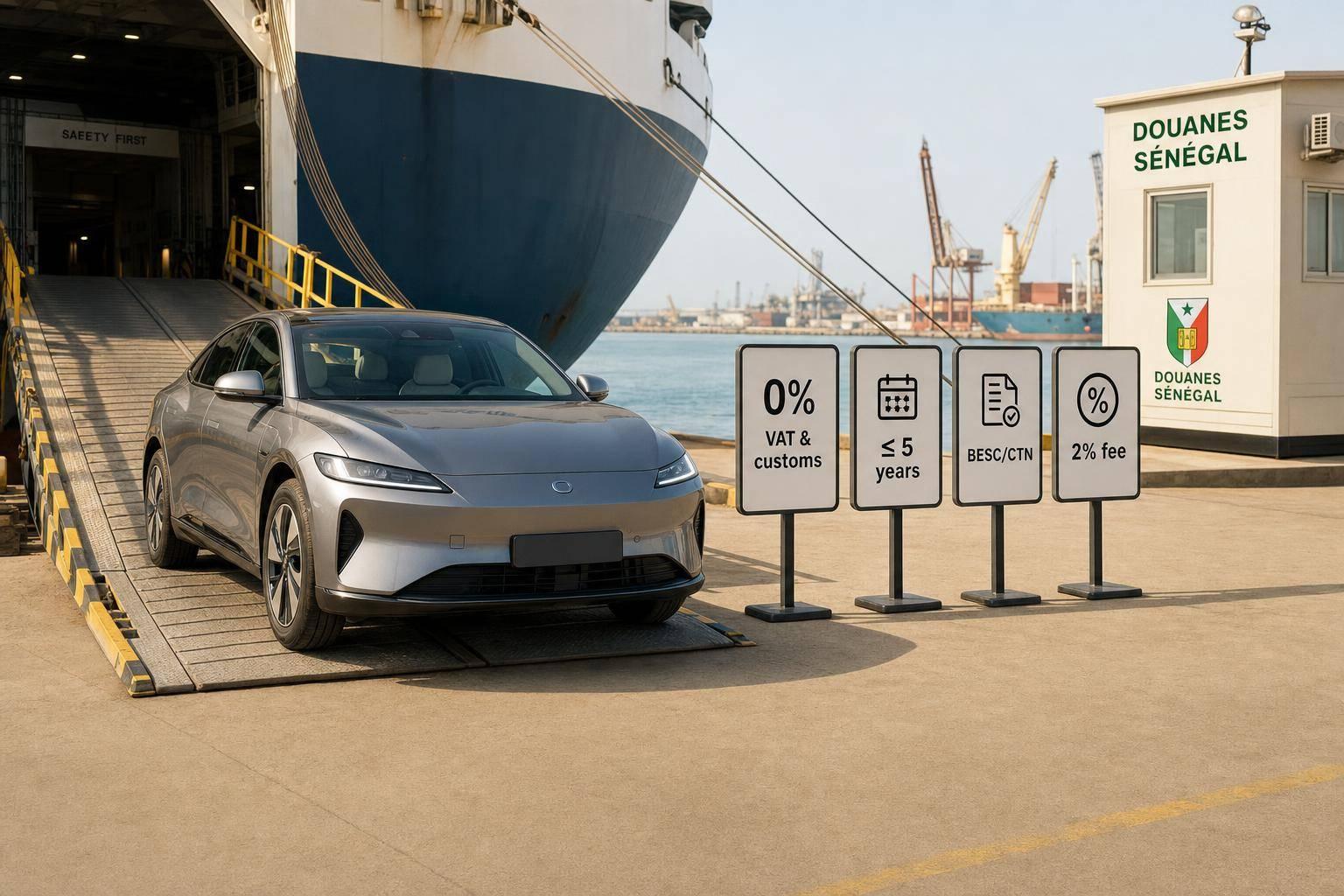
If you import a fully electric car into Senegal in 2026, you can skip both VAT and customs duty. That is the main cost cut. But you still need to clear the 5-year age limit, file the BESC/CTN on time, and pay the 2% customs processing fee, port charges, and registration costs.
Here’s the short version:
- Only 100% EVs qualify – hybrids do not
- Used imports must be 2021 model year or newer in 2026
- VAT: 0% for qualifying EVs
- Customs duty: 0% for qualifying EVs
- Customs processing fee: 2% of CIF
- Port of entry: Dakar
- Usual clearance time: 5–10 business days
- Usual sea transit: 3–4 weeks
- Big risk: VIN, battery, or document mismatches
- Key filing deadline: BESC/CTN must be filed early to avoid penalties
Before I buy, I would check four things first:
- Is the car fully electric?
- Is it within Senegal’s age rule?
- Do all documents match the VIN and EV description?
- Does the landed cost still work after shipping, the 2% fee, port charges, and registration?
A few sample numbers make the math simple. In the article’s examples, a used Nissan Leaf lands at about $17,850, a BYD Dolphin at $28,050, and a Tesla Model 3 at $41,310 before local registration and any storage charges. So yes, the tax break helps – but delays at Dakar can still add costs fast.
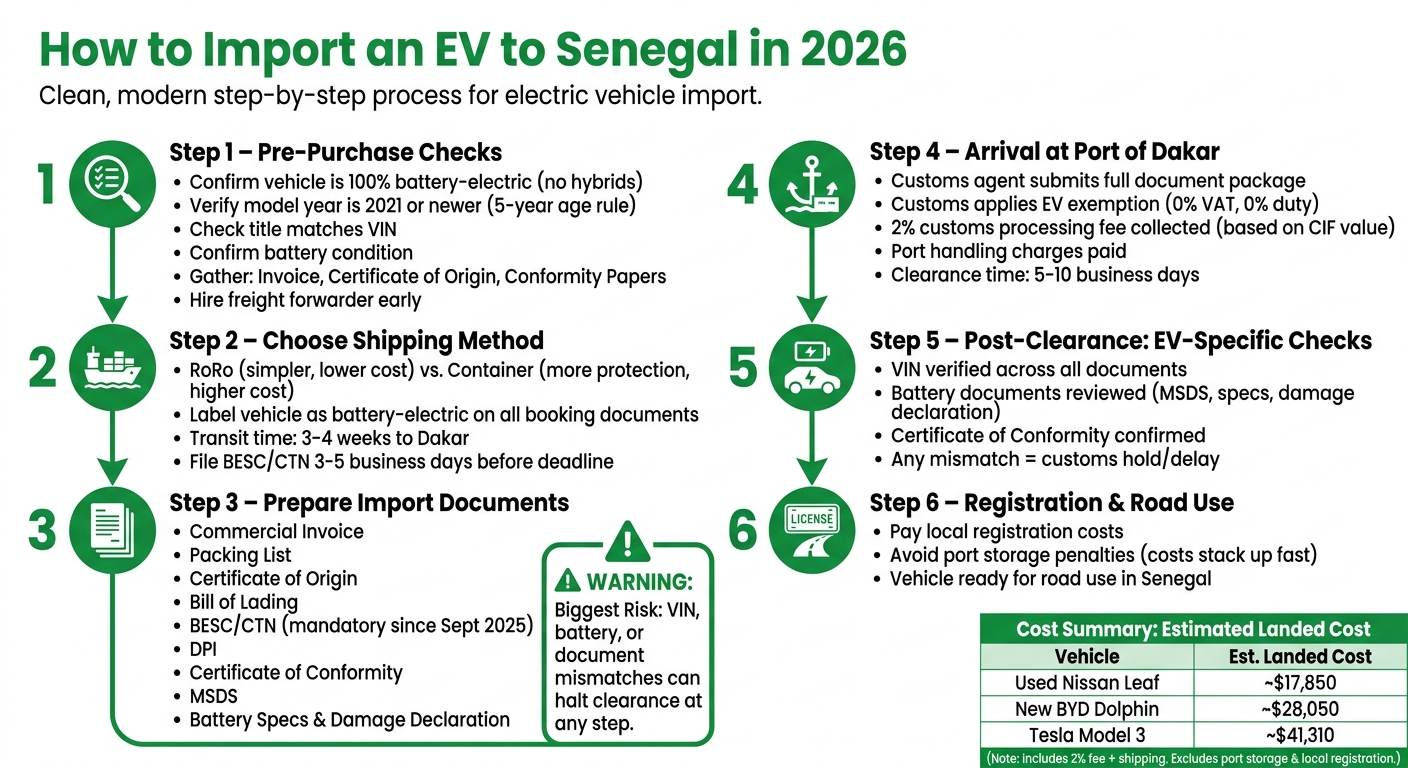
How to Import an Electric Car to Senegal in 2026: Step-by-Step Process
Quick comparison
| Item | Qualifying EV | Non-qualifying vehicle |
|---|---|---|
| Vehicle type | Fully electric only | Hybrid, gas, diesel, or other |
| VAT | 0% | Standard rate may apply |
| Customs duty | 0% | Standard duty may apply |
| Age rule | Must still comply | Must still comply |
| 2% customs processing fee | Yes | Yes |
| Port charges | Yes | Yes |
| BESC/CTN required | Yes | Yes |
In plain terms, importing an EV into Senegal in 2026 can cost much less than importing a standard car, but only if the car qualifies and the paperwork is clean from the start.
sbb-itb-99e19e3
1. Senegal’s 2026 EV import rules and who qualifies
Only 100% battery-electric vehicles qualify for Senegal’s 2026 import exemption. If a vehicle doesn’t meet that rule, it pays Senegal’s standard import taxes.
Vehicle age limits, eligibility, and refusal risks at the port
Senegal applies a 5-year maximum age limit to imported used vehicles. So for a car imported in 2026, the vehicle must be 2021 model year or newer. The EV tax break does not cancel out that age rule.
That point matters. A car can qualify as a fully electric vehicle and still be turned away at Dakar customs if it’s too old.
Before you buy, check the manufacture date and make sure the vehicle details line up with the export paperwork. If the car clears the age rule, the next hurdle is document accuracy before shipment.
Tax exemptions for fully electric cars and charges that still apply
For qualifying fully electric vehicles, Senegal removed VAT and customs duties in July 2025. But that doesn’t mean the import is free. Two cost buckets still remain:
| Fee Type | Rate for Qualifying EVs |
|---|---|
| Import Duty | 0% (exempt) |
| VAT | 0% (exempt) |
| 2% customs processing fee | 2% of CIF value |
| Port fees | Vary by shipping method and handling |
The 2% customs processing fee is based on the CIF value, which includes the vehicle price plus shipping to Dakar. You’ll also need room in your budget for port handling fees, which change based on how the vehicle is shipped.
Key import documents: DPI, invoice, bill of lading, and certificate of origin
Senegal customs asks for a core set of documents for every vehicle shipment. These papers decide whether the car clears Dakar without delay.
- The seller or exporter provides the Commercial Invoice, Packing List, and Certificate of Origin.
- The shipping carrier issues the Bill of Lading.
- The importer or freight forwarder files the BESC/CTN and DPI.
The BESC/CTN has been mandatory for all shipments since September 2025 and must be filed 3–5 business days before the validation deadline to avoid penalties. The DPI is required for customs clearance. It also needs to match the commercial invoice. If those details don’t match, Dakar customs can delay release.
With eligibility and paperwork sorted, the next move is checking the car before purchase and planning shipment to Dakar.
2. Step-by-step process: From choosing an EV to clearing Dakar customs
Pre-purchase checks: eligibility, title, and cargo tracking
Before you send payment, check the basics first. Make sure the EV fits Senegal’s age rule, the title matches the VIN, the battery is in good shape, and the sale includes the invoice, certificate of origin, and conformity papers. The vehicle details should line up across every document. If one paper says one thing and another says something else, customs can slow the whole shipment down.
It also helps to get your freight forwarder lined up early. They should file the BESC/CTN before the vehicle ships.
Shipping to Dakar: RoRo vs. container, transit planning, and EV labeling
Once the documents are in order, you’ll choose between RoRo and container shipping. RoRo is usually the simpler route because the car is driven onto the vessel and secured for the trip. Container shipping gives the vehicle more protection, but it often comes with a higher price tag.
One detail matters more than many buyers expect: the shipper should mark the vehicle as a battery-electric vehicle on the booking and shipping documents. That small step can save headaches later. Transit to Dakar usually takes 3–4 weeks.
Before the car is picked up, have your forwarder double-check the booking details and shipping paperwork. After the shipment is booked, the next stage is customs release in Dakar.
Arrival and customs clearance in Senegal
When the vessel reaches the Port of Dakar, your customs agent should file these documents:
- Bill of Lading
- Commercial Invoice
- Packing List
- Certificate of Origin
- BESC/CTN
At the Port of Dakar, customs reviews the file, applies the EV exemption, collects the 2% customs processing fee, and releases the car after port charges are paid. If the paperwork is complete, clearance in Dakar usually takes 5–10 business days.
After release, the vehicle still needs to be registered for road use in Senegal. In many cases, battery papers and conformity documents are what keep the process moving – or bring it to a halt.
3. EV-specific paperwork, battery documents, and compliance checks
Once the vehicle arrives, EV clearance hinges on technical paperwork that shows the car is safe, easy to identify, and fully electric. In Dakar, that means customs looks closely at battery records and exact vehicle identification, not just the standard import file.
Battery documents: MSDS, battery specifications, and damage declarations
Lithium-ion batteries need a Dangerous Goods declaration, an MSDS, battery specifications, and any disclosure of damage. If those battery papers are missing, incomplete, or don’t line up, clearance can stop at the port.
For used EVs, battery condition is checked shipment by shipment. So the paperwork has to match the battery’s actual condition at the time it was shipped. If the documents say one thing and the battery shows another, that can slow everything down fast.
VIN visibility, EV identification, and certificate of conformity
For EV clearance, customs checks that the invoice, packing list, bill of lading, and certificate of origin all describe the car as a fully electric vehicle and match the VIN. The VIN needs to be visible and identical across every document.
The certificate of conformity should also match the vehicle exactly as imported. And the validated CTN/BESC still needs to be in place.
Document mismatch risks that delay customs release
In Dakar, the biggest delays usually come from VIN mismatches, battery-detail issues, or document descriptions that don’t match. Even a small inconsistency can lead to a customs hold.
There’s also a cost angle here. Clean EV paperwork helps customs move through fee calculation faster, which affects the total landed cost. So these checks shape both the release timeline and how soon the final landed cost can be worked out.
4. How to calculate total landed cost for an EV in Senegal
Once customs release is sorted out, the next step is to map out the full landed cost. This is the number that tells you what the car will actually cost by the time it’s ready to move in Senegal. It includes CIF, port fees, customs processing, and registration.
Cost breakdown: vehicle price, CIF value, port fees, and registration
Senegal calculates import fees using the CIF method – Cost, Insurance, and Freight. In plain English, customs looks at the vehicle’s purchase price, then adds shipping and marine insurance to set the import value.
A 2% customs processing fee applies to the full CIF value. You should also set aside money for port handling, BESC/CTN filing, and registration.
Cost examples for a Nissan Leaf, BYD Dolphin, and Tesla Model 3
The table below shows estimated landed cost for three common EV imports to Dakar in 2026.
| Vehicle | Est. Purchase Price | Shipping & Insurance | 2% customs processing fee | VAT and duty | Est. Total Landed Cost |
|---|---|---|---|---|---|
| Used Nissan Leaf | $15,000 | $2,500 | $350 | $0 | $17,850 |
| New BYD Dolphin | $25,000 | $2,500 | $550 | $0 | $28,050 |
| Tesla Model 3 | $38,000 | $2,500 | $810 | $0 | $41,310 |
Assumption: $2,500 shipping and insurance per vehicle.
These estimates do not include port storage penalties or local registration costs.
That part matters. A deal can look good on paper, then get more expensive once storage or local admin costs start stacking up. So before you book shipping or submit documents, use these figures as your working budget.
When importing makes financial sense and when local costs cancel out the tax benefit
For a used Nissan Leaf priced at $15,000, the lower total landed cost can make importing a good move if the paperwork is clean and the vehicle clearly qualifies as fully electric.
The catch? Delays. If clearance drags on, storage charges start piling up. And that can eat into the tax edge pretty fast. The safer play is simple: clean documents, fast clearance, and no loose ends.
Conclusion: A checklist before you import an EV to Senegal
You’ve checked eligibility, documents, and costs. Now do one last pass before you send any money. First, confirm the vehicle is fully electric and qualifies for Senegal’s EV exemption. That step matters most at the start, not after payment is gone.
Before the car ships, get every document lined up:
- Commercial Invoice
- Packing List
- Certificate of Origin
- Bill of Lading
- DPI
- Certificate of Conformity
- MSDS
- Battery specs
- Battery damage declaration
Check the VIN closely. It needs to be visible and it needs to match every single document. A small mismatch can turn into a big headache at the port.
You’ll also need to file the BESC/CTN 3–5 business days before the filing deadline. Miss that window, and you could face penalties and port delays. Even with the EV exemption, a 2% customs processing fee still applies, along with port handling charges that can change case by case. For timing, plan on 5–10 business days for clearance in Dakar.
If the car qualifies, the paperwork lines up, and the landed cost still makes sense, move ahead. Clean documents, early CTN filing, and a grounded budget give the import a much smoother path.
FAQs
How do I prove a car is fully electric?
To prove a car is fully electric for import into Senegal, the paperwork and the vehicle itself need to line up with local rules.
Your commercial invoice must clearly state that the vehicle is electric. It also needs to list the make, model, year, and VIN.
The car must also carry a front windshield label showing that it is fully electric. On top of that, you’ll need a technical datasheet that confirms the vehicle’s specifications for customs clearance and technical inspection.
What happens if my EV misses the age limit?
If your electric vehicle is older than Senegal allows, it can’t be imported. Customs enforces these age rules strictly to support safety and emissions standards.
Check the vehicle’s manufacturing year before you buy it or arrange shipping. If it doesn’t meet the age rule, the import process can’t go any further.
How much should I budget beyond the car price?
Budget for import taxes and fees, shipping, insurance, port and customs charges, and registration.
For a concrete example from EV24.africa Senegal, a $25,000 car can end up at about $42,952 by the time it’s on the ground and registered.
That total includes customs duty of up to about 30%, 18% VAT on the CIF value, shipping and other fees, marine insurance of about 1%–2%, a Cargo Tracking Note of about $175, and registration costs of $1,500–$2,500 plus CIF-based taxes.