
 Thabo Nkosi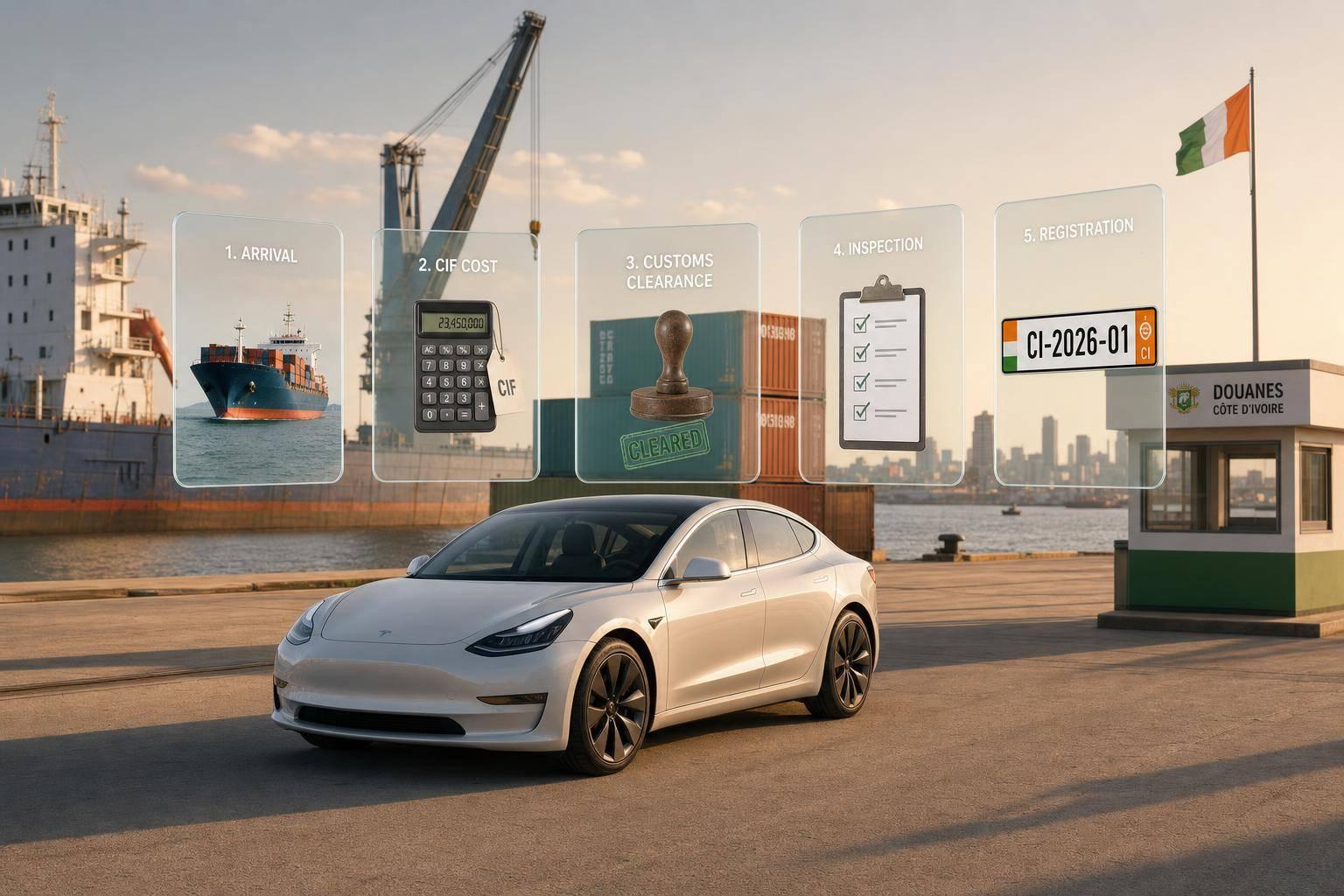
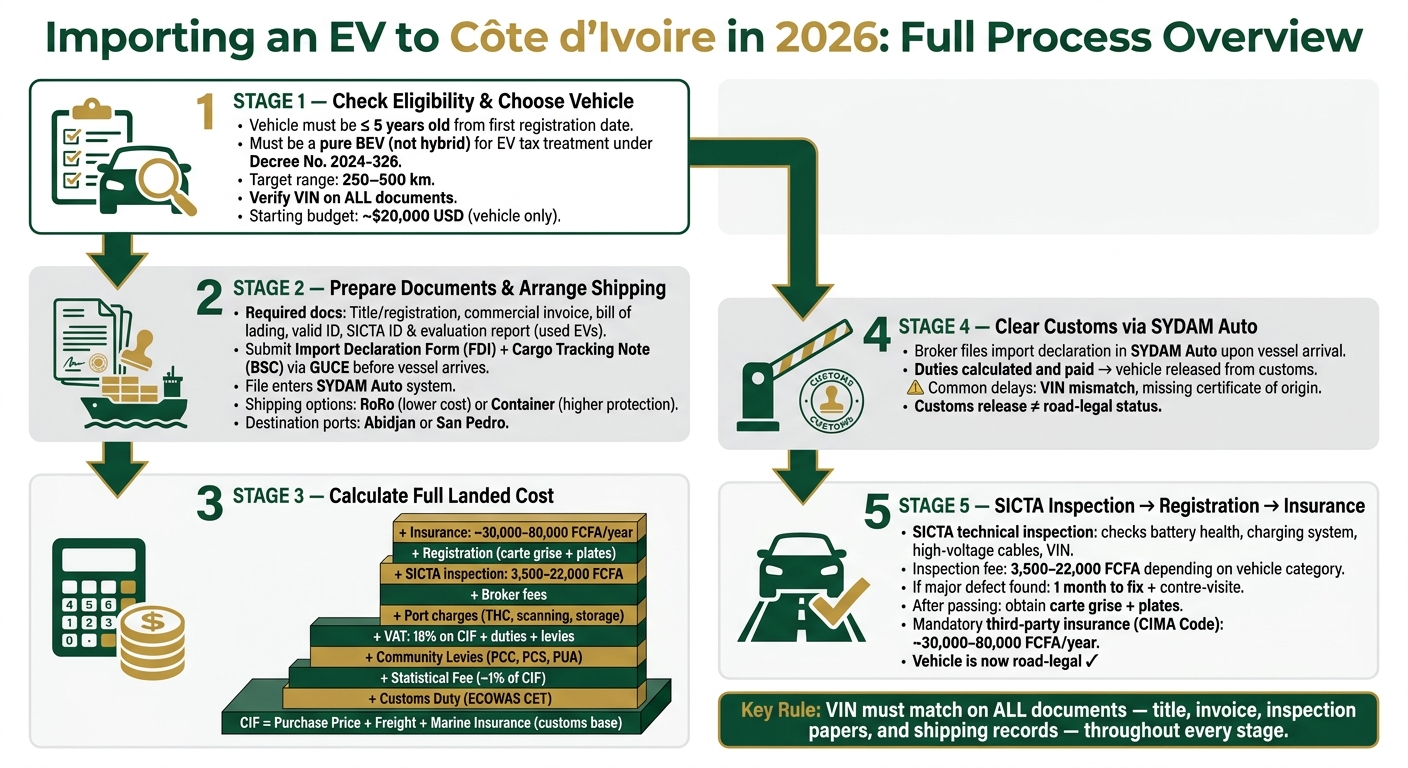
If I were importing an EV into Côte d’Ivoire in 2026, I’d plan for more than the car price. I’d check the 5-year used-car limit, confirm the car is a pure battery EV if I want EV tax treatment, build my budget from CIF first, and get every document lined up before the ship leaves.
Here’s the short version:
- I can import a used EV only if it is no more than 5 years old from its first registration date.
- My landed cost is not just the sticker price. It includes purchase price, freight, insurance, customs charges, port fees, inspection, registration, and local insurance.
- Customs runs through GUCE and SYDAM Auto.
- After customs release, the car still needs a mandatory SICTA inspection before I can get the carte grise and plates.
- VAT is 18%, and it applies to CIF plus duties and levies, not just the car price.
- Technical inspection fees run from 3,500 to 22,000 FCFA.
- Minimum third-party insurance is about 30,000 to 80,000 FCFA per year.
A few points can make or break the process:
- VIN mismatches can stop clearance or registration.
- Missing origin or shipping papers can add port storage costs.
- For used EVs, SICTA valuation and re-inspection can add more cost.
- A practical EV for local use is usually one with about 250 to 500 km of range and charging hardware that works with public stations in Côte d’Ivoire.
If I had to sum up the whole process in one line, it would be this: pick the right EV, calculate the full landed cost early, file customs papers before arrival, pass inspection, then finish registration and insurance.
This article walks through that path in plain terms so you can budget better and avoid the most common delays.
How to Import an Electric Car to Côte d’Ivoire in 2026: Step-by-Step Process
I Shipped a Geely EX5 from China to ivory coast 🇨🇮 – Was It Worth It?

sbb-itb-99e19e3
1. Check EV Import Eligibility and Choose the Right Vehicle
Before you send money to a seller overseas, make sure the EV can actually be imported and registered in Côte d’Ivoire. That one step can save you a lot of hassle later.
Confirm the vehicle meets Ivorian import and registration rules
Imported used vehicles must be no more than five years old from the date of first registration. That detail matters. Check the original registration date on the title, not just the model year or manufacture year.
If you want the incentives under Decree No. 2024-326, make sure the car is classified as a pure BEV. Hybrids may fall under different codes and may not get the same incentives. Get this wrong at customs, and you could end up paying full duties instead of the reduced treatment meant for clean vehicles.
Also, check the VIN on every document the seller sends. That includes the title, invoice, inspection papers, and shipping records. SICTA cross-checks the VIN during the mandatory technical inspection, and even a small mismatch can hold up clearance.
Once you’ve confirmed the car is eligible, the next move is getting the shipping file ready.
Choose specs that work in Côte d’Ivoire
Pick a vehicle that fits local driving conditions, not just the listing photos. Roads outside Abidjan can be rougher, so higher ground clearance is a smart choice. An SUV or a sedan with decent clearance usually makes more sense than a very low car.
For 2026, a driving range of 250 to 500 km is a practical target, especially since fast-charging coverage is still growing. Ask the seller for a battery SOH report, confirm the charging connector works with public stations in Côte d’Ivoire, and review public charging routes in the Neo-Charging app.
| Specification | What to Look For |
|---|---|
| Vehicle age | No more than 5 years from first registration |
| Body style | SUV or high-clearance sedan |
| Battery range | 250–500 km |
| Battery health | Battery State of Health (SOH) report from seller |
| Charging connector | Compatible with public charging stations in Côte d’Ivoire |
| Key inspection points | Battery state, charging system, high-voltage cables |
Find the vehicle and build your starting budget
Start your budget with CIF: vehicle price + ocean freight + cargo insurance. That’s the customs base, so you want that number clear before you commit to the purchase.
A realistic starting point for an imported EV in 2026 is about $20,000 USD for the vehicle alone. That does not include freight, insurance, or the other charges that come after.
So the math is pretty simple: don’t look at the sticker price in isolation. Look at the full landed cost from day one.
Once you’ve picked the vehicle and set the budget, gather the documents and arrange shipping to Abidjan or San Pedro.
2. Prepare Documents and Arrange Shipping to Abidjan or San Pedro
Gather the documents customs and port agents will check
Before you ship, put together the full file. If the documents don’t match, customs and port agents can reject them.
For customs, you’ll need the title or registration certificate, commercial invoice, bill of lading, and a valid ID such as a passport, national ID, or residence permit. If you’re importing a used EV, include the SICTA identification and evaluation report. It’s required to verify the vehicle’s condition and value when it arrives.
Also, check that the VIN and model details match across every document before shipment.
Once the file is complete, the broker can begin the pre-arrival customs filing.
Submit the import file and complete pre-arrival formalities
After the file is ready, a licensed customs broker should submit the Import Declaration Form (FDI) and Cargo Tracking Note (BSC) through GUCE before the vessel arrives. From there, the file moves into SYDAM Auto.
Make sure the invoice states the Incoterm. That tells customs who is responsible for freight and import charges.
Choose a shipping method and price freight accurately
Transit costs usually include freight, insurance, origin handling, and destination handling.
You’ll want to choose the shipping method at this stage because it affects both protection and total freight cost.
| Factor | RoRo | Container |
|---|---|---|
| Cost level | Lower | Higher |
| Protection | Moderate | High (enclosed, sealed) |
| Port handling | Driven on/off the ship | Craned on/off the ship |
| Best for | Standard new or used EVs | High-end or multiple EVs |
Keep the freight quote, insurance certificate, and terminal charges on hand. Those figures go straight into your CIF calculation.
Those freight and handling charges also feed into your landed cost in the next step.
3. Calculate Import Costs: CIF, Customs Duty, VAT, and Port Charges
Once the vehicle is on the water, work out the landed cost before you file with customs.
Main taxes and levies on imported EVs
Start with CIF, which is the customs base: the vehicle price, marine insurance, and freight to Abidjan or San Pedro.
From there, build your budget in this order: customs duty (Droit de Douane) under the ECOWAS Common External Tariff (CET), the statistical fee at about 1% of CIF, then community levies such as PCC, PCS, and PUA where they apply. After that, add VAT at 18% on CIF plus those duties and levies.
That last part matters. VAT isn’t charged on the vehicle price alone. It sits on top of the customs base and the other import charges, which can push the final bill higher than many buyers expect.
Before you lock in the purchase, check the current status of any EV incentives. A small rule change can shift your budget fast.
For used EVs, SICTA may also identify and assess the vehicle’s value for customs purposes.
Other charges that add to your total landed cost
Taxes are only part of the picture. You’ll also need to plan for port charges such as terminal handling (THC), scanning, and storage. These must be paid before the vehicle is released.
Storage is where things can get ugly. If a document is missing or customs takes longer than planned, fees can stack up fast.
Set aside money for:
- Customs broker fees
- SICTA technical inspection fees
- For used EVs, SICTA identification and assessment fees
- Any re-inspection cost
Keep the inspection certificate current. If it expires, you can run into delays with insurance and registration.
Sample landed-cost breakdown for a new EV and a used EV
Used EVs can bring extra inspection risk, so it’s smart to price that in before you buy.
| Cost item | What to include |
|---|---|
| Purchase price | Purchase price abroad |
| Marine insurance | Insurance for transit to Côte d’Ivoire |
| Freight | Shipping to Abidjan or San Pedro |
| CIF value | Customs base |
| Customs duty | ECOWAS CET duty |
| Statistical fee | Usually around 1% of CIF |
| Community levies | PCC, PCS, and PUA where applicable |
| VAT | 18% on CIF plus duties and levies |
| Port charges | THC, scanning, and storage |
| Broker fees | Customs clearing agent fees |
| SICTA inspection | Technical inspection and, for used EVs, identification/evaluation |
| Registration | Plates and carte grise |
For a new EV, the math usually follows the invoice value, freight, and the standard charges added after CIF.
For a used EV, SICTA valuation and a possible contre-visite can push the total higher.
With the landed cost mapped out, the next move is customs filing and vehicle release.
4. Clear Customs and Register the Vehicle in Côte d’Ivoire
How customs clearance works through SYDAM Auto
Once the vessel arrives in Abidjan or San Pedro, your customs broker files the import declaration in SYDAM Auto. Customs then calculates the duties, and the vehicle is released after payment.
That release matters, but it only gets the car out of customs. It does not make the vehicle legal for road use.
The delays that show up most often are pretty simple on paper and painful in practice. A VIN mismatch between the vehicle, invoice, and title is one of the biggest ones. A missing certificate of origin can also hold up release.
Once customs releases the vehicle, the next stop is SICTA inspection.
Pass inspection and submit the registration file
After release, move straight to inspection and registration.
Take the vehicle to SICTA for the technical inspection and, for used EVs, identification. SICTA checks the same VIN and the same documents that were filed with customs. Inspectors also review the battery health, charging system, and high-voltage cables.
Technical inspection fees range from 3,500 to 22,000 FCFA, depending on the vehicle category. If the vehicle fails for a major defect, you have one month to fix it and return for a contre-visite.
Once it passes, you can complete the carte grise and plate process. Before the vehicle goes on the road, you must buy at least third-party liability insurance under the CIMA Code.
Paperwork mistakes that cause costly delays
A few mistakes tend to slow the handoff from customs to registration:
- VIN mismatch: Any difference between the chassis number on the vehicle and the invoice or title can trigger rejection.
- Missing certificate of origin: This can delay customs clearance and registration.
- Major defects: Faulty brakes or a cracked windshield in the driver’s view can cause inspection failure.
- Expired inspection: An out-of-date inspection can delay registration and insurance .
A small paperwork error can snowball fast here. If the VIN, title, invoice, and inspection details all line up from the start, the process is much smoother.
Conclusion: Plan Your Costs Early and Keep Every Step Documented
Plan the full landed cost before you buy. Unexpected fees can pile up fast.
After you set your budget, check the VIN against every document before shipment. Then confirm the current EV tax rules before you commit to the purchase.
Once customs clears the vehicle, complete the inspection and registration file. After customs release, the vehicle goes to SICTA inspection, then to carte grise and insurance before it can be driven legally on the road. If the paperwork stays consistent from start to finish, the path from import to plates is much faster.
FAQs
How long does EV import clearance usually take?
If your electric vehicle’s specs are already in the customs database, clearance usually takes 48 hours to one week. If it’s a new model, the process can take longer.
For imports over $956, it’s smart to use a customs broker or a professional inspection company. They can help keep things smooth and compliant.
Can a returning resident import an EV under different rules?
No. A returning resident imports an EV under the same core Ivorian rules described here. There aren’t any special EV-only rules noted.
You still need to meet the paperwork and customs clearance requirements, follow the five-year age limit for used EVs, and pay the required import and registration taxes.
What if my EV’s charger plug does not match local stations?
Connector fit can be tricky in Côte d’Ivoire because national interoperability rules are still being finalized. That means not every charger will work with every EV, and that can turn a simple stop into a headache.
To cut down on problems, pick a vehicle that supports more than one charging standard, or keep an adapter on hand.
A private home charger can also make life easier, as long as it matches local voltage and power requirements. Before you head out, it helps to double-check station details in apps like Chargemap or PlugShare. They can show connector types and help you confirm whether a station is compatible with your vehicle.