
 Thabo Nkosi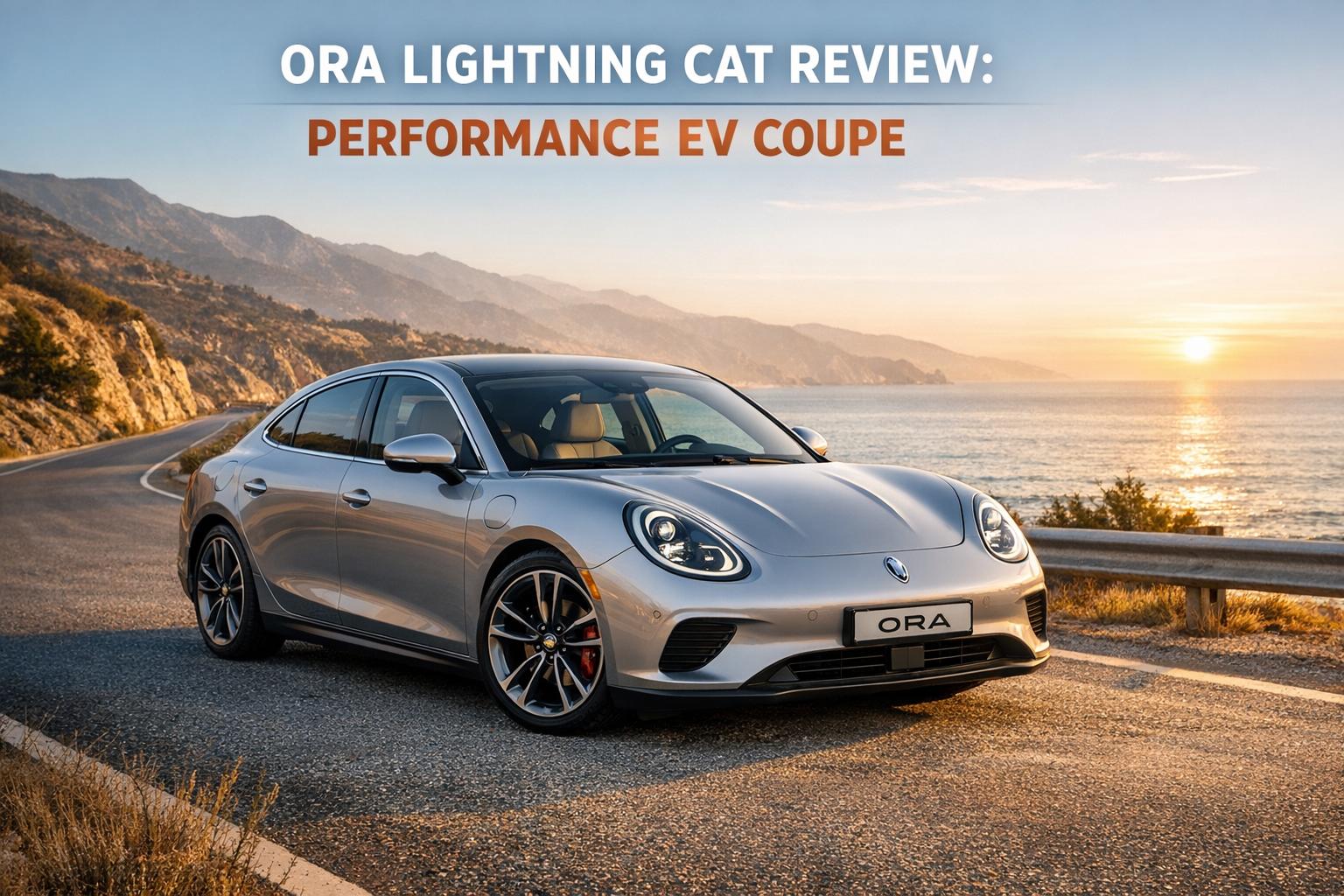
The Ora Lightning Cat is an electric sedan blending retro-inspired design with modern EV performance. Starting at $42,600, it offers two powertrain options: a single-motor front-wheel-drive model (201 hp) and a dual-motor all-wheel-drive version (402 hp). The dual-motor variant accelerates from 0-62 mph in 4.3 seconds, while the 83.5 kWh battery delivers a WLTP-estimated range of 267 miles. Key features include a 12.3-inch touchscreen, 5G-enabled Ora Pilot 3.0 driver assistance system, and Vehicle-to-Load (V2L) functionality for powering external devices.
The car’s suspension is optimized for uneven roads, making it practical for urban and semi-urban areas, especially in regions with potholes or unreliable infrastructure. However, the soft suspension affects cornering stability, and limited charging infrastructure in some areas could pose challenges. With DC fast charging, the battery recharges from 30% to 80% in 30–55 minutes, while home charging takes 8.5 hours at 7.4 kW.
Key Highlights:
- Price: $42,600 (single-motor) to $59,800 (dual-motor AWD)
- Performance: 4.3-second 0-62 mph (dual-motor)
- Range: Up to 267 miles (WLTP) with 83.5 kWh battery
- Charging: DC fast charging (30–55 minutes), V2L capability
- Tech: Level 3 autonomous driving, 12.3-inch touchscreen, Harman Kardon audio
The Ora Lightning Cat is ideal for drivers seeking a stylish, tech-forward EV with strong performance at a more accessible price than European luxury brands.
Design and Aerodynamics
Exterior Design
The Ora Lightning Cat owes its striking exterior to Emanuel Derta, a former Porsche designer. Its profile, reminiscent of the Porsche Panamera, features a sleek, sloping roofline and rounded headlights that fuse retro aesthetics with modern aerodynamic efficiency. Thoughtful design elements like frameless doors and a smooth, covered underbody contribute to an impressive drag coefficient of 0.22 Cd. Higher trims come equipped with 19-inch "cat claw bionic" alloy wheels, which not only enhance the car’s visual appeal but also improve aerodynamics – an advantage in regions where charging stations are scarce. To top it off, an adaptive rear spoiler deploys automatically at higher speeds, further boosting performance.
Interior Design and Comfort
The interior of the Ora Lightning Cat is as refined as its exterior, offering a blend of modern comfort and stylish details. Premium materials are used throughout the cabin, with leather, metallic accents, and soft-touch surfaces on the upper panels, while durable plastics are reserved for lower areas. The floating T-shaped center console simplifies access to essential controls, adding to the car’s sleek and functional design.
Premium trims offer front seats with heating, ventilation, and massage functions, ensuring a luxurious ride. A panoramic glass roof enhances the sense of space, though the sloping roofline may limit headroom for passengers taller than 6 feet. The 113-inch wheelbase provides ample legroom, but the high floor – designed to accommodate the battery pack – can restrict toe space slightly.
"The highlight of the 2023 Ora Lightning Cat is its interior, which overall is comfortable, as distinctive as its exterior and well put together." – Mark Andrews, Carsales.com.au
Is This Porsche-looking Chinese EV A Pleasant Surprise? ORA Lightning Cat Review
Performance and Powertrain
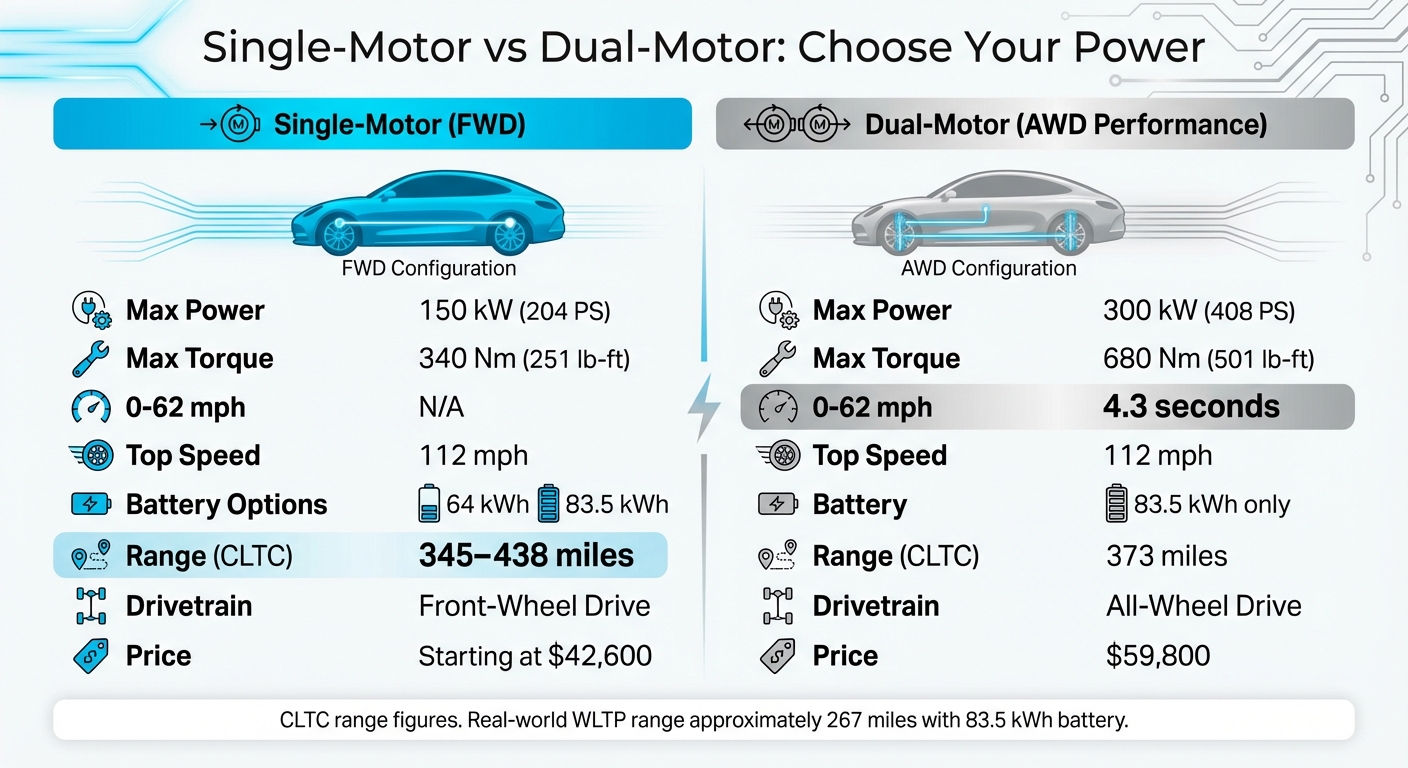
Ora Lightning Cat Single-Motor vs Dual-Motor Specifications Comparison
Single-Motor vs. Dual-Motor Options
The Ora Lightning Cat comes with two powertrain choices, offering flexibility for different driving styles. The single-motor front-wheel-drive model generates 150 kW (204 PS) and 340 Nm (251 lb-ft) of torque, striking a balance between efficiency and performance. If you’re after a more thrilling ride, the dual-motor all-wheel-drive Performance version steps it up with a combined output of 300 kW (408 PS) and 680 Nm (501 lb-ft), thanks to a 150 kW motor on each axle.
The dual-motor version sprints from 0-62 mph in just 4.3 seconds, but this added power comes with a trade-off – its CLTC range of 373 miles is about 65 miles less than the single-motor’s 438 miles. For a detailed comparison of range and other specs, check out the table below. This range of options highlights the Lightning Cat’s ability to cater to both efficiency-focused drivers and those who prioritize performance.
How It Drives
The Lightning Cat delivers the kind of instant torque that EV enthusiasts love, with the dual-motor version maintaining strong acceleration even past 62 mph. That said, the car leans more toward comfort than sharp, precise handling. The suspension is tuned for smoothness, which can result in noticeable body lean during quicker turns – more so than you’d feel in a BMW 5 Series.
"While it does have plenty of performance on tap, the Lightning Cat is more of a comfortable cruiser than sporty saloon." – Dave Humphreys, Car Reviewer
The Performance variant comes with five driving modes: Eco, Standard, Sport, Custom, and Goddess. The Goddess mode softens steering and smooths out acceleration for a more relaxed drive. For a bit of drama, there’s a red button on the steering wheel that activates Supersport mode, complete with synthetic V6 engine sounds. However, not all feedback has been glowing. Some reviewers have pointed out that the Lemon platform struggles to fully handle the high torque. Mark Andrews from Carsales noted, "the result is a car that wallows at the front during anything remotely like hard cornering and the front wheels often scrabble for grip." Additionally, the steering can feel overly assisted, offering limited feedback – something that might leave driving purists wanting more.
Performance Specifications Table
| Specification | Single-Motor (FWD) | Dual-Motor (AWD) |
|---|---|---|
| Max Power | 150 kW (204 PS) | 300 kW (408 PS) |
| Max Torque | 340 Nm (251 lb-ft) | 680 Nm (501 lb-ft) |
| 0-62 mph | N/A | 4.3 seconds |
| Top Speed | 112 mph | 112 mph |
| Battery Size | 64 kWh or 83.5 kWh | 83.5 kWh |
| Range (CLTC) | 345–438 miles | 373 miles |
| Drivetrain | Front-Wheel Drive | All-Wheel Drive |
Battery, Range, and Charging
Battery Size and Driving Range
The Ora Lightning Cat comes with two battery options tailored to suit different driving needs. The standard 64 kWh Lithium-iron Phosphate (LFP) battery offers a CLTC-rated range of 345 miles. For those who need more mileage between charges, the 83.5 kWh Nickel Cobalt Manganese (NCM) battery extends the range to 438 miles (CLTC) for the single-motor version or 373 miles for the dual-motor Performance model.
However, it’s worth noting that CLTC range figures tend to be overly optimistic. Under WLTP testing, the 83.5 kWh battery delivers about 267 miles, and in real-world conditions, that drops closer to 232 miles. If you’re in an area with fewer charging stations, it’s important to plan for a reduced range.
The LFP battery in the base model has some advantages, especially for hotter climates. It’s more durable and better equipped to handle high temperatures and frequent charging cycles compared to NCM batteries. On the other hand, the larger NCM battery provides higher energy density, making it a better option for drivers who often travel long distances between cities.
Charging Times and Efficiency
The Lightning Cat shines when it comes to DC fast charging. With a 50+ kW fast charger, you can recharge the battery from 30% to 80% in about 30 minutes – just enough time for a coffee break. For a full 0-80% charge, you’re looking at roughly 55-60 minutes.
Home charging, however, takes more time. The car is equipped with an 11 kW on-board charger, so even if you install a 22 kW wallbox, the charging speed will max out at 11 kW. Using a standard 7.4 kW home wallbox, a full charge takes about 8.5 hours. Plugging into a basic 2.3 kW wall outlet extends that to around 27 hours.
Energy consumption is rated at 15.5 kWh/100 km under CLTC conditions, which is fairly efficient for an EV with a performance edge. A standout feature is the Vehicle-to-Load (V2L) capability, which lets you power external devices directly from the car – a handy backup during power outages or outdoor activities.
sbb-itb-99e19e3
Technology and Safety Features
Infotainment and Audio Systems
The Lightning Cat comes packed with tech to keep you entertained and connected. It features a 12.3-inch touchscreen alongside a 10.25-inch digital instrument cluster, both powered by a Qualcomm 8155 processor for snappy performance and 5G compatibility. For audiophiles, the car boasts an 11-speaker Harman Kardon system, delivering immersive sound throughout the cabin. Plus, it supports wired Apple CarPlay and Android Auto, making smartphone integration seamless.
One standout feature is the AI-powered cabin monitoring system, which tracks passengers’ pulse rates and temperatures to adjust the climate and seating for optimal comfort. A head-up display further enhances convenience by projecting speed and navigation details directly into the driver’s line of sight.
For a bit of fun, the Lightning Cat offers unique driving modes like "Sport" and "Super Sport", which simulate digital V6 engine sounds during acceleration. Other quirky settings, such as "Warm Man Mode" and "Cave Mode", allow for personalized cabin controls. These infotainment features blend perfectly with the car’s advanced safety and driver assistance systems.
Driver Assistance and Safety Equipment
The Lightning Cat is designed with safety in mind, especially for demanding driving conditions. It comes equipped with the ORA-PILOT 3.0 ADAS system, which uses 28 sensors – including millimeter-wave radars, ultrasonic sensors, and high-definition cameras – to deliver a suite of driver assistance features. Under certain conditions, the car can operate at Level 3 autonomous driving, handling tasks like steering, braking, acceleration, and even parking.
Standard active safety features include:
- Automatic emergency braking with pedestrian and cyclist detection
- Forward and rear collision warnings
- Lane keeping assist
- Blind spot monitoring
- Traffic sign recognition
A 360-degree camera and remote-control parking via Bluetooth smartphone connectivity make parking in tight spaces a breeze.
On the passive safety front, the vehicle is equipped with 8 airbags and a high-strength chassis. During testing, the chassis withstood a 60 km/h flip test with the doors remaining operational and no fire incidents. While the Lightning Cat itself hasn’t been rated by Euro NCAP yet, its smaller sibling, the Ora Good Cat, earned a five-star rating in 2022 and received the "China Top Safety" award.
Adding a practical touch, the car retains physical dials for temperature and fan speed control, offering a user-friendly alternative to fully touchscreen-based systems.
Performance in African Markets
Road Condition Capability
The Ora Lightning Cat’s sleek, low-profile design might look great, but it faces challenges when tackling Africa’s rugged roads. The dual-motor AWD Performance version, with its impressive 300 kW (402–408 hp) output and 680 Nm of torque, does offer solid traction on loose surfaces. However, its chassis struggles to manage all that power effectively. Automotive reviewer Mark Andrews observed that "the car wallows at the front during anything remotely like hard cornering".
The Lightning Cat is built on the "Lemon" platform, also used for petrol SUVs, and features a soft suspension system. While this setup delivers a smooth and comfortable ride on well-paved roads, it doesn’t hold up as well on uneven terrain. Greg Potts from Top Gear pointed out that the suspension feels "harsh on potholes and speed bumps". Coupled with limited ground clearance, these factors make the sedan less suitable for unpaved roads or deeply rutted paths.
For mixed terrain, the dual-motor AWD system steps in to provide improved traction, and the "Goddess mode" feature makes low-speed navigation on rough surfaces more manageable. However, the car’s overall usability on challenging roads also depends heavily on the availability of charging infrastructure.
Charging Infrastructure Considerations
Charging infrastructure is another critical factor for potential EV owners in Africa. Currently, most charging stations are concentrated in major urban areas like Gauteng, Nairobi, and Lagos. This makes the Ora Lightning Cat a more practical choice for city driving. For context, South Africa has around 316 public chargers, and the continent’s EV market is expected to grow at an annual rate of 53.9% through 2031. Since AC slow charging dominates the market at 67.95%, many owners may need to install home wall-box chargers for overnight charging.
The Lightning Cat’s DC fast-charging system takes over 30 minutes to juice up from 30% to 80%, emphasizing the importance of reliable public chargers for long-distance travel. Until fast-charging networks extend beyond urban hubs, drivers will need to carefully plan their routes. On the bright side, the car’s Vehicle-to-Load (V2L) capability, powered by its 82–83.5 kWh battery, can serve as a handy backup during power outages – a common issue in many parts of Africa.
To support EV adoption, platforms like EV24.africa are stepping in, offering buyers access to detailed listings, transparent pricing, and delivery services across 54 African countries.
Strengths and Limitations Table
| Feature | Strength | Limitation |
|---|---|---|
| Performance | Dual-motor AWD provides strong traction on loose surfaces | Soft suspension leads to body lean and handling issues |
| Range | Up to 372 miles (CLTC, AWD version) | Real-world range depends on road conditions |
| Charging | V2L capability offers backup power during outages | DC fast-charging peaks at 64–67 kW; public infrastructure remains limited |
| Cost | Starts at $42,600 with a 5‑year unlimited mileage warranty | Higher upfront cost compared to used ICE vehicles; limited financial incentives |
| Road Capability | AWD provides traction on loose terrain | Low ground clearance and struggles with potholes and speed bumps |
Final Assessment
The Ora Lightning Cat combines a retro-inspired aesthetic with impressive electric performance, though it comes with some compromises. Its Porsche-like styling and upscale interior make an immediate impact, while the dual-motor version delivers 408 hp and 680 Nm of torque, accelerating from 0–62 mph in just 4.3 seconds. That said, as reviewer Dave Humphreys noted, the car leans more toward comfort than precision handling.
Affordability is another key consideration. The pricing is competitive, starting at $42,600 for the single-motor model, while the all-wheel-drive Performance version is priced at $59,800. Although this is higher than the cost of many used gasoline vehicles, the reduced running costs help offset the initial investment. For instance, in Tanzania, driving approximately 62 miles in an electric vehicle costs about $2.50, compared to $13.30 in a petrol car. Practical touches, like physical rotary dials for climate control, also make the car user-friendly in various driving conditions.
The car’s broader appeal will depend heavily on the development of charging infrastructure. In Kenya, for example, the number of public charging stations is expected to grow from 67 in 2023 to over 200 by early 2025. Additionally, the country offers a reduced 10% import duty on fully electric vehicles, making EVs a more attractive option. With a WLTP range of about 430 km (300 miles), the Lightning Cat is well-suited for inter-city travel as more charging corridors become available. Its Vehicle-to-Load (V2L) function further adds to its practicality, especially in areas with unreliable power grids.
FAQs
What sets the single-motor and dual-motor versions of the Ora Lightning Cat apart?
The Ora Lightning Cat comes in two powertrain options. The single-motor model is equipped with front-wheel drive and delivers about 201 horsepower (150 kW). On the other hand, the dual-motor version steps it up with all-wheel drive, boasting a combined output of roughly 402 horsepower (300 kW). This added power not only doubles the performance but also provides better traction, making it a great choice for drivers who prioritize enhanced handling and performance across different road conditions.
How well does the Ora Lightning Cat handle areas with limited charging options?
The Ora Lightning Cat is built with practicality in mind, especially for areas where charging options might be harder to find. Its 83.5 kWh battery delivers a range of up to 398 miles (based on NEDC estimates), giving drivers the freedom to travel longer distances without constantly searching for a charging station.
On top of that, the car’s fast-charging capability allows you to go from 0% to 80% charge in just about 55 minutes, making it easier to get back on the road quickly during extended trips.
With these features, the Ora Lightning Cat offers peace of mind and convenience, even in places where charging infrastructure is still catching up.
What design features enhance the Ora Lightning Cat’s aerodynamics and driving performance?
The Ora Lightning Cat stands out with an aerodynamic design that’s both functional and stylish. Its sloping roofline and coupe-inspired silhouette create a sleek profile, while details like pop-out door handles and frameless doors add modern flair. An active rear spoiler automatically adjusts at higher speeds, improving stability and reducing drag. Topping it off, the 19-inch alloy wheels not only boost performance but also lend an extra layer of elegance to the car’s appearance.