
 Thabo Nkosi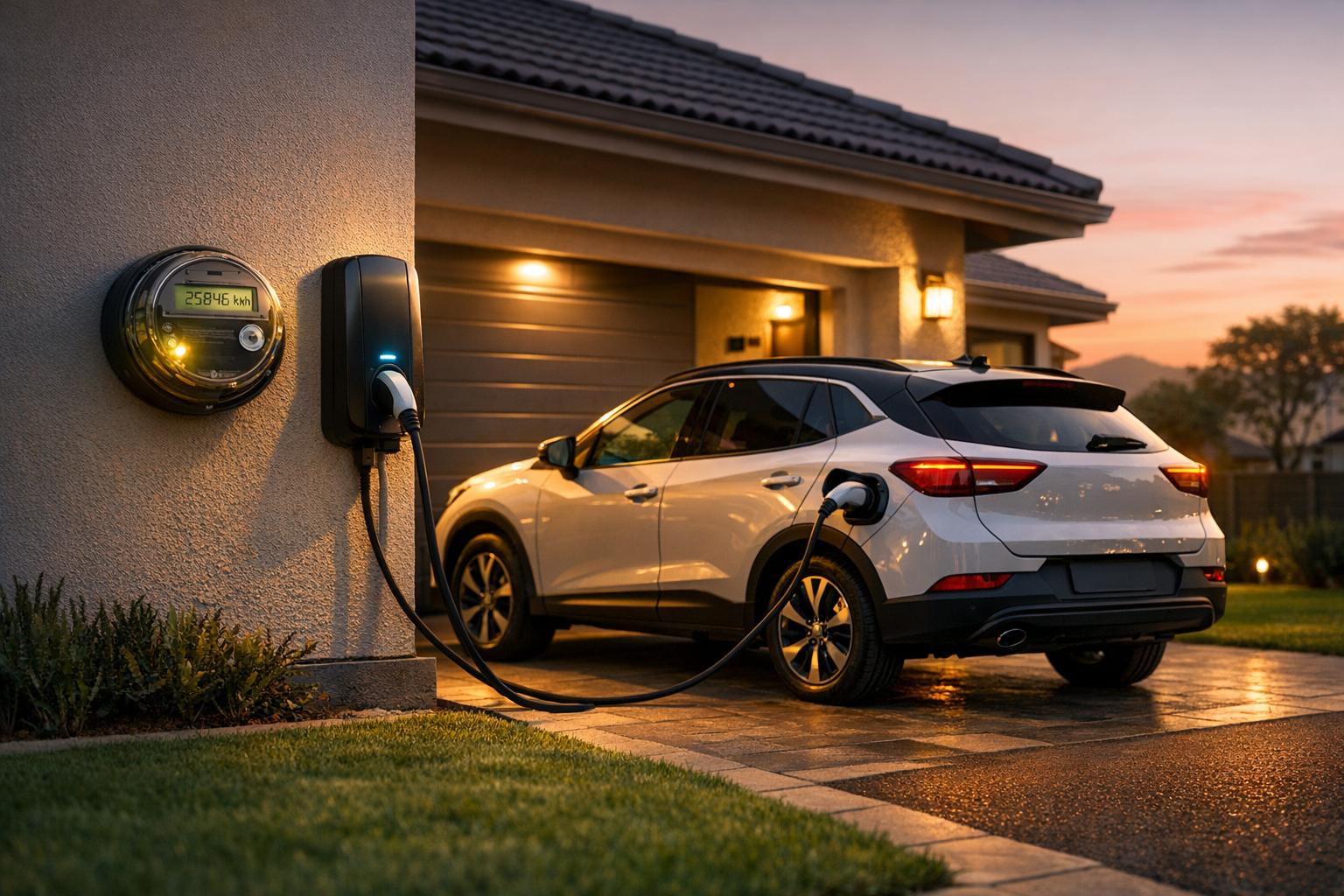
Electric vehicles (EVs) in South Africa offer lower running costs compared to gas-powered cars, but they come with higher upfront expenses. Here’s the quick breakdown:
- Charging Costs: Home charging costs $0.03–$0.04 per kilometer, while public fast charging costs $0.06–$0.08 per kilometer. Gas-powered cars cost about $0.13 per kilometer.
- Upfront Costs: EVs need a home charging station ($650–$1,350), while gas cars don’t require extra infrastructure.
- Maintenance: EVs are cheaper to maintain due to fewer parts and no oil changes.
- Fuel Savings: EV owners driving 12,500 miles per year could save $667–$1,000 annually on energy costs compared to gas vehicles.
EVs are ideal for homeowners who can charge at home and drive frequently, while gas-powered cars may suit those who rely on quick refueling or lack charging access.
Quick Comparison:
| Factor | EVs | Gas Vehicles |
|---|---|---|
| Fuel/Energy Cost | $0.03–$0.08 per km | $0.13 per km |
| Upfront Costs | $650–$1,350 (charger) | None |
| Maintenance | Low | High |
| Convenience | Best with home charging | Best for quick refuel |
If you can install a home charger or pair it with solar panels, EVs offer long-term savings and lower running costs.
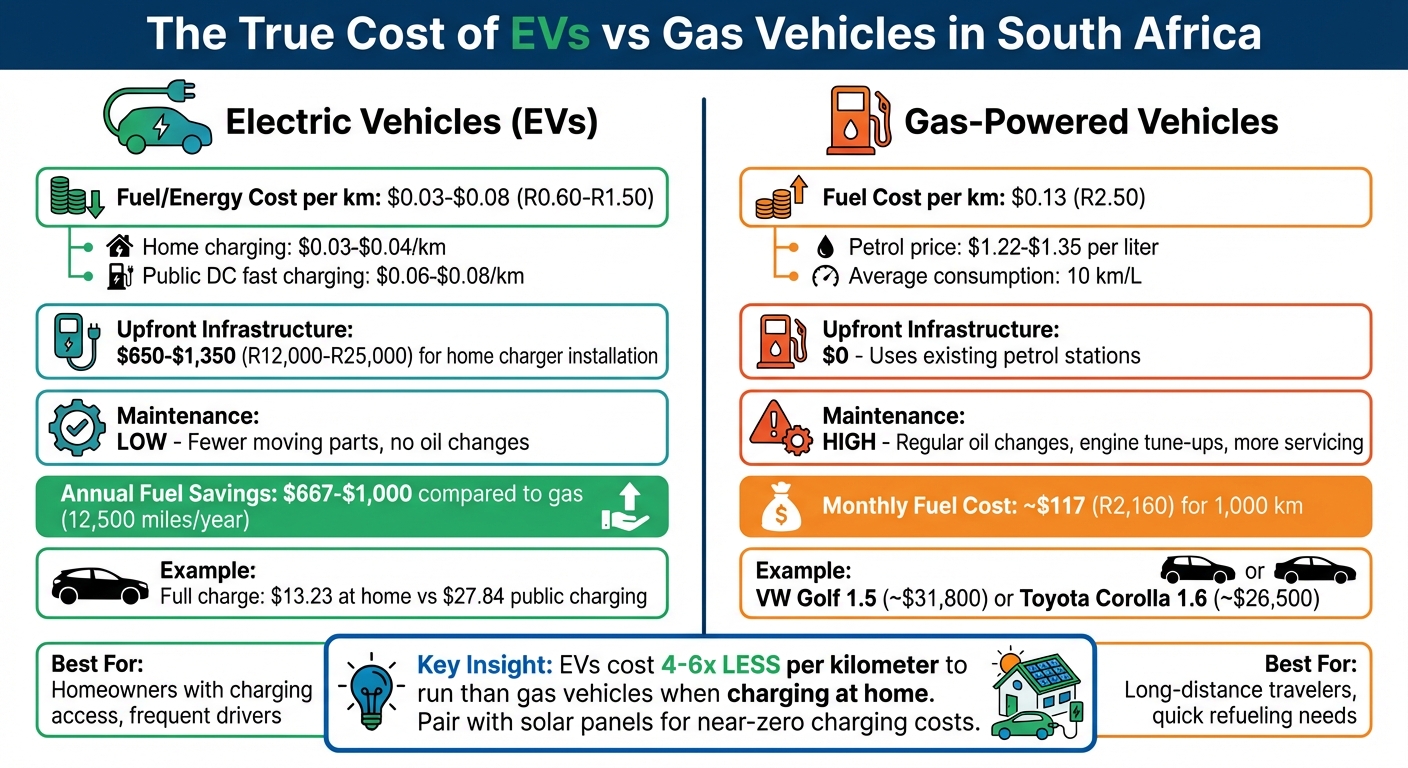
EV vs Gas Vehicle Cost Comparison in South Africa
1. Electric Vehicles (EVs)
Purchase and Financing Costs
When buying an electric vehicle (EV), the costs go beyond just the car itself – you’ll also need a home charging setup. Installing a wallbox charger typically costs between $486 and $1,297 (R9,000–R24,000), with installation fees ranging from $54 to $135 (R1,000–R2,500). While this might seem like a hefty upfront expense, it ensures safe and efficient charging. After all, standard outlets aren’t built to handle the prolonged high-power draw needed for EVs.
But here’s the good news: this initial investment pays off over time. Charging at home is about 50% cheaper than using public DC fast chargers. Plus, most EVs can be fully charged overnight with a standard 7 kW wallbox, making it a practical and convenient solution for daily use.
Once you’ve tackled the initial setup, the ongoing energy costs reveal even more savings.
Energy and Fuel Costs
Charging your EV at home is surprisingly affordable, costing about $0.03–$0.04 per kilometer (R0.60–R0.80). In comparison, public DC fast charging is slightly pricier at $0.06–$0.08 per kilometer (R1.20–R1.50). Meanwhile, petrol-powered vehicles cost significantly more, averaging $0.13 per kilometer (R2.50).
Take the Mercedes-Benz EQA, for example. With its 70 kWh battery, a full home charge costs just $13.23 (R245), while the same charge at a public DC station would run you $27.84 (R515). If you primarily charge at home, you could save between $540 and $810 (R10,000–R15,000) annually compared to relying solely on public charging. And if you install solar panels, your electricity costs could drop to almost nothing, boosting these savings even further.
Beyond cost savings, the availability of charging infrastructure plays a big role in everyday convenience.
Infrastructure and Convenience
A reliable public charging network is essential for EV travel, offering a mix of AC and DC charging options. Costs vary depending on the type of charger: AC charging (7–22 kW) is around $0.32 per kWh (R6.00), while DC fast charging (25–150 kW) ranges from $0.38 to $0.40 per kWh (R7.00–R7.50). Ultra-fast chargers, like BMW’s 150 kW units, cost approximately $0.43 per kWh (R8.00).
"DC chargers combine speed and convenience, enabling 200km in 20 minutes for long-distance trips." – Winstone Jordaan, MD of GridCars
For most EV owners, the strategy is simple: charge at home for your daily needs and use public chargers for longer trips. In South Africa, most networks bill only for the energy consumed, with no extra fees for connection or idling as of 2024. Some manufacturers even offer perks – Jaguar Land Rover owners, for instance, enjoy subsidized AC charging at about $0.16 per kWh (R3.00) through the Jaguar Powerway network.
When you combine the lower running costs with the growing charging infrastructure, it’s clear that EVs are becoming an increasingly affordable and practical choice for South Africans in the long run.
2. Gas-Powered Vehicles
Purchase and Financing Costs
Gas-powered cars often come with a lower sticker price since they don’t require additional investments like a home charging station. For instance, a compact car such as the Volkswagen Golf 1.5 is priced at around $31,800 (R589,000), while a mid-size sedan like the Toyota Corolla 1.6 costs approximately $26,500 (R490,913). Plus, fuel stations are widespread, adding to the convenience.
But here’s the catch: while the upfront cost might be lower, the ongoing expenses can quickly add up. Fuel and maintenance costs, in particular, make gas-powered vehicles less appealing when you zoom out and consider the long-term financial picture.
Energy and Fuel Costs
Fueling a gas-powered car can drain your wallet faster than you might expect. With petrol prices averaging $1.22 per liter (R22.51) and sometimes climbing to $1.35 per liter (R25.00), the costs pile up. If your car gets 10 km/L, that’s about $0.13 per kilometer (R2.50). To put that into perspective, petrol is roughly 4 to 6 times costlier per kilometer than charging an electric vehicle at home.
For someone driving 1,000 kilometers a month, fuel costs could hit $117 (R2,160). Even if you compare this to public DC fast charging rates for EVs – around $0.06–$0.08 per kilometer (R1.20–R1.50) – gas-powered cars remain significantly more expensive to run. The savings at the dealership might not be as sweet when weighed against these recurring costs.
Maintenance and Repairs
Gas-powered vehicles also come with higher maintenance demands over their lifetimes. Regular oil changes, engine tune-ups, and other services – things EVs largely skip – can add up. While exact figures aren’t provided, these routine expenses can significantly impact the total cost of ownership. And as emissions regulations tighten, both fuel and maintenance costs are expected to climb even higher. This makes it clear that the affordability of gas-powered vehicles is often overshadowed by their ongoing financial demands.
Electric Cars Don’t Make Sense In South Africa
sbb-itb-99e19e3
Pros and Cons
When weighing the financial aspects of electric vehicles (EVs) versus gas-powered cars in South Africa, both options have their own set of perks and challenges that impact your budget over time. Let’s break down the key points.
Charging an EV at home can lead to noticeable yearly savings, especially when compared to the higher fuel costs of traditional petrol vehicles. On top of that, EVs generally cost less to maintain. Why? Their electric powertrains don’t require oil changes and have fewer moving parts to worry about.
On the flip side, gas-powered cars are easier to get started with. They don’t demand any additional infrastructure, and refueling is quick and easy at the many petrol stations around. For some drivers, this convenience can make up for the higher ongoing fuel costs.
Here’s a quick comparison of the key differences between owning an EV and a gas-powered car:
| Factor | Electric Vehicle (EV) | Gas-Powered (ICE) Vehicle |
|---|---|---|
| Fuel/Energy Cost | Low (around $0.03–$0.08 per km) | High (approximately $0.13 per km) |
| Upfront Infrastructure | High (home charger installation costs $540–$1,350) | None (uses existing petrol stations) |
| Public Charging Cost | High (DC fast charging costs about double home charging rates) | Standardized (regulated petrol prices) |
| Maintenance | Low (fewer moving parts, no oil changes) | High (requires regular servicing) |
| Convenience | High for homeowners (overnight charging) | High for long trips (quick refueling) |
These comparisons outline the main financial factors to consider when choosing between the two types of vehicles.
Conclusion
Choosing to switch to an EV in South Africa largely depends on how and where you plan to charge it. The cost comparison is striking: charging at home costs around $0.06–$0.09 per mile, while fueling a petrol car averages about $0.27 per mile. This translates to potential savings of $667–$1,000 annually if you rely primarily on home charging instead of public stations. These savings can help offset the higher upfront costs of EV ownership over time.
Installing a home charger comes with an initial investment of roughly $600–$1,600. For those driving 12,500 miles (20,000 km) or more each year, the reduced operating costs can quickly make a noticeable difference. As the IEA puts it:
"Over time lower operating costs can compensate for higher upfront costs."
Home charging plays a key role in keeping costs down. For instance, a premium EV like the Mercedes-Benz EQA shows how charging at home can nearly halve the cost compared to public fast charging. Public fast charging is best reserved for long trips rather than daily use, as it tends to be more expensive.
If you own your home, have a stable electricity supply, and drive frequently, an EV could be a smart financial choice in South Africa. The savings on fuel and maintenance can help balance out the initial expenses of setup and purchase. On the other hand, if you lack access to home charging or often take long journeys beyond the approximately 400 public charging points currently available, sticking with a petrol vehicle might be more practical.
For even greater savings, consider pairing your EV with solar panels. This could bring your charging costs down to nearly zero, making the transition to electric mobility even more cost-effective.
FAQs
What are the long-term financial advantages of owning an EV in South Africa?
Owning an electric vehicle (EV) in South Africa can lead to considerable financial savings over time when compared to traditional gas-powered cars. One of the biggest advantages is the lower cost of electricity compared to gasoline. EV owners often spend only about one-third to half as much per mile on "fuel", which adds up to noticeable savings over the years.
Another perk? EVs are simpler machines. With fewer moving parts, they require less maintenance. Forget about oil changes, frequent brake replacements, or engine repairs – common expenses with internal combustion engine (ICE) vehicles. On top of that, many EV manufacturers include extended battery warranties, often covering up to 8 years or 100,000 miles. This extra coverage provides peace of mind while reducing long-term costs. All these factors together make EVs a smart, budget-friendly option over time.
What are the cost and convenience differences between charging an EV at home versus using public stations?
Charging your EV at home is not only easier but also much lighter on your wallet compared to public charging stations. Setting up a Level 2 home charger usually costs between $600 and $1,300, and residential electricity rates typically range from $0.10 to $0.20 per kWh. When you compare this to the cost of gasoline, the savings per mile are hard to ignore. Plus, a 7 kW home charger can add approximately 20–40 miles of range per hour, making it possible for most EV owners to fully recharge overnight without ever leaving their driveway.
While public charging stations are indispensable for road trips and long-distance travel, they come with their own set of drawbacks. Rates per kWh at public stations are often higher than what you’d pay at home, and many of them tack on session fees as well. On top of that, you need to consider the time spent driving to the station, waiting for an available charger, and potentially standing in line behind other users. For everyday use, home charging is the clear winner – it’s more affordable, saves time, and lets you recharge your car while you sleep or go about your daily routine.
What challenges might you face owning an EV without access to home charging?
Owning an electric vehicle (EV) without access to home charging does come with its own set of hurdles. For starters, you’ll need to depend on public charging stations, which aren’t always conveniently located or consistently available. This often means extra planning, unexpected detours, and the potential for range anxiety – especially in areas where charging networks are still catching up. On top of that, public charging tends to be pricier than charging at home, which can chip away at the cost savings typically associated with EV ownership.
Another consideration is the time factor. Public chargers usually take anywhere from 30 minutes to an hour to provide a decent charge, which doesn’t quite match the ease of plugging in overnight at home. If you don’t have a home charger, you might find yourself relying on workplace or commercial charging options. However, these can come with their own challenges, like needing special permissions, additional equipment, or paying extra fees. This lack of flexibility can restrict your daily driving range and make planning longer trips more complicated. While owning an EV without home charging is certainly doable, it does demand more effort, careful planning, and a willingness to handle higher costs.