
 Thabo Nkosi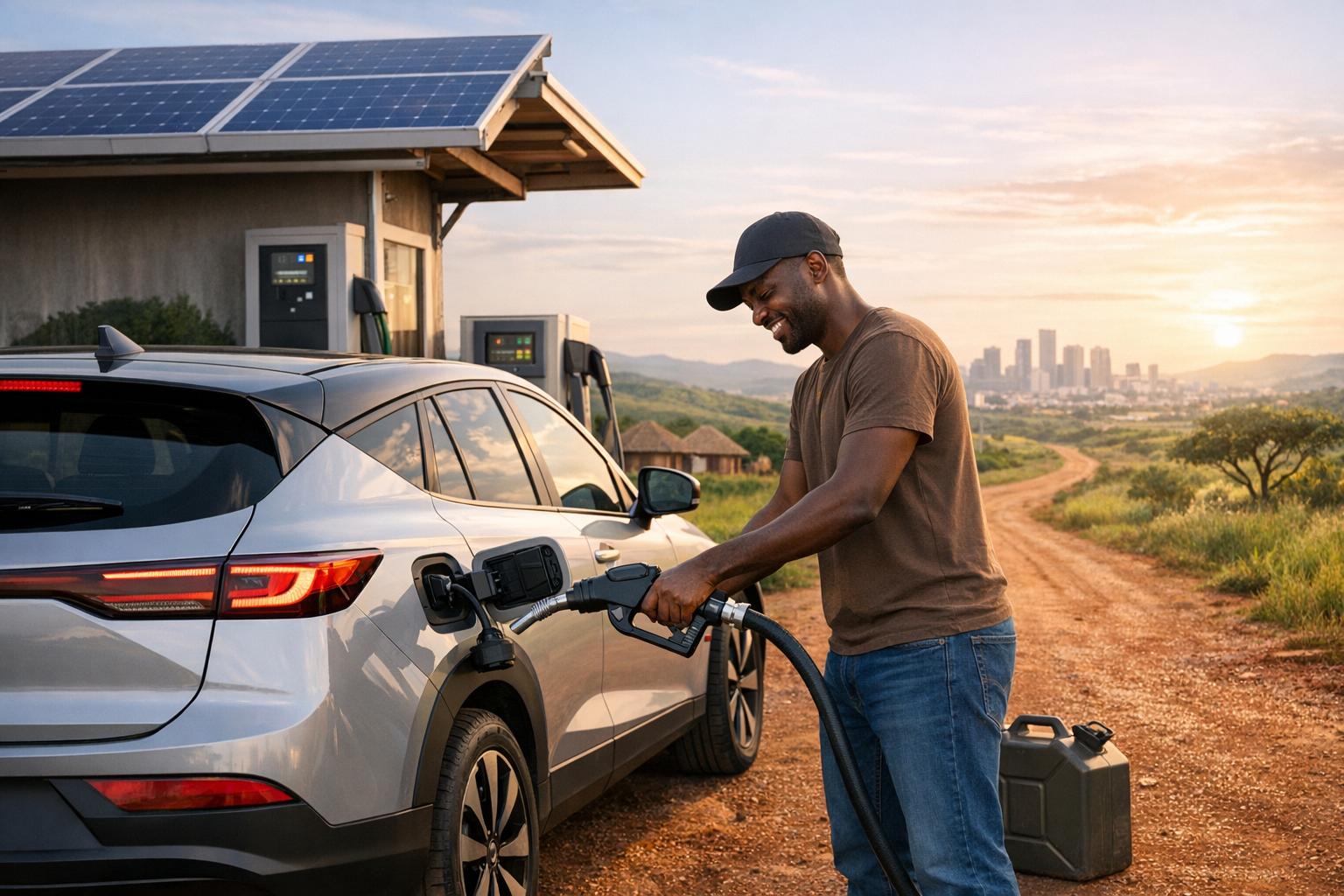
Range-Extended Electric Vehicles (REEVs) offer a practical solution for African drivers who face challenges like limited charging infrastructure, unreliable electricity, and long travel distances. Unlike fully electric vehicles, REEVs combine an electric motor with a gasoline generator that recharges the battery, ensuring extended range and flexibility.
Key takeaways:
- No Range Anxiety: REEVs can switch to gasoline power when the battery runs low, providing ranges up to 621 miles.
- Infrastructure Independence: Works with minimal reliance on charging stations, addressing Africa’s sparse charging networks.
- Cost-Effective: Smaller batteries reduce upfront costs, and efficient fuel use lowers operational expenses.
- Versatile for Terrain: Handles long distances, rough roads, and heavy loads, making it suitable for both urban and rural areas.
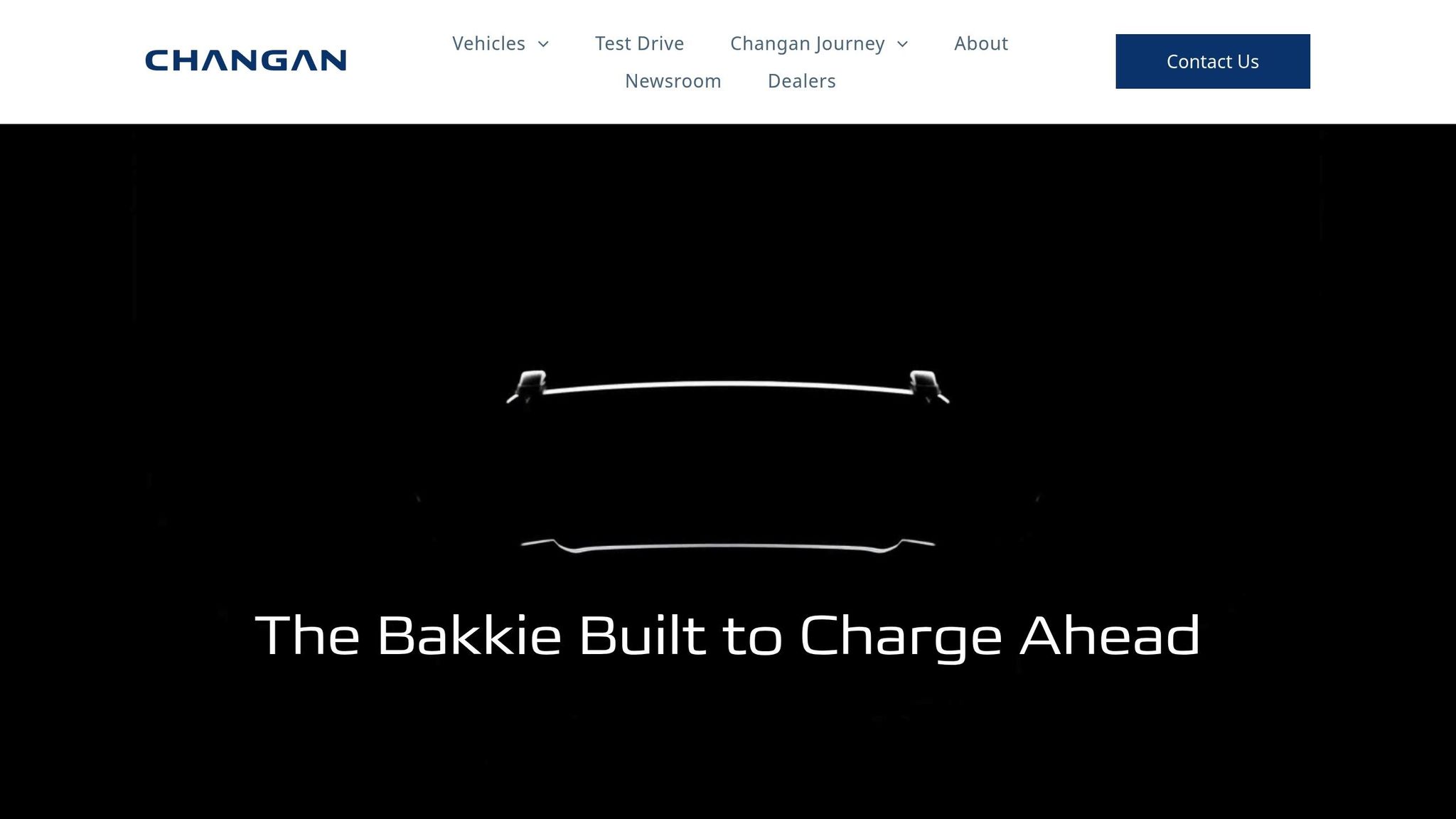
For instance, the Changan Hunter REEV, launched in November 2025, combines a 31.2kWh battery with a 2.0-liter gasoline generator, offering a total range of 1,000 km (621 miles). This makes REEVs ideal for African conditions, balancing electric efficiency with the reliability of traditional fuel systems.
Main Problems for African Drivers
Missing Infrastructure
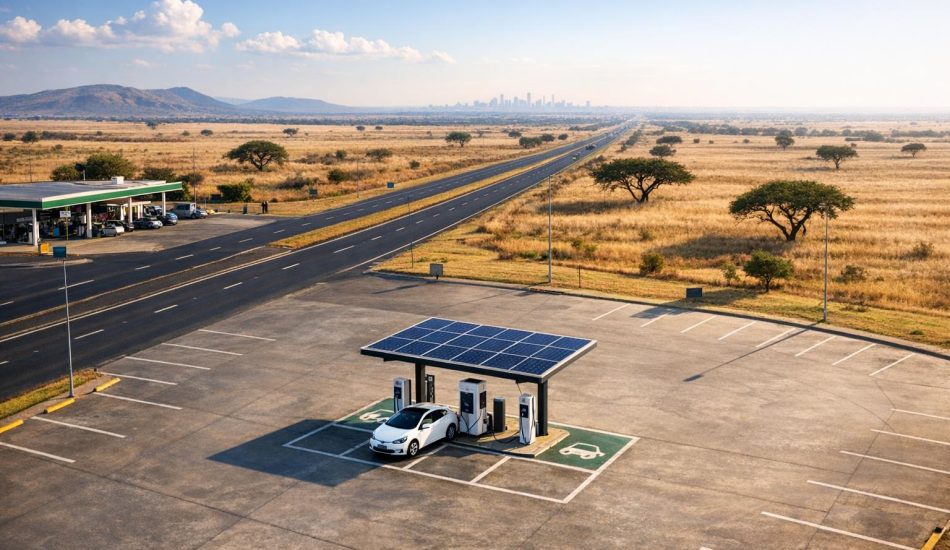
One of the biggest hurdles for electric vehicle (EV) adoption across Africa is the glaring lack of charging infrastructure outside major cities. While some urban areas have a handful of public chargers, rural regions and long intercity routes are a different story altogether. In fact, only 17% of African countries have 10 or more public charging stations. This leaves vast areas without any charging options, making it incredibly challenging for drivers to find reliable charging points. For instance, in South Africa, where destinations are often far apart, driving a fully electric vehicle for long trips becomes nearly impossible without a robust network of fast chargers. Unlike gasoline cars, which can refuel in minutes, battery electric vehicles (BEVs) need daily recharging due to their limited range. Even in cities, the situation isn’t much better, as the existing infrastructure is often hampered by unstable power supplies.
Power Supply Issues and Costs
The problem goes beyond just the lack of chargers. Africa’s unreliable power grids pose a serious challenge to the viability of BEVs. Frequent and prolonged power outages make consistent charging a struggle. For context, sub-Saharan Africa recorded a System Average Interruption Disruption Index (SAIDI) of 39.30 in 2020, compared to just 0.87 for high-income countries in the OECD. This means outages happen more often and last significantly longer. In regions with load shedding – planned power cuts to prevent grid overload – the issue is even worse. For example, in Rwanda, only 53% of households were connected to the national grid by 2024. Emmanuel Mayani, a Clean Energy Research Assistant at the University of Michigan, summed it up perfectly:
"If you keep increasing just the e-bikes, you’re increasing consumers of electricity without increasing the source, the generation or the amount of electricity the consumers are going to access."
Adding to the challenge are high electricity costs. In Kenya, residential electricity rates can climb above 20 cents per kilowatt-hour. On top of that, the cost of charging equipment is steep – Level 2 chargers range from $200 to $1,000, while Level 3 DC fast chargers can cost tens of thousands of dollars.
Driving Conditions and Patterns
African driving conditions present unique challenges that many BEVs simply aren’t equipped to handle. Drivers often cover long intercity distances, navigating rough roads, diverse terrains, and extreme weather. With typical BEV ranges hovering between 100 and 155 miles, many journeys exceed the vehicle’s capabilities. Meanwhile, transport-related emissions in Africa have surged by 84% over the past decade, reflecting growing mobility demands that current electric technology struggles to meet. Lemma Teshome Tufa, writing in Energy Strategy Reviews, highlighted these obstacles:
"The transition towards EVs in SSA still faces significant challenges… Particularly, the absence of clear policies, poor electricity networks, and the scarcity of public e-charging stations."
Long-distance travel often forces drivers to use nearly the entire battery capacity, which accelerates battery degradation. Experts generally recommend keeping the charge between 20% and 80% to extend battery life. These realities point to the need for a more practical solution, such as range-extended electric vehicles (REEVs) equipped with auxiliary generators. These could help drivers cover longer distances and sidestep the challenges posed by limited charging infrastructure.
Exclusive! Changan Hunter REEV Pre-Launch Review
How REEVs Solve These Problems
REEV vs BEV vs PHEV vs ICE Vehicle Comparison for African Drivers
How REEVs Work
Range-extended electric vehicles (REEVs) use a series-hybrid setup that makes them stand out from traditional hybrids. The key distinction? The internal combustion engine doesn’t power the wheels directly. Instead, it acts purely as a generator, recharging the battery and supplying power to the electric motor. This means the vehicle is always driven by electric power, ensuring smooth EV-like performance – even when the range extender kicks in.
Because the engine isn’t mechanically linked to the wheels, it can be positioned anywhere in the vehicle and run at its most efficient RPM. This setup allows for impressive fuel efficiency, with consumption as low as 2.8 L/100 km. When the battery gets low, the generator automatically takes over, keeping the charge steady and letting you continue your trip without the immediate need for a charging station.
This design is a game-changer for drivers in areas with limited charging infrastructure, offering both convenience and peace of mind.
Main Benefits for African Drivers
REEVs tackle infrastructure challenges head-on, especially in regions where charging stations are scarce. If the battery runs out, you can simply refuel at any standard gas station and keep going. This eliminates range anxiety, a common concern for EV users in areas with limited charging options.
Another major perk? REEVs are designed with smaller battery packs – typically between 15 and 30 kWh – compared to the much larger 60 to 100+ kWh batteries in long-range battery electric vehicles (BEVs). These smaller batteries help reduce both the upfront cost and the overall weight of the vehicle, while still providing enough range for daily urban commutes in full electric mode.
For areas with unreliable electricity, REEVs offer unmatched flexibility. You can charge the vehicle using the grid when power is available, and if the electricity cuts out, the onboard generator ensures you remain mobile without interruption.
Vehicle Type Comparison
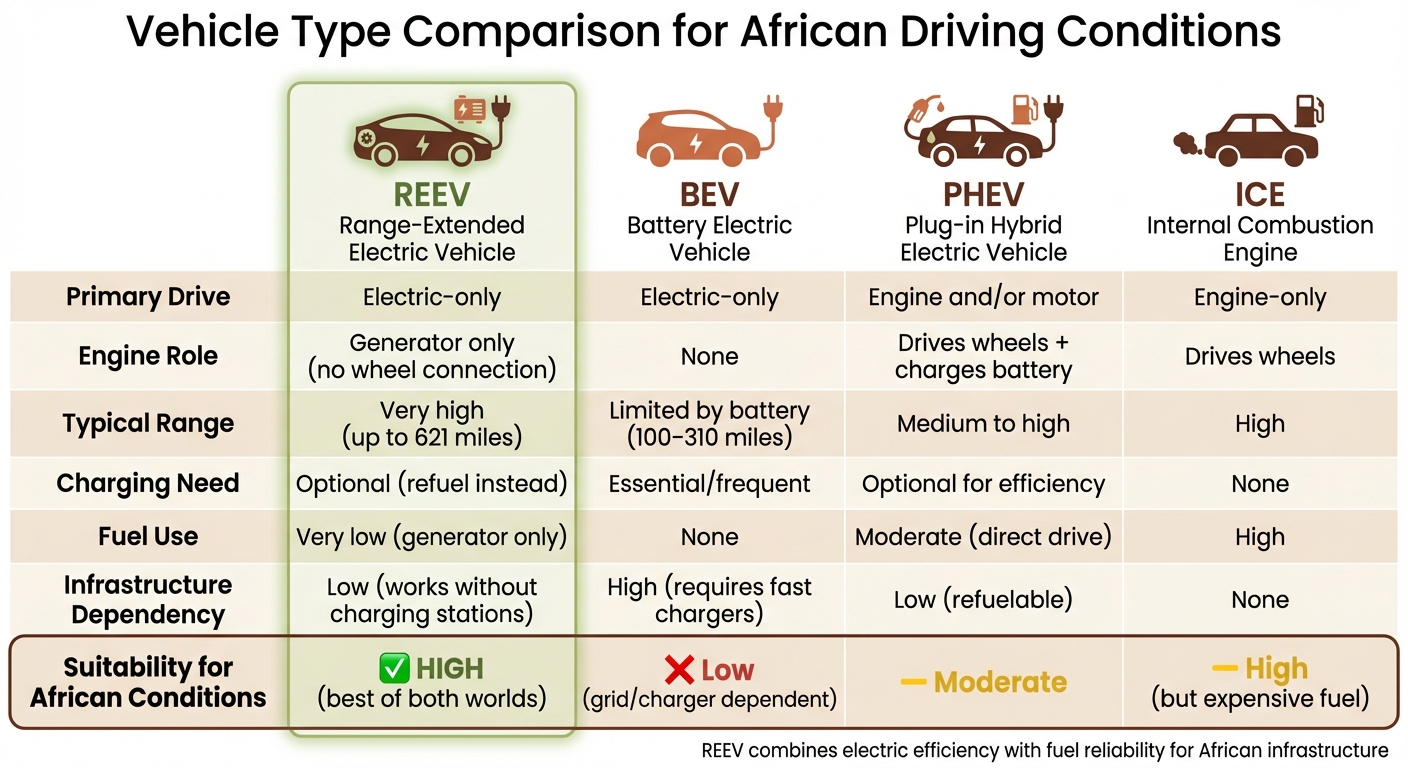
Here’s a quick breakdown of how REEVs stack up against other vehicle types in the context of African driving conditions:
| Feature | REEV | BEV | PHEV | ICE |
|---|---|---|---|---|
| Primary Drive | Electric-only | Electric-only | Engine and/or motor | Engine-only |
| Engine Role | Generator only (no wheel connection) | None | Drives wheels + charges battery | Drives wheels |
| Typical Range | Very high (up to 621 miles) | Limited by battery (100–310 miles) | Medium to high | High |
| Charging Need | Optional (refuel instead) | Essential/frequent | Optional for efficiency | None |
| Fuel Use | Very low (generator only) | None | Moderate (direct drive) | High |
| Infrastructure Dependency | Low (works without charging stations) | High (requires fast chargers) | Low (refuelable) | None |
| Suitability for African Conditions | High (best of both worlds) | Low (grid/charger dependent) | Moderate | High (but expensive fuel) |
This table underscores why REEVs are a smart choice for African drivers. They combine the efficiency and low emissions of electric vehicles with the range and independence of traditional fuel-powered cars. For those navigating long distances, unpredictable power grids, and a lack of charging stations, REEVs offer a practical and reliable solution to embrace electrification without the usual hurdles.
sbb-itb-99e19e3
REEV Use Cases in Africa
City Driving
For daily commutes, REEVs rely entirely on battery power, making them ideal for city driving. Models like the Changan Hunter REEV and Leapmotor C10 REEV offer a pure-electric range of about 145 km (90 miles), which is more than enough for most urban trips without needing to run the onboard generator. These vehicles can be charged overnight at home or work, ensuring emission-free travel during the day. Electric motors provide instant torque, making stop-and-go traffic smoother and more responsive. Plus, their quiet operation and zero tailpipe emissions contribute to better air quality in crowded urban areas. If the battery runs low, the onboard generator steps in to recharge it, eliminating range anxiety. There’s even potential to modify these generators to use Compressed Natural Gas (CNG), tapping into locally available resources to cut costs.
Long-Distance and Cross-Border Travel
REEVs shine on longer journeys, especially where charging infrastructure is limited. In October 2025, Leapmotor International introduced the C10 REEV SUV in South Africa through a partnership with Stellantis. This model combines a 1.5-liter petrol generator with a rear electric drive unit, offering 158 kW of power and 320 Nm of torque. With a total range of 970 km (603 miles) – including a 145 km (90 miles) pure-electric segment – it’s well-suited for extended travel. The Changan Hunter REEV takes things further, delivering a total range of 1,000 km (621 miles) by pairing a 31.2 kWh lithium-iron-phosphate battery with a 2.0-liter turbocharged petrol generator. Importantly, the electric motors handle all wheel power, ensuring consistent performance whether the vehicle is running on battery or the generator.
Business and Delivery Use
For businesses, REEVs tackle challenges like carrying heavy loads, navigating long routes, and handling tough terrain. In November 2025, Changan South Africa unveiled a REEV pickup tailored for commercial use, specifically targeting the "bakkie" market. This model delivers 200 kW of power and 470 Nm (347 lb-ft) of torque, designed to maintain towing and hauling capacity on rugged roads while reducing reliance on fuel. Changan South Africa emphasized:
"This vehicle shows that electric and hybrid technology can also serve the toughest, hardest-working vehicles on South African roads."
Urban delivery fleets can rely on the pure-electric range for most daily routes, avoiding fuel use altogether. For longer trips or continuous deliveries, the generator ensures uninterrupted operation without the hassle of finding charging stations. Since the engine is optimized solely to generate electricity, fuel costs drop significantly for high-mileage operations. Some REEV trucks even come equipped with high-capacity onboard power outlets (up to 7.2 kW), turning the vehicle into a mobile generator capable of powering tools or equipment at remote job sites.
These examples demonstrate how REEVs effectively bridge the gap between urban and long-distance needs, making them a practical solution for Africa’s diverse mobility challenges.
How EV24.africa Supports REEV Adoption
Solutions for African Drivers
EV24.africa provides an online marketplace that connects drivers from all 54 African nations with a variety of REEV models. Each listing includes detailed specifications, transparent pricing, and financing options designed to make REEVs more accessible. To address the challenge of limited dealerships, the platform also integrates delivery logistics, ensuring vehicles can reach customers seamlessly. This driver-focused approach aligns with broader efforts to enhance infrastructure and encourage supportive policies across the continent.
Infrastructure and Policy Support
REEVs are already a practical choice for African drivers. They can charge their vehicles at home, work, or public charging stations, with the onboard generator serving as a reliable backup. This flexibility fits well with Africa’s infrastructure, which is steadily evolving.
Countries like Kenya, Egypt, and Morocco are actively expanding their charging networks and building assembly plants to accelerate the transition away from fossil fuels. South Africa, which produces over 500,000 vehicles annually and accounts for more than 80% of Africa’s total vehicle output, is positioning itself as a key manufacturing hub for advanced automotive technologies. Additionally, the African Continental Free Trade Area (AfCFTA) is expected to simplify supply chains for batteries and electric components, reducing costs for REEV production and maintenance. As Solomon Ekanem, Editor at Business Insider Africa, highlighted:
"The African Continental Free Trade Area (AfCFTA) is expected to play a crucial role in linking supply chains for batteries and electric components".
Conclusion
REEV technology offers African drivers a practical way to embrace electric mobility without overhauling existing infrastructure. By combining an electric motor with an onboard generator, REEVs address the challenge of range anxiety. Drivers can charge their vehicles at home for daily commutes and rely on gas stations for longer journeys, making this solution ideal for Africa’s diverse driving demands.
This approach is particularly well-suited for businesses, cross-border travel, and rural areas where charging stations remain limited. Modern REEV pickups also boast impressive fuel efficiency. As Edna Joseph from SAGLEV highlighted:
"It solves range anxiety where the charging infrastructure is still limited… a good transitional technology while the full EV infrastructure scales."
EV24.africa plays a key role in this transition by offering a seamless platform that connects drivers across all 54 African countries with clear REEV listings, pricing options, and financing plans. Their delivery logistics ensure vehicles reach customers efficiently, addressing the challenges posed by limited dealership networks. This aligns with Africa’s growing charging infrastructure and the robust vehicle manufacturing sector in South Africa, which produces over 500,000 vehicles annually.
As charging networks expand and initiatives like the African Continental Free Trade Area (AfCFTA) enhance regional supply chains for electric components, REEVs provide an essential stepping stone for African drivers. They deliver immediate solutions while paving the way for a more sustainable future in mobility. This blend of innovative technology and regional connectivity represents a significant milestone in Africa’s journey toward greener transportation.
FAQs
How are REEVs more cost-effective and practical than traditional electric vehicles for African drivers?
Range-extended electric vehicles (REEVs) offer a clever mix of electric driving and the convenience of a small gasoline generator that kicks in only when the battery runs low. This setup helps keep costs in check by avoiding the need for a large battery, while still allowing for electric-only driving on most daily trips. Plus, drivers can skip the expense of installing pricey home charging systems, which is especially helpful in areas where electricity isn’t always reliable.
When it comes to efficiency, REEVs shine. On short trips, they function like battery-electric vehicles (BEVs), delivering low-cost, zero-emission driving. For longer journeys, the onboard generator steps in, extending the range and reducing the need for frequent charging stops. Some REEVs, for instance, can provide up to 90 miles of electric-only range and a total range of over 600 miles. This combination of electric efficiency and extended range makes REEVs a practical and cost-effective choice, particularly in places where charging infrastructure is still catching up.
Why are REEVs ideal for both city and rural driving in Africa?
Range-extended electric vehicles (REEVs) combine an electric motor with a small gas-powered generator that kicks in only when the battery gets low. This setup lets REEVs run mostly on electricity for everyday driving, offering a quieter ride with fewer emissions. At the same time, the gas-powered generator provides a reliable backup for longer trips. Drivers can conveniently charge their vehicles at home or at public charging stations, relying on gasoline only when absolutely needed.
In urban areas, REEVs are ideal for short commutes since most daily trips can be completed entirely on battery power. This not only cuts down on fuel costs but also helps reduce air pollution. In rural regions or during long-distance travel, the onboard generator steps in to ease "range anxiety", ensuring you can keep going even when charging stations are hard to find. Take, for instance, a REEV pickup truck: it might offer up to 90 miles of all-electric driving for city use, but with the generator engaged, it can cover a total range of 621 miles. This makes it practical for everything from navigating city streets to tackling remote farm roads. With such adaptability, REEVs are well-suited for the varied driving conditions across Africa.
How does Africa’s limited charging infrastructure impact the use of REEVs?
Africa faces a considerable hurdle in adopting fully electric vehicles due to the limited availability of charging stations. For many drivers, the lack of dependable charging options for longer journeys leads to range anxiety, making them reluctant to transition to battery-only EVs.
Range-Extended Electric Vehicles (REEVs) offer a clever workaround to this problem. These vehicles run primarily on electric power but include a small gasoline generator that kicks in to recharge the battery when necessary. This means drivers can rely on traditional gas stations instead of hunting for scarce charging points. By combining extended driving range with greater convenience, REEVs present a practical alternative for areas where charging infrastructure is still in its early stages, paving the way for cleaner and more flexible transportation options.