
 Thabo Nkosi
Looking for a reliable used electric car in Africa? Here’s a quick guide to the top 10 models that balance performance, affordability, and durability for African road conditions. These cars were chosen for their battery longevity, serviceability, and ability to handle heat, rough roads, and limited charging infrastructure.
Key Models to Consider:
- BMW i3: Compact, reliable with liquid-cooled batteries, but limited ground clearance.
- Nissan Leaf: Budget-friendly, but older models lack active cooling for hot climates.
- Hyundai Kona Electric: Great range and durability, with local assembly in Nigeria.
- Kia e-Niro: Long range and practical for urban and suburban use.
- Renault Zoe: Affordable and compact, but older models may involve battery rental agreements.
- Volkswagen ID.3: Advanced features and excellent range, with local production in South Africa.
- Tesla Model 3: Premium performance and range, but higher upfront costs.
- BYD Atto 3: New entrant with promising battery tech and growing presence in Africa.
- Jaguar I-PACE: Luxurious, but high maintenance costs and limited service access.
- Mini Electric / Honda e: Perfect for city driving with compact designs, but limited range.
Quick Tips:
- Battery Health: Always check the battery’s State of Health (SOH) before purchasing.
- Service Network: Choose models with accessible service centers or local parts availability.
- Charging Needs: Opt for cars with fast-charging capability and consider home solar setups for reliability.
- Road Conditions: Higher ground clearance models like the Hyundai Kona or Kia e-Niro are better for rougher roads.
Summary Table:
| Model | Price Range (USD) | Range (miles) | Key Feature |
|---|---|---|---|
| BMW i3 | $8,000 – $18,000 | 153 | Reliable cooling system |
| Nissan Leaf | $3,500 – $15,000 | 149 – 226 | Affordable entry-level EV |
| Hyundai Kona Electric | $18,000 – $28,000 | 258 | Long range, durable build |
| Kia e-Niro | $17,000 – $27,000 | 239 | Practical and spacious |
| Renault Zoe | $9,000 – $16,000 | 245 | Budget-friendly option |
| Volkswagen ID.3 | $20,000 – $30,000 | 263 – 340 | Advanced tech features |
| Tesla Model 3 | $25,000 – $40,000 | 272 – 358 | Top-tier performance |
| BYD Atto 3 | $22,000 – $32,000 | 261 | New and promising |
| Jaguar I-PACE | $30,000 – $45,000 | 211 – 258 | Luxury with AWD |
| Mini Electric / Honda e | $13,000 – $22,000 | 100 – 217 | Compact for city use |
For a safe and informed purchase, use platforms like EV24.africa to verify battery health, compare listings, and find trusted sellers across the continent.
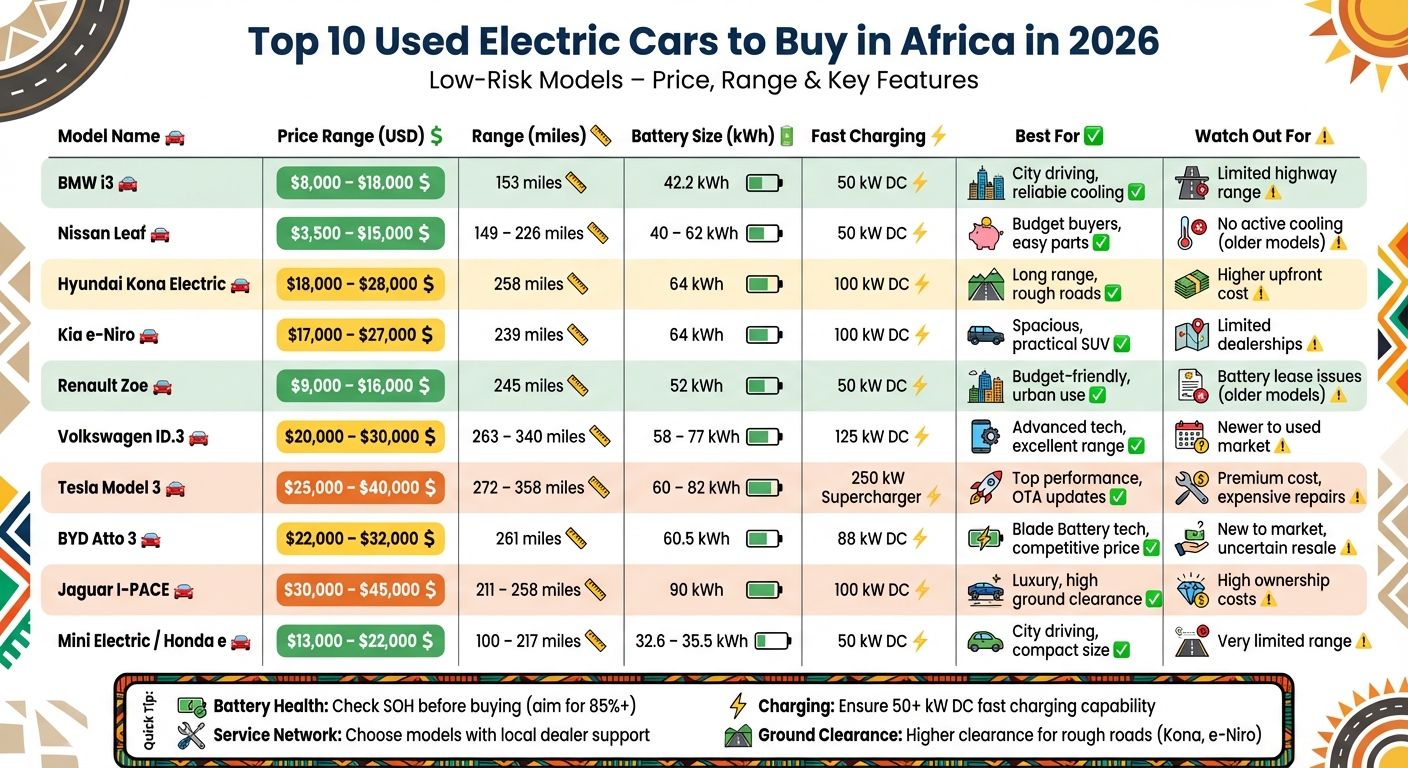
Top 10 Used Electric Cars for Africa 2026: Price, Range & Features Comparison
1. BMW i3
Battery Durability and Real-World Range
The BMW i3 shines in hot climates, thanks to its active thermal management system that uses liquid refrigerant. This feature makes it far more reliable in regions like Africa compared to EVs with passive cooling systems. However, there are differences in battery performance depending on the model year. Cars from 2014–2016, equipped with the smaller 18.2-kWh battery (60 Ah), tend to degrade faster. On the other hand, 2017 and later models feature improved 94 Ah or 120 Ah batteries, which are better at maintaining their capacity. These newer models deliver a range of about 81 miles (130 km) for earlier versions and up to 153 miles (246 km) for 2019–2021 models.
Many i3s also come with a Range Extender (REx) – a small 647-cc gasoline generator that can provide a total range of up to 200 miles (322 km). This feature is particularly useful in areas where charging infrastructure is sparse. One long-term owner, Michel Clasquin-Johnson, shared his experience:
Ten years and 130,000 km later, my i3 gives me the same electric range as the day I bought it.
The i3’s lightweight, rust-resistant chassis adds to its durability, especially in humid or coastal areas. However, there are a couple of potential issues to be aware of. A failure of the A/C compressor, often referred to as "Black Death", can cost more than $10,000 to repair. Additionally, replacing the 12V battery proactively – at around $200 – can prevent system failures.
Availability of Service and Spare Parts in African Markets
In many African countries, such as Nigeria, there isn’t a dedicated BMW EV service network. This forces i3 owners to rely on general mechanics or bring in specialized technicians. Spare parts are another hurdle. They are rarely stocked locally and often need to be imported, which increases both costs and repair times due to shipping and customs fees. Even the i3’s specialized tires can wear out quickly and are expensive to replace.
That said, there are some positive developments. Rwanda, for example, has eliminated import and excise duties on EV spare parts. Meanwhile, platforms like EV24.africa are helping connect owners with suppliers who can source specific components. Still, for major repairs, such as out-of-warranty battery replacements – which can cost between $16,000 and $30,000 – buyers need to budget carefully. Routine annual maintenance costs typically fall between $900 and $1,200.
Affordability and Total Cost of Ownership
The BMW i3 is known for its reliability, with a fault rate of just 11%. Used prices vary depending on the model year:
- 2014–2016 models: $6,000–$12,000
- 2017–2018 models: $12,000–$18,000
- 2019–2021 models: $18,000–$25,000
Interestingly, the i3 has shown strong price retention. Tom Barnard, Editor at Electrifying.com, remarked:
BMW i3 prices are defying gravity and rising. It’s only true for the best models, but shows that this car was really ahead of its time.
Operating costs are another advantage. Charging an EV in Africa is 50–70% cheaper than fueling a gasoline car. While the Range Extender version adds flexibility, it also comes with slightly higher annual service costs due to the small gasoline engine. The lightweight construction contributes to excellent efficiency, making the i3 an economical choice for city driving.
Suitability for African Conditions
The i3’s compact design and tight turning radius make it ideal for navigating crowded cities like Lagos, Nairobi, or Johannesburg. Regenerative braking extends the life of the brake pads, reducing maintenance costs. However, the car’s firm suspension – especially in the i3S variant – can make driving on rough, unpaved roads uncomfortable. Additionally, the rear-hinged "suicide" doors can be tricky to manage in tight parking spaces.
Ground clearance is another limitation. For those who frequently travel on rough terrain, the i3 may not be as practical as higher-riding EVs like the Hyundai Kona Electric. That said, for urban driving with occasional highway trips, the i3 is a reliable and efficient option. Models from 2017 or later with larger battery packs are the best choice, offering better range and fewer maintenance concerns.
2. Nissan Leaf
Battery Durability and Real-World Range
The Nissan Leaf uses a passively cooled battery system, which performs well in moderate climates but tends to degrade faster in extremely hot conditions, like those found in many parts of Africa. The 40 kWh model typically offers a range of about 150 miles (241 km), while the 62 kWh version can exceed 200 miles (322 km). However, older 24 kWh models may see their range drop to as low as 40 miles (64 km) under extreme heat. Filipp Sevostianov, CEO of eCarsTrade, highlights the Leaf’s battery resilience:
"The battery technology has proven more durable than many predicted, with most EVs retaining 85-90% of their original range capacity, making them viable long-term options."
If you’re considering a used Leaf, it’s crucial to check the battery capacity gauge on the dashboard. Nissan considers a battery to have "failed" under warranty if it drops to four bars or fewer. The warranty itself covers 96 months or 100,000 miles. These factors are especially important for buyers in regions with harsh climates, as they directly impact the vehicle’s long-term performance.
Availability of Service and Spare Parts in African Markets
One of the Leaf’s standout features is its compatibility with parts from popular Nissan petrol models like the Juke. Components such as brakes and suspension are shared, making repairs more affordable and ensuring parts are widely available across Africa.
Charging infrastructure is another aspect to consider. The Leaf uses the CHAdeMO fast-charging standard, allowing the 40 kWh model to reach 80% charge in approximately 40 minutes.
Affordability and Total Cost of Ownership
The Nissan Leaf is one of the most budget-friendly used EVs on the market. Older models can be found for as little as $3,500, while second-generation versions (Mk2) range from $7,900 to $17,600, depending on their condition and battery size. It earned a 75/100 Deal Score from eCarsTrade, placing it seventh among the best-used EVs in 2025. Additionally, it has been recognized as the "Best banger EV" for its unbeatable entry-level pricing. With proper maintenance, the Leaf’s design is expected to last 10 to 20 years. This combination of affordability and reliable parts availability makes the Leaf a practical option for many African buyers.
Beyond its cost advantages, the Leaf’s design and features also play a role in determining its compatibility with Africa’s diverse terrains.
Suitability for African Conditions
The Leaf’s low-mounted battery and suspension require extra care on rough or unpaved roads commonly found in Africa. To maintain battery health in hot climates, it’s best to avoid frequent deep discharges and not leave the car fully charged for long periods under direct sunlight. Buyers in especially hot regions should consider the 62 kWh model or 2017 and newer versions, as these have improved battery chemistry that better withstands thermal stress compared to the earlier 24 kWh models.
3. Hyundai Kona Electric
Battery Durability and Real-World Range
The Hyundai Kona Electric comes equipped with a 64 kWh battery, delivering an impressive range of up to 300 miles (482 km). This makes it a practical choice for both daily commutes in the city and longer inter-city drives across Africa, minimizing the need for frequent charging stops. With 204 horsepower and instant torque, it offers quick acceleration, which is especially handy in heavy traffic.
The vehicle also features regenerative braking, which recovers energy to extend the battery range while reducing wear on the brakes. This is particularly useful in urban environments with frequent stop-and-go traffic. If you’re considering a used Kona Electric, it’s wise to look for the 64 kWh version and check for a complete Hyundai dealer service history. This ensures the battery and other EV-specific components have been well-maintained. Its dependable performance and serviceability make it a strong contender in local markets.
Availability of Service and Spare Parts in African Markets
One standout feature of the Kona Electric is its local assembly in Nigeria by the Stallion Group. This not only speeds up access to spare parts but also ensures that technicians are trained specifically for this model. Furthermore, Hyundai’s established dealership networks across major African markets typically provide servicing for the first five years, helping to maintain warranties and ensuring peace of mind for buyers.
Affordability and Total Cost of Ownership
Affordability is another key factor to consider. Used Hyundai Kona Electric models are priced between $12,700 and $31,800. In Nigeria, specifically, prices range from ₦18 million to ₦28 million (approximately $11,000–$17,000), depending on the trim level. This places the Kona in a sweet spot – more budget-friendly than premium EVs while offering a much longer range than models like the Nissan Leaf. Car and Driver awarded it a 7.5/10 rating, praising it as the first EV to deliver "really usable EV range at a reasonable cost".
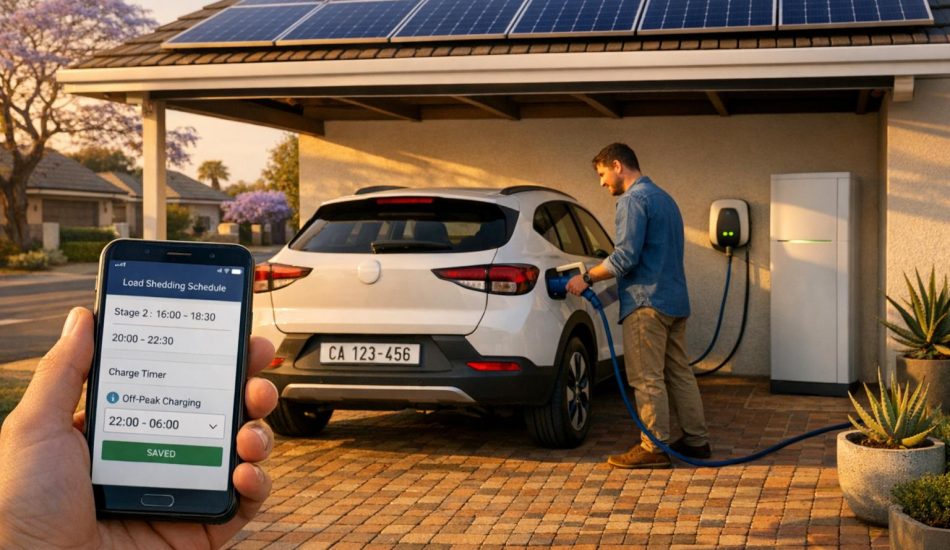
Given the challenges of unreliable power grids in parts of Africa, many owners may find it worthwhile to invest in solar-powered home charging systems. These setups, which include rooftop solar panels and battery storage, can ensure consistent charging access while reducing long-term electricity costs.
Suitability for African Conditions
The Kona Electric is well-suited for Africa’s mix of paved and unpaved roads, thanks to its adequate ground clearance. However, it’s not designed for extreme off-road adventures. Its stable handling makes it a good fit for both crowded city streets and faster highways. Higher-end trims even include ventilated seats, offering added comfort in hot climates. That said, extreme heat can impact the vehicle’s range, as the battery cooling system and air conditioning require additional power. Overall, the Kona Electric strikes a balance between urban practicality and the demands of local road conditions, making it a versatile choice for African drivers.
4. Kia e-Niro
Battery Durability and Real-World Range
The Kia e-Niro has garnered impressive recognition, earning a 99/100 deal score in 2025. Equipped with a 64.8 kWh battery, it offers a real-world range of 212–285 miles (341–459 km). This range provides peace of mind, especially in regions where charging stations might be sparse. The battery’s durability is also noteworthy, with most e-Niros retaining 85–90% of their capacity even after 3–5 years of use. Its regenerative braking system shines in crowded, stop-and-go traffic, particularly in busy African cities, by efficiently recovering energy during frequent stops. However, the range display tends to be overly optimistic when fully charged and adjusts as the vehicle is driven. This reliable battery performance ensures dependable service, which is a key factor in markets with limited infrastructure.
Availability of Service and Spare Parts in African Markets
Kia’s 7-year warranty adds a layer of reassurance for buyers, ensuring reliable access to parts and reducing the risks associated with ownership. An added benefit is that the warranty status can transfer to subsequent owners, making used purchases a safer option.
Affordability and Total Cost of Ownership
Used Kia e-Niro models are priced at an average of $12,000. Beyond the initial purchase cost, the vehicle’s low running expenses and minimal maintenance needs make it an economical alternative to traditional fuel-powered cars.
Suitability for African Conditions
The Kia e-Niro is well-prepared for the diverse road conditions found across Africa. Its crossover design provides practical ground clearance, while the 475-liter boot capacity makes it versatile for both city commutes and longer trips. The battery’s placement under the floor lowers the vehicle’s center of gravity, reducing the risk of rollovers on uneven terrain. It handles stop-and-go traffic efficiently, but it’s worth noting that high ambient temperatures can impact its range. The battery cooling system and air conditioning will draw extra power in such conditions, slightly reducing overall range. While its charging speed is capped at 85 kW – slower than some newer premium models – it remains sufficient for most daily driving needs.
5. Renault Zoe
Battery Durability and Real-World Range
The Renault Zoe has been on the market since 2012, making it one of the longest-standing electric vehicle options available. Earlier models, equipped with a 22 kWh battery, deliver a real-world range of around 90–100 miles. However, newer versions, such as the ZE40 and 52 kWh models, significantly improve this, offering ranges of up to 245 miles. In warmer climates, like those in Africa, the batteries tend to perform more efficiently, which is a bonus. The 52 kWh models are especially well-suited for both city driving and longer commutes. Starting in November 2015, Renault introduced "ZOE i" models that come with a five-year or 60,000-mile battery warranty. These advancements make the Zoe an appealing choice for African markets, where reliability and range are vital considerations.
Availability of Service and Spare Parts in African Markets
The Renault Zoe benefits from sharing many components with the Renault Clio, which simplifies maintenance and ensures easier access to spare parts. Thanks to its electric drivetrain, servicing is typically more straightforward and less costly compared to traditional combustion engine vehicles, as there are fewer moving parts to maintain. That said, it’s important to confirm the vehicle has a complete Renault service history, as only authorized dealers are equipped to handle the high-voltage systems. Notably, the Zoe doesn’t include a spare wheel; instead, Renault provides a sealant kit and advises against self-jacking to avoid potential damage to the battery pack.
Affordability and Total Cost of Ownership
For those seeking a budget-friendly electric vehicle, the Renault Zoe stands out as one of the most affordable small used EVs. Prices for used models typically range from $3,200 to $18,500, depending on the model and condition. However, understanding the battery ownership status is crucial. Many early models were sold with battery rental agreements, costing around $90 per month. Some owners may have opted for a lease buyout, which typically costs about $2,550. For African buyers, choosing a model with an owned battery or a completed lease buyout is the safest bet, as it eliminates ongoing rental fees and simplifies ownership. This combination of affordability and straightforward ownership makes the Zoe an attractive option in regions where EV infrastructure is still evolving.
Suitability for African Conditions
The Renault Zoe’s compact design makes it ideal for navigating the bustling streets of rapidly growing African cities. Its small footprint and versatile cargo space are perfect for urban commutes. The Zoe has also earned high Euro NCAP crash-test ratings and positive feedback from owners, who praise its low operating costs, smooth ride, and ease of driving. While the vehicle excels in urban environments, prospective buyers should inspect the tailgate mechanism if they plan to drive frequently on rougher roads. For those with longer commutes, the post-2019 52 kWh models are a smart choice, offering a range of over 200 miles. On the other hand, the earlier 22 kWh models are better suited for shorter, city-based trips.
6. Volkswagen ID.3
Battery Durability and Real-World Range
The Volkswagen ID.3 is a standout choice for those seeking electric vehicles (EVs) that can handle challenging conditions, like those found in many parts of Africa. Its lithium-ion NMC batteries come equipped with integrated heating and cooling systems, which are crucial for managing high temperatures. To give buyers peace of mind, Volkswagen offers an eight-year or 100,000-mile battery warranty, ensuring the battery retains at least 70% of its original capacity. On average, the battery degrades by just 1.8% per year.
The ID.3 comes with three battery options, each offering varying ranges:
- 52 kWh battery: 170–220 miles (273–354 km)
- 58/59 kWh battery: 190–240 miles (305–386 km)
- 77/79 kWh battery: 270–320 miles (434–515 km)
Charging is quick and convenient, with the ability to go from 10% to 80% in about 30 minutes using a 150 kW DC charger. If you’re considering a used ID.3, it’s worth checking the software version in the "System Information" menu. Models with version 3.0 or higher are better equipped for receiving updates. These features make the ID.3 a solid option for regions with demanding climates.
Availability of Service and Spare Parts in African Markets
Volkswagen’s local production in South Africa significantly boosts the ID.3’s service and maintenance reliability in African markets. Having a manufacturing base in the region means easier access to spare parts and a more extensive service network compared to brands without a local presence. The ID.3 is known for its sturdy build and low likelihood of mechanical issues, reducing the need for frequent repairs. This local infrastructure provides an extra layer of convenience and support for buyers on the continent.
Affordability and Total Cost of Ownership
The ID.3 offers excellent value in the used EV market. Prices for used models range between $11,500 and $32,000, making them a competitive alternative to traditional gasoline-powered vehicles. In fact, used ID.3s are approximately $1,900 cheaper than comparable petrol-powered Golf models. Entry-level models can be found for under $12,700, which further enhances their appeal. With its durability and low maintenance costs, the ID.3 is a smart, budget-friendly option for buyers in Africa.
"Not only are ID.3s now available for less than £10,000, but they are also around £1,500 less than an equivalent age and spec of petrol Golf. That makes them seem seriously good value." – Tom Barnard, Author, Electrifying.com
Suitability for African Conditions
The ID.3’s practical hatchback design and spacious interior make it a great fit for urban areas across Africa. In regions like Kenya, buyers benefit from favorable policies for EVs, such as reduced excise duty (down from 20% to 10%) and a full exemption from Value Added Tax (VAT). However, if you’re looking at older used models, it’s wise to check the 12V battery health. Early versions of the ID.3 had issues with electrical faults that could drain the battery while parked. For areas with limited access to rapid charging infrastructure, the 77 kWh "Pro S" or "Tour" models are ideal, offering a greater range buffer for longer trips.
7. Tesla Model 3
Battery Durability and Real-World Range
The Tesla Model 3 has demonstrated impressive battery durability in real-world conditions. For instance, a high-mileage unit in Australia reached 250,000 miles (400,000 km) while maintaining 90% of its original battery health. This longevity is supported by Tesla’s 8-year or 120,000-mile battery warranty, offering buyers peace of mind against early degradation.
The type of battery used varies by model. Base versions are equipped with Lithium Iron Phosphate (LFP) batteries, which are well-suited for regular charging to 100% without issues. On the other hand, Long Range models use Nickel Manganese Cobalt (NMC) batteries, which provide higher energy density but are best charged to 100% only before long trips to preserve their lifespan. Tesla’s advanced liquid-cooling system plays a crucial role in maintaining optimal battery temperatures, a key factor in preventing degradation, especially in the hot climates of Africa.
While official range ratings are impressive, real-world performance can differ. For example, the 2026 Long Range RWD model is rated at 466 miles (750 km) on the WLTP cycle, but testing shows a more realistic range of about 385 miles (620 km). Used 2022 models offer EPA-rated ranges of 272 miles (437 km) for Standard Range and 358 miles (576 km) for Long Range AWD versions. Battery degradation rates of 1%–2% per year mean most vehicles retain 85%–90% capacity after eight years. These features highlight the Model 3’s reliability, though broader ownership challenges in Africa also need to be considered.
Availability of Service and Spare Parts in African Markets
Tesla’s service network in Africa is still developing, with limited access to official service centers. As a result, owners often depend on third-party mechanics or independent technicians with expertise in EV systems.
"Kenya can enhance its role in the EV space by increasing investment in research and development, rather than relying solely on imported knockdown kits for assembly." – Latiff Cherono, Chief Operations Officer, Gearbox Europlacer
Despite these limitations, the Model 3’s "software-first" design offers a key advantage. Many issues can be resolved remotely via Over-the-Air (OTA) updates, reducing the need for in-person service visits. Its simplified design eliminates common maintenance tasks like oil changes and exhaust repairs, while regenerative braking significantly extends brake pad life. Over five years, maintenance costs for the Model 3 are estimated at about $1,000, compared to $2,500 for a comparable gasoline vehicle.
Affordability and Total Cost of Ownership
The Tesla Model 3 has become more accessible, with used prices for 2022 models averaging $21,600 for Standard Range, $24,600 for Long Range, and $26,200 for Performance versions.
Operating costs are another area where the Model 3 shines. Charging costs are 50%–70% lower than gasoline, making it an economical choice. In Kenya, government incentives have further reduced costs by lowering excise duty from 20% to 10% and exempting EVs from VAT. When evaluating used models, prioritize the State of Health (SOH) of the battery over total mileage – a high-mileage car with 90% SOH is often a better choice than one with lower mileage but 80% SOH.
Suitability for African Conditions
The Model 3’s features make it well-suited for urban environments in Africa. Its regenerative braking system is particularly effective in stop-and-go traffic, capturing energy during braking. Advanced thermal management and preconditioning systems help maintain ideal battery temperatures during charging and operation, even in extreme heat. To extend battery life in hot climates, follow the 20%–80% charging rule and opt for slower home charging (7-11 kW) instead of frequent DC fast charging.
However, the Model 3’s 5.5 inches of ground clearance means it’s better suited for paved roads, as rough rural terrain may pose challenges. Suspension issues, reported by 7% of owners, could also be exacerbated on uneven roads. Despite these concerns, the car has a reliability score of 89.5%, with bodywork defects (12%) being the most common complaint. Consumer reviews are overwhelmingly positive, with the Model 3 earning a 4.6 out of 5 rating based on 201 reviews.
For areas with unreliable power grids, combining a home charger with solar panels offers a practical solution, ensuring energy independence and reducing fuel costs. Features like "Cabin Overheat Protection" and parking in shaded areas can further help manage the intense heat often experienced in African climates.
sbb-itb-99e19e3
8. BYD Atto 3
Battery Durability and Real-World Range
The BYD Atto 3 has carved out a spot in the 2026 value EV market, particularly for those seeking low-risk electric vehicles. Its performance, especially when it comes to battery efficiency and reliability, is evaluated under typical local driving conditions. While long-term durability data is still being collected, most EVs tend to deliver between 85% and 95% of their advertised WLTP range. However, it’s worth noting that highway speeds (around 81 mph or 130 km/h) can significantly lower efficiency compared to city driving. Given these factors, the Atto 3 shines as a practical choice for urban and suburban commutes.
9. Jaguar I-PACE
Battery Durability and Real-World Range
The Jaguar I-PACE features a 90 kWh battery backed by an 8-year/100,000-mile warranty, provided the battery’s state of health (SOH) drops below 70%. It delivers an average efficiency of 2.3 miles per kWh, placing it among the less efficient mass-market EVs. In real-world conditions, you can expect a range of 211–258 miles, which falls short of the WLTP estimate of 253–292 miles. In hotter climates, frequent air conditioning use – especially on highways – can further reduce this range.
Availability of Service and Spare Parts in African Markets
For sustainable ownership in Africa, access to reliable service and spare parts is essential. Jaguar has an official presence in Egypt and Morocco, providing certified service options and parts availability in North Africa. Routine service is required every two years or 21,000 miles, costing about $255. However, major services at the six-year and ten-year marks are significantly pricier due to the replacement of coolant, brake fluid, and gearbox oil. Reliability has been a mixed experience for many owners, with reports of software glitches, electrical issues, and charging system malfunctions. These problems often require specialized diagnostic tools, which may not be readily available outside larger cities.
Affordability and Total Cost of Ownership
The I-PACE is competitively priced in the used EV market. Early models from 2019–2020 can be found for around $18,000 to $25,500, while facelifted 2023–2024 versions start at $30,000 or more. However, potential buyers should be aware of the optional air suspension system. While it enhances ride comfort on uneven surfaces, it is a known weak point that could lead to unexpected repair expenses.
Suitability for African Conditions
The I-PACE’s suitability for African conditions largely depends on balancing its technical features with local road realities. With a ground clearance of 174 mm (6.9 inches) and standard all-wheel drive, it handles uneven surfaces reasonably well. However, its hefty weight of nearly 2.2 tons makes it vulnerable to sharp road irregularities. For better comfort on rough roads, consider models with 18-inch wheels or the air suspension option. While the I-PACE shines in urban environments – thanks to its instant torque and quiet operation – its heavy build and complex electronics are better suited for well-maintained paved roads than rugged rural terrain.
10. Mini Electric or Honda e
Battery Durability and Real-World Range
The Mini Electric (Cooper SE) and Honda e are both compact city cars that have earned a reputation for dependable battery performance. The Mini Electric boasts an estimated range of about 217 miles (350 km), while the Honda e offers a shorter range of 100 miles (160 km). Over time, both models generally retain 85–90% of their original battery capacity after three to five years of use. However, in regions with high temperatures, such as parts of Africa, batteries can degrade more quickly without proper thermal management systems.
The Honda e, in particular, has garnered praise for its reliability. A Motoring Expert from The Independent highlighted:
The Honda e feels like it’s been built to last and there are no horror stories from owners of things going wrong.
Both cars come with an eight-year transferable battery warranty, but their long-term performance depends heavily on access to reliable service networks.
Availability of Service and Spare Parts in African Markets
In South Africa, the Mini Electric benefits from BMW’s well-established dealership and service network, as BMW is one of the "big seven" manufacturers in the country. This extensive infrastructure ensures access to certified technicians and spare parts. Additionally, the Mini Countryman SE shares its platform with the BMW X1 and X2, making it easier to source non-EV-specific components like suspension and brake parts.
On the other hand, the Honda e faces challenges in availability. As of 2025, it is not officially listed among the primary electric vehicles in South Africa, which complicates parts sourcing and specialized servicing outside major cities. For buyers in areas with limited Honda EV support, the Mini Electric is often the more practical option for long-term ownership.
Affordability and Total Cost of Ownership
Affordability is a key consideration alongside battery performance. Used prices for 2026 vary by market, but the Honda e is typically more budget-friendly upfront. In the UK, used Honda e models start at around £10,000 (approximately $13,000). By comparison, the Mini Cooper SE, with a new price of about R802,000 (around $50,000 in South Africa), tends to retain higher resale value.
Both vehicles, however, deliver substantial savings on fuel and maintenance when compared to traditional petrol cars. Their simpler maintenance needs – like no oil changes and longer-lasting brake pads due to regenerative braking – contribute to their overall cost efficiency. For city drivers, home charging offers an economical solution, especially since over 80% of EV charging happens at home using Level 1 or Level 2 setups.
Suitability for African Conditions
These models are tailored for city driving, excelling in heavy traffic with their quiet operation and quick responsiveness. However, their compact size and lower ground clearance make them less ideal for rough or unpaved roads common in rural areas. The Mini Electric’s extended range provides more flexibility for longer urban commutes or occasional highway trips, while the Honda e is better suited for shorter, city-focused loops.
In regions where power outages are common, pairing an EV with a solar panel system can offer a more reliable energy solution. Prospective buyers should also check the State of Health (SOH) of the battery to ensure it meets their needs.
Electric Cars Don’t Make Sense In South Africa
Quick Comparison Table
This table outlines the strengths and challenges of various EV models in African conditions. Prices reflect projected 2026 used market values, while driving ranges are based on practical use estimates.
| Model | Used Price Range (USD) | Battery Capacity (kWh) | Driving Range (miles) | Fast Charging | Main Advantages | Potential Concerns |
|---|---|---|---|---|---|---|
| BMW i3 | $8,000 – $18,000 | 42.2 | 153 | Yes (50 kW DC) | Accessible BMW service network in Africa; lightweight carbon fiber design; great for city driving | Limited highway range; distinctive design may affect resale value |
| Nissan Leaf | $3,500 – $15,000 | 40 – 62 | 149 – 226 | Yes (50 kW DC) | Affordable and reliable; spare parts are easy to find | Older models lack active battery cooling, leading to faster wear in hot climates |
| Hyundai Kona Electric | $18,000 – $28,000 | 64 | 258 | Yes (100 kW DC) | Impressive range; higher ground clearance suits rough roads; solid warranty | Higher upfront cost; fewer dealerships outside major cities |
| Kia e-Niro | $17,000 – $27,000 | 64 | 239 | Yes (100 kW DC) | Roomy interior; practical SUV styling; reliable battery warranty | Availability issues similar to Kona; spare parts may be harder to find |
| Renault Zoe | $9,000 – $16,000 | 52 | 245 | Yes (50 kW DC) | Budget-friendly; compact for urban use; efficient energy consumption | Older models may involve battery lease complications; limited service coverage in Africa |
| Volkswagen ID.3 | $20,000 – $30,000 | 58 – 77 | 263 – 340 | Yes (125 kW DC) | Advanced tech features; durable build; excellent range options | Higher price; limited availability due to its newer entry into the used market |
| Tesla Model 3 | $25,000 – $40,000 | 60 – 82 | 272 – 358 | Yes (250 kW Supercharger) | Leading range and performance; extensive Supercharger network; over-the-air updates | Premium cost; repairs can be expensive; limited third-party service options |
| BYD Atto 3 | $22,000 – $32,000 | 60.5 | 261 | Yes (88 kW DC) | Features Blade Battery technology; expanding presence in Africa; competitive pricing | Relatively new to the market; resale value uncertain; service network still developing |
| Jaguar I-PACE | $30,000 – $45,000 | 90 | 292 | Yes (100 kW DC) | Luxurious features; strong performance; high ground clearance for varied terrain | High ownership costs; complex electronics may require specialized servicing |
| Mini Electric / Honda e | Mini Electric: $13,000 – $22,000; Honda e: $13,000 – $20,000 |
32.6 – 35.5 | 100 – 114 | Yes (50 kW DC) | Mini Electric benefits from BMW service network and is fun to drive in cities; Honda e stands out for its solid build and low maintenance | Both models have very limited range for longer trips; service support may be challenging |
Most EVs retain about 85–90% of their battery capacity after three to five years. Additionally, the lower center of gravity in most electric vehicles enhances safety by reducing rollover risks, especially on uneven African roads.
When choosing an EV, prioritize models with a reliable service network in your area and ensure the battery’s State of Health (SOH) is checked before making a purchase.
Conclusion
When buying a used EV in Africa, it’s essential to evaluate the battery’s condition carefully, as replacing it can cost more than the car itself. Alex Knizek highlights this concern:
The reality is that if you end up having to replace the battery in an EV, the cost could be more than the car’s worth.
Fortunately, battery technology has come a long way. For instance, only 1% of EVs manufactured after 2016 have needed battery replacements, compared to 13% of pre-2015 models. This makes newer used EVs a much safer bet, particularly if they’re still within the standard 8-year or 100,000-mile factory battery warranty.
To ensure you’re making a sound investment, it’s critical to check the battery’s health before purchasing. Use built-in diagnostics or a third-party OBD-II tool for an accurate assessment. Additionally, confirm that the onboard charger offers at least 6.6 kW and supports DC fast charging above 50 kW. For certain models, like the Renault Zoe, double-check whether the battery is owned or leased.
Another key factor is the availability of a reliable service network. Models that share components with popular gasoline cars – like the Nissan Leaf, which uses suspension and brake parts from the Nissan Juke – are often easier and less expensive to maintain. Opting for vehicles with established dealer networks can also help you sidestep issues with parts shortages, which can be a problem for low-production models.
For a hassle-free buying experience, visit EV24.africa. The platform offers detailed specs, transparent pricing, and delivery services across all 54 African countries, making it easier to find a reliable used EV tailored to African driving conditions.
FAQs
What should I check when evaluating the battery health of a used electric car?
The battery is the heart of any used electric car, directly impacting its range, performance, and long-term expenses. To start, check the remaining battery capacity against its original specification. For instance, a 75 kWh battery should typically retain around 65–70 kWh after five years, given that most EV batteries lose about 2–3% of their capacity annually. Always request a battery health report or diagnostic data from the seller, and make sure it matches up with the car’s service history.
It’s also important to ask about the car’s charging habits and how it’s been used. Practices like frequent fast charging, deep discharges, or prolonged exposure to extreme heat can wear down the battery faster. If possible, review the vehicle’s charging records or ask if there have been any temperature-related issues. Additionally, confirm whether the battery warranty is still active – many manufacturers provide coverage for up to 8 years or 100,000 miles. Lastly, check the availability of spare parts for the specific model, as replacing a battery can be a major expense.
How do service and charging networks impact owning a used electric car in Africa?
Service and charging networks are key to making the ownership of used electric vehicles (EVs) in Africa more convenient and reliable. Having a solid service network, complete with authorized dealers and skilled technicians, simplifies car maintenance, ensures accurate battery health checks, and provides access to genuine spare parts. This can significantly lower unexpected repair expenses – an especially important factor for second-hand EVs, where reliability is often a major concern.
Charging infrastructure plays an equally critical role. While urban centers in countries like South Africa and Egypt continue to expand public charging options, rural areas still struggle with limited access. In these regions, EV owners may have to depend on home charging setups or travel long distances to find a charging station. A well-developed charging network not only makes daily use more convenient but also boosts the resale value of EVs, as potential buyers are more likely to choose cars that are easy to service and charge in their local area.
In short, robust service and charging networks are essential for creating a hassle-free and cost-effective ownership experience, making used EVs a practical option for drivers across Africa.
What are the best used electric cars for handling rough roads in Africa?
If you’re searching for a dependable used electric car that can tackle Africa’s rugged and varied road conditions, here are some excellent options to consider:
- Dayun Yuehu S5: This compact SUV is built to endure tough environments, featuring a sturdy suspension system and a heat-resistant battery. It’s priced around $25,000 and delivers an impressive range of 205 miles.
- BYD Dolphin: A hatchback equipped with a reinforced chassis and advanced battery technology, the Dolphin is well-suited for hot and dusty areas. You can find used models for approximately $21,200.
- ROX eXplorer: Designed for rural and uneven terrains, this EV boasts high ground clearance and a reinforced undercarriage. Prices for used models typically range between $25,000 and $30,000.
These vehicles are crafted with durability at their core, offering features like enhanced suspensions, dependable batteries, and improved ground clearance to handle unpaved and uneven roads with ease.