
 Thabo Nkosi
Stellantis and Leapmotor are working together to address South Africa’s electric vehicle (EV) challenges. Their partnership focuses on making EVs more accessible by introducing Range-Extended Electric Vehicles (REEVs), like the Leapmotor C10. These vehicles use a gasoline engine to recharge the battery, solving issues like limited charging infrastructure and range concerns. Stellantis is also investing R3 billion in a new manufacturing plant, aiming to produce 50,000 units annually by the end of 2025. Leapmotor’s REEVs, starting at $50,633, target affordability in a price-sensitive market. Together, they aim to boost EV adoption and support South Africa’s energy transition goals.
Stellantis vs Leapmotor: Key Strengths in South Africa’s EV Market
1. Stellantis
Market Strategy
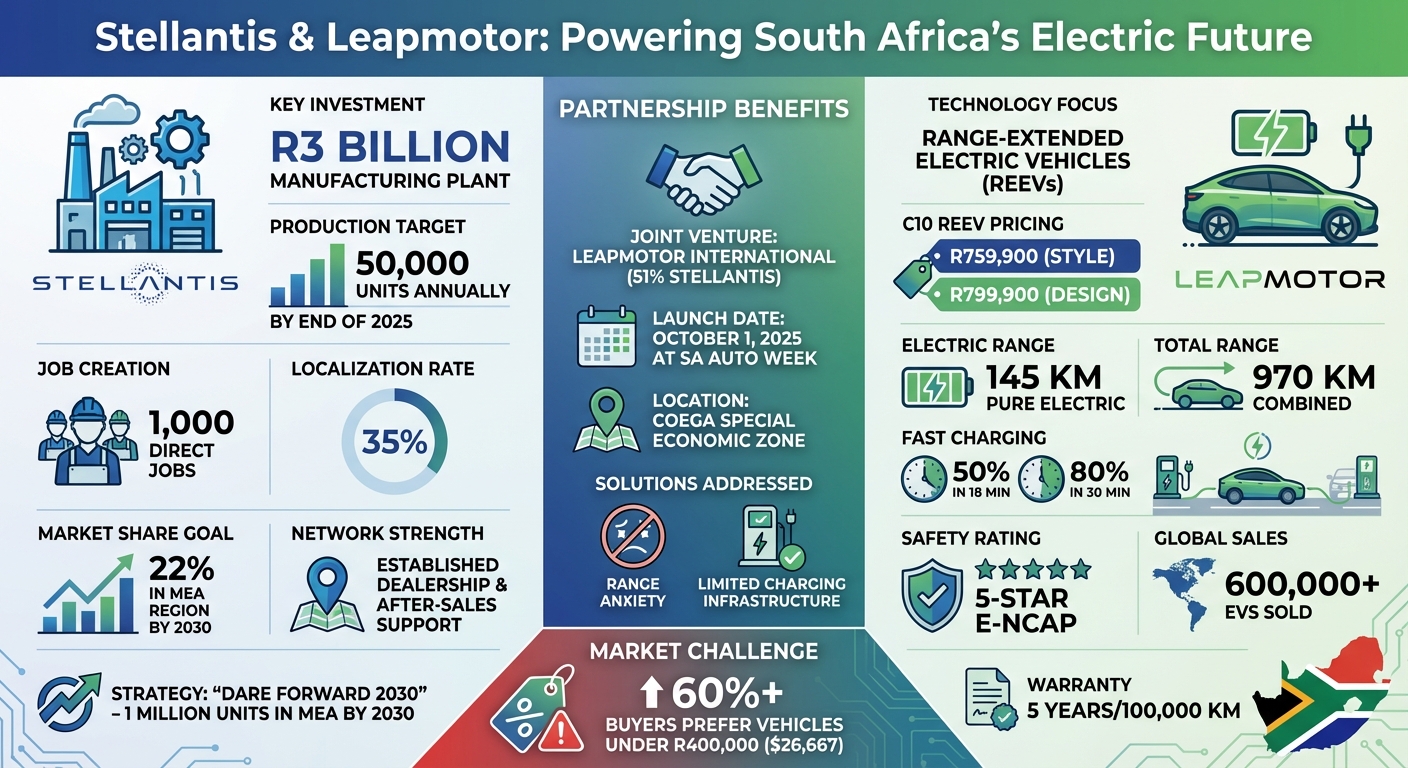
Stellantis has committed R3 billion to establish a manufacturing plant in the Coega Special Economic Zone. This facility is expected to roll out 50,000 units annually by the end of 2025, with a localization rate of 35% and the creation of 1,000 direct jobs.
This initiative is a cornerstone of Stellantis’s "Dare Forward 2030" strategy, which aims to produce 1 million units in the Middle East and Africa (MEA) region by 2030 and secure a 22% market share. To strengthen its position in South Africa’s electric vehicle (EV) market, Stellantis launched Leapmotor International as a joint venture – 51% owned by Stellantis – on October 1, 2025.
"The construction of this plant is critical to Stellantis’s Dare Forward 2030 strategy. This strategy also speaks to the South African industrialization plan which is a very important tool in helping us achieve our target to produce a million units in the MEA region by 2030 – a factor that will help us attain 22% market share in this region. Our medium to long-term objective is to ensure that 90% of vehicles sold in the MEA region are sourced from our production plants in this region."
- Samir Cherfan, Stellantis Middle East Africa COO
This investment not only supports Stellantis’s ambitious production goals but also aligns with South Africa’s industrialization efforts, setting the stage for further technological and operational growth in the region.
Technology and Innovation
In addition to ramping up manufacturing, Stellantis is enhancing its technological capabilities by adopting a vertical integration model. This approach allows the company to produce essential electrical components in-house, ensuring better quality control and cost efficiency across its global network. The Coega plant is also set to expand its scope to include new-energy vehicles, such as electric, hybrid, and hydrogen-powered models, depending on market demand and government support for charging infrastructure.
Affordability and Accessibility
Understanding the price-sensitive nature of the South African market, Stellantis is leveraging Leapmotor’s competitive pricing to make EVs more accessible. For instance, in the UK, the Leapmotor T03 is priced at £15,995 (R376,972), while the Leapmotor C10 SUV costs £36,500 (R860,442) – both roughly £1,000 cheaper than comparable models. These vehicles are set to debut in South Africa at select dealerships following SA Auto Week 2025. Competitive pricing is a key strategy for encouraging the adoption of sustainable mobility in the region.
2. Leapmotor

Market Strategy
Leapmotor made its debut in the South African market through a partnership with Stellantis, officially launching during SA Auto Week 2025, held from October 1 to 3 in Gqeberha, Eastern Cape Province. The company has strategically focused on introducing Range-Extended Electric Vehicles (REEVs) to tackle the region’s energy challenges and the limited availability of charging infrastructure.
In mid-October 2025, Leapmotor rolled out the C10 REEV, priced at $50,633 (R759,900) for the Style variant and $53,327 (R799,900) for the Design variant. This pricing positions the C10 REEV to compete head-to-head with plug-in hybrid models from Chery and Haval in South Africa’s D-segment SUV market. Leapmotor aims to stand out in this competitive space by emphasizing cutting-edge technology and performance.
Technology and Innovation
The C10 REEV operates on full electric power, using a 1.5-liter gasoline engine solely as a generator. It offers a pure electric driving range of up to 90 miles (145 km) and a total combined range of approximately 603 miles (970 km). With DC fast charging, the battery can reach 50% capacity in just 18 minutes or 80% in 30 minutes.
Built on the LEAP3.0 platform, Leapmotor integrates cell-to-chassis (CTC) technology to reduce production costs while maintaining high performance. The C10 REEV is packed with advanced features, including lidar sensors, AI-driven navigation, and over-the-air (OTA) updates. Additionally, it has earned a 5-star E-NCAP safety rating, further solidifying its appeal in the market.
Impact on South Africa’s EV Market
Leapmotor benefits from Stellantis’ well-established dealership and service network across South Africa, providing essential after-sales support that builds consumer confidence. Each vehicle comes with a robust five-year/62,137-mile (100,000 km) warranty and service plan. Looking ahead, Leapmotor plans to expand its lineup with fully electric models set for release in 2026. By combining advanced technology, thoughtful design, and reliable local support, Leapmotor is helping to drive South Africa toward a more electric-driven future.
Stellantis brings Chinese EVs to South Africa
sbb-itb-99e19e3
Pros and Cons
Stellantis and Leapmotor each bring unique strengths to South Africa’s electric vehicle (EV) market, contributing in different ways while facing their own challenges.
Stellantis is making a bold move with its R3-billion investment in the Coega plant. This project is expected to generate 1,000 jobs and achieve 35% localization, which supports the company’s robust local network. However, South Africa’s market presents a challenge: more than 60% of buyers prefer vehicles priced under R400,000 (around $26,667). This preference could limit the appeal of premium EV models Stellantis might introduce. On the other hand, its well-established domestic network ensures strong after-sales support, a critical factor in building trust among consumers in a developing EV market.
Leapmotor, meanwhile, tackles one of the biggest hurdles in EV adoption: range anxiety. Its Range-Extended Electric Vehicle (REEV) technology is designed to provide reliable performance in both urban and rural areas, addressing the scarcity of charging stations. By partnering with Stellantis, Leapmotor also gains access to an established distribution network, making it easier to reach potential buyers.
| Aspect | Stellantis | Leapmotor |
|---|---|---|
| Key Strengths | R3-billion investment; 1,000 new jobs; strong local presence | REEV technology solving range anxiety; competitive pricing |
| Main Challenges | Market sensitivity to vehicles over R400,000 ($26,667) | – |
| Infrastructure Advantage | Established distribution and after-sales support network | Leverages Stellantis’ dealership network |
| Technology Focus | Local production, job creation, and quality assurance | Advanced REEV technology |
This collaboration highlights how the two companies can complement each other in addressing South Africa’s EV challenges. Together, they tackle issues like limited charging infrastructure and energy supply constraints, paving the way for greater EV adoption in the region.
Conclusion
The Stellantis-Leapmotor collaboration highlights how combining strengths can address major challenges in the electric vehicle (EV) market. Stellantis contributes its extensive dealership network and top-tier after-sales support, while Leapmotor brings its cutting-edge REEV technology and commitment to affordability. Together, they tackle two critical hurdles to EV adoption in the region: range anxiety and limited charging infrastructure.
"Leveraging our existing global presence, we will soon be able to offer our customers price competitive and tech-centric electric vehicles that will exceed their expectations." – Carlos Tavares, CEO, Stellantis
This partnership has the potential to reshape the market. Beyond just boosting sales, it plays a key role in advancing South Africa’s transition to cleaner mobility. Leapmotor’s impressive track record – selling over 600,000 EVs globally in less than a decade and aiming for 500,000 annual sales by 2025 – combined with Stellantis’ 51% majority stake in Leapmotor International, supports the country’s Just Energy Transition goals. It also strengthens South Africa’s role as a hub for advanced manufacturing and sustainable innovation.
This approach sets an example for future automotive collaborations across Africa, showing how global expertise and accessible technology can meet the unique needs of emerging markets. Stellantis and Leapmotor are paving the way for sustainable mobility solutions, demonstrating that South Africa’s electric future hinges on delivering the right vehicles and infrastructure to support them.
FAQs
What are Range-Extended Electric Vehicles (REEVs) and how do they function?
Range-Extended Electric Vehicles (REEVs) combine the benefits of electric mobility with a clever backup system. These vehicles feature a main battery and electric motor, just like regular EVs, but they also include a small gasoline-powered generator. Here’s the key difference: unlike traditional hybrids, the gasoline engine in a REEV never drives the wheels. Instead, it powers the generator, which recharges the battery when its charge gets low.
You charge a REEV the same way as any other electric vehicle – by plugging it in. But when the battery runs low, the generator steps in to produce electricity, keeping the car running without needing an immediate charging station. This design makes REEVs a great option for longer trips, especially in areas still building out their EV charging infrastructure. It’s a smart way to enjoy the perks of electric driving while easing concerns about range.
How will Stellantis and Leapmotor’s partnership shape South Africa’s electric vehicle market?
Stellantis has taken a 51% stake in Leapmotor International and committed $1.6 billion, a move that gives Leapmotor access to Stellantis’ vast dealer network and supply chain know-how across Africa. With over 500 sales points at their disposal, this collaboration promises a quicker rollout of new EV models and dependable local support – two factors that are critical for overcoming challenges often faced by imported electric vehicles.
The first model to emerge from this partnership, the Leapmotor C10 REEV, made its debut in South Africa in September 2025. Priced under R400,000 (around $22,700), it’s aimed squarely at a broad segment of the market. The C10 comes equipped with a 28.4 kWh lithium-iron-phosphate battery, a 1.5-liter gasoline generator, and an all-electric range of up to 170 km (106 miles). Its total range spans an impressive 970–1,150 km (603–715 miles), thanks to its hybrid setup. Add in fast-charging capability and a robust drivetrain, and the C10 is built to tackle both city commutes and long-distance road trips, effectively addressing range anxiety.
By delivering affordable, high-performing EVs through a well-established dealership network, Stellantis and Leapmotor aim to speed up EV adoption in South Africa. Their efforts also seek to diversify the market and inspire investment in charging infrastructure, laying the groundwork for a more sustainable automotive future in the region.
What advantages does Stellantis gain by opening a manufacturing plant in South Africa?
Stellantis’s decision to set up a local manufacturing plant in South Africa brings several advantages, especially when it comes to tailoring vehicles for the region’s specific driving needs. For instance, the Leapmotor C10 REEV, with its 145 km electric-only range and a combined 970 km range thanks to its generator-assist system, is a perfect fit for long-distance travel. This design helps ease concerns about range anxiety, making it a practical choice for South African drivers.
Producing vehicles locally also means cutting down on import duties and shipping expenses. As a result, Stellantis can offer the C10 REEV at a more competitive price – starting at around $41,000 USD. This pricing strategy makes electric vehicles more attainable for a broader audience, supporting affordability and encouraging EV adoption in the market.
Beyond affordability, the local plant enhances Stellantis’s supply chain efficiency by tapping into its global expertise and established dealer network. With a distribution system capable of delivering 95% of parts within a day, the company ensures reliable service and minimal downtime for EV owners. This initiative not only boosts customer satisfaction but also creates local jobs, driving growth in South Africa’s automotive sector while aligning with the country’s broader sustainability goals.