
 Thabo Nkosi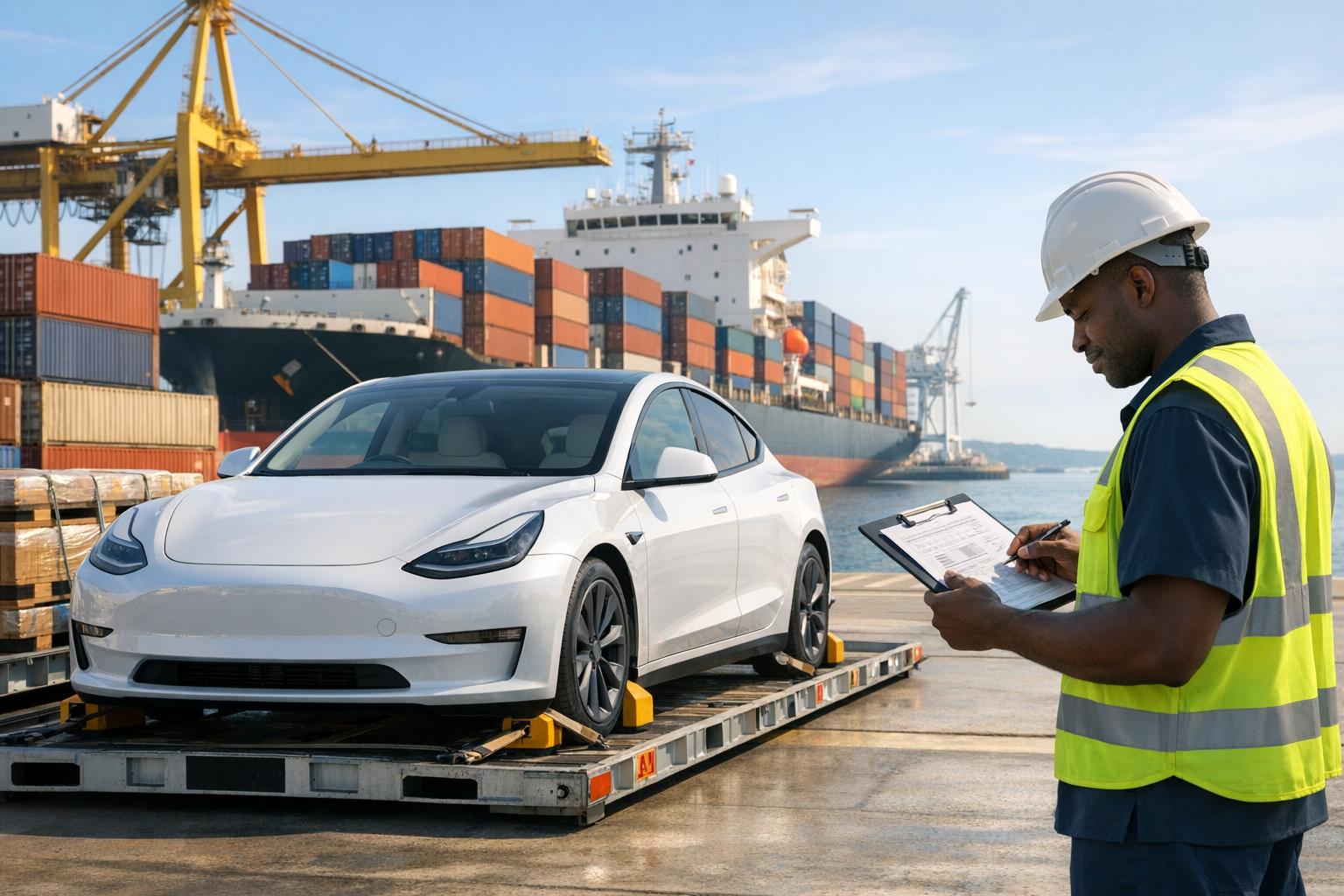
Want to import an electric car to Africa? Here’s what you need to know:
- Regulations vary by country: For example, South Africa requires permits and limits used car imports, while Kenya enforces an 8-year age limit and roadworthiness inspections.
- Tax benefits exist: Some countries, like Kenya, offer reduced excise duties for EVs, while others, like Ethiopia, have banned fossil-fuel vehicle imports entirely.
- Shipping options: Choose between Ro-Ro (around $3,500–$4,500) or container shipping ($4,500+ for extra protection).
- Key documents: Ensure you have a Bill of Lading, Certificate of Conformity, and safety certifications like UN38.3 for batteries.
- Customs clearance: Prepare for duties, VAT, and inspections. Hiring a clearing agent can simplify the process.
- Vehicle compatibility: Opt for EVs with high ground clearance, long battery range (248+ miles), and Type 2/CCS2 charging ports to handle Africa’s unique conditions.
Quick tip: Research your destination country’s specific rules before starting. A smooth process depends on preparation and compliance with local requirements.
Import Regulations by Country
Bringing an electric vehicle (EV) into Africa involves navigating a maze of country-specific rules. Each nation has its own requirements for permits, age restrictions, and compliance standards. What works in South Africa might not apply in Nigeria or Kenya, so thorough research is a must.
Required Permits and Import Rules
South Africa requires an import permit from the International Trade Administration Commission (ITAC) before shipping your vehicle. Additionally, a Letter of Authority (LOA) from the South African Bureau of Standards (SABS) is necessary to confirm the vehicle meets local safety standards. Importing used vehicles is heavily restricted and generally allowed only for returning residents, immigrants, or under specialized circumstances.
Nigeria mandates compliance with the Standards Organization of Nigeria Conformity Assessment Program (SONCAP) for all imports. The SONCAP certification, which costs around $2,000 per car model, ensures that vehicles meet Nigerian safety and environmental regulations.
Kenya enforces an 8-year age limit from the date of first registration for imported vehicles. Importers must also secure a Certificate of Roadworthiness from the Kenya Bureau of Standards (KEBS), obtained through an authorized inspection agency in the exporting country.
Morocco has stricter rules, allowing only vehicles under 5 years old to be imported.
Tax benefits and duty structures also play a major role in shaping the feasibility of EV imports.
2025 Tax and Duty Benefits for Electric Vehicles
South Africa imposes a 25% import tariff on electric vehicles, which is notably higher than the roughly 18% tariff for gasoline-powered cars. However, there are full duty rebates under Rebate Item 460.17/87.03 for vintage vehicles (over 40 years old) or collector’s items recognized internationally, provided an ITAC permit is obtained.
Kenya has a tax structure that favors EVs. Fully electric vehicles are subject to a 10% excise duty, significantly lower than the 20% to 35% levied on internal combustion engine vehicles.
Don’t overlook local drive-side requirements and safety documentation, which are just as important as permits and taxes.
Standards Compliance and Drive-Side Requirements
Drive-side compatibility is a key factor that varies across Africa. Kenya requires Right-Hand Drive (RHD) for all imported vehicles. Similarly, South Africa mandates RHD for vehicles to be registered and driven on public roads. Left-Hand Drive (LHD) vehicles face registration restrictions unless special exemptions apply. Nigeria, on the other hand, uses LHD as its standard.
For EVs, additional safety documentation is crucial. This includes Material Safety Data Sheets (MSDS) and UN38.3 test reports, especially for ocean freight. Many countries also require a Pre-Export Certificate of Conformity (PVOC) or Certificate of Conformity (COC) to ensure the vehicle meets local safety and roadworthiness standards.
| Country | Drive-Side | Age Limit | Primary Standard | Key Permit | Certification Cost |
|---|---|---|---|---|---|
| Kenya | Right-Hand Drive (RHD) | Max 8 years | KEBS (KS1515:2000) | COC / PVOC | $800+ |
| South Africa | RHD for road use | Restricted for used cars | SABS | ITAC Permit / LOA | Approx. $3,800 (valid 2 years) |
| Nigeria | Left-Hand Drive | Max 15 years | SONCAP | SONCAP Certificate | Approx. $2,000 per model |
To avoid fines or delays, submit electronic cargo tracking documents (ECTN/CTN/ACID) at least five days before your vessel arrives at an African port. Vehicles that fail to meet these regulations risk seizure or being denied registration, so double-check all requirements before proceeding with your purchase.
Selecting an Electric Vehicle for African Conditions
When choosing an electric vehicle (EV) for Africa, it’s essential to consider the region’s unique challenges. With less than 20% of roads in Africa paved, your EV must be equipped to handle rough, uneven terrain. High ground clearance and durable suspension systems are must-haves, especially if you’re venturing beyond urban areas. These features ensure the vehicle can withstand the rugged conditions commonly encountered.
Battery performance is another critical factor. Opt for EVs with advanced thermal management systems to maintain battery efficiency in extreme heat. Additionally, high-capacity batteries are necessary for traveling long distances between sparse charging stations. Unlike Europe or North America, Africa lacks dense charging networks, so EVs with a range of over 248 miles (400 km) are ideal for rural journeys.
Key EV Features for African Markets
Charging port compatibility is non-negotiable. EVs equipped with Type 2 connectors for AC charging and CCS2 for DC fast charging are best suited for African markets. Vehicles from North America (Type 1/CCS1) or China (GB/T) will require adapters, so confirm your EV includes Type 2 and CCS2 ports before importing.
Considering that only eight African countries have reliable electricity grids, it’s wise to look for EVs that support smart charging or can integrate with solar-powered charging stations. These features can help mitigate power outages and reduce running costs. In Uganda, for instance, electric motorcycle drivers reported earning three times more income than those using petrol-powered bikes, thanks to lower electricity costs.
For those frequently tackling rough terrain, models like the Subaru Solterra, with its X-MODE for off-road driving, or the Kia EV9, which offers Terrain Mode for Mud, Sand, and Snow, are excellent choices. The Volvo EX40 stands out for its smooth suspension, making it a great option for bumpy, unpaved roads. If reliability is your top priority, the Nissan Leaf is a proven performer with 14 years of electric vehicle experience and an impressive 95.6% reliability rating.
Finding EVs Through Reliable Platforms
Once you’ve identified the features you need, turn to a trusted platform to find your EV. EV24.africa provides a curated selection of EVs with detailed specifications, clear pricing, and delivery options across the continent. Whether you’re after a rugged off-road model or a city-friendly commuter, their verified listings and transparent details make the search process easier and more reliable. They even offer financing options to make EV ownership more attainable.
How to Import an Electric Car: Step-by-Step
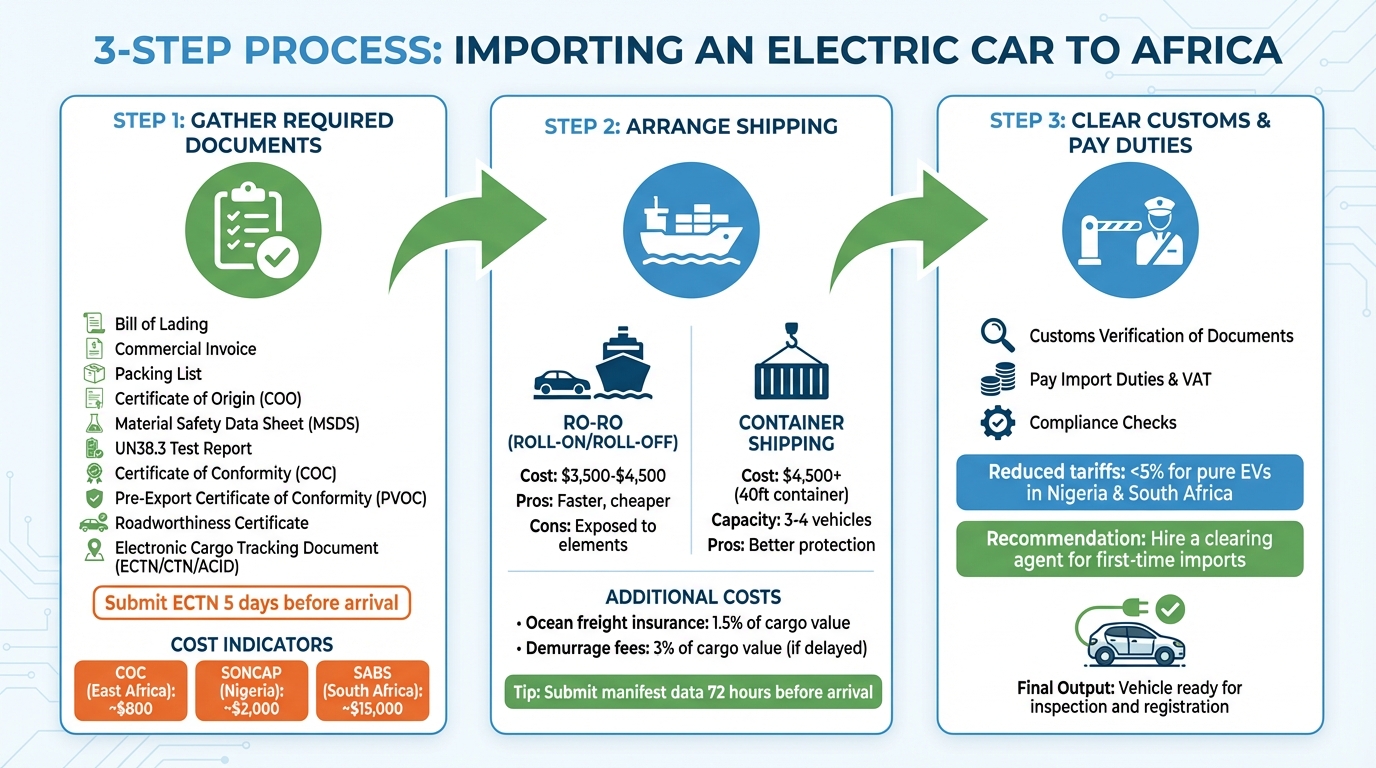
How to Import an Electric Car to Africa: 3-Step Process Guide
Bringing an electric vehicle (EV) into Africa takes careful planning. The process typically unfolds in three stages: preparing documents, managing shipping logistics, and clearing customs. While the exact steps can differ depending on the destination country, understanding the essentials can save you from unnecessary delays or penalties. Here’s a breakdown of what you’ll need to do.
Step 1: Gather Required Documents
Start by collecting the key shipping documents: Bill of Lading, Commercial Invoice, Packing List, and Certificate of Origin (COO). Since electric cars come with specialized battery systems, you’ll also need a Material Safety Data Sheet (MSDS) and a UN38.3 test report to ensure the battery meets safety standards.
Next, secure compliance documents, such as a Certificate of Conformity (COC), Pre-Export Certificate of Conformity (PVOC), vehicle technical files, and a Roadworthiness Certificate. If you’re importing to East African Community countries, the COC is especially important and typically costs around $800. For Nigeria, you’ll need a SONCAP certification, which costs about $2,000 per model, while South Africa requires an SABS certification, priced at approximately $15,000.
Additionally, submit an Electronic Cargo Tracking Document (ECTN, CTN, or ACID) at least five days before the car arrives at the port. For used vehicle imports into South Africa, you’ll also need a Letter of Authority from the National Regulator for Compulsory Specifications (NRCS) and an import permit from the International Trade Administration Commission (ITAC). To speed up processing, submit manifest data – including details like the VIN and battery capacity – 72 hours before the vehicle’s arrival.
Step 2: Arrange Shipping
When it comes to shipping, you have two main options:
- Ro-Ro (Roll-on/Roll-off): Costs range from $3,500 to $4,500 for shipping from Chinese ports to African destinations like Durban or Lagos. This method is quicker and more affordable but leaves vehicles exposed to the elements.
- Container Shipping: A 40-foot container, which can hold three to four vehicles, costs around $4,500. This option offers better protection for your car.
Don’t forget to budget for ocean freight insurance, which typically costs 1.5% of the cargo’s value. Also, set aside 3% of the cargo’s value for potential demurrage fees, which are charged if your vehicle remains at the port beyond the free storage period.
Strategic port selection can streamline the process. For example, the Port of Mombasa in Kenya has a pre-inspection zone that can speed up clearance. Similarly, some North African countries, like Egypt, have expedited customs clearance for EVs. To avoid long storage times and additional fees, you might also consider inland dry ports, such as CityDeep ICD in South Africa or facilities in Ibadan, Nigeria. Finally, ensure the EV’s battery packaging meets short-circuit proof standards in addition to UN38.3 certification.
Step 3: Clear Customs and Pay Duties
Once your EV arrives, customs officials will verify that all documentation matches the vehicle. Some countries, like Nigeria and South Africa, have reduced import tariffs on pure electric vehicles to less than 5%, making EVs more affordable in these markets.
If this is your first time importing, hiring a clearing agent is a smart move. These professionals understand local customs processes and can handle duty calculations, VAT payments, and compliance checks. Be sure to confirm the specific import duties and VAT rates for your destination, as these vary by country.
Customs clearance times depend on the efficiency of pre-declarations and the destination country. Keep all receipts and clearance documents, as you’ll need them for vehicle registration and any future references.
sbb-itb-99e19e3
After Your Vehicle Arrives
Once your electric vehicle (EV) has cleared customs, there are a few essential steps to get it certified and registered for use on the road.
Vehicle Inspection and Roadworthiness Certification
The inspection process varies depending on the country.
In Kenya, a pre-shipment roadworthiness inspection is mandatory. This inspection, conducted by a KEBS-appointed agent, ensures compliance with KS1515:2000 standards. Once your vehicle passes, you’ll receive a Certificate of Roadworthiness, which is a key document for registration.
In South Africa, inspections take place after the vehicle arrives. Before registering your EV, you must secure a Letter of Authority (LOA) from the National Regulator for Compulsory Specifications (NRCS). Additionally, a clearance certificate from the South African Police Service (SAPS) is required. This certificate is issued only after you’ve obtained a referral and registration certificate from the registering authority. To simplify the process, it’s best to work with a licensed clearing agent.
Once your vehicle passes all safety checks, you can move on to the registration process.
Registering Your Vehicle
The registration process also differs by country.
In Kenya, vehicle registration is managed by the National Transport and Safety Authority (NTSA) through the eCitizen portal. You’ll need a TIMS account to complete the process. Key documents include the original canceled export logbook, KRA PIN Certificate, Bill of Lading, Commercial Invoice, and the KEBS pre-shipment certificate. Additionally, you’ll need to activate local insurance before number plates can be issued.
In South Africa, registration must be done in person at local authorities using the electronic National Administration Traffic Information System (eNaTIS). Required documents include the NRCS LOA, SAPS clearance certificate, foreign registration documents, SARS proof of compliance, and identification or corporate documents. South African residents must provide an RSA identity document, while foreigners need a traffic register number certificate.
Conclusion
By 2025, importing an electric vehicle to Africa has become more straightforward, thanks to zero-tariff policies across 53 countries and tax exemptions in Ghana, Egypt, and Rwanda. Still, success hinges on careful planning and adherence to each country’s specific regulations. For example, Ethiopia allows only certain used energy-efficient vehicles, Morocco enforces strict battery capacity standards, and Kenya is pushing for a 5% EV registration target. Understanding these nuances can save you from unnecessary delays.
To ensure a smooth process, plan meticulously. Start by gathering the necessary documents, selecting an EV suited for local conditions, and preparing for shipping and customs clearance. Once the vehicle arrives, procedures like inspection and registration vary depending on the country. Partnering with experienced clearing agents and platforms like EV24.africa can simplify the process, especially in regions where charging infrastructure remains sparse – less than 0.3 chargers per 1,000 vehicles. A well-thought-out approach can help navigate these challenges and pave the way for a successful import experience.
Africa’s electric vehicle market is advancing rapidly, spurred by ambitious sustainability targets. For instance, Morocco aims to generate 50% of its energy from renewable sources by 2030, while Tunisia plans to have 50,000 EVs on its roads by 2025. This is a prime opportunity to cut costs, reduce emissions, and embrace the shift toward greener transportation. With favorable policies and a solid import strategy, now is the perfect time to join Africa’s electric mobility movement.
FAQs
What should I consider when choosing an electric car for African roads?
When picking an electric car for African roads, you’ll want to prioritize durability, driving range, and regulatory compliance. Given that many roads are unpaved, it’s a smart move to go for vehicles with high ground clearance – around 9 inches – and a sturdy suspension system to handle uneven terrain. Long-range batteries are also a must, especially in regions where charging stations are scarce. Aim for models that can cover close to 500 miles on a single charge. For those planning to use the car for commercial purposes, look for a high payload capacity, ideally 2,200 lbs or more.
Regulatory compliance is another key factor. In most African countries, vehicles must be left-hand drive, less than 10 years old, and meet Euro II emission standards or higher. Additionally, ensure the car has proper battery safety certifications and meets technical requirements for smooth customs clearance. Lastly, it’s wise to choose brands with an established service network in the region. This makes it easier to find spare parts and get maintenance support. By keeping these aspects in mind, you can select an EV that’s reliable, efficient, and ready to tackle Africa’s diverse driving conditions.
What are the import regulations and tax benefits for electric cars in different African countries?
Importing electric vehicles (EVs) into African countries comes with a variety of regulations and requirements. Most nations demand essential paperwork such as a purchase invoice, a certificate of origin, and a local compliance certificate. Age restrictions are also common – Seychelles, for instance, only allows EVs that are up to 3 years old, while Ghana permits vehicles as old as 10 years. On top of that, some countries enforce technical standards like Euro II emissions compliance or specific configurations such as right-hand-drive models in South Africa.
Tax policies for EV imports also vary widely. Morocco provides significant tax breaks, potentially reducing import fees for a $25,000 EV to just $200–$800. In contrast, South Africa imposes a 25% import duty along with a 14% VAT. Ghana offers duty waivers for EVs used in public transport and will introduce an 8-year import-duty exemption for certain models starting in 2024. Nigeria’s forthcoming 2025 Electric Vehicle Transition Bill removes VAT but includes a 15% national levy and an import duty ranging from 10–20%. Understanding these country-specific regulations and incentives is essential for anyone looking to bring an EV into the region.
What documents do I need to import an electric car into Africa?
To bring an electric vehicle (EV) into Africa without hiccups, you’ll need to have all the essential paperwork in order. These documents are crucial for navigating customs and meeting local regulations:
- Commercial invoice: This serves as proof of purchase, detailing the transaction and including the buyer’s and seller’s information.
- Certificate of Origin: Confirms where the vehicle was manufactured, which helps determine applicable tariffs.
- Bill of Lading: Provides shipment details, such as the carrier, vessel, and port of entry.
- Vehicle title or registration: Establishes legal ownership of the EV.
- Customs declaration form: Official documentation required by the customs authority of the destination country.
- Import permit: Certain countries, like South Africa, mandate government approval before the vehicle is shipped.
- Compliance certificate: Verifies that the EV complies with local safety and technical standards, such as Ghana’s G-CAP.
- Battery documentation: Includes safety certifications or inspection reports for the lithium-ion battery.
Make sure these documents are complete and formatted correctly – for example, using USD ($) for monetary values and mm/dd/yyyy for dates. This preparation can save you from unnecessary delays or extra costs during the import process.