
 Thabo Nkosi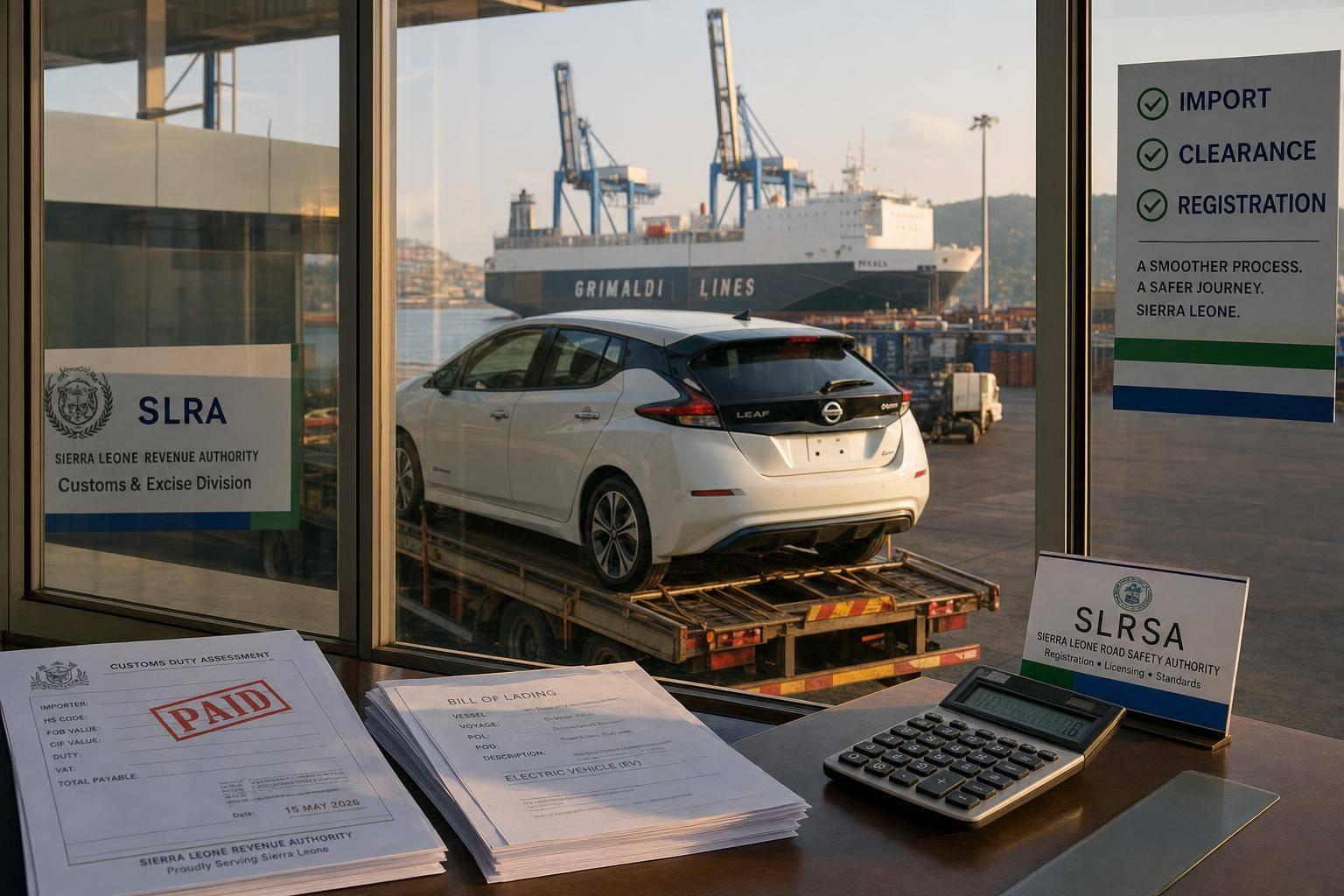
If you import a new fully electric car into Sierra Leone in 2026, you may pay 0% customs duty, 0% VAT/GST, and 0% excise tax – but you still need to budget for shipping, port fees, SLRSA registration, and insurance.
If I were planning an EV import, I’d focus on four things first:
- Tax status: new BEVs get the main tax break
- Total landed cost: car price is only part of the bill
- Customs clearance: delays can add storage and demurrage charges
- Registration: you cannot legally drive before SLRSA finishes the process
A simple way to price the deal is:
Total landed cost = vehicle price + shipping and insurance + import charges + port and broker fees + inland delivery + registration + first-year insurance
The article also makes one point very clear: customs release does not mean road legal use. After the car leaves the port, you still need inspection, registration, plates, and insurance.
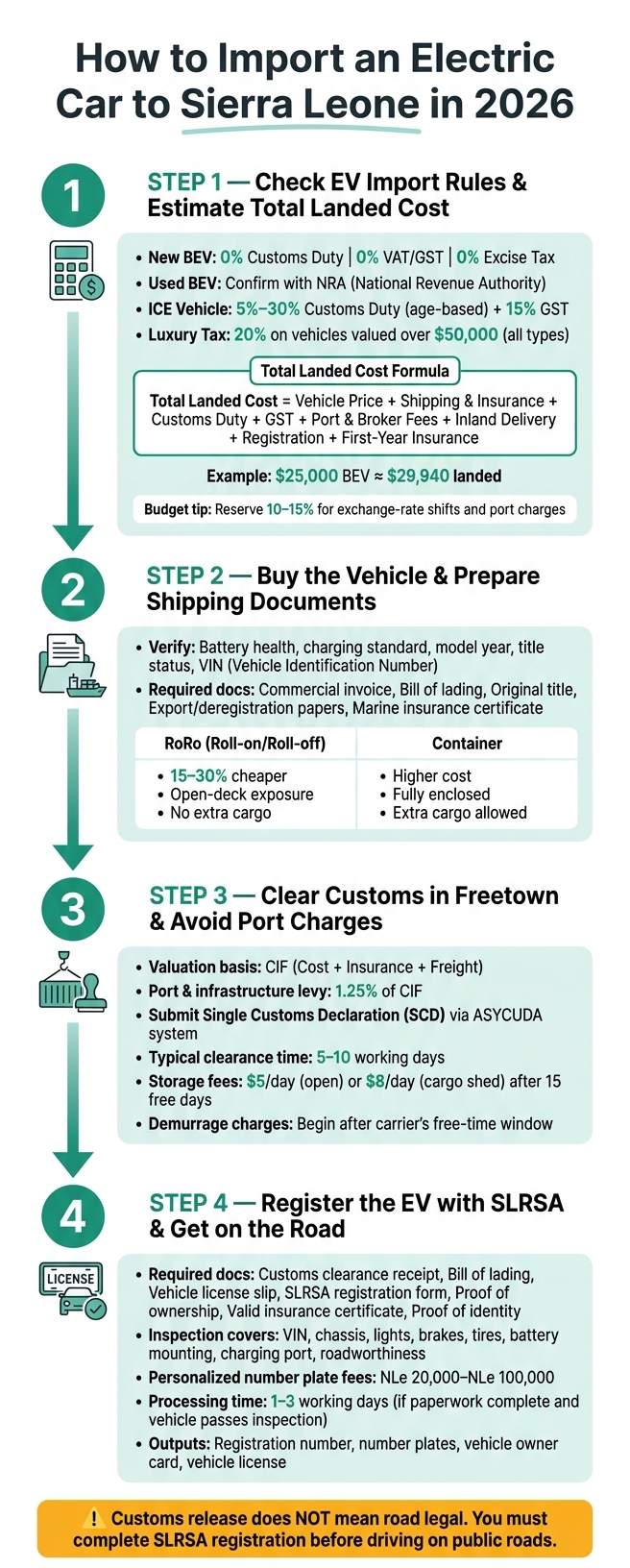
How to Import an Electric Car to Sierra Leone in 2026: Step-by-Step Process
Quick comparison
| Item | New BEV | Used BEV | ICE Vehicle |
|---|---|---|---|
| Customs duty | 0% | Check with NRA | 5% to 30% by age |
| VAT/GST | 0% | Check with NRA | 15% in most cases |
| Excise tax | 0% | 0% | May apply |
| Luxury special tax | 20% over $50,000 | 20% over $50,000 | 20% over $50,000 |
| Registration with SLRSA | Yes | Yes | Yes |
| Main risk | Port and paperwork costs | Tax treatment not fully clear | Higher tax bill |
Bottom line: if you’re importing a new EV, the tax side may be light, but the process still depends on clean documents, the right customs coding, and fast follow-through at the port and with SLRSA.
sbb-itb-99e19e3
Step 1: Check EV Import Rules and Estimate Your Total Landed Cost
Check the tax treatment before you buy. That one step can change the whole deal. Once you know how Sierra Leone will treat the vehicle at customs, you can price it with a lot more confidence before you send money to the seller.
How Sierra Leone Taxes New and Used Electric Cars
Fully electric vehicles are exempt from customs duty and VAT/GST. Sierra Leone’s Medium-Term Revenue Strategy also sets excise tax on electric vehicles at zero.
Used BEVs are a bit less straightforward. They need NRA confirmation, and customs may assess them under used-vehicle rules. So before you buy, contact NRA Customs at Queen Elizabeth II Quay and ask them to confirm the HS code, duty rate, and GST treatment for that exact vehicle.
For conventional ICE vehicles, the tax picture is much heavier. Customs duty is based on age:
- 5% for cars no older than 4 years
- 20% for cars between 4 and 10 years old
- 30% for cars older than 10 years
A 20% special tax can also apply to luxury vehicles valued above $50,000.
The Cost Formula to Use Before You Order
Even if duty and GST are cut or waived, your final bill will still be higher than the seller’s asking price. Shipping, port charges, paperwork, and local delivery all add up.
Use this formula to build your budget in U.S. dollars:
Total Landed Cost (TLC) = Vehicle Price + Shipping & Insurance + Customs Duty + GST + Port & Broker Fees + Inland Delivery + Registration & Licensing + First-Year Insurance
Here’s what that can look like in practice: a $25,000 BEV can land near $29,940 after shipping, port fees, registration, and insurance.
It’s also smart to leave some breathing room in your budget. Reserve 10% to 15% for exchange-rate shifts and port charges.
Cost Comparison Table: New BEV vs. Used BEV vs. ICE Vehicle
The table below shows the main cost lines side by side. Anything marked Confirm with NRA is where buyers usually need the most care.
| Cost Component | New BEV | Used BEV | ICE Vehicle |
|---|---|---|---|
| Customs Duty | 0% – exempt | Confirm with NRA | 5%–30% based on vehicle age |
| VAT / GST | 0% – exempt | Confirm with NRA | 15% standard GST on most imports |
| Excise Tax | Zero | Zero | Age/engine-based charges may apply |
| Luxury Special Tax | 20% if value exceeds $50,000 | 20% if value exceeds $50,000 | 20% if value exceeds $50,000 |
| Port & Broker Fees | Applicable | Applicable | Applicable |
| SLRSA Registration | Required | Required | Required |
In plain English: new BEVs usually face the lowest tax burden, while used BEVs need a direct check with NRA before you move ahead. With that cost picture in place, the next job is getting the shipping documents ready.
Step 2: Buy the Vehicle and Prepare Your Shipping Documents
Now that you have a cost estimate, the next step is to buy the vehicle and get your documents lined up before anything leaves port. This part matters more than many buyers think. A small paperwork error can slow release at the Port of Freetown and add costs you didn’t plan for.
Choose an EV With Clear Ownership Records and the Right Specs
Before you send payment, verify five things: battery health, charging standard, model year, title status, and VIN.
Battery health has a direct effect on how far the car will go on a charge. If the battery is worn down, the car’s day-to-day range drops, and resale value can drop with it. Charging standard matters just as much. If the connector type doesn’t fit the charging setup you can access in Sierra Leone, the vehicle may be much harder to use than it looks on paper.
Also check the car’s size and ground clearance. Local roads can include potholes and unpaved sections, so a low-slung EV may be a headache from day one.
On the ownership side, the title should be clean: no liens, no salvage mark, and no theft flags. If a lien holder is listed on the title, you’ll need a notarized written authorization from the lender before the vehicle can be exported. Run the VIN through the motor vehicle registry in the exporting country, then compare it with the physical chassis marking on the car itself. If those numbers don’t match, customs can hold the vehicle almost at once.
Once you’ve picked the vehicle, get the paperwork locked in before shipment.
Documents to Collect Before the Car Ships
Every document should match across the board. That means the VIN, make, model, year, buyer, and seller details should be identical everywhere. Even one mismatch can lead to a customs revaluation and delay release.
Before the car leaves port, make sure you have:
- A commercial invoice showing the seller and buyer names, full vehicle description, VIN, price, currency, and agreed Incoterms
- A bill of lading or seaway bill with the vessel name, loading and discharge ports, VIN, and shipment type. Review the draft before it is finalized so you can catch any error in the VIN, year, buyer, or seller details early
- The original title or proof of ownership
- Export or deregistration papers from the origin country, where required
- A marine insurance certificate covering the voyage to Freetown
Once the file is complete, the next place costs tend to tighten is customs clearance in Freetown.
RoRo vs. Container: How Your Shipping Choice Affects Cost
Choosing between roll-on/roll-off and container shipping is mostly a tradeoff between price and protection.
RoRo is usually 15%–30% cheaper than container shipping for one car. The vehicle is driven onto the vessel and driven off at arrival, which usually means simpler port handling and, in many cases, faster processing too.
Container shipping costs more, but the EV stays inside a sealed steel box for the full voyage. That gives it better protection from sea spray, minor knocks, and unauthorized access. It also allows you to place extras inside, like a charger or spare parts. For a high-value EV, or for a shipment that includes equipment you want moved together, that can make container shipping the better fit.
| Factor | RoRo | Container |
|---|---|---|
| Relative cost | Lower | Higher |
| Vehicle protection | Open-deck exposure | Fully enclosed |
| Extra cargo | Not permitted | Permitted inside container |
| Port handling | Driven on/off vessel | Crane offload, destuffing required |
| Best for | Standard running EVs, cost-focused buyers | High-value or accessory-loaded EVs |
After you choose the shipping method, customs valuation and port charges become the next big cost drivers.
Step 3: Clear Customs in Freetown and Avoid Extra Port Charges
Before your vessel gets to Freetown, make sure you understand the clearance process. Storage and demurrage can start piling up fast after arrival.
How Customs Values the EV and Calculates Import Charges
The National Revenue Authority (NRA) values the vehicle based on CIF: the purchase price, freight to Freetown, and marine insurance. From that amount, customs applies any exemption or levy that fits the shipment. Sierra Leone also charges a 1.25% port and infrastructure levy on CIF for imports.
If you’re importing a fully electric vehicle, it’s smart to confirm the exemption has been coded the right way before shipment. That gives customs what it needs to apply the exemption during clearance.
Once customs sets the CIF value, all clearance documents need to match it. If one number is off, the whole process can slow down.
Documents Required During Customs Clearance
Your clearing agent submits the Single Customs Declaration (SCD) through ASYCUDA. NRA then assigns an inspection level, which decides how much review the shipment will get.
You’ll usually need:
- Bill of lading
- Commercial invoice
- Packing list
- Customs declaration forms
- Valuation or origin documents
- NRA payment receipts for any duties, GST, or levies charged
If you’re applying for an EV-related exemption, you’ll also need proof that the vehicle qualifies, such as an approval letter or an NRA-issued exemption code.
Port and terminal operators won’t release the cargo until all port charges and any demurrage have been paid.
Customs rules can shift, so ask your broker for an updated checklist before the vessel arrives. In many cases, straight-through clearance takes 5 to 10 working days.
Any mismatch can delay release and drive storage costs up.
Port Charges That Often Catch Importers Off Guard
These fees are separate from import tax, but they still hit your landed cost.
| Charge Type | What It Covers | Budget Tip |
|---|---|---|
| Terminal handling | Loading and unloading the vehicle or container at the terminal | Ask for a fee schedule upfront |
| Storage fees | Cargo held beyond the free-time window | Clear it before free time ends |
| Demurrage | Carrier charges for containers held beyond free days | Confirm your shipping line’s free-time window |
| Scanning/inspection fees | NRA scanning or physical inspection where required | Budget for these if your declaration is selected for review |
| Broker/clearing agent fees | Document handling and coordination with NRA and port operators | Request an itemized quote before hiring an agent |
| Inland transport | Moving the vehicle from Freetown Port to your final destination | Costs vary by distance and road conditions |
Open storage costs $5/day after 15 days. Cargo shed storage costs $8/day after 15 days. Ask for delay-cost estimates at both 3 days and 10 days so you know what a hold-up could cost before it happens.
Step 4: Register the EV With SLRSA and Get It on the Road
Once customs clearance is done, the last step before you can use the EV on public roads is SLRSA registration and inspection. After customs release, go straight to SLRSA and finish that process before driving the vehicle on the road.
Registration Documents and Inspection Requirements
Take both originals and copies of every required document to SLRSA. In many cases, delays happen for one simple reason: missing paperwork.
You’ll need:
- Customs clearance receipt or release documents
- Bill of lading or shipping document
- Vehicle license slip issued during customs clearance
- Completed SLRSA registration form
- Proof of ownership, such as the original purchase invoice, title, or export/de-registration certificate from the country of origin
- Valid motor insurance certificate
- Proof of identity, such as a national ID or passport
- If needed, customs-issued vehicle valuation or assessment papers, especially for dealers or returning residents
The inspection covers the VIN, chassis number, motor and chassis identifiers, lights, brakes, tires, battery mounting, charging port, warning lights, and general roadworthiness. If the vehicle fails, registration is held up until the problem is fixed. That’s why it makes sense to sort out known faults before you show up.
If the EV passes inspection, SLRSA moves on to fee assessment and registration issuance.
Registration Fees, Outputs, and Processing Time
Registration fees depend on the vehicle category. A 2024 regulatory instrument shows personalized number plate fees from NLe 20,000 to NLe 100,000, based on the plate type. On top of that, plan for first registration, inspection, plates, and licensing, then check the current total with SLRSA before you pay.
Once approved, you’ll receive a registration number, physical number plates, a vehicle owner card, and a vehicle license. Under SLRSA’s service charter, first registration usually takes 1–3 working days when the paperwork is complete and the vehicle passes inspection on the first try.
When delays happen, the usual causes are pretty plain: missing originals, VIN details that don’t match, unpaid fees, or defects found during inspection.
Conclusion: Your 2026 Import Checklist for Budgeting and Compliance
Here’s the short version:
- Confirm customs release is complete, and do not drive the EV on public roads until SLRSA registration and licensing are finished.
- Gather all ownership, shipping, identity, and insurance documents before going to SLRSA.
- Present the EV for physical inspection and fix any issues flagged during the check.
- Pay the required registration and licensing fees.
- Collect the registration number, number plates, vehicle owner card, and vehicle license.
FAQs
Can I import a used EV duty-free too?
Yes. Sierra Leone exempts qualifying 100% electric vehicles from VAT and customs duties, whether the vehicle is new or used. The aim is to support the shift to greener transport.
There are a couple of limits, though. Vehicles older than 10 years may face extra taxes, and the vehicle must still meet local safety and emissions rules to qualify.
How much should I budget beyond the car price?
Beyond the EV’s sticker price, you’ll also need to set aside money for shipping from the United States to Freetown. In most cases, that runs about $2,212–$3,079. On top of that, local costs for port handling, inspections, and admin work usually add another $1,500–$2,500.
It’s also smart to check if the vehicle qualifies for any duty or VAT relief. If it doesn’t, standard charges can include 10% import duty and 12.5% VAT, plus registration and compliance fees.
When is an imported EV legal to drive in Sierra Leone?
An imported electric vehicle is legal to drive in Sierra Leone only after it clears customs, passes the required destination inspection at the Port of Freetown, and completes official vehicle registration.
It also needs to meet the safety and emissions rules set by the Environmental Protection Agency Sierra Leone, the Standards Bureau, and the Ministry of Trade and Industry. Once registration is complete, you’ll receive the documents needed to legally drive the vehicle on Sierra Leonean roads.