
 Thabo Nkosi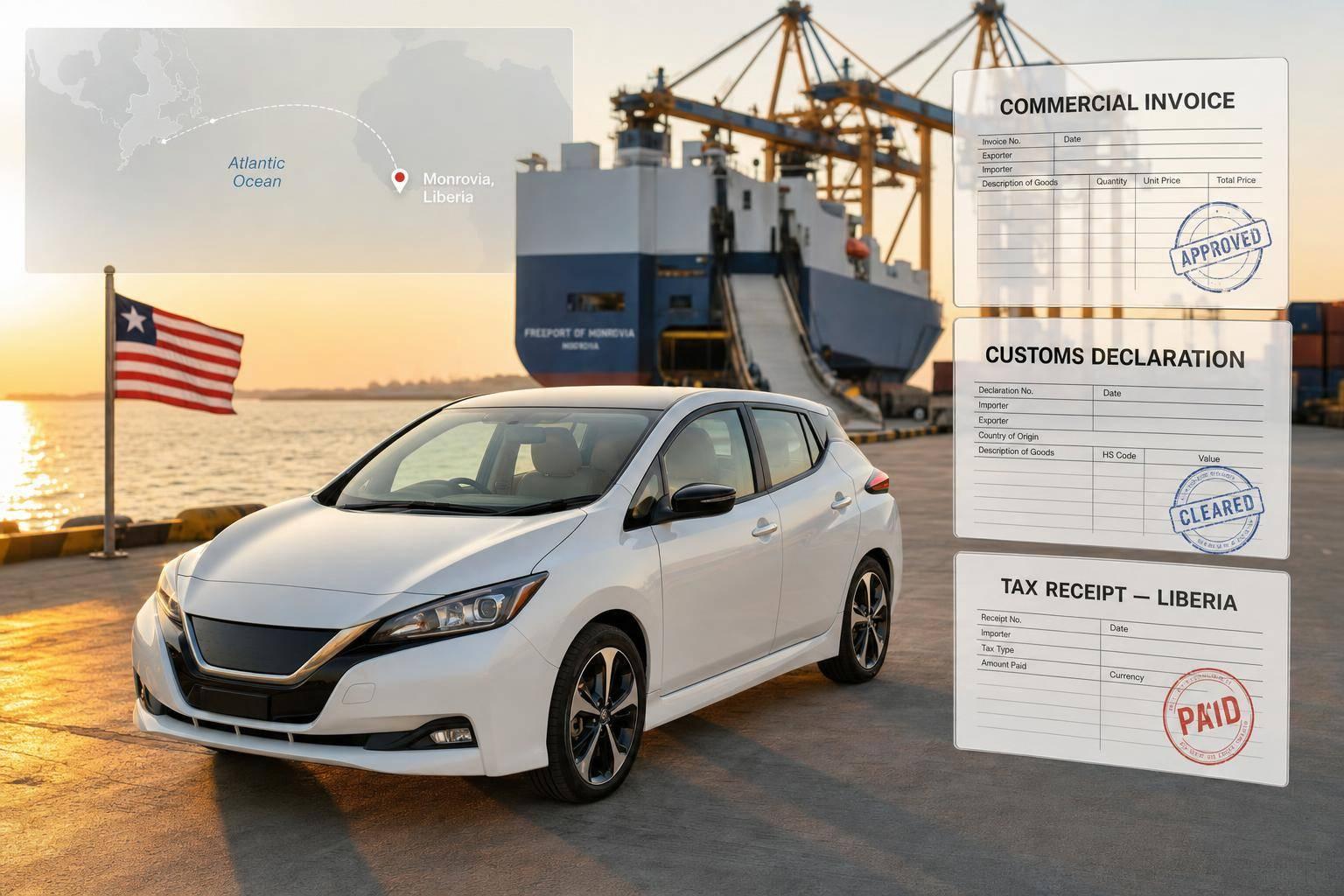
Yes, you can import a fully electric car to Liberia in 2026, and the big headline is simple: standard import duty and VAT may be 0% for 100% EVs – but your total bill still includes freight, port fees, customs charges, broker fees, inland delivery, registration, plates, and insurance.
If I were planning this import, I’d focus on five things first:
- Check the car fits Liberia’s rules: left-hand drive, correct vehicle class, and age-limit fit
- Confirm the battery is in good shape: for a used EV, aim for 80%+ battery state of health
- Estimate the full landed cost: not just the sale price
- Get the paperwork matched exactly: invoice, Bill of Lading, title, VIN, and buyer name
- Plan clearance before arrival: storage fees at Monrovia can add up if documents are off
A simple way to think about the budget is:
Total landed cost = vehicle price + freight + insurance + customs fees + port charges + broker fees + inland transport + registration + insurance
One sample in the article shows how this works in practice: a used EV with a $21,400 CIF value can still end up at about $22,528 before registration, even with 0% duty and 0% VAT. That’s why the sticker price alone doesn’t tell you much.
Here’s the short version of what matters most:
- 100% EVs may get duty and VAT relief
- Hybrids are treated differently from full EVs
- RoRo is often cheaper than container shipping, but container shipping gives more protection
- Customs uses CIF value for many charges
- Common delays come from VIN mismatches, low declared values, and missing documents
- After customs, you still need inspection, registration, plates, and third-party insurance before road use
This guide is about helping you avoid extra costs, bad vehicle picks, and port delays before you send money.
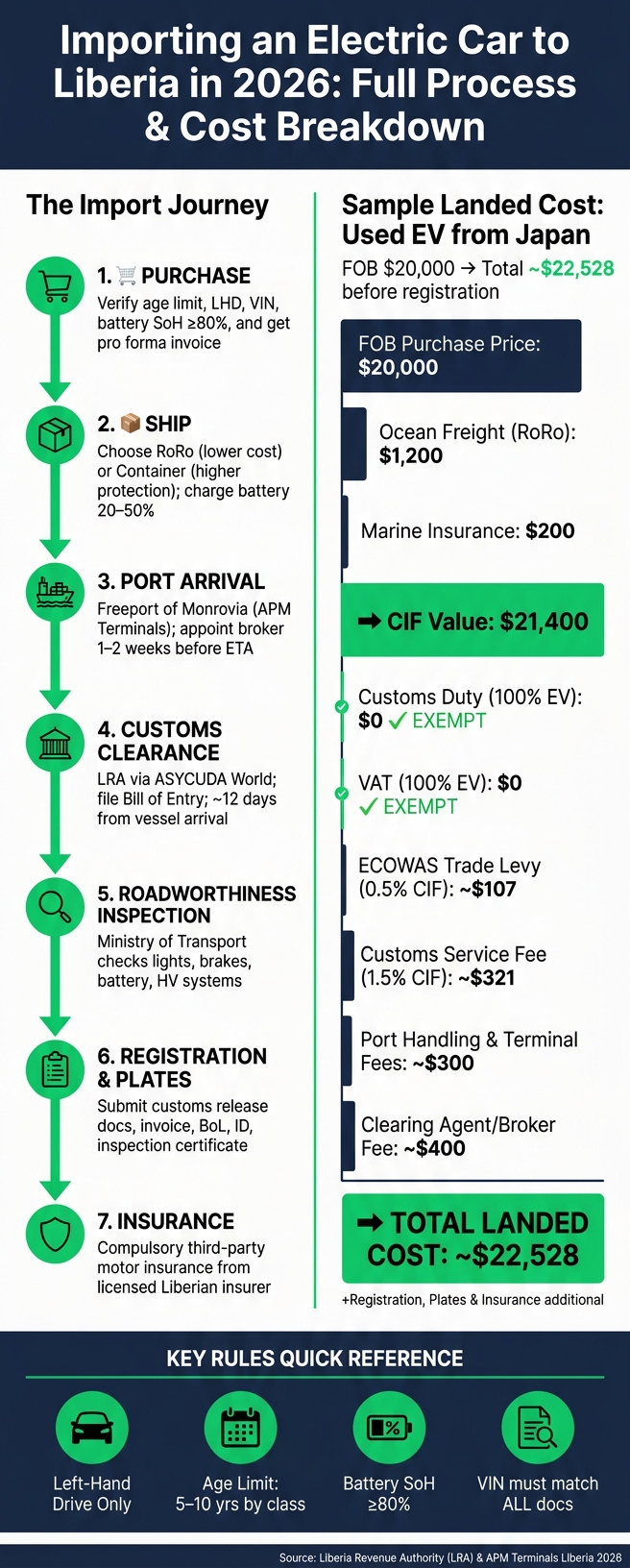
How to Import an Electric Car to Liberia: Step-by-Step Process & Costs
1. What Importing an Electric Car to Liberia Involves in 2026
Before you buy, map the full import chain. That gives you a better shot at estimating cost, avoiding delays, and picking an EV that can clear without trouble.
The process is pretty simple on paper: buy the car abroad, ship it to Monrovia, clear customs, collect it, then finish registration and insurance before you drive it. In practice, the biggest mistakes happen when people treat each step like its own job. It’s one connected chain. If one part breaks, the whole process slows down.
That’s why document checks and agency requirements should come first, even before you start comparing vehicles.
1.1 The Agencies, Port, and Documents That Control the Process
The first major risk point is paperwork. If your documents don’t line up, customs clearance can stall fast.
The Liberia Revenue Authority (LRA) handles customs valuation, duty and tax assessment, and final clearance through the ASYCUDA World electronic system. The Freeport of Monrovia, operated by APM Terminals, is the arrival point where your car is received, stored, and released after Customs issues an electronic release order. After that, the Ministry of Transport (MoT) handles registration, license plates, and roadworthiness checks. These steps have to happen in that order.
Most port delays aren’t caused by the vehicle itself. They come from document mismatches.
You’ll usually need:
- Commercial invoice
- Bill of Lading (BoL)
- Original vehicle title or export certificate
- Passport or national ID
- Proof of insurance
Every document should match on the buyer name, VIN, make, model, year, and declared value. A small spelling difference between the invoice and BoL can cause a problem. A VIN mismatch on the title can do the same. When that happens, the car may sit at port while storage fees keep adding up. It’s much cheaper to fix errors before shipment than after arrival.
| Stage | Agency / Entity | Key Document |
|---|---|---|
| Purchase | Seller / Supplier | Commercial Invoice, Vehicle Title |
| Shipping | Shipping Line | Bill of Lading |
| Port Arrival | Freeport of Monrovia (APM Terminals) | Bill of Lading |
| Customs Clearance | Liberia Revenue Authority (LRA) | Invoice, Bill of Lading, Export Certificate |
| Registration | Ministry of Transport (MoT) | Clearance Proof, Passport or National ID, Insurance |
1.2 A Simple Landed-Cost Formula to Use Before You Commit
Landed Cost = FOB vehicle price + freight + marine insurance + PSI/BIVAC fees + customs duty and taxes + port charges + clearing agent fees + inland delivery + registration, plates, and insurance.
Don’t commit to a car until that total fits your budget. That’s the number that matters, not just the sale price.
Current guidance says that 100% battery electric vehicles are exempt from standard import duty and VAT. That helps, but it doesn’t mean the import is cheap. Port handling fees at APM Terminals, clearing agent fees, and Ministry of Transport registration costs still apply. Those local charges can still come to about $1,500.
The costs that tend to catch buyers off guard are customs valuation results and port storage charges if clearance takes too long. That’s why pre-arrival document prep is one of the best ways to cut avoidable costs.
Before you buy, confirm current duty rates, port tariffs, and fee schedules directly with the LRA and your shipping agent.
With the landed cost mapped, the next step is choosing an EV that fits Liberia’s import rules and road conditions.
sbb-itb-99e19e3
2. Choose an EV That Fits Liberia’s Rules and Road Conditions
Once you’ve worked out your landed cost, the next step is picking the right vehicle. This is where a lot of import mistakes happen. Not because the car looks bad on paper, but because it doesn’t fit Liberia’s rules or day-to-day driving conditions.
2.1 Check Legal Fit First: Age Limit, Left-Hand Drive, and Vehicle Class
Import left-hand-drive vehicles only. Before you send any money, confirm that the car meets Liberia’s age rules and that its body type lines up with the customs class used at clearance. Check the VIN or chassis number, build year, steering position, and paperwork for yourself – don’t rely on a seller saying the car is "eligible".
Age limits matter more than many buyers expect. Most used vehicles face a 10-year cap, while sedans, buses, pickups, 4x4s, and light trucks face a 5-year cap under the cited rule. If the class is wrong, the steering position is wrong, or the model year doesn’t match, clearance can stop cold. And when that happens, storage fees start piling up.
Classification matters too. Liberia’s tariff schedule treats fully electric vehicles differently from hybrids, and it also separates passenger vehicles from commercial vehicles. So the drivetrain and body type listed on the paperwork need to match the car you’re buying. A mismatch here can turn a simple import into a long, expensive mess.
Once the legal side checks out, move to the next screen: battery condition and road fit.
2.2 New vs. Used EVs: Battery Checks and Models That Import Well
Use the table below to compare new and used EVs.
| Factor | New EV | Used EV |
|---|---|---|
| Purchase price | Higher upfront | Lower entry point |
| Depreciation | Steeper in the first few years | First owner has already absorbed the drop |
| Battery risk | Minimal | Requires SoH verification |
| Warranty coverage | Manufacturer coverage | Often limited or expired |
| Expected range | More predictable | Depends on battery condition |
| Documentation risk | Lower, with standard documentation | Higher if history or condition is unclear |
| Ease of inspection | Easier to verify from spec sheet and seller documents | Needs closer battery and history checks |
If you’re buying a used EV, ask for a battery state-of-health (SoH) report before you commit. A car can look spotless and still have a battery that’s lost a chunk of its usable range. Aim for 80%+ SoH. Treat anything below 75% as a discount-only buy, because that drop usually shows up in daily driving. Ask for:
- A battery SoH report
- A full-charge range photo
- Charging logs
- An independent diagnostic scan showing no cell imbalances or thermal issues
Road conditions matter just as much as battery data. Liberia has a limited paved road network and a long rainy season, so a compact crossover or small SUV often makes more sense than a low sedan. In plain terms, extra ground clearance can save you a lot of grief.
Charging is also more concentrated in urban areas like Monrovia. That means you should check the plug type, AC charging standard, and DC fast-charging standard, if the vehicle has it. It’s smart to lean toward models with connectors that are easier to support, and make sure the car comes with its original charging equipment.
2.3 Using EV24.africa to Shortlist Vehicles for Liberia
On EV24.africa, filter by budget, body type, mileage, battery data, and paperwork. Then verify the VIN, title, and export certificate before making payment. The comparison tool can help you weigh standard-range and long-range versions side by side.
For driving mostly in Monrovia, a standard-range battery will often make more sense financially than paying extra for range you may never use. More battery sounds nice, but if your driving is mostly urban, that extra cost may just sit there.
Two import-friendly options worth a look are the BYD Atto 3 and the Wuling Air EV. Both offer either compact crossover or city-car practicality, both have growing parts availability in African markets, and both tend to come with straightforward documentation from established manufacturers.
Once your shortlist is down to EVs that are compliant and battery-checked, the next move is figuring out how to ship the vehicle to Monrovia.
3. Shipping an Electric Car to Monrovia
Once your EV is compliant and on your shortlist, the next move is picking the shipping method. That choice affects freight cost, damage risk during transit, and what you may pay at the Freeport of Monrovia.
3.1 RoRo vs. Container Shipping for EVs
RoRo is usually the lower-cost option for a running EV. The vehicle is driven onto the ship and then driven off again in Monrovia. Container shipping costs more, but it gives the car added protection from weather, handling issues, and theft. If you’re shipping a higher-value EV, or sending it with parts or tools, that extra cover may be worth the bigger freight bill.
In plain terms, your shipping method changes the total landed cost before customs even enters the picture.
| Shipping Method | Cost | Protection | Best Use Case | Main Drawback |
|---|---|---|---|---|
| RoRo | Lower | Moderate | Standard, running EV with no extra cargo | Vehicle is exposed; loose items are not allowed |
| Container | Higher | High | High-value EVs or vehicles shipped with parts/tools | Higher freight cost and more complex handling |
RoRo carriers usually don’t allow loose items inside the vehicle. So if you need to ship accessories, spare parts, or extra cargo, a container is often the better fit.
After you choose the method, make sure the shipping documents and battery condition line up with the carrier’s rules.
3.2 Shipping Paperwork and EV Battery Handling Requirements
Before the vessel sails, check that the key shipping documents match exactly. That includes the Bill of Lading, commercial invoice, export title or deregistration paper, packing list for container shipments, and marine insurance certificate. The VIN, make, model, year, and electric drivetrain description should be identical across all of them. Even a small mismatch can slow down loading or release.
Battery rules matter too. Many carriers want the battery charged between 20% and 50%, and some set the limit at 30% or less. Some carriers may also reject a vehicle that can’t be driven on and off the vessel under its own power. Get that requirement confirmed in writing before you book.
Once the booking is locked in, arrival planning becomes the next big cost-control step.
3.3 Freeport of Monrovia Charges, Storage Risk, and Arrival Planning
APM Terminals Liberia publishes 2026 vehicle handling fees for the Freeport of Monrovia. These include RoRo light-vehicle charges, terminal handling, and a surcharge for non-runners. Free storage days are limited, so delays can get expensive fast. Container shipments can also face demurrage charges if the container isn’t returned on time.
A few simple steps can help you stay ahead:
- Appoint a licensed clearing agent 1 to 2 weeks before ETA
- Send documents early
- Have funds ready before the vehicle arrives
Once the car lands, customs valuation and taxes come next.
4. Liberia Customs, Taxes, and Clearance Steps
With your EV already in transit and your arrival plan set, customs is the next big cost checkpoint. This is the stage where a budget can stay under control – or start creeping up.
4.1 The Taxes and Fees That Make Up Your Import Bill
In Liberia, most import charges are based on CIF: the vehicle price plus freight and insurance to Monrovia. Some levies are also tied to that CIF value. For 100% EVs, current policy sets customs duty, VAT, and internal taxes at 0%.
| Cost Component | Calculation Base | Indicative Rate/Amount | Notes |
|---|---|---|---|
| Customs duty, VAT, internal taxes | CIF Value | 0% | Full exemption for 100% electric vehicles |
| ECOWAS Trade Levy (ETL) | CIF Value | 0.5% | Apply at the current LRA tariff, if chargeable to your shipment |
| Customs Service/User Fee | CIF Value | ~1.5% | Apply at the current LRA tariff, if chargeable to your shipment |
| Port & Terminal Fees | Per vehicle/weight | Varies | Handling, storage, and documentation at the Freeport of Monrovia; storage charges start from the day of discharge |
| Broker/Clearing Agent Fee | Service contract | Fixed or % of CIF | Budget it separately; rates vary by agent |
So yes, duty and VAT may be zero. But that does not mean your import bill is zero-heavy. The ETL, customs service fee, port charges, and broker fee can still add a few hundred dollars or more to the total. Before you ship, check each line against the current LRA tariff and port fee schedule.
Once those charges are clear, your broker can file the declaration and move the shipment into the customs process.
4.2 How Customs Clearance Works After Arrival
After the vehicle arrives, clearance runs through ASYCUDA World in a set sequence. If you know the flow ahead of time, it’s much easier to plan for storage risk and avoid slowdowns.
- Cargo arrival notice: The shipping line files the electronic manifest before the vessel docks. After discharge, the consignee or clearing agent gets an arrival notice.
- Electronic declaration (Bill of Entry): Your licensed broker gathers the commercial invoice, bill of lading, packing list, and any inspection reports, then files the declaration in ASYCUDA with scanned documents attached.
- Classification, valuation, and channel assignment: Customs places the shipment into a processing channel. A low-risk channel may move fast, while a red channel can lead to physical inspection or scanning.
- Duty and fee payment: Customs issues an assessment. Once any remaining levies and fees are paid, an electronic release order goes to the terminal.
- Terminal release and gate-out: The terminal releases the vehicle, final port charges are settled, and the permit is issued to remove the vehicle from the terminal. Clearance takes about 12 days from vessel arrival, and it can move faster when the documents are complete.
Most delays come from three very familiar problems:
- VIN mismatches between the bill of lading, invoice, and the vehicle itself
- Undervalued invoices that lead customs to recalculate CIF using internal databases, published valuation references, or similar shipments
- Missing or inconsistent documents that force manual review
These issues are cited as common delay triggers. A licensed customs broker can help catch them before they turn into storage charges.
That matters because port fees don’t just sit there quietly. The longer release takes, the more those charges can stack up.
4.3 A Sample Landed-Cost Calculation for a Hypothetical EV Import
This is an illustration only, not an official quote. Think of it as a budgeting worksheet you can use before you commit to shipping.
Hypothetical vehicle: a used electric car purchased FOB from a Japanese exporter.
| Cost Item | Amount (USD) |
|---|---|
| FOB purchase price | $20,000 |
| Ocean freight (RoRo, Japan → Monrovia) | $1,200 |
| Marine insurance | $200 |
| CIF Value | $21,400 |
| Customs duty (0% – full EV exemption) | $0 |
| VAT/GST (0% – full EV exemption) | $0 |
| ECOWAS Trade Levy (~0.5% of CIF) | ~$107 |
| Customs service/user fee (~1.5% of CIF) | ~$321 |
| Port handling & terminal fees (indicative) | ~$300 |
| Clearing agent/broker fee (indicative) | ~$400 |
| Estimated Total Landed Cost (before registration) | ~$22,528 |
The math is pretty straightforward. A car with a $21,400 CIF value can still land at about $22,528 before registration, even with duty and VAT set at zero. In plain terms, the exemption helps a lot – but the other fees still matter.
5. Registration, Final Checks, and Making the Right Buying Decision
5.1 Post-Clearance Steps: Inspection, Registration, Plates, and Insurance
Once Customs releases the EV, the next part starts on the road side of the process. Pay any remaining terminal charges, collect the gate pass, and only then move into road compliance. After that, the vehicle goes through inspection, registration, plating, and insurance.
First comes the roadworthiness inspection by the Ministry of Transport and traffic police. Inspectors check the lights, brakes, tires, steering, structure, and the EV’s battery, charging, and high-voltage systems. You need a valid inspection certificate before registration can move forward. MOT will not process registration without it.
Next, submit your file to the Ministry of Transport registration office. That file should include:
- customs release documents
- Bill of Lading
- purchase invoice
- proof of identity
- inspection certificate
Once the file is approved, pay the registration and plate fees. Then install the plates on the front and rear before driving the vehicle.
After that, get compulsory third-party motor insurance from a licensed Liberian insurer before using the vehicle on public roads. Some insurers may also offer EV-focused cover for battery value and specialized repairs. It’s worth asking a plain question here: does the policy cover battery damage and EV repair work?
The right order is customs release and port exit paperwork → roadworthiness inspection → MOT registration → plates → insurance → road use. Miss one step, and you could end up dealing with fines, delays, or even impoundment.
5.2 Final Checklist Before You Send Money or Clear the Car
Use this checklist before you pay the seller or approve clearance.
| Check | What to Confirm |
|---|---|
| Age limit | Vehicle meets Liberia’s current age limit for its class |
| Drive configuration | Left-hand drive (LHD) is confirmed through the VIN and foreign registration documents |
| Battery health | Independent diagnostic report shows state of health at or above 80% and no unresolved battery or powertrain error codes |
| Document consistency | VIN matches exactly across the Bill of Lading, commercial invoice, and the physical vehicle |
| Shipping method | RoRo or container is confirmed, and the carrier’s state-of-charge requirement has been communicated to the seller |
| Full landed cost | Full landed cost includes purchase price, freight, port charges, broker fees, inspection, registration, plates, and insurance |
| Broker arranged | Licensed customs broker is engaged before arrival, not after the vehicle reaches port |
| Charging plan | Home charging access and a compatible charger are ready |
An unusually low price is often a warning sign. A used EV with a battery below 70% SOH may need an expensive replacement, so if a seller will not share a battery diagnostic report, walk away.
Also, ask for a formal pro forma invoice, not a chat message. Clean paperwork can help you avoid valuation disputes and clearance delays.
FAQs
Do hybrids get the same tax relief as full EVs?
No. Hybrids do not get the same tax relief as full electric vehicles in Liberia.
Right now, only 100% battery-electric vehicles get the full exemption from VAT and customs duties. Hybrids might be part of future gradual import-duty cuts, but they do not qualify for those full exemptions at this time.
What if my EV arrives with the wrong documents?
If your EV arrives with the wrong paperwork, or some documents are missing, customs clearance will probably slow down. And while the car sits there, storage and demurrage fees can start piling up.
Contact your clearing agent right away. Even a small mismatch in the VIN, vehicle value, or proof that the car is electric can lead to a valuation review or the wrong classification. That can affect any tax exemption you were expecting. Before shipment, make sure every digital copy matches the rest.
How long does EV customs clearance usually take?
In Liberia, EV customs clearance usually takes 3 to 5 weeks for sea shipments and 2 to 3 weeks for air shipments. Across the full import process, most shipments take 17 to 45 days, depending on the route and shipping method.
One thing makes a big difference: paperwork. If your documents are ready before the vehicle arrives, the process tends to move with fewer hold-ups. On the flip side, missing papers or late payments can drag things out and add extra storage fees.