
 Thabo Nkosi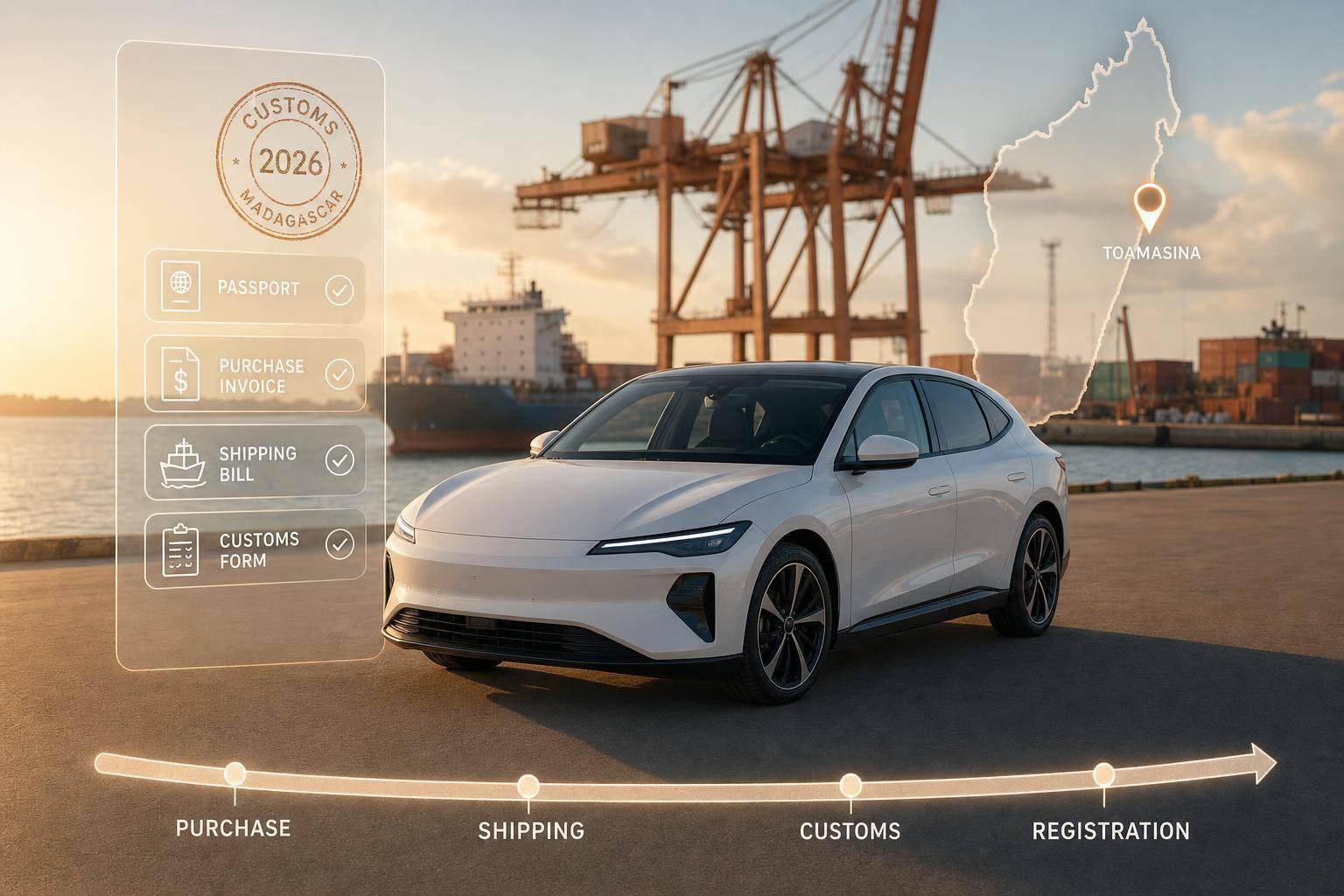
If you import a 100% electric car into Madagascar in 2026, customs duty and VAT are 0%. That is the big cost point. But you still need to pay for shipping, port charges, broker fees, inland delivery, inspection, insurance, and registration.
If I were planning this import, I’d check three things first:
- Is the car fully electric? Only full EVs get the 0% duty and 0% VAT treatment.
- Do I have the right papers before shipping? Missing BSC, CIVIO, title, or invoice papers can delay release at Toamasina.
- Can I finish registration within 30 days? Customs clearance comes first, then inspection, tax clearance, insurance, and DTT registration.
Here’s the short version:
- Main port: Toamasina
- Shipping time: about 6 to 10 weeks
- Used cars: usually need a CIVIO pre-shipment inspection
- All shipments: need a BSC
- Registration fee: about 100,000 to 500,000 Ariary (around $22 to $110)
- Used EV sample landed cost: about $18,700 to $19,100
- New EV sample landed cost: about $39,510 to $40,010
What matters most is not just the car price. I’d budget from CIF first, then add local charges after arrival. In simple terms, that means:
Car price + freight + insurance + port costs + broker fees + inland transport + registration
A quick side-by-side makes the cost picture easier to see:
| Item | Used EV | New EV |
|---|---|---|
| Purchase price | $15,000 | $35,000 |
| Freight + insurance | $2,500 | $3,000 |
| CIF | $17,500 | $38,000 |
| Duty | $0 | $0 |
| VAT | $0 | $0 |
| Port + broker | $800–$1,200 | $1,000–$1,500 |
| Inland delivery | $300 | $400 |
| Registration | About $100 | About $110 |
| Total landed cost | $18,700–$19,100 | $39,510–$40,010 |
So if you want the simple answer: buy a full EV, prepare the shipment file before departure, clear customs at Toamasina, pass inspection, get insurance and tax clearance, and register fast. That’s the path to getting the car released and on the road with fewer delays.
How to Ship a Car to Madagascar | Cost, Shipping Methods & Import Tips
sbb-itb-99e19e3
Madagascar’s 2026 Import Rules for Electric Cars
Before you send money to a seller abroad, make sure the EV you want can clear Madagascar’s import rules. If you miss this step, the car can end up stuck at the port, and the bill can climb fast.
Vehicle Eligibility, Age Limits, and Prohibited Imports
Madagascar allows imports of 100% electric vehicles (BEVs), hybrids, passenger cars, and light commercial vehicles such as vans and small trucks. Used EVs are also allowed, as long as they meet customs rules and are not cut-and-shut vehicles.
For most vehicle imports, the main gateway is the Port of Toamasina (Tamatave).
After the vehicle arrives, it still can’t go straight onto the road. Every imported vehicle must pass a local technical inspection (visite technique) and get a technical conformity certificate before it can be legally registered and driven in Madagascar.
If the vehicle clears those checks, the next job is getting the pre-shipment paperwork customs will ask for.
Rules for Individuals, Companies, and Returning Residents
Companies are allowed to import light commercial EVs, including vans and small trucks. Returning residents must provide a Quitus fiscal (tax clearance certificate) before registration can move forward.
EV-Specific Policy Points to Check Before You Buy
Here’s the part that can change the math of the deal:
- Only 100% electric vehicles get a full exemption from customs duties and VAT.
- Hybrids do not get a full exemption. They only receive progressive cuts in import duties.
You should also check the invoice value before you buy. Customs will use that figure to assess CIF and any charges that still apply.
Next comes the document check and shipment filings needed before the EV can leave the port.
Step-by-Step: From Buying the EV Abroad to Clearing Customs in Madagascar
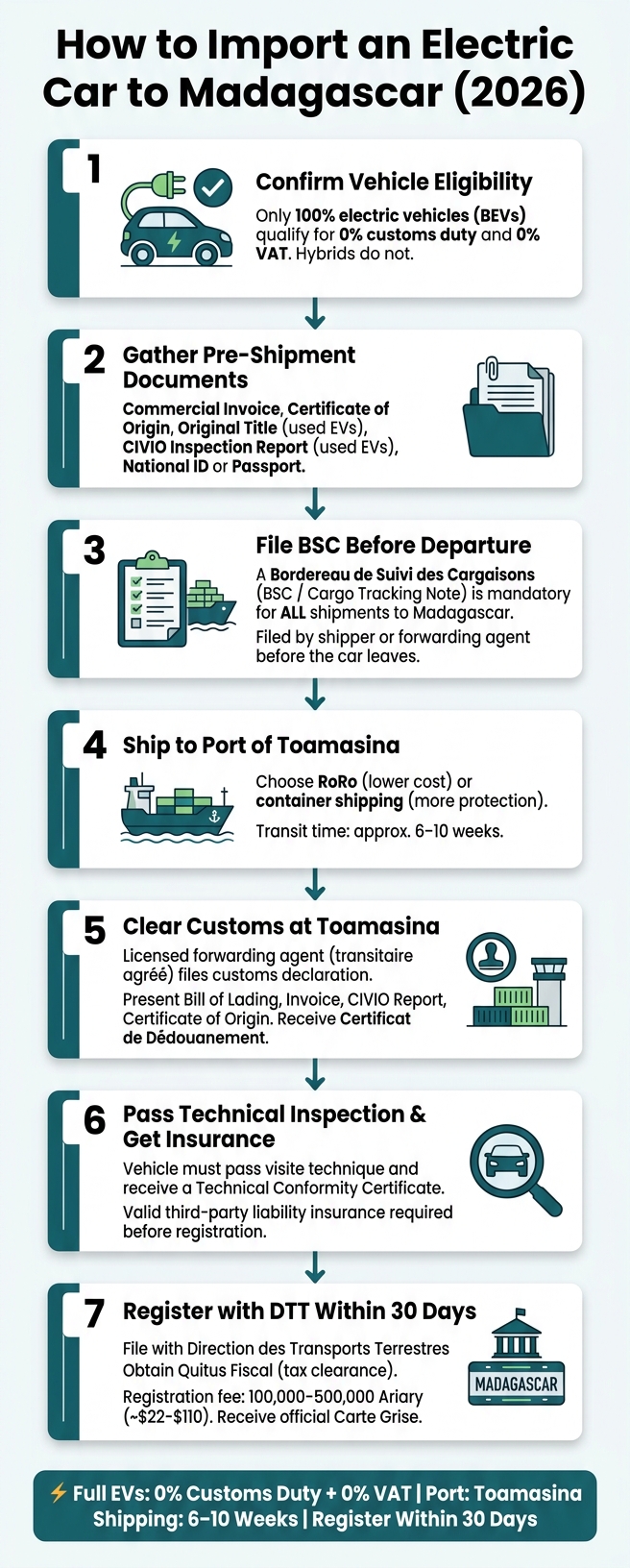
How to Import an Electric Car to Madagascar: Step-by-Step Process
Choose the EV and Confirm It Can Be Imported
Check import eligibility before you send payment. Look at the model year, the vehicle’s condition, and the original registration card (carte grise) first. You’ll also want to confirm that the car still qualifies for the full EV exemption before moving ahead.
If you’re buying a used EV, ask for a battery-health check. That one step can save you a lot of trouble later. Once everything checks out, gather the shipping paperwork before the car leaves the country of origin.
Pre-Shipment Requirements: CIVIO, BSC, and Shipping Documents
After buying the EV, submit the pre-shipment paperwork before the vehicle departs.
For used vehicles, a CIVIO pre-shipment inspection is required. This inspection checks the car’s condition and declared value. In most cases, the seller or a licensed inspection agency handles it.
A BSC (Bordereau de Suivi des Cargaisons), also called a Cargo Tracking Note, is required for all shipments to Madagascar. It’s usually filed by the shipper or forwarding agent before departure.
Shipping terms matter here too. Terms like FOB (Free on Board) and DDP (Delivered Duty Paid) spell out who handles freight, customs, and delivery. That sounds like a small detail, but it can change both cost and workload.
| Document | Who Arranges It | Purpose |
|---|---|---|
| Commercial Invoice | Seller / Marketplace | Proof of purchase price and vehicle details |
| Export Certificate / Old Registration Card | Seller | Confirms legal export from origin country |
| BSC (Cargo Tracking Note) | Shipper / Forwarding Agent | Mandatory shipment tracking for Madagascar |
| CIVIO Inspection Report | Inspection Agency / Seller | Pre-shipment condition and value verification |
| Bill of Lading | Shipping Line | Transport contract and title of goods |
| National ID or Passport | Buyer | Required for customs declaration and registration |
| Certificate of Origin | Manufacturer / Seller | Confirms where the vehicle was built |
Ship the Car, Clear Customs at Toamasina, and Register It Locally
For shipping, RoRo (Roll-on/Roll-off) is often the lower-cost option, while container shipping gives the car more physical protection. Transit time from the origin country to the Port of Toamasina (Tamatave) is usually 6 to 10 weeks.
Once the ship arrives in Toamasina, a licensed forwarding agent (transitaire agréé) handles customs clearance and then moves into the registration process. The agent files the customs declaration and presents the Bill of Lading, commercial invoice, CIVIO report, and Certificate of Origin to get the customs clearance certificate (certificat de dédouanement).
Even if the EV qualifies for a tax exemption, you should still plan for:
- Shipping costs
- BSC filing fees
- Port handling charges
After customs clearance, you must get the Quitus fiscal (tax clearance certificate) before registration can continue. Registration must be completed within 30 days of arrival.
The application is filed with the Direction des Transports Terrestres (DTT). Before the vehicle can be driven legally, it must pass a technical inspection (visite technique) and receive a certificate of technical conformity. You also need valid third-party liability insurance.
Once the file is approved, the vehicle receives a unique registration number and the official Carte Grise. Registration fees usually run from 100,000 to 500,000 Ariary.
Import Costs, Taxes, and Landed Cost Examples
The Main Charges: CIF, Customs Duty, VAT, and Other Import Fees
For a 100% electric vehicle, customs duty and VAT are zero in 2026.
That said, the car still won’t land at your door for free. You should also budget for port handling, broker fees, inland delivery, and registration. Port and brokerage costs at Toamasina can shift based on the broker you use and how long the vehicle stays in storage. If the car needs to go to Antananarivo or another city after arrival, add inland transport to your estimate. You should also set aside money for DTT registration.
The breakdown below helps you estimate your landed cost before you commit to the purchase.
How to Estimate Your Total Landed Cost Before You Buy
Start with the purchase price. Then add freight and insurance to get CIF. After that, add port fees, broker charges, inland delivery, and registration. For a 100% electric vehicle, customs duty and VAT stay at $0.
| Step | Component | Notes |
|---|---|---|
| 1 | Purchase Price (FOB) | Price paid to the seller abroad |
| 2 | Freight & Insurance | Shipping to Toamasina + transit insurance |
| 3 | CIF Value | Steps 1 + 2 – the customs valuation base |
| 4 | Customs Duty & VAT | $0 for 100% EVs |
| 5 | Port Handling & Brokerage | Estimated and variable |
| 6 | Inland Delivery | If needed, depending on your final destination |
| 7 | DTT Registration | 100,000–500,000 Ariary (about $22–$110) |
| Total | Landed Cost | CIF + Steps 5, 6, and 7 |
Landed Cost Examples: Used EV vs. New EV
These examples show the difference between a used EV and a new EV once all import costs are added. The used EV example uses a Nissan Leaf. The new EV example reflects a BYD Seal or Tesla Model 3. All figures are in USD and are estimates, so freight rates and broker fees can change based on the country of origin and the time of year.
| Cost Component | Used EV (e.g., Nissan Leaf) | New EV (e.g., BYD Seal / Tesla Model 3) |
|---|---|---|
| Purchase Price (FOB) | $15,000 | $35,000 |
| Freight & Insurance | $2,500 | $3,000 |
| CIF Value | $17,500 | $38,000 |
| Customs Duty (0%) | $0 | $0 |
| VAT (0%) | $0 | $0 |
| Port Handling & Brokerage | $800–$1,200 | $1,000–$1,500 |
| Inland Delivery (to Antananarivo) | $300 | $400 |
| DTT Registration | ~$100 | ~$110 |
| Total Estimated Landed Cost | $18,700–$19,100 | $39,510–$40,010 |
Next, gather the documents customs and DTT will require.
Documents Checklist and Final Takeaways
Required Documents for Customs and Registration
Get the full customs file ready before the vehicle ships. That simple step can help you avoid storage charges at Toamasina and cut down the odds of registration delays.
Once you’ve worked out the import cost, put the clearance file together in this order:
| Stage | Document | Notes |
|---|---|---|
| Pre-Shipment | Commercial Invoice (Facture d’achat) | Purchase invoice |
| Pre-Shipment | Certificate of Origin | Origin proof |
| Pre-Shipment | Original Registration/Title (used vehicles only) | Used vehicles only |
| Pre-Shipment | CIVIO Report (used vehicles only) | Used vehicles only |
| Shipping / Customs | Bill of Lading (B/L) | Issued by shipping line |
| Shipping / Customs | BSC (Bordereau de Suivi des Cargaisons) | Pre-departure filing |
| Post-Clearance / Registration | Customs Clearance Certificate (Certificat de dédouanement / Quitus fiscal) | Customs release |
| Registration | National ID or Passport | Owner identification |
| Registration | Proof of Address | Required for registration |
| Registration | Technical Conformity Certificate | Final registration |
| Registration | Valid Local Auto Insurance | Third-party liability insurance |
Bring certified copies of every original document. It also helps to submit the full file early, especially at DTT offices in Antananarivo, where slow paperwork can drag things out.
Common Mistakes That Increase Cost or Delay Customs Release
Most delays come from paperwork problems and missed filing dates. If you miss the BSC deadline or send in an incomplete customs packet, the vehicle can get stuck at the port and push back registration.
Another easy mistake is treating a hybrid like a 100% electric vehicle. That doesn’t work. Only fully electric vehicles get the VAT and customs duty exemption. Hybrids follow a system of progressive reductions instead.
Conclusion: Key Steps to Budget, Comply, and Register Successfully
Don’t look at price alone. Check the timeline too.
Make sure the EV is fully electric, file the BSC and CIVIO report before shipment, clear customs, complete the inspection, and register with DTT within 30 days. For budgeting, plan for registration fees of 100,000 to 500,000 Ariary and expect shipping to take about 6 to 10 weeks.
FAQs
How do I prove a car is fully electric?
To show that your car is fully electric for customs and registration in Madagascar, you’ll need documents that confirm the vehicle’s powertrain and technical compliance.
The two main ones are the Certificate of Origin and an official technical conformity certificate.
If the car is a used import, you’ll also need a Vehicle Identification Check.
During customs clearance, these documents help officials confirm that the car is a 100% electric model, which matters for VAT and customs-duty exemption.
What happens if I miss the 30-day registration deadline?
If you miss the 30-day registration deadline after purchase, you could face monetary fines, immediate immobilization of your car, and even seizure by authorities.
You must complete registration before driving your imported vehicle on public roads in Madagascar.
Can I import a used EV without a CIVIO report?
No. For used vehicles, a Vehicle Identification Check is mandatory before shipping to Madagascar.
This inspection helps confirm the car’s identity and condition under import rules. Skip it, or ship without the required paperwork, and you could run into customs delays or trouble during registration.