
 Thabo Nkosi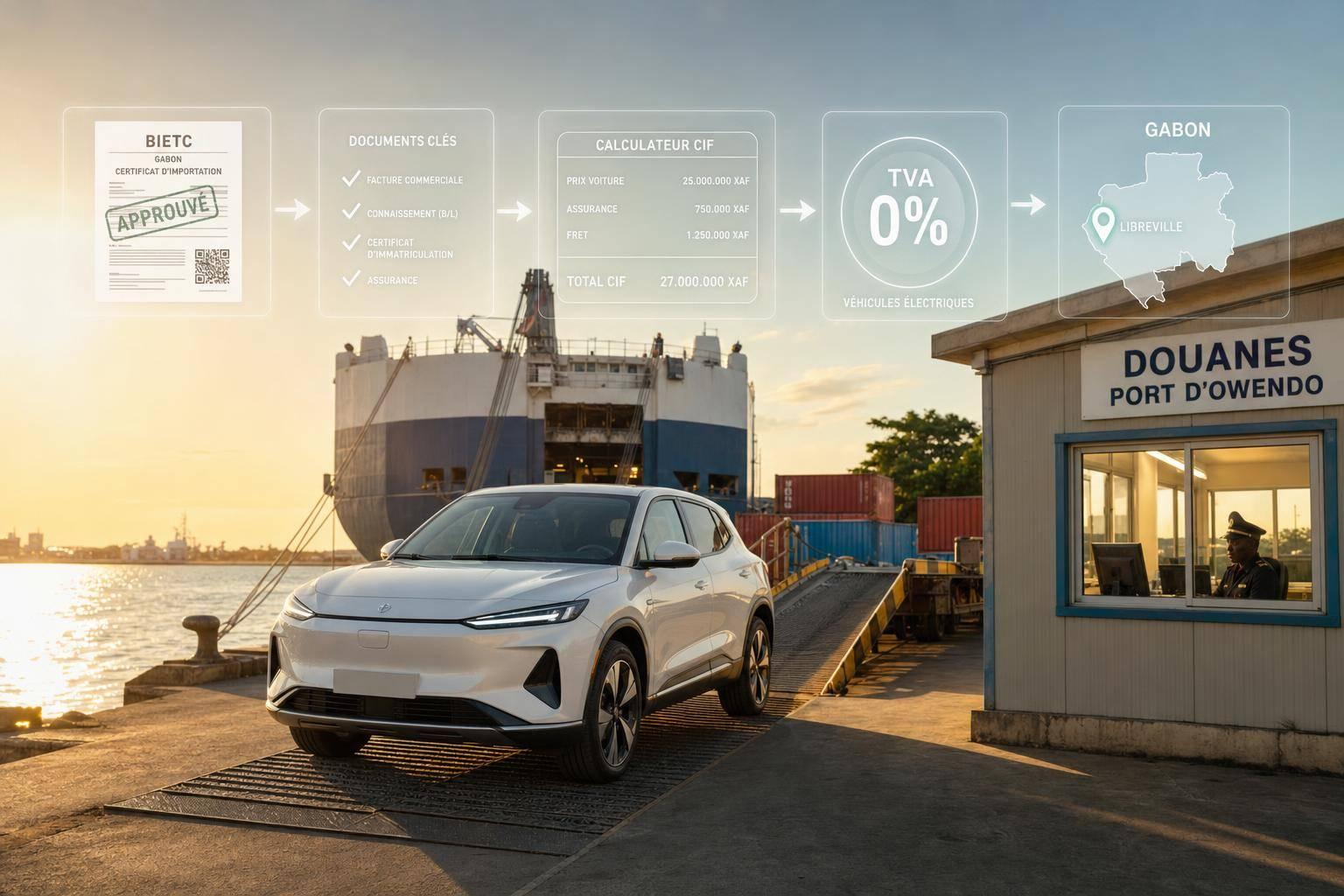
If you import a fully electric car into Gabon in 2026, VAT is 0% instead of 18%. That can cut your bill by thousands of dollars. But you still need to budget for customs duty, RUSID, BIETC, port charges, broker fees, and registration.
If I were planning an EV import to Gabon today, I’d focus on these points first:
- VAT for full EVs: 0% in 2026
- Customs value basis: charges are built from CIF = vehicle price + freight + insurance
- Extra charges still apply: customs duty, RUSID at about 3%–4% of CIF, BIETC, port handling, storage, broker fees, and plates
- Used-car limit: the vehicle generally must be 10 years old or less from first registration
- Used EV paperwork: expect a roadworthiness report and, in many cases, a battery-health report
- BIETC timing: it must be filed before the ship leaves the loading port
- Main risk: wrong or missing documents can lead to storage charges, amendment costs, and clearance delays
Here’s the simple version: the 0% VAT rule helps a lot, but it does not make the import cheap. Your total cost still depends on the car’s CIF value, the duty rate tied to its tariff code, and local charges at Owendo port near Libreville.
A sample case in the article shows how fast the math adds up. A used Tesla with a $30,200 CIF value can end up near $40,860 landed, even with $0 VAT, once duty and local fees are added. So before you ship, I’d check the numbers, confirm the EV’s classification with a broker, and make sure the BIETC and vehicle papers match line for line.
This article covers the full path in plain English: costs, documents, vehicle rules, BIETC filing, customs clearance, and registration in Gabon.
2026 Customs Duties, VAT Rules, and Import Costs for EVs in Gabon
Gabon calculates import charges based on CIF: the vehicle price, plus freight, plus marine insurance.
How EV Import Taxes Differ From Petrol and Diesel Cars
Gabon’s 2026 finance law sets VAT on fully electric vehicles at 0% for both imports and domestic sales. That’s a big cost cut. But it doesn’t wipe out the whole import bill. Customs duty, RUSID, and port-related fees may still show up.
Here’s the split between what drops away in 2026 and what still needs to be budgeted for:
| Charge | ICE Vehicles | Electric Vehicles (2026) |
|---|---|---|
| Customs Duty | Applies; standard vehicle import duty remains separate from VAT. | Applies unless a specific exemption is confirmed by customs. |
| VAT | Standard VAT at 18% | 0% – exempt on importation and domestic sale |
| RUSID | ~3%–4% of CIF | Still applies; no EV-specific exemption identified |
| Port/Clearance Fees | Apply | Apply |
How to Estimate Your Landed Cost Before You Ship
FOB price + freight + insurance = CIF. So if you buy a vehicle for $18,000 FOB, pay $1,500 for shipping, and $300 for insurance, your CIF comes to $19,800.
From there, more charges are added on top. These can include customs duty, RUSID at about 3%–4% of CIF, and BIETC fees: $150 for shipments from dollar-zone countries, €100 from Europe, or 20,000 FCFA for shipments from CFA-zone countries.
Before you ship, check these cost items:
- Vehicle FOB price shown on the commercial invoice
- Freight and marine insurance
- CIF total: FOB + freight + insurance
- Customs duty charged on CIF
- RUSID at about 3%–4% of CIF
- BIETC fee based on the shipment’s origin zone
- Port, handling, broker, and storage fees
- Local registration, inspection, and plate issuance after clearance
It also helps to leave some room in your budget for storage and demurrage if paperwork gets held up at the terminal.
Next, confirm that the vehicle meets Gabon’s import rules and gather the documents customs will want to see.
sbb-itb-99e19e3
Eligibility Rules, Compliance Checks, and Required Documents
Once you’ve estimated your landed cost, the next job is simple: make sure the EV can legally enter Gabon before it ships. If the car is over the age limit, missing conformity papers, or loaded without a valid BIETC, costs can pile up fast. Think storage fees, amendment charges, and customs delays on top of what you already planned to spend.
Vehicle Rules for Used and New Electric Cars
In Gabon, a vehicle counts as used if it is at least six months old from its first registration date abroad and has more than 6,000 km on the odometer. The age cap for import is 10 years from first registration, and that rule applies across vehicle categories A through E.
Some rules connect that 10-year limit to Gabonese nationals. So if you’re a foreign buyer, it’s smart to check your status with a local clearing agent before you book shipment.
For new EVs, keep the certificate of conformity and warranty documents on hand. For used EVs, you’ll also need a roadworthiness certificate from an approved inspection center in the export country. On top of that, importers are more often being asked for a battery-health report that shows capacity, fast-charge count, and error codes. Freight forwarders and EV specialists keep pointing to the same problem: missing battery paperwork is a common reason shipments get held up.
Document Checklist for Pre-Shipment and Arrival
Getting your paperwork lined up before the car is loaded can save a lot of time and money at Libreville port. Here are the main documents customs usually expects:
| Document | Issued By | Stage |
|---|---|---|
| Commercial invoice | Seller | Before loading |
| Proof of payment | Bank or escrow provider | Before loading |
| Bill of Lading (BoL) | Shipping line | On arrival |
| Foreign title / registration certificate | DMV or equivalent authority | Before loading & on arrival |
| Roadworthiness / technical inspection report | Authorized inspection center (export country) | Before loading |
| Battery-health / EV diagnostic report | Dealer or EV specialist | Before loading (used EVs) |
| BIETC cargo-tracking note | Gabonese Shippers Council (CGC) online system | Before loading |
| Interpol vehicle verification document | Relevant authority | Before loading & on arrival |
| Importer ID (passport or corporate registration) | Government / company registry | Before loading & on arrival |
| Tax registration certificate (companies/dealers only) | Gabonese tax authority | On arrival |
| Recent tax-payment certificates (companies/dealers only) | Gabonese tax authority | On arrival |
Customs brokers at Libreville port often suggest having digital scans and notarized copies ready before loading, not only at arrival. If you’re importing through a company or dealership, the tax-regularity certificate (attestation de régularité fiscale) is required. If that paper is missing, clearance can stop right there.
With the file in order, the next item is BIETC filing before loading.
BIETC and Other Pre-Shipment Formalities
BIETC – Bordereau d’Identification Électronique de Traçabilité des Cargaisons – has to be filed before the vessel leaves the loading port. In many cases, shipping lines won’t issue the final Bill of Lading until the BIETC number is confirmed. The filing goes through the Gabonese Shippers Council (CGC) online system.
The BIETC details need to match the invoice and BoL exactly. That includes:
- shipper and consignee
- VIN
- make, model, and year
- gross weight
- invoice value and currency
- ports
- vessel name
Those data points must line up with no gaps or mix-ups. If they don’t, customs may send the shipment for manual review, which can slow clearance. Fixing errors after departure is often hard and usually comes with amendment fees. If the BIETC is late or missing, penalties can reach the full freight value, and daily port storage charges may keep running until the issue is fixed.
Once the BIETC is done and the paperwork is set, you can move on to shipping, customs clearance, and registration in Libreville.
Step-by-Step: How to Import an Electric Car Through Libreville
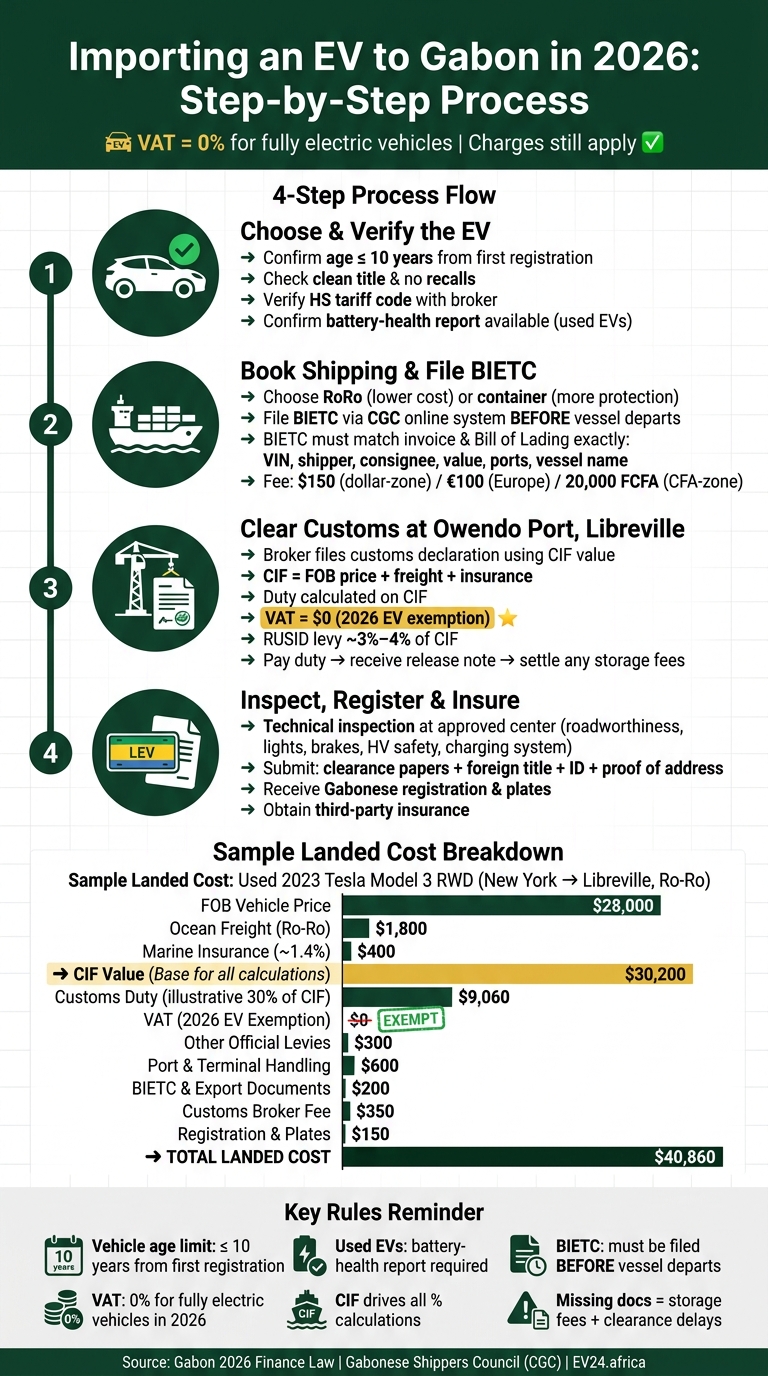
How to Import an Electric Car to Gabon in 2026: Step-by-Step Cost & Process Guide
With your paperwork in order and the BIETC rules clear, the import process comes down to three phases: shipping, customs, and registration. In plain terms, it goes like this: book, file, clear, and register.
Step 1: Choose the EV and Confirm Import Eligibility
Before you send payment, make sure the EV can legally be imported, has a clean title, and can meet Gabon’s inspection rules. It’s also smart to check for recalls or export limits in the country where the car is being shipped from.
Once those points check out, you can move ahead with shipping and BIETC filing.
Step 2: Book Shipping, Prepare BIETC, and Send the File
For a single EV, RoRo is often the lower-cost option. A container usually gives the car more protection. After you book shipping, review the draft bill of lading, then have your broker file the BIETC before departure. The VIN, seller, consignee, value, and port details need to match the invoice and title exactly. The BIETC must be validated before the vessel leaves the loading port.
Once the BIETC is validated, your broker can handle clearance when the vehicle arrives in Libreville.
Step 3: Clear Customs, Pay Charges, and Register the Vehicle
When the vessel reaches Owendo port near Libreville, your customs broker gets the discharge details from the shipping line and pays any local port charges that must be settled before clearance. The broker then files the customs declaration using the CIF value – the vehicle price, plus freight, plus insurance – along with the tariff code used for electric vehicles. Customs uses that CIF amount to calculate duty and any other charges that apply. After the duty bill is paid, customs issues a release note. The car can then leave the port once any remaining storage fees are cleared.
After customs release, send the EV for technical inspection at an approved center. Inspectors usually check roadworthiness, lights, braking systems, and for EVs, high-voltage safety and the charging system.
Registration comes next. You’ll need to present the customs clearance papers, the title or registration from the country of origin, proof of identity, and proof of address to the registration authority.
| Step | Responsible Party | Key Documents | Main Fees |
|---|---|---|---|
| Port discharge & terminal handling | Shipping line / broker | Arrival notice, final BL | Terminal handling, storage |
| Customs declaration filing | Licensed customs broker | BL, BIETC, invoice, title/registration, Interpol control document | Broker service fee |
| Duty payment | Importer / broker | Customs assessment notice | Import duty on CIF value |
| Customs release | Customs authority | Release note, duty receipts | Any outstanding port charges |
| Technical inspection | Approved inspection center | Release note, foreign title/registration | Inspection fee |
| Local registration & plates | Gabonese registration authority | Clearance docs, inspection certificate, ID, proof of address | Registration fee, plate fee |
| Third-party insurance | Local insurer | New registration certificate | Insurance premium |
The Interpol control document is one of the main customs papers, so don’t push it to the last minute. Use the cost example below to check your own landed total.
Sample Cost Breakdown and Final Checks
Hypothetical Landed-Cost Example for an EV Imported to Gabon
Here’s a simple sample for a used 2023 Tesla Model 3 RWD shipped from New York/New Jersey to Libreville by roll-on/roll-off (Ro-Ro). Treat it as a planning tool, not a final quote. Swap in your own numbers before you move ahead.
| Cost Item | USD | XAF (approx. @ $1 ≈ 600 XAF) | Notes |
|---|---|---|---|
| FOB vehicle price | $28,000 | 16,800,000 | Agreed price at the U.S. export port |
| Ocean freight (Ro-Ro) | $1,800 | 1,080,000 | New York/New Jersey → Libreville |
| Marine insurance (~1.4%) | $400 | 240,000 | About 1%–1.5% of vehicle value |
| CIF value | $30,200 | 18,120,000 | Base for customs calculations |
| Customs duty (illustrative 30% of CIF) | $9,060 | 5,436,000 | Applied to CIF; confirm the HS code with your broker |
| VAT: $0 (2026 EV exemption) | $0 | 0 | Under the 2026 revised Article 210, electric vehicles are VAT-exempt |
| Other official levies | $300 | 180,000 | Estimate only; confirm with your broker |
| Port & terminal handling | $600 | 360,000 | Storage, scanning, documentation |
| BIETC and export documents | $200 | 120,000 | BIETC filing plus seller/export paperwork |
| Customs broker fee | $350 | 210,000 | Licensed clearing agent in Libreville |
| Registration & plates | $150 | 90,000 | Registration and first plate issuance |
| Total landed cost | $40,860 | ~24,516,000 | Illustrative landed-cost estimate |
The big takeaway is pretty simple: CIF drives the math. Once freight and insurance are added, every charge tied to a percentage gets bigger too. On the other hand, the 2026 VAT exemption wipes out one major cost line.
Use this table as a working draft for your own import plan. Get current quotes before booking anything, because freight, duty, and port charges can shift.
How EV24.africa Fits Into the Import Process
Once you’ve mapped out the numbers, the next job is pulling together the listing, invoice, and shipping paperwork needed for clearance.
EV24.africa can help buyers compare listings, estimate landed cost, gather BIETC documents, and connect with vetted customs brokers for Gabon. The platform includes brands such as Tesla, BYD, Hyundai, and others, with clear pricing and detailed vehicle specs so buyers can check the duty math before they commit.
It can also help line up freight forwarders for Ro-Ro or container quotes to Libreville and help collect the papers needed for BIETC filing, including the commercial invoice, title, export declaration, and packing list. Final taxes and clearance decisions still sit with Gabonese customs authorities.
Conclusion: Key Checks Before You Import
Before sending any deposit, double-check these points:
- Confirm eligibility: Make sure the EV’s age, condition, and HS classification match Gabon’s import rules.
- Calculate from CIF: Add freight and insurance first, then work out duty and other fees.
- Verify the VAT exemption applies: Check with your broker that the vehicle’s HS code and usage category qualify under the 2026 revised Article 210 exemption.
- File BIETC before departure: The CGC filing must be validated before the vessel sails.
- Build a full landed-cost estimate: Use the table above as your budget template and replace the sample figures with live quotes for freight, duty, fees, and any first-registration insurance.
- Confirm timing and storage risk: Ask for the transit and clearance timeline so port storage charges don’t pile up.
FAQs
How can I confirm my EV qualifies for the 0% VAT rule?
Make sure your vehicle is a fully electric BEV that runs only on a rechargeable battery and electric motor. Hybrids, plug-in hybrids, and any vehicle with an internal combustion engine don’t qualify.
Your paperwork also needs to match the vehicle’s 100% electric status. That includes the commercial invoice, certificate of origin, and technical specification sheets. A licensed customs broker can also help confirm the right HS tariff code.
What mistakes most often delay EV customs clearance in Gabon?
The most common cause is document inconsistency.
If the VIN, buyer or seller details, model year, or declared value don’t match across the bill of lading, commercial invoice, certificate of origin, and customs declaration, customs may pause the process for review.
Other common delays come from missing or incomplete paperwork. This often includes battery specifications, dangerous goods declarations, required import authorizations, missed filing deadlines, or approvals that weren’t secured before shipping.
Should I ship my EV by Ro-Ro or container to Libreville?
It comes down to budget and the level of protection you need.
Ro-Ro is usually the lower-cost, faster option. The vehicle is driven on and off the ship, which makes it a good fit for EVs that are in working condition.
Container shipping costs more, but the vehicle stays fully enclosed. That gives it better protection from weather and damage during transit. It’s often the better pick for high-value or delicate EVs. It can also hold charging equipment or spare parts along with the vehicle.