
 Thabo Nkosi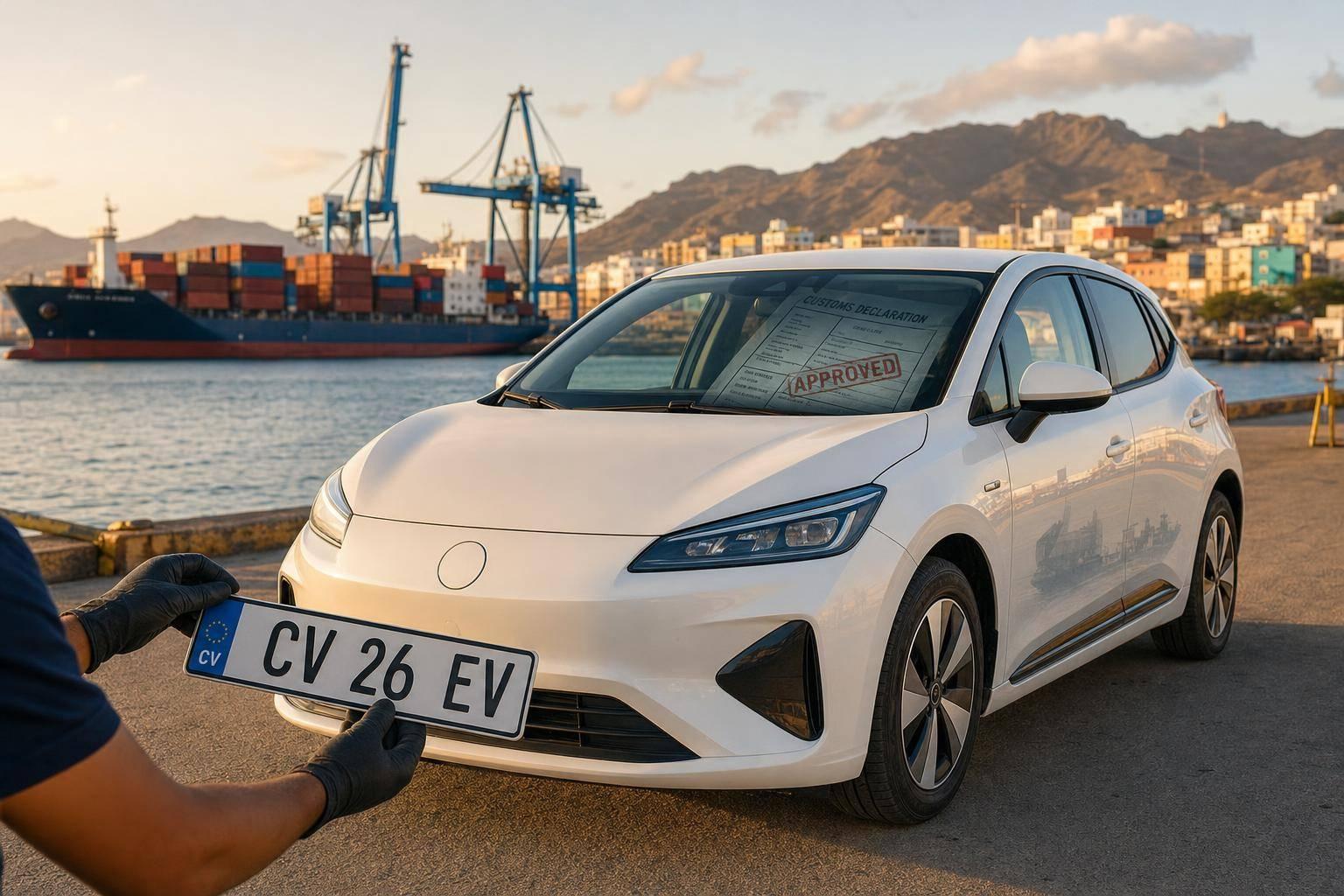
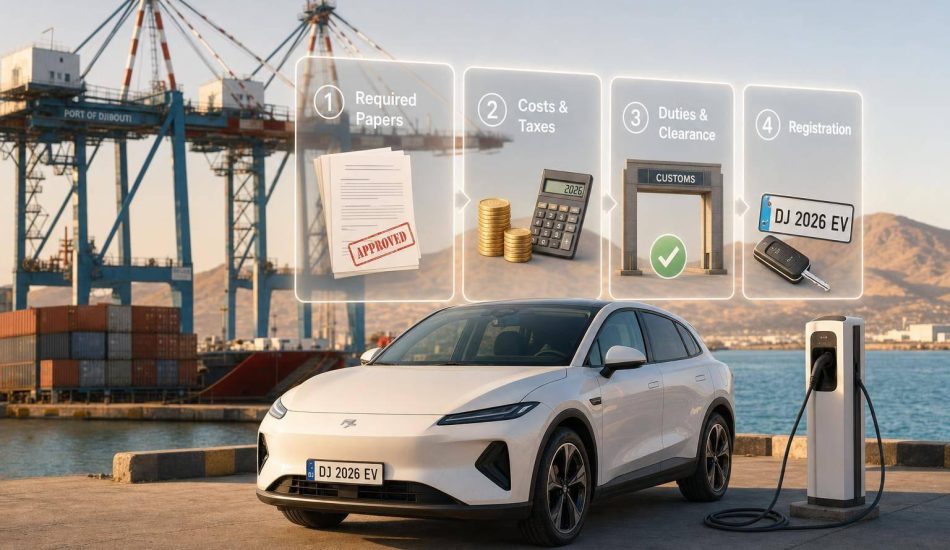
If the car is a qualifying fully electric vehicle, you may pay 0% import duty, 0% VAT, and 0% ICE in Cape Verde in 2026. That can cut your total cost by thousands of dollars. But you still need to budget for shipping, marine insurance, port fees, customs processing, registration, inspection, and local insurance.
If I were planning an import today, I’d check these first:
- Is the vehicle fully battery-electric?
- Do all documents match the VIN, price, model, and buyer name?
- What is the full landed cost, not just the sale price?
- Will the charging plug work in Cape Verde?
- Can I register it fast after customs release?
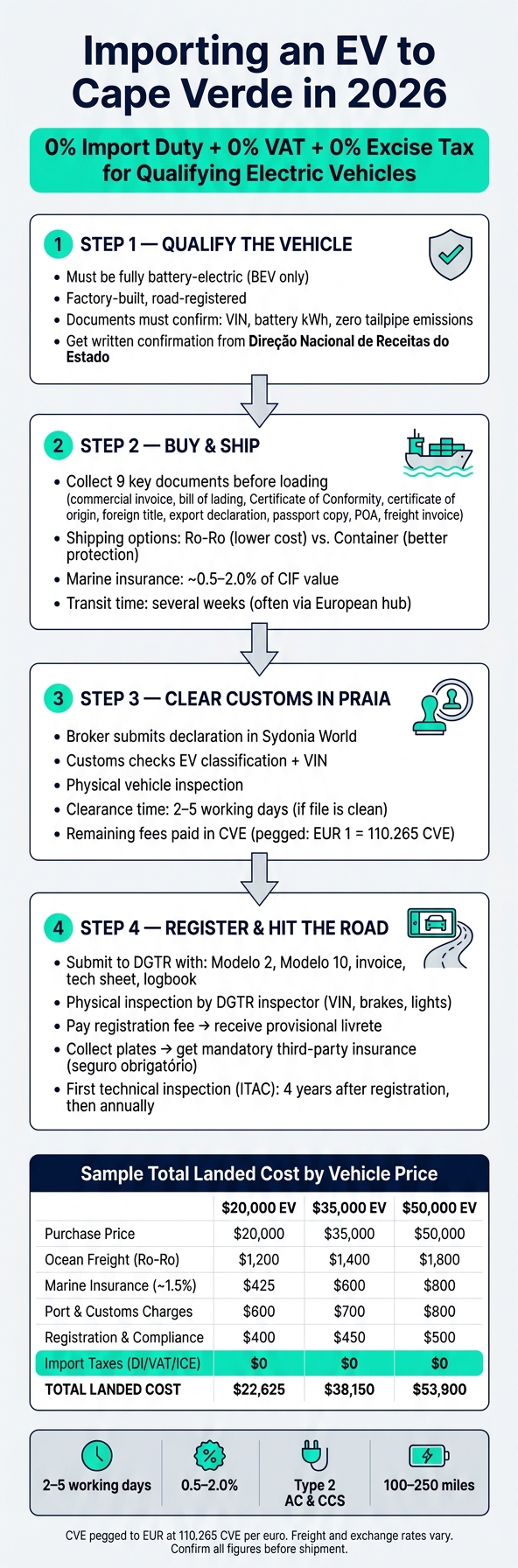
Here’s the article in one simple view:
- A qualifying EV can get tax exemptions
- You still pay freight + insurance + port/customs fees + registration
- Customs clearance often takes 2–5 working days if the file is clean
- Sample landed costs in the article range from about $22,625 to $53,900
- After customs, you still need DGTR registration, inspection, plates, and third-party insurance
Bottom line: I’d treat the tax break as only part of the math. The deal works when the vehicle qualifies, the paperwork is clean, and the total landed cost still fits the budget.
How to Import an Electric Car to Cape Verde: Step-by-Step Process & Costs
Cada vez mais veículos elétricos em Cabo Verde
sbb-itb-99e19e3
1. Confirm the electric car qualifies for Cape Verde’s EV import incentives
Before you pay or book freight, make sure the exact vehicle qualifies for Cape Verde’s EV tax breaks. Check the 2026 EV classification before you buy. If you’re looking at a hybrid, plug-in hybrid, or a converted vehicle, get written customs confirmation first. The car should also be factory-built, registered for road use, and in line with normal safety and approval standards.
Double-check the 2026 rules before shipment. A Ministry of Finance clarification says the 200,000 CVE ICE surcharge that applies to many imported vehicles does not apply to EVs. Even so, it’s smart to get written confirmation from the Direção Nacional de Receitas do Estado (National Revenue Directorate) or your customs broker before the car ships.
EV type, age, and proof of compliance
You need to show that the car is fully battery-electric. Customs will look at the paperwork you submit, so every document should be clear and consistent. If the documents don’t line up, delays can happen fast.
Have these ready:
- VIN and manufacturer technical sheet confirming a fully electric drivetrain, including battery capacity in kWh, rated power, and zero tailpipe emissions
- Seller invoice or purchase agreement showing model, year, sale price, and EV status
- For used EVs, registration history and odometer reading
Use documents that all describe the vehicle the same way: fully electric. Also check that the HS code matches Cape Verde’s EV classification.
Choosing an EV that fits island driving and charging conditions
Tax status is only one part of the choice. The car also needs to make sense for Cape Verde’s roads and climate: steep terrain, coastal humidity, salt air, and a charging network that’s still growing.
For most island driving, a real-world range of 100 to 250 miles per charge is usually enough. Pay more attention to actual range in hot weather than to official lab ratings, because heat and elevation can cut battery performance. Cape Verde’s charging setup tends to use common international standards like Type 2 AC and CCS for DC fast charging. If you’re importing from the U.S., check connector fit before you buy. You may need an adapter or a local charging setup.
If you’re buying a used EV, battery condition can make or break the deal. Ask for a battery health report that shows remaining capacity and any warranty terms that still apply across borders. Heat and coastal humidity can wear batteries down faster. It’s smart to lean toward models with sealed battery packs and underbody parts built to resist corrosion, since salt air can be rough on exposed components.
Service and repairs matter too. Cape Verde is a small market, so parts and EV-trained mechanics may be harder to find. It’s usually better to pick brands with support networks in West Africa or Europe, clear repair documentation, and remote diagnostics.
Once eligibility is confirmed, gather the export documents before booking freight.
2. Buy and ship the car: documents, freight, and port arrival
Once the EV qualifies, book shipping and put together a clean document file before the car leaves the export country. This part needs to be tight. A name mismatch, a wrong VIN digit, or one missing paper can slow clearance at the port.
Documents to collect before the car leaves the export country
Your Praia customs broker will use these documents to file the import declaration. The buyer and seller names, VIN, vehicle value, and dates need to match exactly across the full file.
Collect these before the car is loaded:
- Commercial invoice – seller, buyer, vehicle description, sale price, and currency
- Freight invoice – transport cost used in landed cost calculations
- Bill of lading or waybill – issued by the shipping line; consignee name must match your ID
- Technical spec sheet or Certificate of Conformity – confirms drivetrain, battery, and EV status
- Certificate of origin or CCVO – confirms manufacturing origin and supports the EV exemption claim
- Foreign title or registration logbook – original ownership document from the export country
- Export declaration – confirms the car was legally cleared to leave the origin country
- Buyer’s passport copy and, if you’re a resident, a Cape Verdean tax ID or local ID
- Power of attorney (POA) naming your Cape Verde clearing agent, ideally in Portuguese or bilingual
If the name, value, or VIN differs from one document to another, clearance can be delayed.
Ro-Ro vs. container shipping, insurance, and Incoterms
Ro-Ro is often the lowest-cost option for drivable EVs. Container shipping costs more, but it gives the car better physical protection. Before you lock anything in, check whether the route is true Ro-Ro, containerized, or a transshipment setup. Routes to Cape Verde can change based on the origin port and sailing schedule.
| Factor | Ro-Ro | Container |
|---|---|---|
| Relative cost | Lower; often the cheapest option | Higher, plus terminal handling and devanning fees |
| Best for | Standard drivable EVs, cost-sensitive imports | Higher-value EVs, extra parts, added protection |
| Physical protection | More exposed during transit | Enclosed and sealed |
| Marine insurance priority | Important, because carrier liability is limited | Still important, but risk is lower |
On Incoterms, the term in your purchase contract decides who pays for freight and insurance. It also affects the number Cape Verdean customs uses as the base for some port-related charges. Under FOB, you arrange and pay for freight and insurance after loading, so you build the CIF value yourself. Under CIF, the seller pays freight and insurance to the Cape Verdean port, and the CIF figure appears directly on the invoice. Even if a qualifying EV is exempt from customs duty, VAT, and excise, some remaining port charges and statistical taxes are still based on CIF value. That matters when you’re building your budget.
Marine insurance is worth buying. Battery packs are expensive, and standard carrier liability usually won’t pay the full vehicle value if something goes wrong at sea. A full all-risks policy that clearly covers the battery often runs about 0.5–2.0% of the insured CIF value. On a $30,000 EV with a CIF value of about $32,000, that’s around $160–$640.
Transit from the U.S. to Praia often takes several weeks, depending on the departure port, routing, and customs processing. Many shipments move through a European hub before the final leg to Praia or Mindelo.
Customs clearance at the port
When the car arrives, the process shifts from shipping to customs review. The shipping line files the manifest, your broker submits the declaration in Sydonia World, customs checks the EV classification and VIN, inspects the vehicle, and releases it after the remaining port charges are paid. Then you pay the remaining port charges assessed on the CIF value.
If your file is clean, clearance usually takes 2–5 working days. A licensed customs clearing agent who knows EV imports can review the paperwork before filing, submit the declaration correctly, and help line up the inspection so the car doesn’t end up sitting at the port longer than needed.
After release, total the taxes, port charges, and registration costs.
3. Calculate taxes, fees, and total landed cost in Cape Verde
Which taxes a qualifying EV may skip and which fees still apply
Once the car clears customs, you need to add up every tax, port charge, and registration cost before moving on to registration.
A qualifying battery-electric vehicle pays 0% import duty, 0% VAT, and 0% ICE in Cape Verde.
That sounds like a big win. But it doesn’t mean the import is free. You still need to pay shipping, insurance, port handling, broker charges, and a few local fees.
| Cost Component | Qualifying EV | Conventional ICE Vehicle |
|---|---|---|
| Import Duty (DI) | 0% – Exempt | Varies by vehicle category; can reach 10–40% of CIF value |
| VAT (IVA) | 0% – Exempt | About 15% of CIF value |
| ICE (Excise Tax) | 0% – Exempt | 200,000 CVE flat for 0–4-year-old vehicles |
| Ocean Freight | Payable (USD, market rate) | Payable |
| Marine Insurance | Payable (~1–2% of CIF) | Payable |
| Port Handling (ENAPOR) | Payable in CVE | Payable in CVE |
| Customs Broker Fee | Payable in CVE | Payable in CVE |
| Community Tax (TC) | 0.5% of CIF value | 0.5% of CIF value |
| Statistical Fee (TEA) | 5,000 CVE + 500 CVE/page | 5,000 CVE + 500 CVE/page |
| Registration & Inspection | Payable in CVE | Payable in CVE |
Cape Verdean escudo (CVE) is pegged to the euro at EUR 1 = 110.265 CVE. To turn local CVE fees into U.S. dollars, use the current EUR/USD exchange rate.
Landed cost formula and sample budgets by vehicle price
Total Landed Cost = Purchase Price + Ocean Freight + Marine Insurance + Port & Customs Charges + Registration & Compliance Costs
Here are sample budgets for three EV price points:
| Cost Item | $20,000 EV | $35,000 EV | $50,000 EV |
|---|---|---|---|
| Purchase Price | $20,000 | $35,000 | $50,000 |
| Ocean Freight (Ro-Ro) | $1,200 | $1,400 | $1,800 |
| Marine Insurance (~1.5% of CIF) | $425 | $600 | $800 |
| Port & Customs Charges (CVE → USD) | $600 | $700 | $800 |
| Registration & Compliance (CVE → USD) | $400 | $450 | $500 |
| Import Taxes (IVA, DI, ICE) | $0 | $0 | $0 |
| Total Landed Cost | $22,625 | $38,150 | $53,900 |
Treat these figures as estimates, not final quotes. Freight rates move, exchange rates shift, and local charges can change from one shipment to the next. Before you lock in your budget, confirm the shipping quote and the current exchange rate.
Cape Verde’s official trade portal also has a vehicle customs cost simulator that can give you a quick estimate in CVE.
Once you know the full landed cost, the next step is registration, inspection, and plates.
4. Register the EV and get it on the road
Registration documents, inspection, and payment steps
After customs releases the vehicle, DGTR takes over the last step for road registration. You’ll need to submit the EV to the Direção-Geral dos Transportes Rodoviários (DGTR) for registration.
Bring these documents with you:
- Modelo 2 application
- Modelo 10 customs release
- Commercial invoice
- Technical data sheet
- Foreign logbook
- Customs clearance papers
- Government ID
All of those are part of the standard file DGTR reviews.
Before DGTR gives the car a registration number, an inspector checks the vehicle in person. They confirm the VIN, make sure the car matches the technical sheet, and review basic safety items like brakes and lights.
Once the vehicle passes inspection, DGTR issues a payment notice for the registration fee. After you pay, you receive the provisional livrete while DGTR prepares the final registration certificate.
Private buyer vs. company registration requirements
The vehicle file stays the same in both cases. The main difference is the proof of ownership and who signs on behalf of the owner.
| Requirement | Private Individual | Company |
|---|---|---|
| Identity documents | Passport, residence card, or national ID | Company registration certificate, tax ID, and the representative’s ID |
| Ownership proof | Purchase invoice and foreign logbook | Purchase invoice, foreign logbook, and any stamped transfer document if applicable |
| Authorization | Not required | Power of attorney or corporate mandate for the signing representative |
| Core vehicle forms | Modelo 2, Modelo 10, technical data sheet, and prior logbook | Same, plus business registration and tax documents |
Companies often handle this through a broker or fleet manager. That’s because DGTR must confirm that the registered owner is a valid legal entity before it completes the registration.
Final steps after registration
Once registration is approved, DGTR assigns the registration number. You can then collect the physical plates after paying any remaining plate charge.
After the plates are issued, third-party liability insurance (seguro obrigatório) becomes mandatory for any vehicle used on public roads in Cape Verde. Insurers also need to see a valid inspection certificate before they issue or renew a policy.
Technical inspection is handled by ITAC. It runs fixed centers in Praia and São Vicente, and mobile inspection is available on other islands. For a privately owned passenger EV, the first inspection is due four years after first registration. After that, inspection is required every year. Bring the livrete, proof of ownership, and your last inspection record each time.
Hold on to these papers. You’ll need them for later inspections, resale, and proof of import status.
Conclusion: A checklist to avoid delays and surprise costs
Once you’ve worked out the landed cost, the next step is making sure the process doesn’t go sideways. A missed document, a late filing, or slow registration can turn a good deal into extra fees and a long wait.
Check the EV tax treatment before the vehicle ships. Qualifying battery-electric vehicles are exempt from customs duty, VAT, and excise.
Get every seller document together before shipment, including the battery MSDS. If paperwork is missing, the car can get stuck at the port, and storage fees can start piling up.
Bring in a licensed clearing agent early. They can handle filing, inspection, and release, which helps keep things moving.
Once the EV is released, register it right away and complete any needed inspection, fee payment, and plate collection. Waiting too long can put tax benefits at risk.
Use the checklist below as your last review before shipment and again after the vehicle arrives.
| Checklist Item | Why It Matters |
|---|---|
| Confirm it is fully electric | Exemptions apply only to zero-emission vehicles. |
| Collect all shipping documents and battery MSDS | Avoids port delays and storage fees. |
| Calculate landed cost first | Prevents surprise charges at the port. |
| Choose shipping method by cost and protection | Affects freight cost and transit risk. |
| Hire a licensed despachante | Manages port filing, inspection, payment, and release. |
| Register immediately after release | Delays can jeopardize tax benefits. |
| Finish inspection and payment | Finalizes plates and the registration certificate. |
FAQs
What if my EV is used?
Yes, you can import a used electric vehicle into Cape Verde. EV24.africa offers certified used models alongside new ones.
A used EV can cost less upfront. But there’s a trade-off. Battery age, software, service history, and overall condition can vary quite a bit from one car to another.
Just like a new EV, a used one must meet local environmental and safety standards to qualify for customs duty and VAT exemptions and complete registration.
Can I import a plug-in hybrid?
Maybe. It depends on whether the plug-in hybrid meets Cape Verde’s local rules on emissions and vehicle approval.
Tax breaks like VAT exemption and customs duty waivers usually apply only to vehicles that qualify as electric-powered. To get them, you’ll need paperwork that shows the vehicle’s electric capabilities. The car also has to pass local safety and compliance checks before it can be registered.
How much cash do I need upfront?
Start with the car’s purchase price. Then add shipping, insurance, and port costs.
One thing can help bring the total down: electric vehicles are exempt from customs duties and VAT.
You should also set aside money for registration fees, which usually run from $48 to $177. On top of that, keep some extra cash on hand for possible storage fees, clearing agent charges, and other surprise logistics costs.