
 Thabo Nkosi
Maintaining an electric vehicle (EV) in Africa can be more challenging than in other regions due to infrastructure gaps, limited access to skilled technicians, and high costs for parts like batteries. While EVs generally cost 40% less per mile to maintain globally, African conditions – such as poor road quality, frequent power outages, and high electricity costs – affect these savings. Key insights:
- Battery replacement is the biggest expense, often exceeding $10,000 after warranties expire (5–8 years).
- Tires wear out faster due to rough roads and heavier EV designs, costing around $125–$150 per set in countries like Nigeria.
- Charging costs vary widely, with electricity averaging $0.20 per kWh in West Africa.
- South Africa has lower maintenance costs thanks to better infrastructure, while countries like Nigeria face higher costs due to limited access to service centers.
To reduce costs, focus on regular maintenance, use home charging where possible, and choose EVs with strong warranty coverage. Despite challenges, EVs eliminate many traditional car expenses (like oil changes) and can save up to 50% on lifetime fuel and maintenance costs compared to gas vehicles.
Electric Cars Don’t Make Sense In South Africa
Main Challenges Affecting EV Maintenance Costs in Africa
Several factors contribute to higher maintenance costs for electric vehicles (EVs) in Africa, making ownership more challenging for many.
Battery Replacement Expenses
The cost of replacing an EV battery is a major hurdle, often exceeding $10,000. While manufacturer warranties – typically lasting 5 to 8 years – offer some relief early on, the financial strain of replacing a battery after the warranty period can be overwhelming. Beyond the batteries themselves, the lack of adequate service centers across the region adds another layer of difficulty to maintenance.
Shortage of Authorized Service Centers
Africa faces a critical shortage of skilled technicians and readily available EV parts. This scarcity leads to prolonged repair times and higher costs. For example, Volkswagen‘s decision to focus its EV efforts in Europe until 2050 highlights how limited Original Equipment Manufacturer (OEM) presence in Africa restricts local support. When parts need to be imported, the costs and delays increase significantly, making even routine repairs more expensive and time-consuming.
Road Quality and Vehicle Wear
The condition of many African roads – marked by potholes, unpaved stretches, and rough terrain – accelerates wear and tear on EVs. Suspension systems and tires are particularly vulnerable. In Ghana, for instance, around 80% of vehicles are imported from regions with smoother roads, meaning these EVs are not designed to handle the harsher conditions. As a result, tire replacements and suspension repairs are more frequent. Additionally, high ambient temperatures in many parts of Africa place extra stress on EV battery cooling systems, reducing their efficiency over time. Combined with limited service options, these challenges significantly impact the overall cost of maintaining EVs compared to gas-powered vehicles.
Comparing EV and Gas Vehicle Maintenance Costs
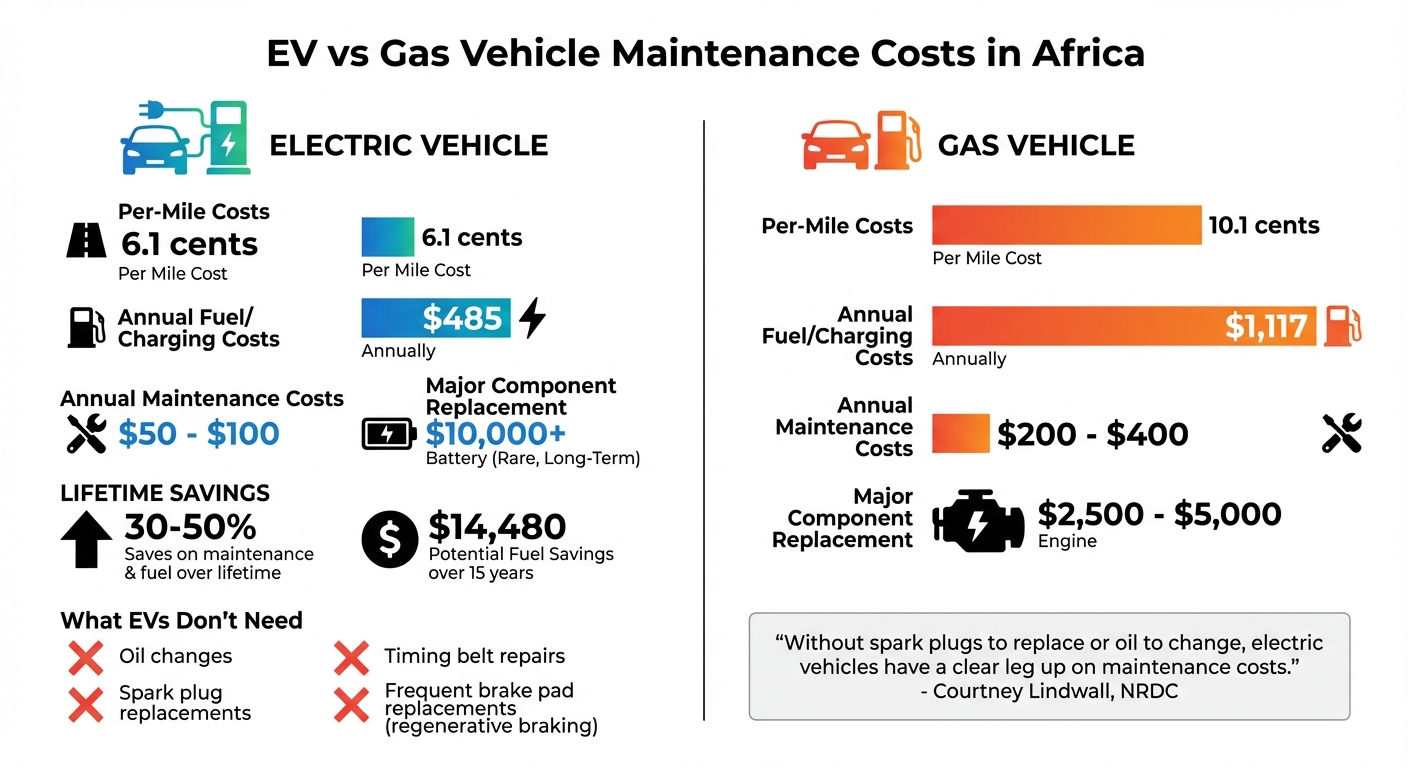
EV vs Gas Vehicle Maintenance Costs in Africa Comparison
Electric vehicles (EVs) bring noticeable savings when it comes to maintenance compared to gas-powered cars. With no need for oil changes, spark plug replacements, or timing belt repairs, EVs eliminate many routine expenses. Plus, their regenerative braking systems significantly reduce wear on brake pads, making them last far longer than those in traditional vehicles. Let’s break down the yearly costs to highlight these differences.
Yearly Maintenance Expenses
On average, maintaining an EV costs about 6.1 cents per mile, while gas vehicles run closer to 10.1 cents per mile. Fuel savings also add up: EV drivers spend approximately $485 annually on electricity compared to the $1,117 gas vehicle owners shell out for fuel.
"Without spark plugs to replace or oil to change, electric vehicles have a clear leg up on maintenance costs." – Courtney Lindwall, Contributor, NRDC
However, things get a bit more nuanced in specific regions. Take Ghana, for example. A 2020 study published in Energy Policy by G.K. Ayetor and colleagues compared the Tesla Model 3, Tesla Model S, and Nissan Leaf against the Toyota Corolla. While EVs in Ghana do save on maintenance and fuel, the total cost of ownership is still 13.5% higher than the Corolla. This is largely due to the high initial purchase price, limited spare parts, and the $826 average cost of installing a home charger. Interestingly, the Toyota Prius hybrid proved to be a more economical choice, offering 30% savings on cost per mile.
| Category | EV Costs (USD) | Gas Vehicle Costs (USD) |
|---|---|---|
| Annual Maintenance | $50–$100 | $200–$400 |
| Per-Mile Running Cost | $0.061 | $0.101 |
| Battery/Engine Replacement | $10,000+ | $2,500–$5,000 |
These annual savings may seem small at first, but over time, they add up in a big way.
Total Cost Savings Over Vehicle Lifetime
When you look at the big picture, EVs can save between 30–50% on maintenance and fuel costs over their lifetime. Some estimates even suggest lifetime fuel savings alone could hit $14,480 over 15 years, depending on local electricity and gas prices. The challenge lies in overcoming the higher upfront costs and infrastructure hurdles. But once those are addressed, EVs prove to be far less expensive to maintain than gas vehicles, which have many more components that can break or wear out.
How Maintenance Costs Differ Across African Countries
Maintenance costs for electric vehicles (EVs) vary significantly across Africa, shaped by differences in infrastructure, labor availability, and technical expertise. Countries with more reliable electricity grids and established service networks tend to have lower ongoing expenses. On the other hand, nations still developing their EV ecosystems face higher costs due to limited access to parts and dependence on expensive foreign labor.
"We are talking here about basic provisions like reliable electricity, water supply, transportation networks…" – Christian-Géraud Neema, Africa Editor, China-Global South Project
Market size also plays a big role. For instance, South Africa’s larger EV fleet (6,000 out of 12 million vehicles) benefits from economies of scale, while Kenya’s smaller market (350 out of 2.2 million vehicles) struggles to achieve the same cost efficiencies. Additionally, African countries that export raw materials like lithium but lack local refining capabilities face higher costs for finished batteries, which drives up replacement expenses. Below are examples of how these factors impact maintenance costs in specific countries.
Nigeria: Higher Costs Due to Infrastructure Challenges
Nigeria’s EV owners face higher maintenance costs due to limited charging stations and service centers. Annual expenses typically range from ₦70,000 to ₦80,000 (approximately $50–$60 USD). While this is 30–50% cheaper than maintaining petrol vehicles, EV owners outside major cities often struggle with access to services. Public charging costs range between ₦90 and ₦150 per kWh, and replacing a battery can cost more than ₦10 million. Most service infrastructure is concentrated in urban areas, forcing rural drivers to travel long distances for repairs, which adds both time and logistical challenges to their overall maintenance costs.
South Africa: More Developed Infrastructure, Lower Costs
South Africa benefits from better infrastructure compared to many other African nations. A more reliable electricity grid, established service networks, and a larger EV fleet contribute to lower maintenance costs by encouraging competitive pricing for parts and labor. Additionally, the availability of local expertise in chemical and industrial engineering reduces dependence on costly foreign technicians. However, even in South Africa, grid stability remains a factor that impacts the upkeep of charging infrastructure.
Urban vs. Rural Cost Disparities
Urban EV owners generally enjoy lower maintenance costs thanks to smoother roads, accessible service centers, and readily available parts. Most of their expenses are limited to routine inspections and minor repairs. However, rural EV owners face unique challenges. Rough terrain accelerates wear on tires and brakes, leading to more frequent replacements. For example, in Nigeria, a full set of tires costs around ₦200,000, and rural drivers tend to replace them more often than their urban counterparts. The lack of trained EV technicians in rural areas further complicates matters, as owners may need to pay premium fees for mobile services or travel long distances for repairs. These disparities highlight the importance of addressing infrastructure gaps to lower long-term maintenance costs across all regions.
sbb-itb-99e19e3
What Drives EV Maintenance Costs: Batteries, Tires, and Charging
When it comes to maintaining an EV in Africa, three key areas dominate the costs: batteries, tires, and charging equipment. Knowing what drives these expenses can help EV owners manage their budgets and make smarter decisions to keep long-term costs in check. Let’s take a closer look at each of these components.
Battery Costs and Care
Replacing an EV battery is often the most expensive part of ownership. By 2025, swapping out a battery pack could cost anywhere from $5,000 to $25,000, with the average retail price landing around $130–$150 per kilowatt-hour. For instance, replacing the battery in a smaller EV like the Nissan Leaf (40–60 kWh) might set you back $6,000–$10,000, while a larger vehicle like the Rivian R1T pickup (100–135+ kWh) could cost anywhere between $17,000 and $28,000.
Two main factors influence these prices: battery size and chemistry. Larger batteries mean more cells and raw materials, which drive up costs. On the other hand, lithium-iron-phosphate (LFP) batteries are generally less expensive per kWh than nickel-rich ones, though they tend to weigh more. Opting for refurbished or salvaged batteries can cut costs by 30–50%, but they won’t offer the same warranties as new, original equipment manufacturer (OEM) packs.
Most manufacturers provide an eight-year/100,000-mile warranty, guaranteeing at least 70% of the battery’s capacity during that period. However, extreme heat can speed up battery degradation, so keeping the temperature between 50–86°F is ideal. Parking in shaded areas or garages can help, as can avoiding frequent charges to 100% or discharges to 0%. Instead, try to maintain the charge between 20% and 80%. Similarly, using slower Level 2 home chargers instead of fast DC chargers can help preserve battery health. For vehicles with liquid-cooled batteries, it’s important to check coolant levels as recommended by the manufacturer.
While batteries take the spotlight, tire maintenance is another area where costs can quickly add up.
Tire Replacement and Care
For EV owners in countries like Nigeria, tires are the most frequent maintenance expense. EVs tend to wear out tires faster than traditional cars due to their instant torque and heavier weight – batteries can add up to 2,000 pounds to the vehicle. In Nigeria, replacing a full set of tires typically costs around ₦200,000 (approximately $125–$150 USD).
Road conditions significantly impact tire wear. Smooth roads help extend tire life, while rough terrain accelerates wear and tear. Regular tire rotations, which cost only a few thousand naira, can help distribute wear evenly, improving the tires’ lifespan.
"With EVs known for instant torque, tyres may wear faster if the car is driven aggressively." – 234Drive
To save on tire costs, avoid aggressive driving and ensure the tires are properly inflated. Rural drivers, in particular, should inspect their tires more frequently due to potentially rougher road conditions. These small habits can make a big difference in controlling maintenance expenses.
Charging Equipment Upkeep
Maintaining charging equipment is another important piece of the puzzle. For home chargers, the upkeep is relatively simple but still requires attention. Budget around $400 per year per charger for tasks like cleaning, checking parts, and safely storing cables. DC fast chargers, however, come with steeper maintenance costs – extended warranties alone can exceed $800 annually per charger. In areas with limited infrastructure, securing a maintenance contract with guaranteed response times can improve reliability.
Home charging is not only more convenient but also easier on the battery, as its slower charging speeds reduce wear. Public DC fast chargers, while quicker, can slightly accelerate battery degradation. For non-networked chargers, consider installing separate electric meters or using third-party software to monitor energy usage accurately. These steps can help keep charging-related costs under control.
How to Reduce Your EV Maintenance Costs in Africa
Facing the challenges of maintaining an electric vehicle (EV) in Africa? With a few smart strategies and consistent habits, you can significantly cut down on long-term expenses. Prioritize warranty coverage, stick to regular maintenance, and consider home charging to save money and keep your EV running smoothly.
Choose EVs with Strong Warranty Coverage
A solid warranty can save you from unexpected repair costs. Many EV manufacturers offer warranties that cover critical components like batteries, electric motors, and charging systems. When shopping for an EV, take the time to compare warranty terms – some brands provide more extensive coverage than others. Platforms like EV24.africa can help you find detailed warranty information from top EV brands, making it easier to avoid surprise expenses. A strong warranty ensures that major repair costs are covered during the early years of ownership, giving you peace of mind.
But warranties alone aren’t enough – regular maintenance is key to protecting your investment.
Stick to Regular Maintenance Schedules
While EVs require 30–40% less maintenance than gas-powered vehicles, routine upkeep is still important. Essential tasks like tire rotations, brake fluid checks, and cabin filter replacements become even more crucial in Africa’s hot and dusty conditions. For example, parking in shaded areas and minimizing the use of DC fast charging can help preserve your battery’s health in high temperatures .
Don’t overlook brake fluid checks, even though regenerative braking reduces wear on pads and rotors. In dusty environments, replacing cabin air filters is a must to maintain air quality inside the vehicle. Many EVs also come with over-the-air (OTA) updates, which can optimize battery performance and resolve issues remotely, saving you trips to service centers. Following these simple maintenance routines can prevent small problems from escalating into expensive repairs.
Once you’ve got maintenance covered, home charging can help you save even more.
Install Home Charging Equipment
Home charging is one of the most cost-effective ways to keep your EV powered. On average, charging at home costs about $0.05 per mile, compared to $0.11 per mile at public charging stations – a 50% savings. Over a year, home charging might cost you around $589, while relying solely on public chargers could set you back approximately $1,234.
Investing in a Level 2 home charger, which typically costs between $200 and $1,000, provides enough charging capacity for daily driving and can cut your charging expenses in half compared to public options. In areas with unreliable electricity, pairing your home charger with solar panels offers a more stable and cost-effective power source. Plus, home charging is gentler on your battery compared to rapid DC fast charging, which can help extend its lifespan.
Conclusion
Owning an electric vehicle (EV) in Africa comes with its share of hurdles – like steep upfront costs and limited infrastructure – but the long-term savings are hard to ignore. On average, EVs cost about 40% less per mile for maintenance and slash annual charging expenses by 60% compared to traditional vehicles. Over time, these savings can make EVs a smart financial move, even as infrastructure challenges remain across the continent.
To make the most of these savings, it’s crucial to plan wisely. Choose vehicles with strong warranties, stick to regular maintenance schedules, and consider installing a home charging station to reduce costs further. While issues like sparse service centers and the high cost of battery replacements still exist, progress is being made. Countries such as South Africa and Morocco are actively growing their EV infrastructure and manufacturing capabilities.
As highlighted by the Energy for Growth Hub:
"We must close this evidence gap to move beyond anecdotal narratives and provide the data-based foundation Africa needs to fully participate in and benefit from the global electric vehicle revolution."
For those looking to join this shift, EV24.africa offers a range of new and pre-owned EVs with transparent pricing, detailed specifications, and flexible financing options across all 54 African countries. Whether you’re purchasing your first EV or upgrading, choosing the right model is a key step toward lowering maintenance costs and embracing sustainable mobility. With informed decisions, you can take full advantage of Africa’s evolving electric mobility landscape.
FAQs
What are the biggest challenges of maintaining an electric vehicle in Africa?
Maintaining an electric vehicle (EV) in Africa presents some distinct challenges, largely due to the region’s developing EV infrastructure and environmental conditions. While EVs typically demand less upkeep than traditional gas-powered vehicles, finding skilled technicians to work on high-voltage systems can be a real hurdle. This makes routine servicing more complicated than it might be in regions with a more established EV ecosystem.
The hot and dusty climates common in many parts of Africa also take a toll on lithium-ion batteries. These conditions can strain the battery’s cooling systems, requiring more frequent checks to ensure optimal performance and extend the battery’s lifespan.
One of the most pressing issues, however, is the lack of charging infrastructure. Public chargers are scarce in most African countries, leaving EV owners to depend on home or improvised charging setups. These setups can be tricky to maintain and are often vulnerable to power fluctuations. The limited availability of public charging options also drives up the cost of installing and maintaining private chargers, which can make owning an EV less practical for many people.
In short, the combination of a shortage of trained technicians, environmental challenges affecting battery health, and an underdeveloped charging network creates significant obstacles to maintaining EVs in Africa.
What can EV owners in Africa do to lower battery replacement costs?
EV owners in Africa can save on battery replacement costs by focusing on extending their battery’s lifespan and making informed decisions when a replacement is unavoidable. To keep your battery healthy, avoid exposing it to extreme temperatures and try to maintain its charge level between 20% and 80% during daily use. Making use of regenerative braking can also reduce strain on the battery over time.
Opting for EVs with smaller battery packs is another way to cut potential replacement costs, as these models often come with more budget-friendly battery options. If a replacement is needed, refurbished batteries can be a cost-effective alternative, offering significant savings compared to brand-new ones. For long-term reliability, have your battery inspected and serviced by qualified local technicians to prevent unnecessary wear and control future expenses.
Why do EV maintenance costs differ across African countries?
EV maintenance costs across Africa can differ widely due to a mix of infrastructure challenges, tax policies, and environmental factors. In areas where charging stations are scarce or electricity grids are unreliable, EV owners often have to invest more in home charging setups, which can drive up costs. Tax policies also play a big part – some countries offer tax breaks on EV parts like batteries to lower expenses, while others impose steep import duties, making maintenance pricier.
Another key factor is the availability of skilled technicians. In regions with a shortage of trained EV mechanics, repairs and servicing not only cost more but may also take longer to arrange. Local climates add another layer of complexity – extreme heat or high humidity can wear down batteries faster, increasing the need for replacements or repairs. Government policies also make a difference. Countries that actively support EV infrastructure often see lower maintenance costs, thanks to better access to services and resources. Together, these elements create a patchwork of maintenance costs across the continent.