
 Thabo Nkosi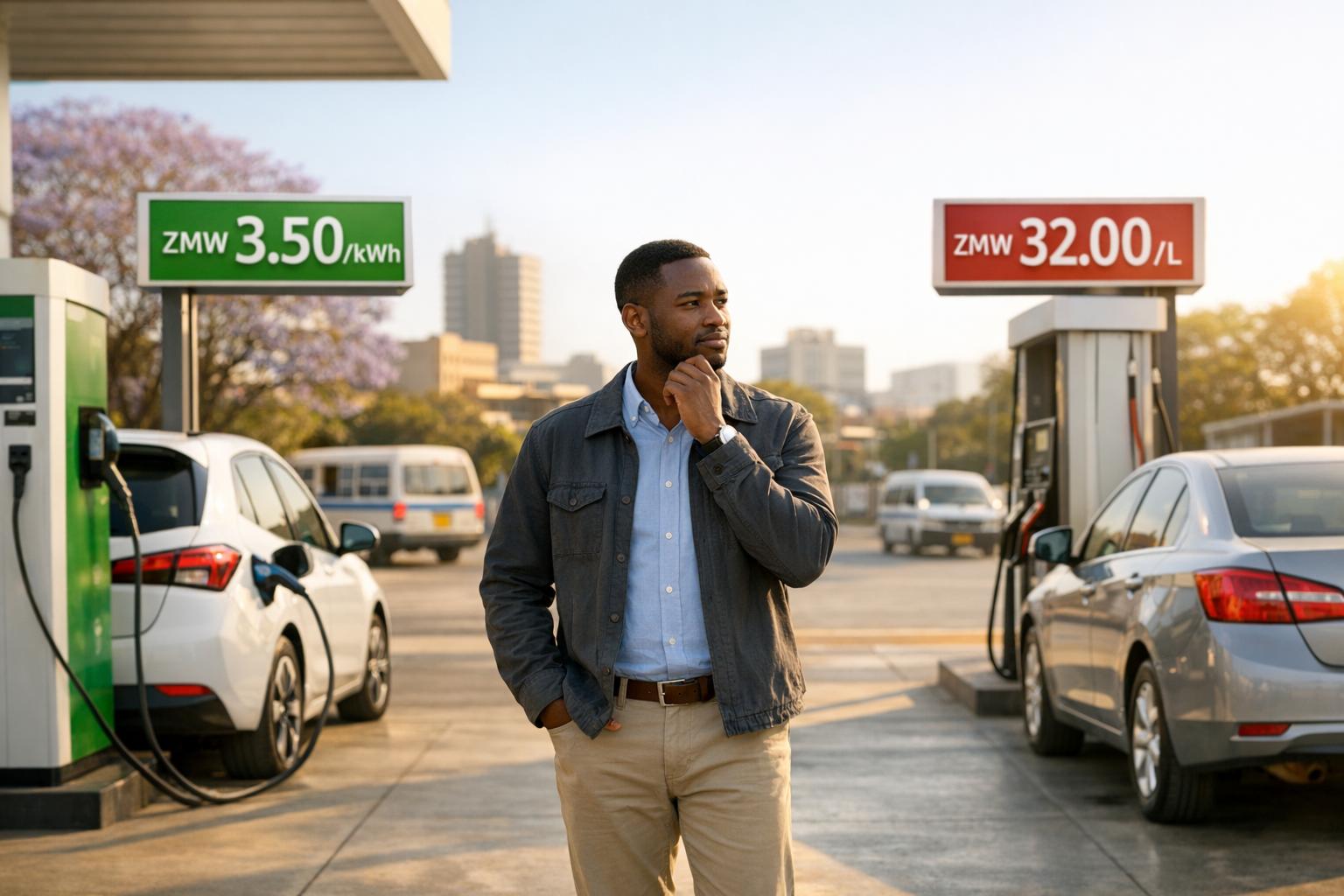
Electric vehicles (EVs) are becoming more popular in Zambia, thanks to a 0% customs duty policy that has made their prices competitive with petrol cars. But which one actually costs less in the long run? Here’s the breakdown:
- Purchase Price: EVs, like the Nissan Leaf (starting at $8,000), now rival petrol cars in upfront costs, especially with tax breaks.
- Fuel vs Charging Costs: Petrol costs about $46.28/month for average city driving, while charging an EV at home with ZESCO electricity is much cheaper. Solar charging can reduce costs to near zero after installation.
- Maintenance: EVs are simpler to maintain, saving about 40% in upkeep compared to petrol cars, which need oil changes, spark plug replacements, and more.
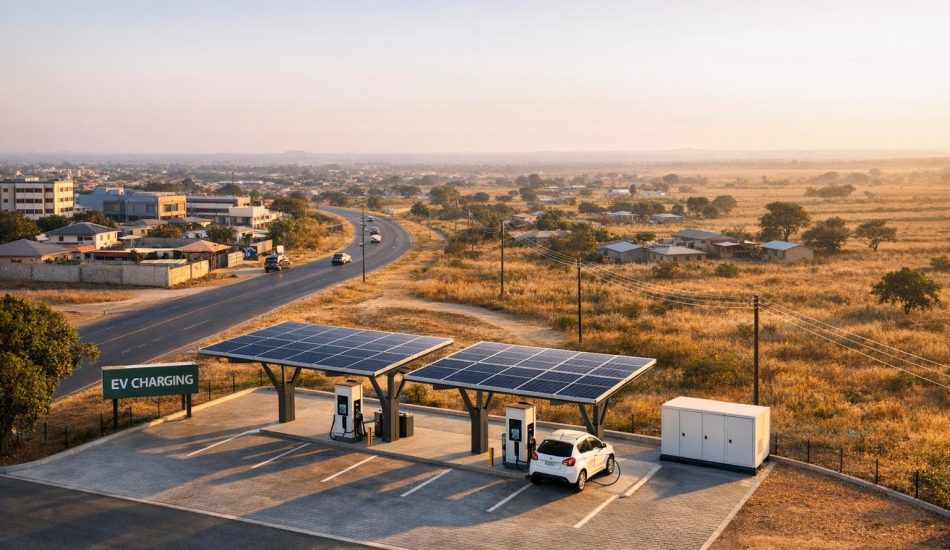
- Infrastructure: Petrol stations are everywhere, but EV charging points are growing, with a $20 million investment in solar-powered stations in major cities.
- Government Incentives: EVs benefit from tax exemptions and green financing options, while petrol cars face higher duties.
Quick Takeaway: EVs are cheaper to own and operate over time, especially for city drivers with access to home charging. Petrol cars still offer convenience for long-distance travel but come with higher running costs.
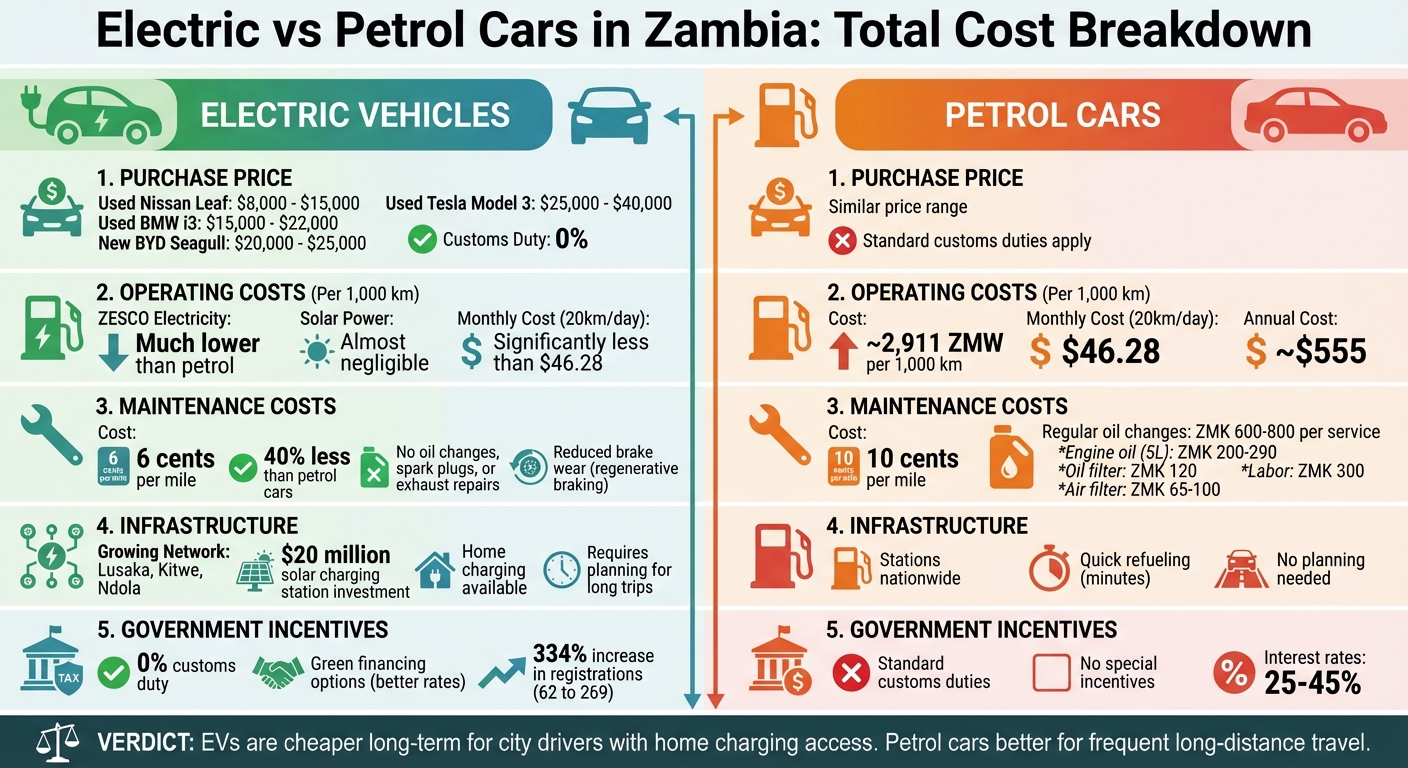
Electric vs Petrol Cars Cost Comparison in Zambia
Cheaper Than Petrol? The Tipping Point for Electric Vehicles in Africa
sbb-itb-99e19e3
Purchase Price: Initial Costs
Understanding the upfront expenses is key when considering the overall cost of owning a vehicle. In Zambia, the price gap between electric vehicles (EVs) and petrol cars has narrowed thanks to the government’s decision to implement a 0% customs duty on EVs. While EVs generally cost more worldwide, this tax relief reduces the disparity locally. However, buyers should still account for other charges like Value Added Tax (VAT), excise duty on the CIF (Cost, Insurance, and Freight) value, and fees for clearing agents.
Price Differences Between EVs and Petrol Cars
Here’s a snapshot of EV prices based on listings from EV24.africa:
- A used Nissan Leaf costs between $8,000 and $15,000, offering a range of about 150–250 km (93–155 miles).
- A used BMW i3 is priced at $15,000 to $22,000, with a range of 200–260 km (124–161 miles).
- A new BYD Seagull sells for $20,000 to $25,000, delivering a range of approximately 305 km (189 miles).
- A used Tesla Model 3 ranges from $25,000 to $40,000, offering a range of about 400–550 km (249–342 miles).
These figures illustrate that, when factoring in similar levies, EVs can hold their own against many popular petrol or diesel vehicles in Zambia. Before committing to an import, it’s essential to confirm the vehicle’s condition through a live video walk-around and review its auction grade sheet. Additionally, hiring a clearing agent to handle Zambia Revenue Authority (ZRA) paperwork can save time and effort. These upfront considerations pave the way for evaluating financing options.
Financing Options with EV24.africa
While EV prices are competitive, navigating Zambia’s high interest rates is crucial for affordability. Vehicle loan interest rates in the country typically range between 25% and 45%. To address this challenge, EV24.africa works with asset financing specialists who simplify the process, especially for those importing EVs. These partners often provide more flexible terms compared to traditional banks, focusing on the vehicle’s value rather than rigid income criteria. This approach can benefit self-employed individuals or those with irregular incomes.
To reduce overall costs, buyers should aim for a larger down payment to lower the principal and, consequently, the interest. It’s also worth exploring "green financing" packages, which may offer slightly better rates for EV purchases. Comparing quotes from multiple banks and financing providers is a smart move to identify hidden fees and secure the best terms. Applicants will need to provide documents such as a pro-forma invoice, proof of income, a National Registration Card, a driver’s license, and recent bank statements. These financing options, combined with the duty waiver, make EV ownership in Zambia more accessible and cost-effective.
Operating Costs: Fuel vs Electricity
After buying a vehicle, operating costs quickly become your biggest ongoing expense. In Zambia, the difference between fueling a petrol car and charging an electric vehicle (EV) is striking. By understanding these costs, you could save thousands of kwacha every year. Here’s how they compare.
Fuel Costs for Petrol Cars
Petrol prices in Zambia are unpredictable, driven by global oil markets and local taxes. Currently, petrol costs around 29.11 ZMW per liter. For someone driving 20 km daily in cities like Lusaka or Kitwe, the monthly fuel expense averages about $46.28. This assumes a vehicle with moderate fuel efficiency of 10 km per liter. Over a year, that’s roughly $555 spent on petrol alone. If your commute is longer or you travel between cities often, these costs rise even further. Plus, sudden price hikes make it tough to plan your budget.
So, how does this stack up against the cost of charging an EV?
Electricity Costs for EVs
Charging an EV at home using ZESCO’s residential electricity tariffs is much cheaper than filling up at a petrol station. ZESCO uses a tiered pricing system (R1 to R6), where rates increase with higher energy consumption. While an Emergency Tariff adjustment introduced on November 1, 2024, raised prices for heavy users, electricity still remains a more affordable option for powering vehicles.
Most EV owners in Zambia charge their cars overnight when the grid is more stable and demand is lower. For those who invest in solar panels, the cost of charging drops to almost nothing after installation. This makes EVs an attractive option for long-term savings.
Cost Comparison per 1,000 km
To better illustrate the cost difference, here’s a side-by-side comparison:
| Vehicle Type | Energy Source | Estimated Cost per 1,000 km | Key Cost Driver |
|---|---|---|---|
| Petrol Car | Petrol (Gasoline) | ~2,911 ZMW | Global oil prices & local taxes |
| Electric Vehicle | ZESCO Electricity | Much lower than petrol | Local electricity tariffs |
| Electric Vehicle | Solar Power | Almost negligible | Initial solar installation |
Over time, EVs clearly have the edge. Petrol prices are tied to volatile global markets, while electricity costs – though variable – are easier to predict each month. Plus, Zambia’s Ministry of Green Economy and Environment has signed a $20 million deal to install solar-powered charging stations in major cities. This initiative will reduce reliance on the grid and ensure EVs remain practical even during load shedding.
Maintenance Costs: EVs vs Petrol Cars
In Zambia, where operating expenses play a huge role in vehicle ownership, the difference in maintenance costs between electric vehicles (EVs) and petrol cars can significantly influence total costs. EVs, with their simpler mechanical systems, tend to be far easier – and cheaper – to maintain compared to petrol cars, which have numerous moving parts that wear out over time.
Maintenance Costs for Petrol Cars
Owning a petrol car in Zambia means preparing for regular servicing. Typically, every 5,000 to 10,000 kilometers, you’ll need to handle oil changes, replace filters, and occasionally swap out spark plugs. For instance, maintaining a 1.5L Toyota Corolla costs around ZMK 600 to ZMK 800 per basic service session. Here’s a quick look at some common expenses:
- Engine Oil (5 liters): ZMK 200 to ZMK 290
- Oil Filter: About ZMK 120
- Air Filter: ZMK 65 to ZMK 100
- Labor Costs: Approximately ZMK 300
Beyond these routine services, petrol cars also require periodic spark plug replacements, timing belt adjustments, and even transmission repairs. On average, maintaining a petrol car costs about 10 cents per mile.
Maintenance Costs for EVs
EVs, on the other hand, skip many of these routine tasks. There’s no need for oil changes, spark plug replacements, or exhaust system repairs. Maintenance focuses on simpler tasks like tire rotations, cabin air filter changes, and monitoring the health of the battery. Thanks to regenerative braking, brake pads last much longer, reducing wear and tear.
In Zambia’s warm climate, keeping the battery in good shape involves maintaining charge levels between 20% and 80%. When it comes to cost, EVs average about 6 cents per mile for maintenance – roughly 40% less than petrol cars. In some markets, annual EV maintenance can be as much as 60% to 70% cheaper compared to petrol vehicles.
5-Year Maintenance Comparison Table
| Maintenance Item | Petrol Car | Electric Vehicle |
|---|---|---|
| Engine Oil & Filter | Required every 5,000–10,000 km | Not Required |
| Spark Plugs | Periodic replacement needed | Not Required |
| Air/Fuel Filters | Regular replacement | Cabin air filter only |
| Brake Wear | Standard friction-based wear | Reduced wear (regenerative braking) |
| Transmission Service | Multi-speed (fluid changes) | Single-speed (minimal service) |
| Estimated Cost per Mile | 10 cents | 6 cents |
Over a five-year period, these cost differences add up quickly. Petrol cars require more frequent service to keep them running efficiently, while EVs provide a simpler, lower-maintenance option. For Zambian drivers, these savings can make EVs an attractive long-term choice.
Infrastructure: Charging vs Refueling
EV Charging Infrastructure in Zambia
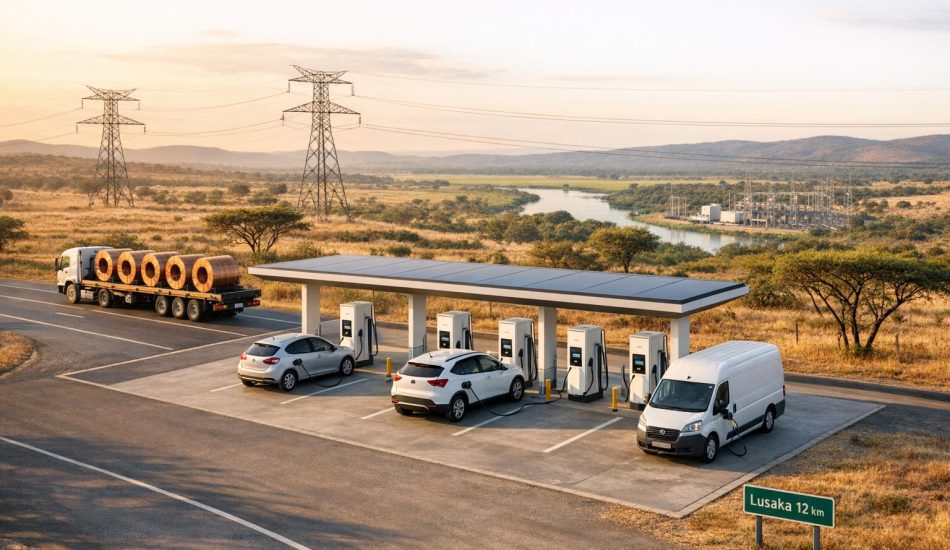
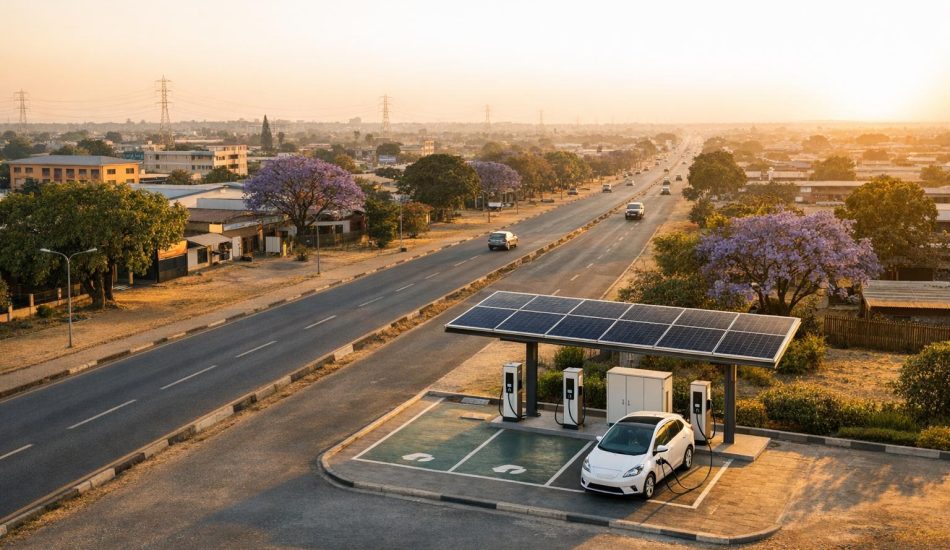
Zambia’s EV charging network is still in its early stages, but it’s growing steadily in urban areas like Lusaka, Kitwe, and Ndola. You can now find public charging stations popping up at shopping malls, office complexes, and even some petrol stations. A big push came in September 2025, when the Ministry of Green Economy and Environment inked a $20 million deal with EVC Investments to roll out solar-powered charging stations in these cities. By using solar energy, the initiative aims to tackle issues like grid instability and load shedding.
For most EV owners, home charging is the go-to option, especially for daily commutes. But for longer trips, drivers need to plan ahead. Apps like PlugShare have become essential tools, helping users locate charging points along major routes. While the charging network is expanding, it still has a long way to go to match the convenience of petrol stations.
On the other hand, petrol stations have long been a cornerstone of Zambia’s transportation infrastructure.
Petrol Station Accessibility
Petrol stations are everywhere, from bustling cities to remote towns. Refueling is quick and easy, usually taking just a few minutes. This accessibility makes spontaneous road trips and travel outside urban areas a breeze. In contrast, EV charging infrastructure is still largely confined to major cities.
How Infrastructure Affects Vehicle Choice
The contrast between Zambia’s emerging EV charging network and its well-established petrol station system significantly impacts consumer decisions.
For now, petrol cars offer unmatched convenience, thanks to the widespread availability of refueling stations. You can fill up almost anywhere, anytime, with minimal planning. EVs, however, come with the perk of home charging, which eliminates the need for frequent trips to a fuel station and lowers operating costs. For city residents with predictable daily routines, EVs are becoming a practical option. But for those who frequently travel long distances or live in rural areas, petrol vehicles remain the more reliable choice until EV charging infrastructure catches up.
| Feature | EV Charging Infrastructure | Petrol Station Infrastructure |
|---|---|---|
| Current State | Expanding in urban areas | Established nationwide |
| Primary Location | Home and cities like Lusaka, Kitwe, Ndola | Available throughout Zambia |
| Energy Source | National grid, increasing solar use | Imported liquid fuel |
| Travel Planning | Requires planning for long trips | Minimal planning needed |
| Investment | $20 million solar rollout (Sept. 2025) | Mature, long-standing network |
These differences in infrastructure are a key factor in determining long-term costs and convenience for vehicle owners.
The move toward solar-powered charging stations is expected to improve reliability, especially during load shedding. And with the government scrapping customs duties on EVs, adoption is picking up speed. As the charging network expands, the convenience gap between EVs and petrol cars is likely to shrink, making electric vehicles a more practical choice for a growing number of Zambians.
Government Policies: Taxes and Incentives
Tax Incentives for EVs
Government policies in Zambia are playing a big role in making electric vehicles (EVs) more accessible. By eliminating customs duties on imported EVs – including electric motorcycles, buses, trucks, and charging accessories – the government has significantly lowered upfront costs. However, importers still need to pay VAT on the CIF value and a small excise duty. To avoid unexpected expenses, it’s wise for buyers to get a detailed quote from a professional clearing agent to understand all Zambia Revenue Authority charges.
In addition to tax incentives, Zambia is setting up special economic zones to attract investments in EV-related industries, taking advantage of the country’s copper production. This focus on EVs has already shown results, with registered EVs jumping by 334% – from 62 to 269 – between early 2024 and mid-2025. Some banks are even offering green loans with better rates compared to standard vehicle loans, making EV ownership even more appealing.
"The game-changer has been the government’s decision to completely remove customs duties on imported electric vehicles. This single policy has slashed the upfront cost, putting EVs in the same price bracket as many popular petrol or diesel cars."
- Younes Rabeh, African EV Market News
While EVs benefit from these tax breaks, petrol vehicles remain subject to standard duties, which impacts their overall cost and competitiveness.
Taxes and Levies for Petrol Cars
Petrol and diesel vehicles don’t enjoy the same tax relief as EVs. They are subject to standard customs duties, along with VAT and excise duty – charges that EVs also pay but often at lower rates. Without customs duty exemptions, petrol vehicles face higher overall pricing, giving EVs a clear edge in the market.
| Tax/Fee Type | Electric Vehicles (EVs) | Petrol/Diesel Vehicles |
|---|---|---|
| Customs Duty | 0% | Standard applicable rates |
| Value Added Tax | Applicable (on CIF value) | Applicable |
| Excise Duty | May apply (typically lower) | Standard applicable rates |
| Government Incentives | High (Green Economy initiatives) | None |
This tax structure highlights how government policies are designed to promote EV adoption by making them more affordable compared to petrol-powered cars.
How Policies Affect Total Cost
The customs duty exemption has made EVs much more competitive in Zambia. Used EVs can now rival the cost of used petrol cars imported from countries like Japan. For instance, a used Nissan Leaf can be imported for around $8,000 to $15,000, while a new BYD Seagull costs between $20,000 and $25,000. Without customs duties, EV prices align with petrol cars, and their lower running costs – thanks to cheaper electricity or solar charging – make them even more economical in the long run. When combined with green financing options, these policies are turning EVs into an attractive choice for Zambian drivers.
Conclusion: Which Is Cheaper in Zambia?
When you break down the numbers – initial purchase price, operating costs, maintenance, and infrastructure – electric vehicles (EVs) clearly take the lead for long-term savings. Thanks to the government’s removal of customs duties, EVs now compete on price with petrol cars right from the start. In fact, used EVs are now priced similarly to imported petrol models, making them a viable choice for many buyers.
The real savings come over time. Charging an EV at home costs far less than filling up a tank of petrol, and if you invest in solar panels, your energy costs could drop to almost nothing. Maintenance is another area where EVs shine. Without oil changes, exhaust systems, or other complex moving parts, maintenance expenses are significantly lower, helping you recoup any higher upfront costs fairly quickly.
Charging infrastructure is also catching up fast. The government is rapidly expanding solar-powered charging stations, ensuring better access for EV owners. For most Zambians who primarily drive within cities, home charging already meets daily needs. Petrol stations still hold the edge for long-distance travel, but for urban drivers, EVs are already a practical option. Combine this with emerging financing options tailored for EVs, and the economic case becomes even stronger.
That said, financing remains a hurdle. With interest rates ranging from 25% to 45%, loans can be costly. However, some banks now offer green financing options with more favorable terms for EV buyers, making monthly payments easier to handle. A larger down payment can also help reduce the total interest paid over the life of the loan. When you weigh all these factors together, EVs clearly offer a cost advantage for most Zambian drivers.
The takeaway: If you’re an urban driver with the ability to manage the upfront costs, EVs deliver substantial savings through lower fuel, maintenance, and tax expenses. On the other hand, petrol cars might still be the better fit for those who frequently travel long distances or prioritize the convenience of widespread refueling options.
FAQs
How much does it cost to charge an EV at home in Zambia?
Charging an electric vehicle (EV) at home in Zambia usually costs between $0.16 and $0.22 per kWh. The actual cost will vary based on local electricity rates and how much energy your vehicle consumes.
How long do EV batteries last in Zambia’s heat, and what does replacement cost?
EV batteries in Zambia generally last for around 13 years or even longer. Today’s batteries are built to withstand heat, with an average annual degradation rate of about 2.3%. However, extreme temperatures can speed up this wear and tear. When it comes to replacements, costs can be quite high and vary based on the battery’s size and technology. Unfortunately, specific pricing details for Zambia aren’t easily accessible.
Can I road-trip across Zambia in an EV without running out of charge?
Yes, taking a road trip across Zambia in an EV is getting easier thanks to better charging infrastructure and supportive government policies. Zambia has eliminated customs duties on EVs and charging equipment, making it more affordable for people to own one. With the country’s abundant clean hydroelectric power and a bit of planning – like identifying charging stations and managing your EV’s range – you can cover long distances. Plus, the infrastructure is set to keep improving as EV adoption grows.