
 Thabo Nkosi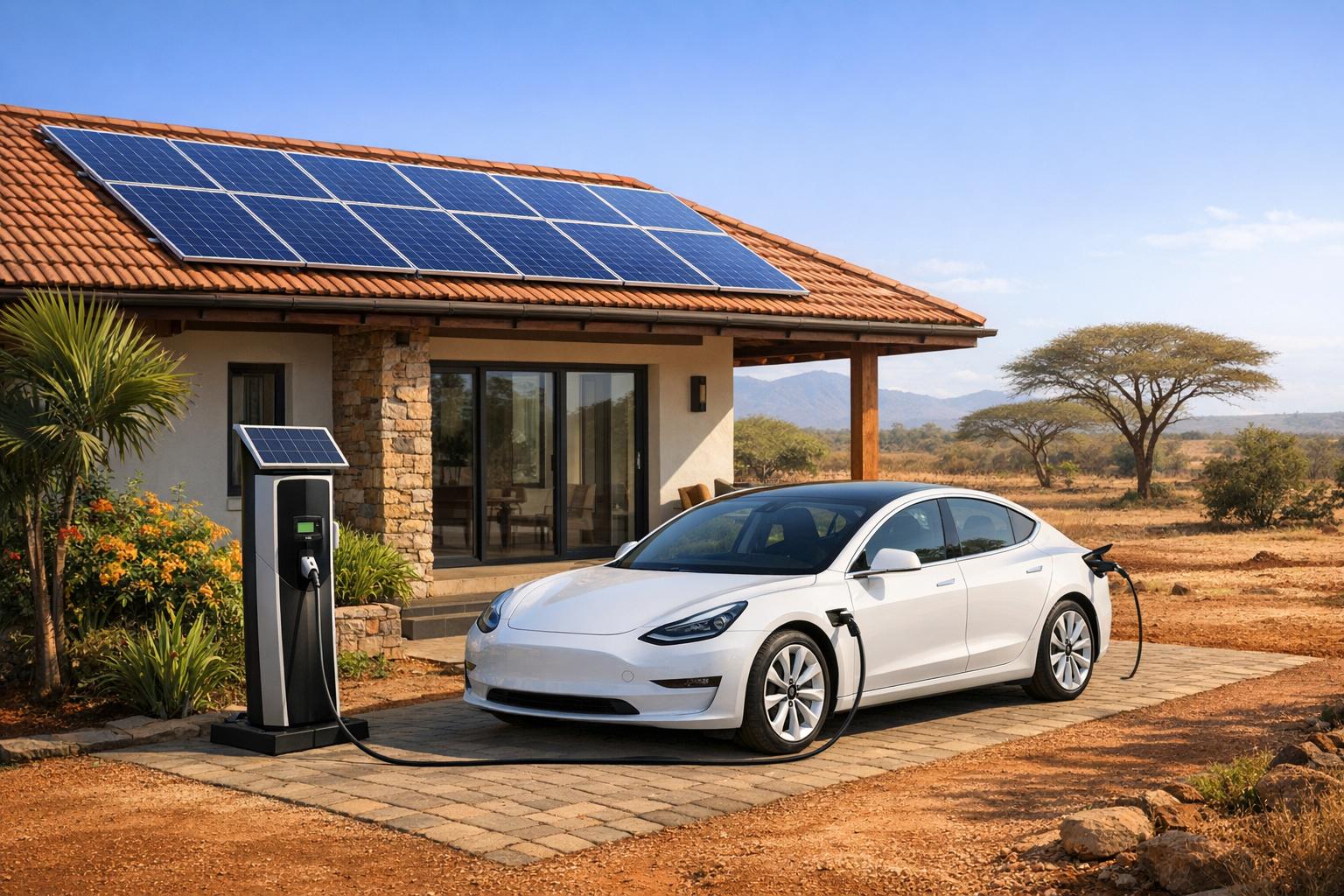
Charging your EV with solar power at home in Africa can save you money, reduce reliance on the grid, and offer a cleaner energy solution. Here’s what you need to know:
- Cost Savings: Solar EV charging at home is 4–6 times cheaper than using petrol. For example, a BYD Atto 3 owner in Johannesburg saved $121 monthly, recouping installation costs in just 7 months.
- System Requirements: A typical setup includes solar panels (10 kW recommended for households with EVs), a hybrid inverter, lithium-ion batteries (10–15 kWh), and a Level 2 EV charger.
- Climate Considerations: Monocrystalline panels perform best under Africa’s sunny conditions, and proper ventilation helps manage heat. Battery systems ensure uninterrupted power during outages.
- Installation Costs: A complete system can range from $8,500 to $12,800 for solar arrays, with batteries and chargers adding $7,000–$12,000.
- Maintenance: Regular cleaning and system checks are essential to maintain efficiency and prolong lifespan.
Solar EV charging is a cost-effective solution for tackling Africa’s power challenges while promoting energy independence. Below, we’ll explore how to assess your needs, choose components, and maintain your system.
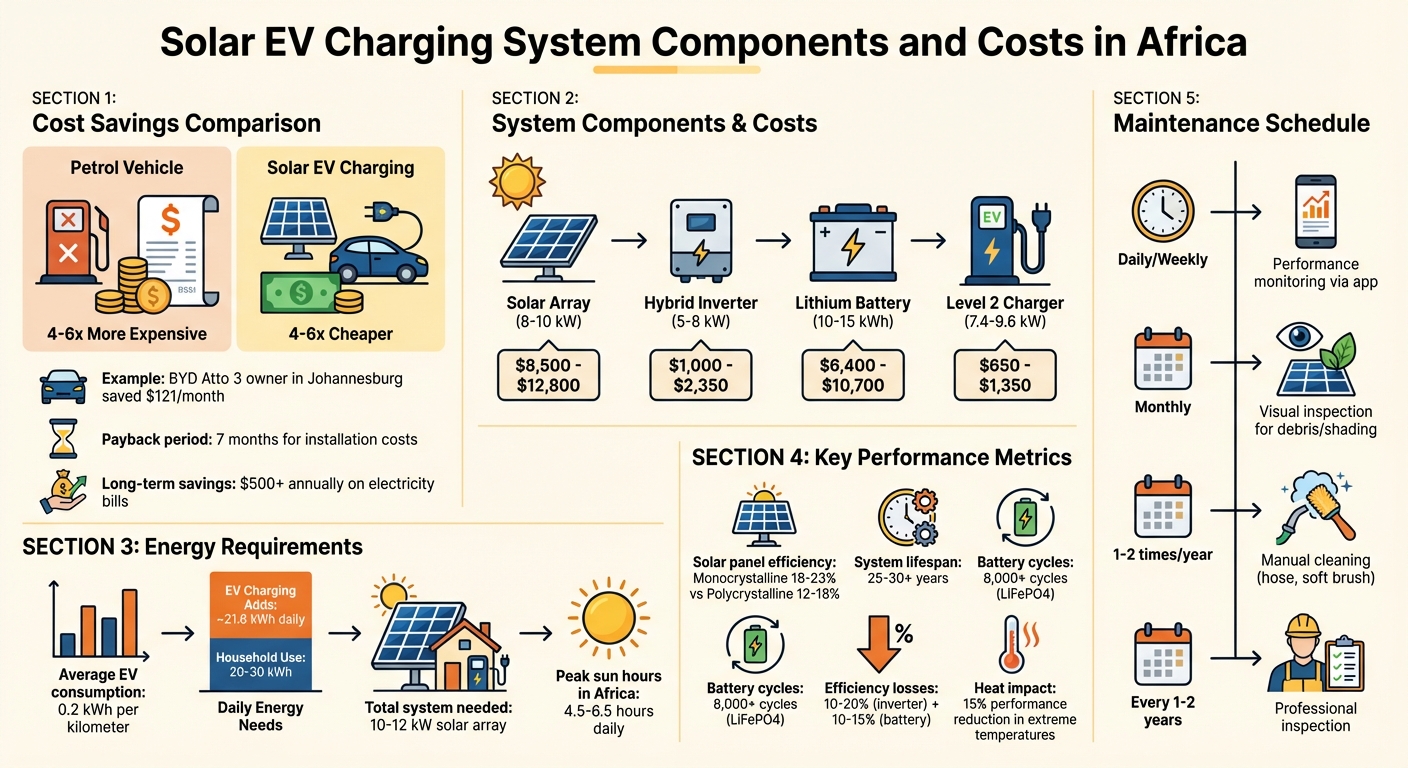
Solar EV Charging System Components and Costs in Africa
Assessing Your Home Energy Needs and Setup
Understanding EV Charging Requirements
Start by figuring out how much energy your electric vehicle (EV) needs. On average, EVs consume about 0.2 kWh per kilometer – or approximately 31 kWh per 100 miles for those in the U.S.. For instance, if you drive 50 kilometers a day, you’ll need about 10 kWh daily.
Take James Ndungu’s example from January 2025. He conducted a study for his Tesla Model 3 and Model Y, which together covered 2,500 miles per month. After crunching the numbers, he found that charging both EVs required 648 kWh monthly. Adding this to his household’s baseline energy use of 600 kWh, his total monthly demand reached 1,248 kWh – or about 41 kWh per day. To meet this, he installed a 10 kW solar system with 33 panels, each rated at 325W.
It’s also important to factor in charging losses. Inverters typically operate at around 85% efficiency, so you’ll need to multiply your energy estimate by 1.18 to account for those losses. For example, if your EV needs 10 kWh daily, your solar system should generate about 11.8 kWh. Reviewing your electricity bills from the past 6–12 months can give you a solid idea of your home’s baseline energy use before adding the EV’s needs. Once you’ve determined your energy requirements, it’s time to evaluate your home’s setup for solar installation.
Evaluating Your Home for Solar Installation
After calculating your energy needs, take a close look at your home’s features to get the most out of your solar panels. A north-facing roof with a slope between 15° and 40° is ideal for capturing sunlight. For example, in South Africa, most areas enjoy 4.5 to 6.5 peak sun hours daily, with 5.5 hours often used for winter calculations. Based on these figures, a 1 kW solar array can generate roughly 4–6 kWh of electricity per day.
Check for any shading caused by nearby trees, buildings, or other obstructions. Also, inspect your roof’s condition – if it’s aging or in poor shape, it’s wise to replace it before installing solar panels. If your roof isn’t suitable due to shading or structural issues, consider alternatives like a solar carport or a ground-mounted system.
Finally, don’t overlook your home’s electrical panel. Many older homes with 100 Amp panels might need upgrades to support a Level 2 EV charger, while a 200 Amp panel usually offers enough capacity. Ensuring your setup is ready for both solar and EV charging is key to long-term efficiency and reliability.
Choosing the Right Solar Components for African Climates
Selecting Solar Panels: Monocrystalline vs Polycrystalline
In African climates, monocrystalline solar panels are often the go-to choice due to their higher efficiency and durability in challenging conditions. These panels, crafted from a single silicon crystal, typically offer efficiencies between 18% and 23%, outperforming polycrystalline panels, which range from 12% to 18% efficiency. This makes monocrystalline panels ideal for regions where roof space is limited, as they generate more electricity per square foot. Premium options, like those from EcoFlow, can even reach efficiencies as high as 22%–23%.
While polycrystalline panels are more affordable upfront, their lower energy output per square foot often makes monocrystalline panels a smarter long-term investment. Plus, monocrystalline panels generally last 25 to 30 years or more and perform reliably in extreme heat. To ensure durability against Africa’s dusty conditions and seasonal rains, look for panels with at least an IP68 rating. Also, make sure your inverter and EV charger are compatible with your panels, especially under fluctuating power conditions.
Picking the Right Inverter and EV Charger
Hybrid inverters are an excellent choice for handling Africa’s unpredictable power supply. These inverters can simultaneously draw energy from solar panels, batteries, and the grid, ensuring a steady power flow even during load-shedding or voltage fluctuations. Brands like Deye and Victron offer hybrid models that can be paralleled, allowing for system expansion as your energy needs grow. When choosing an inverter, make sure its "Max PV Input" or "Max DC Input" rating exceeds the total wattage of your solar array. Adding surge protection devices (SPDs) is also crucial to safeguard your equipment from voltage spikes.
For EV charging, a Level 2 (240V) smart charger is recommended. These chargers can deliver up to 9.6 kW and often include features like "Charge on Solar", which prioritizes solar energy for vehicle charging. Before installation, have an electrician confirm that your home’s electrical panel can handle both household loads and the charger.
| Charger Model | Amperage | Key Solar Feature |
|---|---|---|
| Tesla Universal Wall Connector | 48A | "Charge on Solar" via Tesla App |
| Wallbox Pulsar Plus | 40A/48A | Eco-Smart solar charging mode |
| Emporia Level 2 | 48A | Integrated energy management/monitoring |
| Enphase IQ 50 | 40A | Seamless integration with Enphase devices |
A well-chosen battery system will round out your solar setup, storing energy for peak usage times and outages.
Battery Options: Lithium-Ion vs Second-Life EV Batteries
When it comes to storing solar energy in African climates, lithium-ion batteries – specifically LiFePO4 (Lithium Iron Phosphate) – are widely considered the most dependable option. These batteries last over 10 years, support an 80% to 90% depth of discharge (DoD), and can endure more than 8,000 charge cycles. On the other hand, traditional lead-acid batteries are limited to a 50% DoD and typically last only 3 to 5 years. To maintain performance in high temperatures, install batteries in shaded, well-ventilated areas.
A strong Battery Management System (BMS) is essential for protecting against voltage irregularities, managing heat, and ensuring proper cell balancing in harsh environments. For areas with frequent load-shedding, size your battery system to provide 2–3 days of backup power. Keep in mind that energy losses of 10% to 20% can occur due to inverter inefficiencies, along with an additional 10% to 15% from battery charging and discharging processes.
Finally, opt for batteries from brands with established service centers in Africa, such as Huawei or Victron Energy, to ensure reliable warranty support and easy access to replacement parts.
Step-by-Step Guide to Solar EV Charger Installation
Preparing Your Site for Solar Installation
Once you’ve assessed your energy requirements and chosen the right components, it’s time to prepare for the installation of your solar EV charger. Start by having a licensed electrician perform a load calculation on your main electrical panel. This calculation will determine whether your existing 100- or 200-amp panel can handle a Level 2 charger or if you’ll need a sub-panel or an upgrade to safely manage the additional 40–50 amp draw. Once the panel’s capacity is confirmed, you can move forward with finalizing your solar site layout.
Next, evaluate the mounting area to determine the ideal placement for your solar panels. Use prior roof assessments to confirm panel locations and cable routes. Digital tools can help measure space and shading accurately. For regions in the Southern Hemisphere, like many parts of Africa, panels should ideally face north to capture maximum sunlight. In areas prone to high winds, fixed, low-profile galvanized steel mounts are recommended to minimize exposure to extreme conditions.
Before activating the system, install essential safety components. These include DC and AC surge protection devices (SPDs), DC disconnect switches, lightning arrestors, and a reliable grounding system. Proper installation is key to ensuring the system performs well, even during challenges like load-shedding or severe weather. Use short, straight cable runs housed in protective conduits to reduce wear and tear from environmental factors.
"Utilities and permitting offices typically mandate professional installation to ensure code compliance, eligibility for incentives, and safe operation." – SolarEdge Marketing
Installing and Configuring Solar Components
Begin by connecting your solar panels in series or parallel to a DC combiner box equipped with fuses. Install fuses on the positive wires at three critical points: between the solar panel and charge controller, between the controller and battery, and between the battery and inverter. The power then passes through a DC disconnect switch and a DC surge protector before reaching the hybrid inverter.
From the inverter, connect to an AC distribution panel that includes an AC surge protector and a disconnect switch. Your Level 2 EV charger should be connected to a dedicated circuit branch within this AC panel. For areas with frequent load-shedding, which is common in parts of Africa, integrate a battery storage system with the inverter. This setup allows seamless switching between solar, battery, and grid power sources.
Opt for chargers with dynamic load balancing features that adjust their output based on your household’s real-time energy use. This helps avoid overloading your panel without requiring costly upgrades. Smart chargers with "Charge on Solar" modes can prioritize solar energy during peak production times. Install your inverter and batteries in a secure, well-ventilated area to prevent overheating and maintain long-term efficiency. Finally, have your electrician ensure that all grounding and bonding comply with local electrical codes before activating the system.
Cost Estimation and System Sizing
Estimating Costs for Solar EV Charging Systems
Investing in a solar EV charging system comes with a notable upfront cost, but prices are becoming more affordable. For instance, utility-scale solar PV installations in Africa now average about $1.30 per watt, compared to $1.80 per watt globally. In South Africa, a complete 5 kW solar system – including panels, an inverter, and batteries – costs between $4,800 and $8,000. Systems designed to handle both household energy and EV charging (typically 8–10 kW) are priced between $8,500 and $12,800 for the solar array, while hybrid inverters range from $1,000 to $2,350.
Battery storage represents a significant portion of the total investment. Lithium-ion batteries generally cost $651 to $1,510 per kWh, with a standard 13.5 kWh home battery system averaging around $10,877. For EV charging in Africa, a 10–15 kWh battery system is common, translating to an investment of approximately $6,400 to $10,700.
The Level 2 EV charger itself adds another expense, costing between $650 for basic models and $1,350 for high-end 11 kW units. Professional installation typically adds $135 to $270.
| Component | Typical Capacity for EV + Home | Estimated Cost Range (USD) |
|---|---|---|
| Solar Array | 8 kW – 10 kW | $8,500 – $12,800 |
| Hybrid Inverter | 5 kW – 8 kW | $1,000 – $2,350 |
| Lithium Battery | 10 kWh – 15 kWh | $6,400 – $10,700 |
| Level 2 Charger | 7.4 kW – 9.6 kW | $650 – $1,350 |
Charging your EV at home is estimated to be 4–6 times cheaper than using petrol. Over time, the savings can offset the initial investment, especially when you rely on solar power for charging, further reducing your long-term costs.
Once you’ve estimated your budget, the next step is to size your system to meet your daily energy needs effectively.
Sizing Your System for Daily Energy Needs
Proper system sizing ensures that your solar setup operates efficiently. Start by calculating your total energy demand. In South Africa, households typically consume 600–900 kWh per month, which breaks down to about 20–30 kWh daily. Adding a Level 2 EV charger can significantly increase this consumption. For example, if you charge your EV 15 times a month using a 9.6 kW charger for 4.5 hours per session, each session consumes about 43.2 kWh. This totals roughly 648 kWh per month, or about 21.6 kWh daily.
To determine the size of your solar array, combine your household and EV charging daily energy needs and divide by the average peak sun hours in your area. In South Africa, 5.5 peak sun hours per day is a good estimate. For instance, if your home uses 30 kWh daily and your EV charging adds 21.6 kWh, your total daily load is 51.6 kWh. Accounting for system losses (multiply by 1.3), you’d need approximately 67 kWh of energy daily. This translates to a solar array size of about 12.2 kW (67 kWh ÷ 5.5 hours).
Under ideal conditions, a 10 kW solar system can generate 40–44 kWh daily. To cover both household and EV charging needs, it’s wise to opt for a system slightly larger than 10 kW.
For battery sizing, consider your essential nighttime energy requirements and backup needs during load-shedding. A 10–15 kWh battery is typically sufficient to power key appliances and charge your EV when solar energy isn’t available. Pairing this battery capacity with a 10–12 kW solar array strikes a good balance between cost-effectiveness and reliability.
Additionally, as a rule of thumb, plan to add about two extra solar panels for every 9.6 kWh of battery storage. This ensures your batteries recharge efficiently while still supplying power for your home.
sbb-itb-99e19e3
Optimizing Solar EV Charging for Load-Shedding and Heat
Managing Charging During Load-Shedding
To keep your solar EV charging system running smoothly during load-shedding and high temperatures, a few smart strategies can make all the difference.
In many parts of Africa, load-shedding is a frequent challenge. To counter this, consider installing a battery storage system capable of providing 2–3 days of autonomy – enough to power your household even without sunlight or grid electricity during that time. A hybrid inverter is another essential component, as it ensures a seamless power supply during outages. Pair this setup with a smart energy management system to optimize how your stored energy is used. For instance, you can allocate a portion of the battery specifically for EV charging during scheduled power cuts.
"In regions like South Africa and other parts of Africa, frequent power outages and unreliable grid electricity make solar energy systems a lifeline for homes and businesses." – Coolithium
Timing is also key. Charge your EV during peak solar production hours, typically from 10 AM to 3 PM, to make the most of direct solar energy while preserving your battery reserves. If you know load-shedding is planned for the evening, charging your EV during the day ensures that your battery storage is saved for powering household essentials at night.
While managing outages is critical, dealing with high temperatures is equally important for maintaining system efficiency.
Improving System Performance in Extreme Heat
High temperatures can significantly impact the efficiency of solar panels and related equipment, so it’s crucial to plan for these conditions during installation.
In many African regions, temperatures often exceed 77°F (25°C), which is considered the optimal condition for solar panels. When panel temperatures climb to 150°F (65.5°C) or higher, efficiency drops noticeably. For example, a panel with a temperature coefficient of -0.2%/°F loses about 6% efficiency as temperatures rise from 77°F to 107°F. To account for these effects, expect a general 15% performance reduction due to heat.
Proper airflow is essential to combat overheating. Install panels with enough space between them and the roof to allow natural heat dissipation. Additionally, place inverters and batteries in shaded, well-ventilated areas or indoors to prevent heat-related failures and extend their lifespan. Lithium-ion batteries are particularly well-suited for hot climates as they tolerate heat better than lead-acid options.
Dust accumulation is another factor that can increase panel temperatures and block sunlight. Regular cleaning with a garden hose helps maintain efficiency by removing dirt and debris. When choosing panels, prioritize those with the lowest temperature coefficient, as they are less affected by heat. Despite these challenges, Africa’s abundant sunlight often offsets minor efficiency losses, ensuring your system continues to generate plenty of energy year-round.
Maintenance Tips for Long-Term System Performance
Taking care of your solar EV charging system is essential to ensure it runs smoothly and lasts for decades. In Africa’s challenging climates, regular upkeep not only protects your investment but also keeps your system performing efficiently for over 25 years. By sticking to a maintenance routine, you can optimize your panels’ output and catch potential issues early with the help of monitoring tools.
Cleaning and Inspecting Solar Panels
Dust and debris can cut your solar panels’ efficiency by around 7%. This is especially true in Africa’s dry and dusty regions, where rain is scarce and natural cleaning is limited. Always remember to turn off your system before cleaning to avoid accidents or damage.
Start by rinsing your panels with a garden hose to remove loose dirt. Then, use a soft brush and a gentle cleaning solution – like mild detergent or a diluted vinegar mix (1:8) – to scrub away stubborn grime. Avoid pressure washers, as they can harm the delicate photovoltaic cells and seals. Also, don’t spray cold water onto hot panels; the sudden temperature change could cause cracks or thermal shock.
"Washing them off with the hose is sufficient if you notice any sort of thick layer of dust, pollen, dander, or ashes. Other than that, they’re virtually maintenance free." – Guy Gabay, Solar Energy Contractor
How often should you clean? Aim for once or twice a year, but in especially dusty areas, you might need to clean more frequently. If the panels are hard to reach, hiring a professional is a good option. Expect to pay roughly $25 per panel or around $150 for a package that includes cleaning and a system checkup. If you prefer DIY, allocate about $100 for tools like brushes, squeegees, and extension poles.
After each cleaning, check your system’s performance to ensure everything is running at its best.
Monitoring System Performance
Keeping an eye on your system’s performance is just as important as cleaning. Smart monitoring tools, like the mySolarEdge Home platform or the Tesla app, provide real-time updates on your energy production and usage. These apps show whether your energy is coming from solar panels, a home battery, or the grid. Regularly check your production meter – if the output dips below expected levels on a sunny day, it might be time for cleaning or further maintenance.
Historical data in these apps can help you notice gradual efficiency drops, and automated alerts can notify you about system errors or charging statuses without needing to inspect the electrical panel manually.
For example, in January 2025, James Ndungu installed a 10kW solar-powered EV charging system using a Canadian Solar inverter with 3 MPPTs and 33 panels (325W each). The setup included a solar production meter and a bi-directional meter for net metering. By factoring in a 5% efficiency loss due to dirt and 15% due to temperature, he was able to compare actual energy output against expectations.
| Maintenance Task | Frequency | Tools Needed |
|---|---|---|
| Visual Inspection | Monthly | None (check for debris/shading) |
| Performance Monitoring | Weekly/Daily | Mobile App / Monitoring Portal |
| Manual Cleaning | 1–2 times per year | Hose, soft brush, mild soap, squeegee |
| Professional Inspection | Every 1–2 years | Licensed Electrician/Solar Pro |
Conclusion and Key Takeaways
This guide walks you through the essential steps to build a cost-effective and dependable solar EV charging system in Africa. Installing a solar-powered EV charger at home isn’t just a wise financial move – it’s a leap toward energy independence in regions where grid reliability can be a challenge. After an initial payback period of 6 to 10 years, your system provides free, grid-independent energy while protecting you from rising electricity costs and unreliable power supplies.
"Solar powered EV charging ensures you’re powering your car with 100% renewable energy, directly from your rooftop."
Here’s a quick recap: Use monocrystalline solar panels for efficiency, size the system appropriately (e.g., a 10 kW array to generate 40–44 kWh daily), and choose durable lithium-ion or second-life batteries. Smart chargers with scheduling capabilities allow you to charge during peak sunlight hours, maximizing solar energy use. Additionally, surge protection devices help protect your setup when power is restored after outages.
Routine cleaning and inspections can keep your system running efficiently for over 25 years. Considering that solar panels last for decades and require minimal maintenance, the long-term savings are substantial. For instance, a typical 4 kW solar system can save more than $500 annually on electricity bills, even before factoring in the savings from charging your EV. Beyond financial benefits, you’re also contributing to cleaner air and quieter, more sustainable communities across Africa.
FAQs
How can I figure out the right size for a solar-powered EV charging system at home?
To figure out the right size for a home solar system to charge your EV, start by estimating how much energy you’ll need daily. Most EVs use about 30 kWh per 100 miles, so if you drive 40 miles a day, you’ll need roughly 12 kWh of energy.
Once you know your daily energy needs, calculate the size of the solar array. Divide your energy requirement by the average peak sunlight hours in your area. For instance, if your area gets about 4.5 hours of sunlight daily, you’ll need a system that produces around 3.1 kW to generate 12 kWh. Factor in panel efficiency (typically about 85%), and round up slightly for better performance. In this case, installing a 3.5 kW system would be a smart move, which usually means 10–12 panels, depending on the wattage of the panels you choose.
If you want to charge your EV at night or during power outages, adding a battery is a good idea. To account for energy losses, pick a battery that can store at least 20% more than your daily energy needs. For a 12 kWh requirement, a 15 kWh battery system would work well. Also, make sure your inverter is capable of handling both the output from your solar array and the peak load of your EV charger to ensure everything runs smoothly.
What are the key costs of installing a solar-powered EV charger at home in Africa?
Installing a solar-powered EV charger at home in Africa involves a few key expenses to consider. First, the EV charger itself – usually a Level 2 wall box – plus professional installation typically costs between $650 and $1,300. This price generally includes labor, necessary wiring, and compliance certification to ensure everything meets safety standards.
Next, you’ll need a solar panel system to power the charger. For a standard 5 kW setup, which is sufficient for daily EV charging, the cost ranges from $6,500 to $9,500, not including installation. Additional equipment like a grid-tie inverter, priced between $1,000 and $1,500, may also be required. If you want the option to charge at night or during power outages, you might consider adding battery storage, which can cost anywhere from $2,000 to $5,000.
There are also ongoing expenses to factor in. These include occasional maintenance for the solar panels and inverters, as well as any supplementary electricity drawn from the grid – costs that vary depending on your location. While the initial investment might seem steep, the savings on fuel can often offset these expenses within 6 to 12 months, especially if you take advantage of financing options or local incentives.
How can I make my solar EV charging system more effective during power outages and hot weather?
To keep your solar EV charging system running smoothly during power outages and hot weather, it’s essential to focus on a few critical components:
- Battery storage: Opt for a battery with enough capacity to meet your EV’s charging needs, even during outages. Adding a safety margin ensures your vehicle stays charged when the grid is down.
- Solar panel setup: Position your solar panels at the best angle for your location to capture the most sunlight. Panels with a low temperature coefficient are better suited for hot climates, and ensuring proper ventilation can help prevent overheating.
- Smart energy management: Use a charger or energy management system that schedules charging during peak sunlight hours and prioritizes battery power during outages. This approach conserves energy and safeguards your system.
Keep an eye on your system’s performance and make adjustments as needed to ensure reliable operation, even in tough conditions.