
 Thabo Nkosi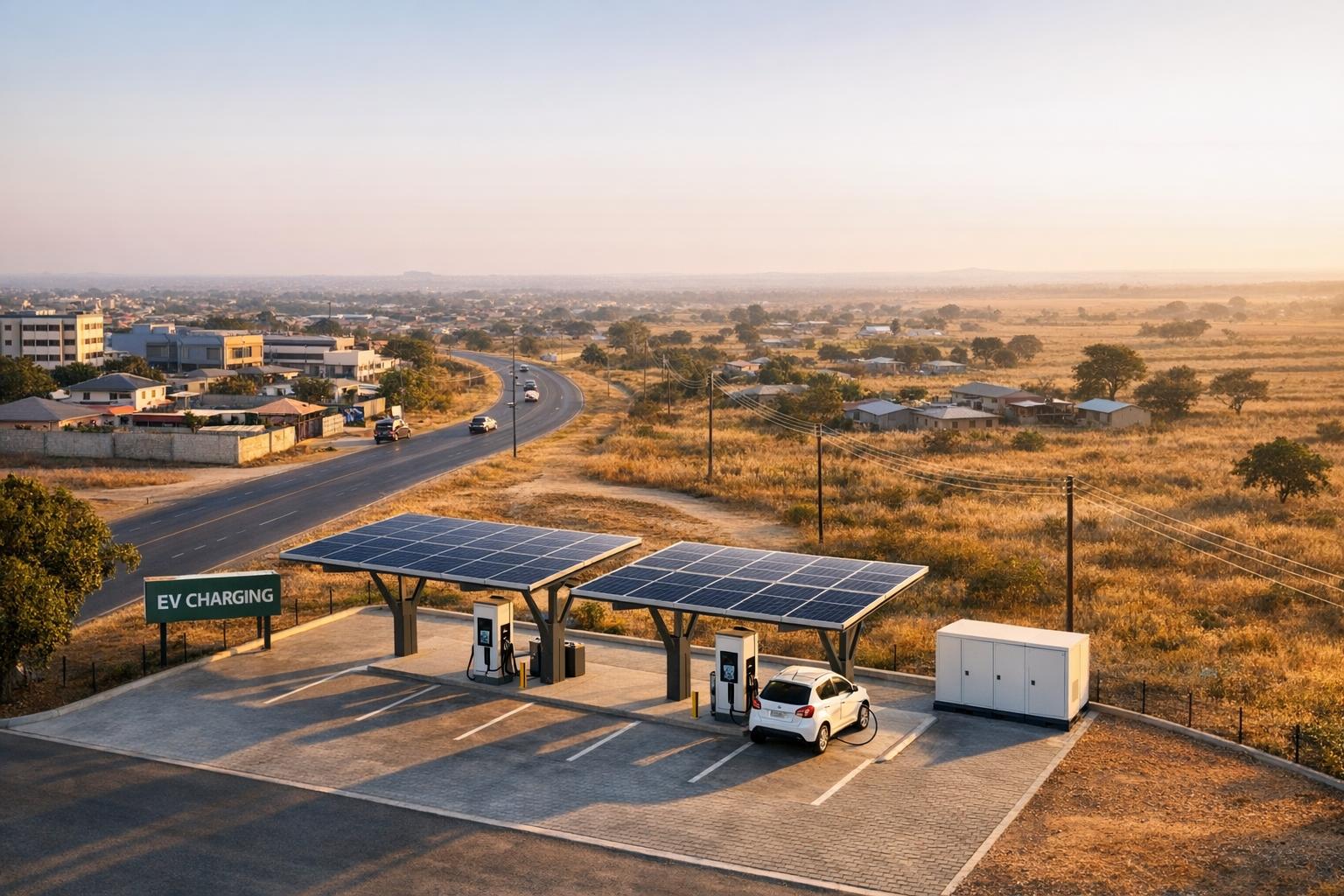
Charging an electric car in Zambia is becoming easier, but challenges remain. Here’s the current situation:
- Growth in EV Adoption: EV registrations in Zambia grew by 334% from 2024 to mid-2025, reaching 269 vehicles.
- Charging Options: Most EV owners rely on 12-hour home charging using wall sockets. Public fast-charging stations are limited but are being installed in cities like Lusaka, Kitwe, and Ndola.
- Solar-Powered Stations: A $20 million government partnership is introducing solar-powered charging hubs to address power outages and grid issues.
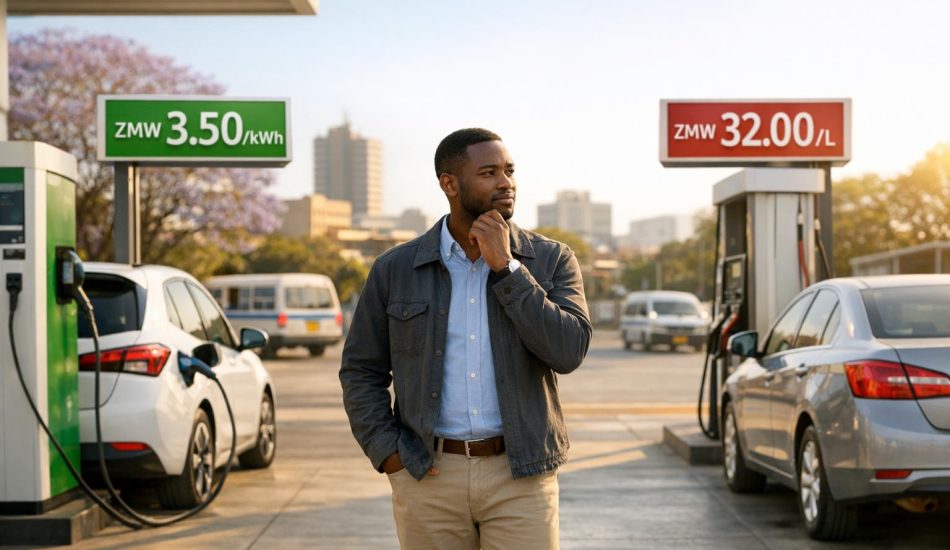
- Cost Advantage: Charging an EV for a 357-km trip costs around K200, compared to K1,500–K2,000 for a gasoline vehicle – about six times cheaper.
- Coverage Gaps: Rural areas and highways lack charging stations, making long-distance travel difficult.
Efforts from ZESCO, the government, and private companies aim to expand the network, but infrastructure challenges, including grid reliability and funding, slow progress. EV owners must plan routes carefully and use tools like EV24.africa to locate charging stations. Zambia’s EV future looks promising, but significant work is needed to support broader adoption.
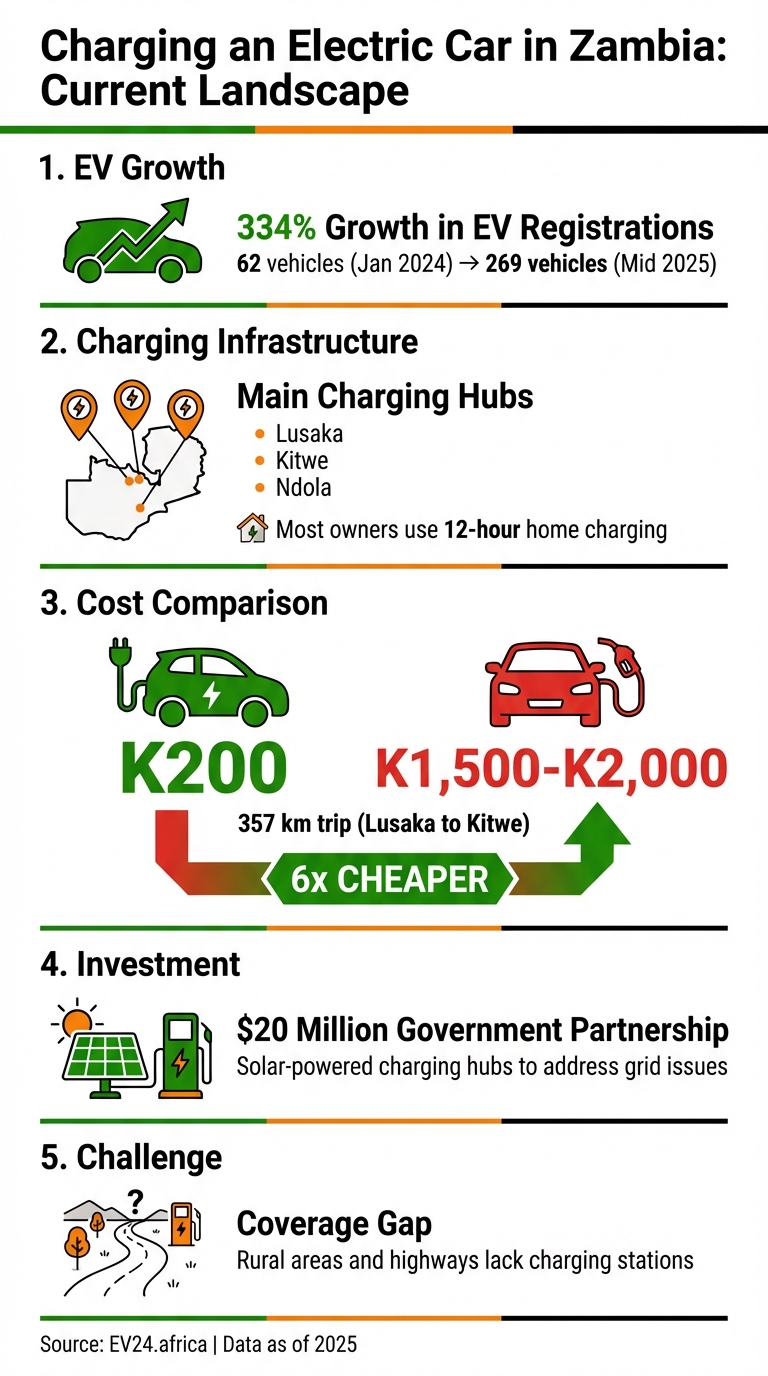
Zambia EV Charging Infrastructure: Key Statistics and Cost Comparison 2024-2025
EV Charging Infrastructure in Zambia Today
Number and Location of Charging Stations
Zambia’s electric vehicle (EV) charging network is still in its infancy, with most infrastructure concentrated in three key urban areas: Lusaka, Kitwe, and Ndola. ZESCO Limited is leading efforts to expand the availability of fast chargers across cities and towns, aiming to move beyond the current dependency on slower, 12-hour domestic charging setups.
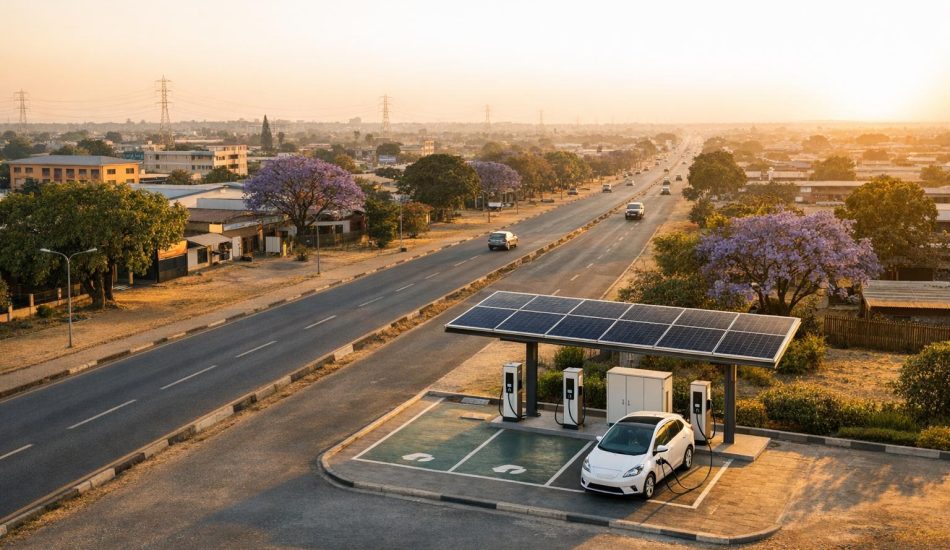
Public charging stations are being strategically placed in shopping malls, office parks, and existing fuel stations. In addition, the Ministry of Green Economy and Environment has partnered with EVC Investments on a $20 million initiative to install solar-powered charging stations, highlighting the growing role of renewable energy in transportation.
Despite these advancements, much of the country, particularly outside urban centers, remains without access to EV charging infrastructure.
Access and Coverage Gaps
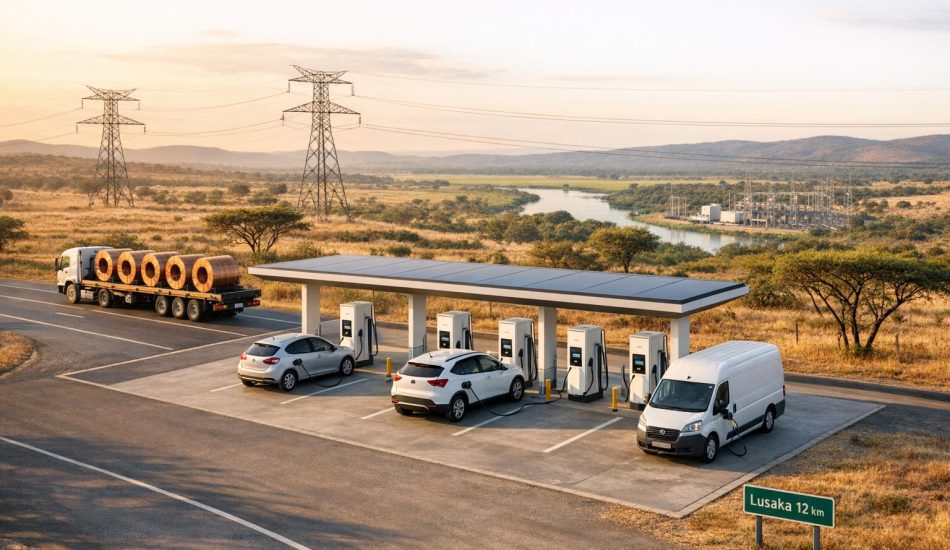
The divide between urban and rural areas is stark when it comes to charging access. Residents in Lusaka and the Copperbelt region are beginning to see more public charging options, but rural areas and long-distance highway routes remain largely neglected. This lack of coverage makes inter-city travel challenging, especially for trips to remote areas like Mongu or Lukulu.
Victor Mapani, Managing Director of ZESCO Limited, has acknowledged this issue:
"The challenge is when you take your long trips. That’s why I now want to ensure that along the way we plant the electric vehicle chargers for usage."
sbb-itb-99e19e3
This Is The First Electric Vehicle (EV) Public Charge Station 🚉⛽ In Chainama Area Of Lusaka Zambia
How to Charge Your EV in Zambia
This section explains practical ways to charge your EV in Zambia while considering model compatibility with the available infrastructure.
Payment and Activation Options
ZESCO’s Managing Director describes the activation process as straightforward: connect your vehicle, start the charge, and you’re ready to go. For home charging, EVs can be plugged into standard domestic sockets, taking about 12 hours to fully charge.
Public charging stations, on the other hand, offer faster charging speeds, making them ideal for longer trips. These stations operate on commercial rates and support payments through various methods, including RFID cards, mobile apps, and contactless options. ZESCO’s "Smart House" app may soon be integrated to manage charging sessions, simplifying the process even further. This combination of home and public charging options bridges the gap between convenience and accessibility.
The cost difference is striking. For instance, charging an EV for a 357-km trip from Lusaka to Kitwe costs around K200, whereas a similar journey in a petrol vehicle would cost between K1,500 and K2,000. As Mapani highlights, "The difference is about six times. Six times cheaper to drive an electric car." This pricing advantage not only makes EVs more economical but also aligns with the environmental benefits discussed earlier.
Which EV Models Work with Zambian Chargers
A variety of EV models are compatible with Zambia’s charging infrastructure. In October 2025, the Ministry of Green Economy and Environment introduced the GAC Aion-Y, demonstrating its ability to cover the 357-km Lusaka-to-Kitwe route on a single charge. Other compatible models include the BYD Seagull, Nissan Leaf, Tesla Model 3, and BMW i3, all of which support standard plug types like Type 2, CCS, or CHAdeMO.
These vehicles can be charged at home using domestic sockets or at public Level 2 and Level 3 (DC Fast Charging) stations, which are becoming more common in major cities. To ensure safety and compatibility, the Energy Regulation Board (ERB) has set technical and safety standards for all charging stations. Understanding which models work with the infrastructure allows drivers to make informed decisions when choosing an EV for Zambia’s expanding network.
Barriers to Expanding Charging Infrastructure
Power Grid and Electricity Supply Problems
Zambia’s reliance on hydropower presents a tough challenge for expanding EV charging infrastructure. Around 90% of the nation’s electricity comes from hydroelectric sources, making the power grid heavily dependent on consistent rainfall. During droughts, electricity production drops significantly, leading to widespread load-shedding. This means households and businesses often endure hours without power.
For EV owners, this creates a real headache. Overnight charging plans frequently fall apart due to unexpected outages. To make matters worse, a single 350 kW DC fast charger draws as much electricity as several homes combined, adding even more strain to an already fragile grid.
The grid itself isn’t helping matters. Across Africa, utilities experience a median of 81 power outages annually, and Zambia’s grid struggles with system losses exceeding 20%. Distribution transformers are another weak link, often at risk of overloading, especially during peak EV charging hours between 7 p.m. and 10 p.m.. On top of these reliability issues, financial constraints further complicate efforts to expand charging infrastructure.
Limited Stations and Funding
Beyond grid challenges, funding is another major roadblock. Setting up fast-charging stations requires a hefty initial investment, and with loan interest rates in Zambia ranging from 25% to 45%, financing these projects becomes a steep uphill climb. Add to that the cost of grid upgrades – hitting even a modest 5% EV adoption rate in a major city could require hundreds of thousands of dollars in transformer replacements over just five years.
For private investors, the math doesn’t look great. As of July 2025, there were only 269 registered electric vehicles in Zambia, meaning charging stations are unlikely to turn a profit anytime soon. The Gletscher Energy R&D Team highlights this dilemma:
Many charging stations may not be profitable for several years until EV numbers rise… Governments may need to subsidize operations or provide incentives for longer to bridge this gap.
This creates a classic chicken-and-egg situation: without enough chargers, EV adoption remains low, but without more EVs on the road, there’s little motivation to build new charging stations. It’s a cycle that continues to hold back progress.
Government and Business Efforts to Build Charging Networks
Government Support and Policies
The Zambian government has been actively working to expand the country’s EV charging infrastructure. To encourage adoption, customs duties on electric vehicles and related accessories, including charging systems, have been eliminated. Additionally, the government is investing in infrastructure upgrades. In October 2025, the Ministry of Green Economy and Environment signed a $20 million agreement with EVC Investments to establish a network of solar-powered charging stations in major cities. This solar-based approach helps tackle grid reliability issues, particularly during load-shedding periods. Minister Mike Mposha also announced the removal of VAT for locally produced EVs to promote domestic assembly.
State utility Zesco Limited is playing a leading role in expanding the charging network. In March 2026, Managing Director Victor Mapani shared the company’s vision:
As Zesco, our innovation is to deploy charging stations in so many cities and towns so that you’ll be able to charge every time that you get to a point. We would like to have these chargers mounted and installed in most of the public places.
Zesco plans to install chargers in high-traffic areas such as shopping malls and government offices, making charging more convenient for long-distance travelers. Alongside these government-led initiatives, private companies are stepping in to address coverage gaps.
Private Company Investments
The private sector is also making strides to boost Zambia’s EV charging network. BYD Zambia, for instance, has introduced electric vehicles in Lusaka and built fast-charging facilities to support its customers. Managing Director Angelika Andersen highlighted the progress:
Zambians now have improved access to electric vehicles amid a shift toward cleaner, more efficient transportation.
Another notable effort comes from EV24.africa, which partnered with the Zambia Electric Mobility Innovation Alliance (ZEMIA) in 2024 to develop a comprehensive framework that includes vehicle imports, infrastructure development, and fleet programs. ZEMIA President Kabayo Muhau explained:
By merging EV24’s sourcing capabilities with our leadership within the local ecosystem, we aim to drive faster adoption and establish a solid foundation for the country’s electric mobility future.
This partnership focuses on logistics companies and ride-hailing services, where shared charging infrastructure can reduce operating costs and create demand for additional stations. Financial institutions are also beginning to support the sector by offering "green loans" with favorable interest rates for EV-related projects, though these loans are still somewhat limited in availability.
Together, these public policies and private-sector initiatives are addressing infrastructure challenges and supporting the growth of Zambia’s EV market.
Finding Charging Stations: Apps and Tools
As the charging network grows, knowing how to locate operational stations becomes just as important.
EV24.africa Charging Information
EV24.africa is a go-to resource for electric vehicle (EV) owners and potential buyers in Zambia. It offers detailed guides on charging infrastructure, import processes, and vehicle options. This is especially helpful in a market where the number of registered EVs has jumped from 62 at the start of 2024 to 269 by mid-2025 – a staggering 334% growth. The platform also includes curated vehicle listings, showcasing models with ranges from 150 km to 550 km, helping buyers choose the right fit.
Beyond just information, EV24.africa collaborates with the Zambia Electric Mobility Initiative Association (ZEMIA) to support the local EV ecosystem. Their efforts include expanding Zambia’s charging network and developing digital mobility solutions. To make navigating the charging infrastructure easier, the platform integrates digital mapping tools, helping users locate charging points across the country.
Mapping Tools for Charging Stations
Modern mapping tools are a game-changer for EV drivers. These apps provide real-time data on charging station locations and even allow users to activate chargers via features like RFID cards or in-app controls. Drivers can also upload reviews and photos, offering insights into the condition and reliability of specific stations.
With these tools, drivers can easily find charging points at shopping malls, office complexes, and fuel stops along major highways. Many apps let users filter stations by power level, connector type, and pricing, making it simple to find a match for their vehicle. Before heading out, check user reviews and photos to ensure the station meets your needs, and use the filters to select stations that align with your car’s power and connector requirements.
Conclusion
While Zambia’s EV charging network faces hurdles like limited coverage and grid reliability, the outlook is optimistic. At present, most EV owners rely on home charging, but public fast-charging hubs are beginning to appear in urban areas such as Lusaka, Kitwe, and Ndola. These stations are often located at shopping malls, office complexes, and select fuel stations. However, long-distance travel remains a challenge due to the lack of charging points between cities.
Efforts by both the government and private sector are making strides to bridge these gaps. Initiatives like duty-free EV imports, solar-powered charging stations, and highway fast chargers are helping to alleviate range anxiety. Zambia’s grid, fueled by nearly 90% renewable hydro energy, provides a strong foundation for clean transportation. Additionally, with operating costs nearly six times lower than those of traditional fuel vehicles, EVs offer an economically appealing alternative.
"The future is here, as Zesco we would like to take a lead in ensuring we start mounting chargers wherever and where need is."
- Victor Mapani, Managing Director, ZESCO Limited
As the infrastructure grows and tools to locate charging stations improve, Zambia is positioning itself as more than just an EV adopter – it could become a regional leader in green technology and manufacturing. For now, EV owners should stay updated and plan their routes carefully as the network continues to develop.
For the latest updates on Zambia’s EV charging progress, keep following EV24.africa.
FAQs
How can I charge an EV during load-shedding in Zambia?
To charge your EV during load-shedding in Zambia, it’s important to plan ahead. Aim to charge during periods of stable electricity or off-peak hours when power is more dependable. Installing a Level 2 home charger with a 40-amp circuit can make charging faster whenever electricity is available. If you have the option, consider adding solar panels as a backup energy source to keep your EV charged even during outages. By scheduling your charging times and incorporating renewable energy, you can ensure your EV stays ready to go.
What charger plug types should my EV support in Zambia?
In Zambia, you’ll need an EV that works with Type C, D, and G plug types, as these are the standard power sockets used there. Making sure your vehicle is compatible with these plug types will ensure hassle-free charging.
How do I plan a long trip with few chargers on highways?
When you’re heading out on a long trip and charging stations are few and far between, a little preparation can go a long way. Start by mapping out your route and identifying charging stations ahead of time. Apps like PlugShare or ChargePoint can help you locate stations and even check their availability in real-time.
Focus on stopping in towns or cities where charging infrastructure is more likely to be reliable. If your vehicle supports fast charging or battery swapping, make sure to include those options in your plan – they can save you a lot of time.
For added peace of mind, consider carrying a portable charger if your car allows it. And don’t forget to keep a close eye on your battery levels throughout the trip. With careful planning, you can avoid unnecessary stress and enjoy the journey.