
 Thabo Nkosi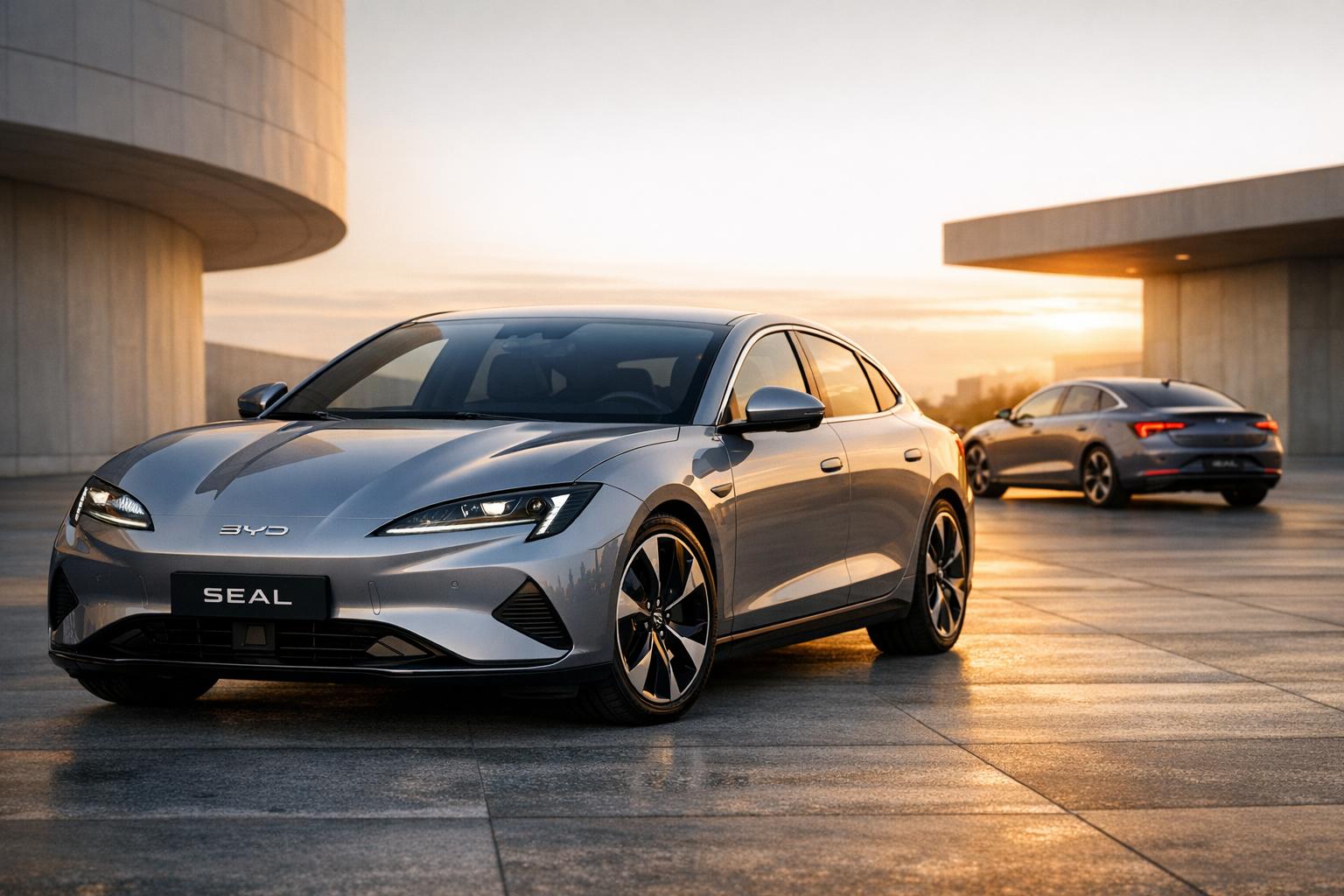
The BYD Seal and Tesla Model 3 are two popular electric sedans competing for attention. Here’s a quick breakdown:
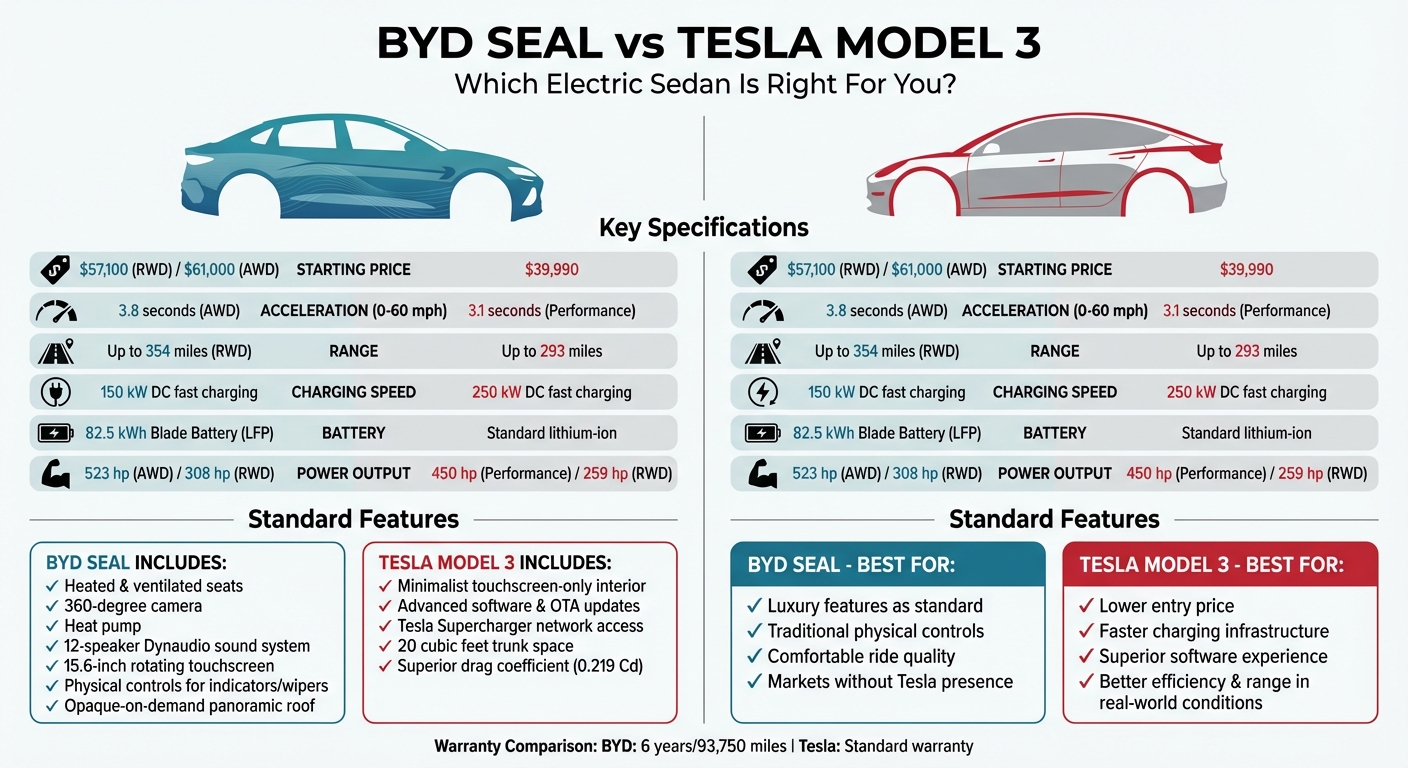
- BYD Seal: Starts at $57,100 (RWD) and $61,000 (AWD). It offers standard luxury features like heated/ventilated seats, a heat pump, a 360-degree camera, and a 12-speaker sound system. The AWD model boasts 523 hp and a 0–62 mph time of 3.8 seconds, with a range of up to 323 miles. Its Blade Battery technology improves durability and safety but supports slower 150 kW charging.
- Tesla Model 3: Starts at $39,990. Known for its minimalist design, it features a touchscreen-focused interior and Tesla’s advanced software. The Performance model hits 60 mph in 3.1 seconds with a range of up to 293 miles. It supports faster 250 kW charging and benefits from Tesla’s extensive Supercharger network.
Key Differences: The Seal focuses on comfort and high-end features, while the Model 3 excels in efficiency, performance, and charging speed. Pricing and availability vary by region, with BYD gaining traction in markets where Tesla isn’t officially present.
Quick Comparison
| Feature | BYD Seal | Tesla Model 3 |
|---|---|---|
| Starting Price | $57,100 (RWD) / $61,000 (AWD) | $39,990 |
| Performance | 0–62 mph in 3.8 sec (AWD) | 0–60 mph in 3.1 sec (Performance) |
| Range | Up to 354 miles (RWD) | Up to 293 miles |
| Charging Speed | 150 kW | 250 kW |
| Interior | Physical controls, luxury features | Minimalist, touchscreen-based |
| Market Presence | Available in Africa | Limited to specific regions |
Both cars cater to different preferences. Choose the Seal for a more feature-rich experience or the Model 3 for cutting-edge tech and charging convenience.
BYD Seal vs Tesla Model 3: Complete Specs and Features Comparison
1. BYD Seal

Performance and Range
The BYD Seal is available in two trims: RWD (rear-wheel drive) and AWD (all-wheel drive). The RWD Design trim delivers 308–313 hp, accelerating from 0 to 62 mph in 5.9 seconds. Meanwhile, the AWD Excellence trim steps things up with 523–530 hp, hitting 62 mph in just 3.8 seconds.
When it comes to range, the Design trim offers up to 354 miles on the WLTP cycle, while the AWD version provides 323 miles. Real-world testing, however, suggests a range closer to 240 miles for the AWD and 255 miles for the RWD under moderate driving conditions. Powering the Seal is an 82.5 kWh Blade Battery, which supports DC fast charging at up to 150 kW. This allows the battery to go from 10% to 80% in around 37–38 minutes. While this charging speed lags behind competitors like the Hyundai Ioniq 6 (which reaches up to 233 kW), it remains sufficient for most daily driving scenarios.
Features and Technology
The BYD Seal incorporates Cell-to-Body construction for its Blade Battery, integrating it into the car’s structure. This design enhances the car’s torsional rigidity to an impressive 40,500 Nm/degree, while the 8-in-1 electric powertrain achieves an efficiency rate of 89%.
Inside the cabin, you’ll find a 15.6-inch rotating touchscreen, which can switch between landscape and portrait modes. While this feature adds versatility, the interface may feel clunky to some users. Unlike Tesla’s stripped-down approach, the Seal retains physical controls for indicators and wipers – something many drivers prefer. The Seal also comes packed with standard features, including heated and ventilated front seats, a 360-degree camera, a heat pump, a 12-speaker Dynaudio sound system, and an opaque-on-demand panoramic roof.
Pricing and Affordability
The BYD Seal combines performance and technology at a competitive price point. The RWD Design trim starts at $57,100, while the AWD Excellence trim is priced at $61,000. These prices place the Seal roughly $5,000 above the base Tesla Model 3 in some markets. However, its long list of standard features – many of which are optional on rivals – helps justify the higher price tag.
"BYD tends to pack its cars with kit as standard, and the Seal is no exception." – The Independent
The Seal also offers peace of mind with a 6-year/93,750-mile general warranty and an 8-year/125,000-mile battery warranty. On the practical side, storage options include a 400-liter rear trunk and a 53-liter front trunk, making it a well-rounded choice for buyers looking for a Tesla alternative.
2. Tesla Model 3
Performance and Range
The base rear-wheel drive (RWD) Model 3 delivers 259 horsepower and 307 lb-ft of torque, going from 0 to 60 mph in 5.9 seconds. On the other hand, the Performance variant packs a punch with 450 horsepower and 471 lb-ft of torque, reaching 60 mph in just 3.1 seconds. This impressive acceleration is partly due to its weight, which is about 270 kg lighter than the BYD Seal. For comparison, the Seal’s all-wheel-drive model achieves 60 mph in 3.8 seconds, making the Performance Model 3 noticeably quicker.
When it comes to charging, the RWD Model 3 supports DC fast charging at speeds up to 170 kW, slightly outpacing the Seal’s 150 kW limit. It also boasts a drag coefficient of 0.219 Cd, enhancing its overall efficiency. These numbers highlight the Model 3’s capability, but there’s more to explore beyond the specs.
Features and Technology
Tesla’s approach to design and technology is anything but conventional. The Model 3 features a clean, minimalist interior where nearly all functions are controlled through a central touchscreen. Traditional buttons and dials are replaced by steering wheel-mounted controls. While some drivers appreciate this futuristic aesthetic, others find the lack of physical controls inconvenient, particularly for tasks like adjusting mirrors or changing the wiper speed. Still, the Model 3 offers practical advantages, such as 20 cubic feet of trunk space – much more than the Seal.
"Boiled cabbage has greater appeal than the Model 3’s interior." – James Arbuckle, The Drive
Where the Model 3 truly shines is its software. Its infotainment system is often praised for being intuitive and refined, especially compared to the BYD Seal’s system, which has been criticized for cluttered menus and awkward translations. Tesla’s edge in technology extends to its proprietary Supercharger network, which offers unmatched reliability and a seamless user experience compared to third-party charging options.
"Tesla still has a big advantage in this department [charging], and with its own Supercharger network, many buyers prefer the American brand for this convenience." – Miguel Cortina, Mexico Editor, MotorTrend
Pricing and Affordability
Price is another area where the Model 3 sets itself apart. In the UK, the Model 3 starts at £39,925, making it about £5,000 less expensive than the entry-level BYD Seal, which is priced at £45,695. Across Europe, the Long Range AWD Model 3 is approximately €1,000 cheaper than the BYD Seal Excellence. However, in Mexico, the Model 3 is more expensive than the Seal, which starts at $45,270.
Interestingly, Tesla does not officially sell its vehicles in any African country as of early 2025. In contrast, BYD has established a presence in Africa through local distributors, giving it a foothold in markets where Tesla is absent.
New Tesla Model 3 v BYD Seal: Ultimate review!
sbb-itb-99e19e3
Advantages and Disadvantages
Here’s a side-by-side look at how the BYD Seal and Tesla Model 3 measure up across key features.
BYD Seal
| Feature | Advantages | Disadvantages |
|---|---|---|
| Interior Quality | High-end cabin with textured upholstery and traditional physical controls | Infotainment system can be tricky to navigate |
| Ride Comfort | Soft suspension that smooths out bumps on rough roads | Hefty curb weight (≈4,817 lbs) impacts efficiency and handling |
| Battery & Warranty | LFP "Blade Battery" allows frequent 100% charges; backed by a 6‑year/93,750‑mile warranty | Slower DC charging speeds max out at 150 kW |
| Pricing | Competitive pricing in some regions, such as Mexico (around $45,270) | Costs about £5,000 more than the Model 3 in the UK |
| Market Presence | Distribution available in African markets through local channels | Overly sensitive ADAS system with frequent alerts |
Tesla Model 3
| Feature | Advantages | Disadvantages |
|---|---|---|
| Performance | Lighter build (≈270 kg less) and quick acceleration (0–60 mph in 3.1 seconds) | Minimalist interior might not appeal to drivers who prefer physical controls |
| Software | Sleek and user-friendly infotainment system | Lack of physical controls can feel inconvenient |
| Charging | Access to Tesla’s exclusive Supercharger network and faster DC charging (up to 250 kW) | No official sales presence in African markets |
| Efficiency | Superior real-world range (293 miles vs. 255 miles in winter conditions) | Stiffer ride quality may not be ideal for rough roads |
| Storage | Generous 20 cubic feet of trunk space | Does not support Apple CarPlay or Android Auto |
The BYD Seal leans toward a more traditional driving experience, with physical controls and a suspension system that handles uneven roads well. However, its infotainment system can be a source of frustration. Real-world testing revealed its AWD model delivered only 2.9 miles per kWh (97 MPGe), falling short of its advertised 3.9 miles per kWh.
The Tesla Model 3, on the other hand, excels with its polished software, faster charging capabilities, and better energy efficiency. However, in areas where Tesla lacks an official presence, the BYD Seal’s availability becomes a key advantage. Ultimately, buyers will need to weigh performance, comfort, and regional availability to find the right fit.
Conclusion
The BYD Seal and Tesla Model 3 each bring their own set of strengths to the table. The BYD Seal stands out with its traditional controls, well-crafted interior, and the advanced Blade Battery technology, which ensures thermal stability and supports full charging. Its V2L capability is a practical feature, allowing you to power external devices during outages – a handy option for emergencies or outdoor activities. However, some drawbacks include its somewhat cluttered infotainment system and a slower 150 kW charging rate.
On the other hand, the Tesla Model 3 excels in efficiency, software sophistication, and charging infrastructure. With a real-world range of 293 miles, even in winter conditions, it surpasses the Seal’s 255-mile range, making it a strong contender for long-distance travel. Its lighter build and precise handling enhance the driving experience, though the minimalist interior and absence of physical controls might not appeal to everyone.
For buyers in Africa, the decision may come down to local support and priorities. The BYD Seal offers a more familiar driving experience and durability for challenging terrains, while the Tesla Model 3 shines with its cutting-edge software and access to Tesla’s extensive Supercharger network. Ultimately, your choice will depend on whether you prioritize comfort and traditional features or advanced technology and charging convenience.
"If you want something different from the Model 3, the RWD Seal is the way to go. You’ll get more range than the AWD, the same design, features, and enough power for everyday use." – Matthew MacConnell, The Drive
FAQs
How does the BYD Seal compare to the Tesla Model 3 in performance and features?
The BYD Seal and Tesla Model 3 are both strong contenders in the electric sport-sedan market, each with its own appeal. The BYD Seal, with its dual-motor all-wheel-drive system, can go from 0 to 60 mph in just 3.8 seconds. It’s powered by an 82.6 kWh battery, delivering an estimated range of 323 miles. Tesla’s Model 3, however, edges ahead in range, offering up to 348 miles in its longest-range version – perfect for those who prioritize longer drives.
Feature-wise, the BYD Seal brings a lot to the table. It includes a front storage “frunk,” heated and ventilated seats, Apple CarPlay, a 12-speaker audio system, and wireless phone charging – a package that leans heavily into comfort and convenience. Meanwhile, the Tesla Model 3 shines with its advanced driver-assistance features, over-the-air software updates, and a sleek minimalist interior with high-resolution displays. While the Seal focuses on crafting a feature-packed interior, the Model 3 is all about cutting-edge technology and efficiency.
How does the BYD Seal’s Blade Battery compare to Tesla’s battery and charging technology?
The BYD Seal’s Blade Battery is built for speed and endurance, while Tesla’s battery system focuses on energy density and seamless integration with its expansive Supercharger network.
The Blade Battery supports high-voltage charging, enabling it to add up to 250 miles of range in just 5 minutes under optimal conditions. In comparison, Tesla’s Superchargers currently deliver about 170 miles in 15 minutes, though upgrades for faster charging are on the horizon.
BYD utilizes LFP (lithium iron phosphate) battery chemistry, prioritizing safety and durability – especially in warmer climates. Tesla, on the other hand, employs high-energy-density lithium-ion chemistry, which is fine-tuned for maximizing range and minimizing weight. While the Seal excels in charging speed, Tesla’s widespread charging infrastructure ensures unparalleled convenience for road trips and extended journeys.
Ultimately, the decision between these two systems hinges on your personal charging preferences and driving patterns.
How do I decide between the BYD Seal and Tesla Model 3 for my driving needs?
When comparing the BYD Seal and the Tesla Model 3, there are a few key factors to weigh: range and charging, performance, and price and interior features.
Starting with range and charging capabilities, the BYD Seal’s dual-motor AWD version delivers about 323 miles on a single charge, while the single-motor version offers slightly more. However, its charging speed tops out at 150 kW, which is slower than Tesla’s Supercharger network. For those who often depend on fast charging or need extended range, the Model 3 could be a more practical choice.
When it comes to performance and driving experience, the BYD Seal’s dual-motor setup can go from 0 to 60 mph in roughly 3.8 seconds, comparable to the Model 3 Performance trim. The Seal stands out for its roomy interior and smooth handling, though some drivers mention its light steering feel and occasionally intrusive driver-assist alerts. Tesla, on the other hand, is often praised for its sharp steering and regular software updates that enhance the driving experience. If sporty handling and cutting-edge tech are priorities, the Model 3 might have the upper hand.
Finally, consider price and interior features. The BYD Seal includes high-end touches like heated and ventilated seats and a rotating touchscreen but typically comes with a higher price tag. Tesla’s Model 3, while generally more affordable, features a minimalist design and access to the extensive Supercharger network. If budget and a streamlined tech ecosystem are key factors, the Model 3 could be a better fit. However, for those who value a more luxurious cabin and extra storage space, the BYD Seal is a compelling option.