
 Thabo Nkosi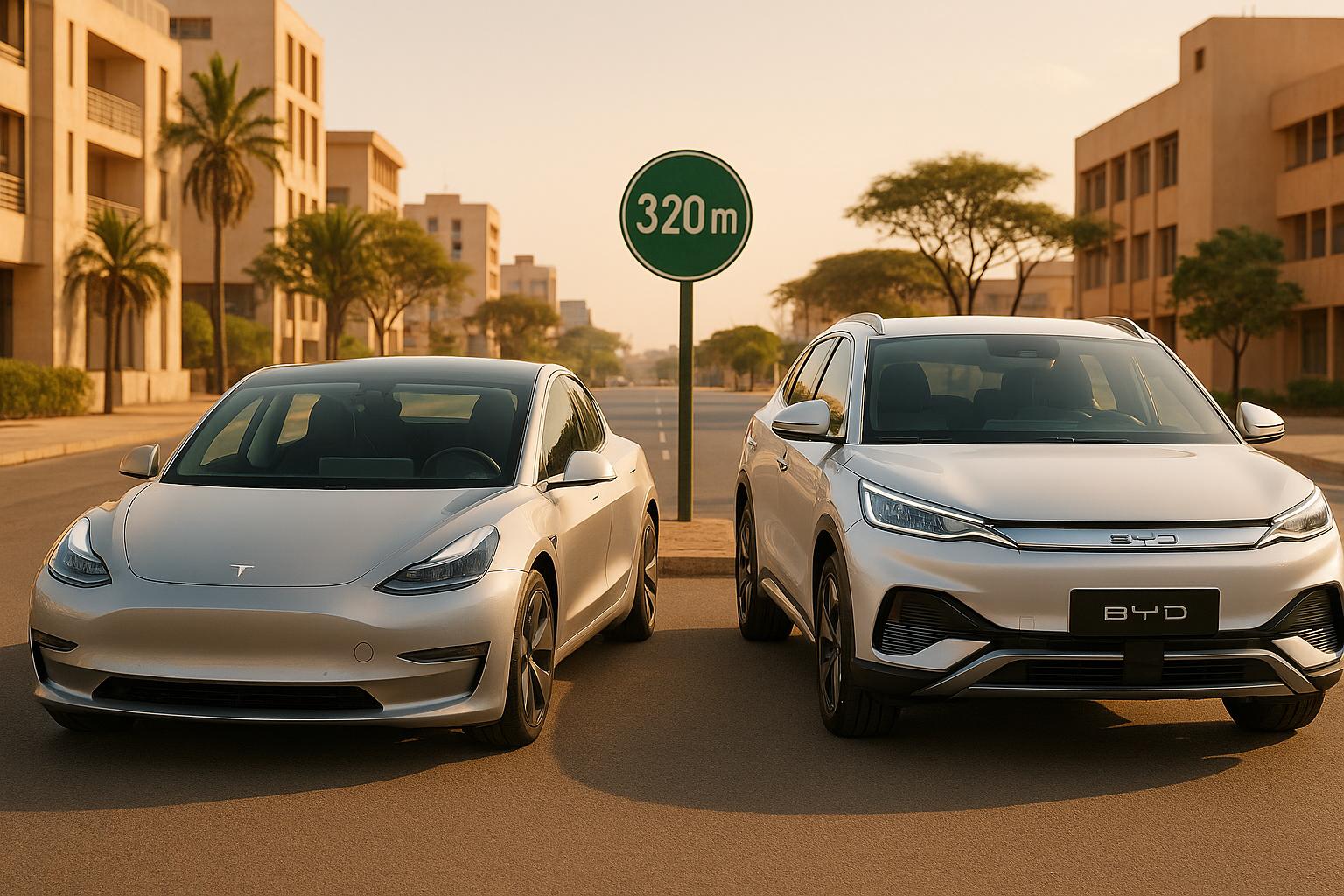
When choosing an EV in Africa, range and cost are critical. Tesla and BYD dominate this space but cater to different needs. Tesla excels in long-range performance and efficiency, while BYD offers affordable options with durable batteries suited for hot climates. Here’s a quick breakdown:
- Tesla: Known for cutting-edge tech, long-range efficiency, and premium features. Models like the Model 3 and Model Y offer up to 348 miles of range but come with higher price tags.
- BYD: Focuses on affordability and durability. The BYD Seal provides 376 miles of range for $20,700, while the Dolphin starts at just $11,800. Their Blade Battery handles heat better and lasts longer.
Quick Comparison:
| Feature | Tesla Model 3 Long Range AWD | BYD Seal 06 GT |
|---|---|---|
| Range (miles) | ~348 | ~376 |
| Base Price (USD) | Not listed | $20,700 |
| Battery Durability | Moderate | High |
For SUVs, Tesla’s Model Y and BYD’s Atto 3 offer similar ranges (~260 miles), but BYD’s pricing is more transparent. African buyers should weigh Tesla’s efficiency against BYD’s affordability and climate-suited battery tech. Platforms like EV24.africa simplify the buying process with clear pricing and delivery support across the continent.
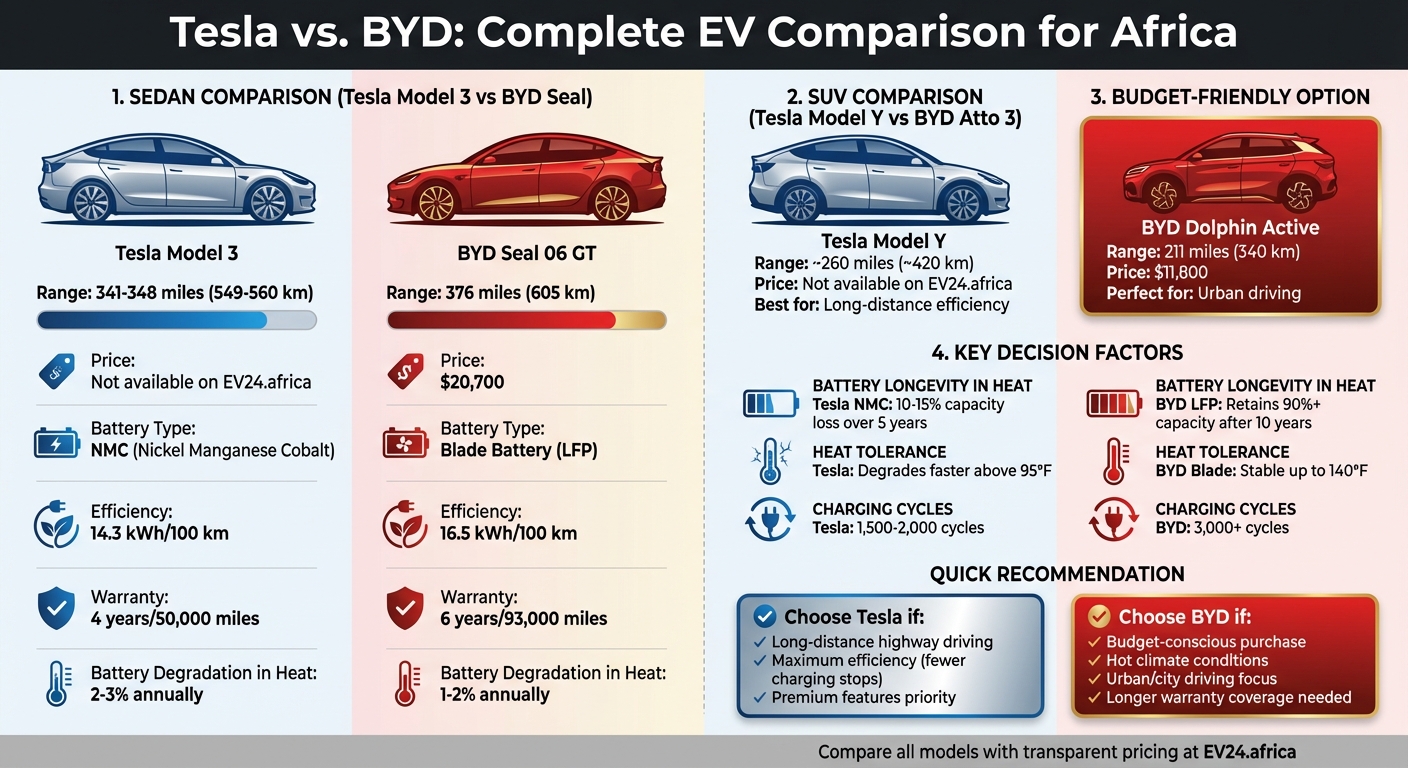
Tesla vs BYD Electric Vehicles: Range, Price and Battery Comparison for Africa
TESLA MODEL 3 VS BYD SEAL 2025 : HONEST UK ROAD TEST! WHO WINS?
Tesla EVs: Range, Efficiency, and Cost
Tesla’s electric vehicles are designed with a focus on long-range performance and energy efficiency. The Model 3 sedan and Model Y SUV stand out for their advanced battery systems and aerodynamic builds, which help maximize the distance covered on a single charge. Let’s take a closer look at what each model brings to the table.
Tesla Model 3
The Model 3 offers impressive range options. The Rear-Wheel Drive (RWD) variant has an EPA-estimated range of about 272 miles (438 km), while the Long Range All-Wheel Drive (AWD) version extends that to approximately 341 miles (549 km) with a battery capacity of 75–82 kWh. Under the WLTP testing cycle, the Long Range AWD variant achieves between 421 and 436 miles, making it a solid choice for long trips. For example, on a lengthy drive like the 870-mile stretch between Johannesburg and Cape Town, the Long Range version requires fewer charging stops compared to vehicles with smaller ranges.
Daily driving is where the Model 3 truly shines. Its responsive steering and improved grip, even with eco-focused tires, ensure smooth handling on highways and through sharp turns. The Long Range AWD version also boasts quick acceleration, going from 0 to 60 mph in just 4.2 seconds – ideal for merging or overtaking. Starting at around $38,990 for the base RWD model, the Model 3 comes with a 4-year/50,000-mile warranty and an 8-year/100,000-mile battery guarantee, adding confidence for those who rack up miles quickly.
Tesla Model Y
While the Model 3 sets the bar for efficiency in sedans, the Model Y brings Tesla’s performance to the SUV category. It offers a range that often exceeds 300 miles (483 km) on a full charge, making it comparable to the Model 3 Long Range. However, the Model Y adds more practicality with its larger cargo space and higher ground clearance, making it a great option for family trips, unpaved roads, or rougher terrain. Though the Model Y comes with a higher price tag than the Model 3, its added space and versatility make it a strong contender in the premium SUV market.
Given Tesla’s limited Supercharger network in regions like Africa compared to North America or Europe, owners are advised to plan for home charging or rely on third-party charging stations to make the most of the Model Y’s range capabilities. This planning ensures a seamless experience, even in areas where charging infrastructure is still developing.
BYD EVs: Range, Technology, and Affordability
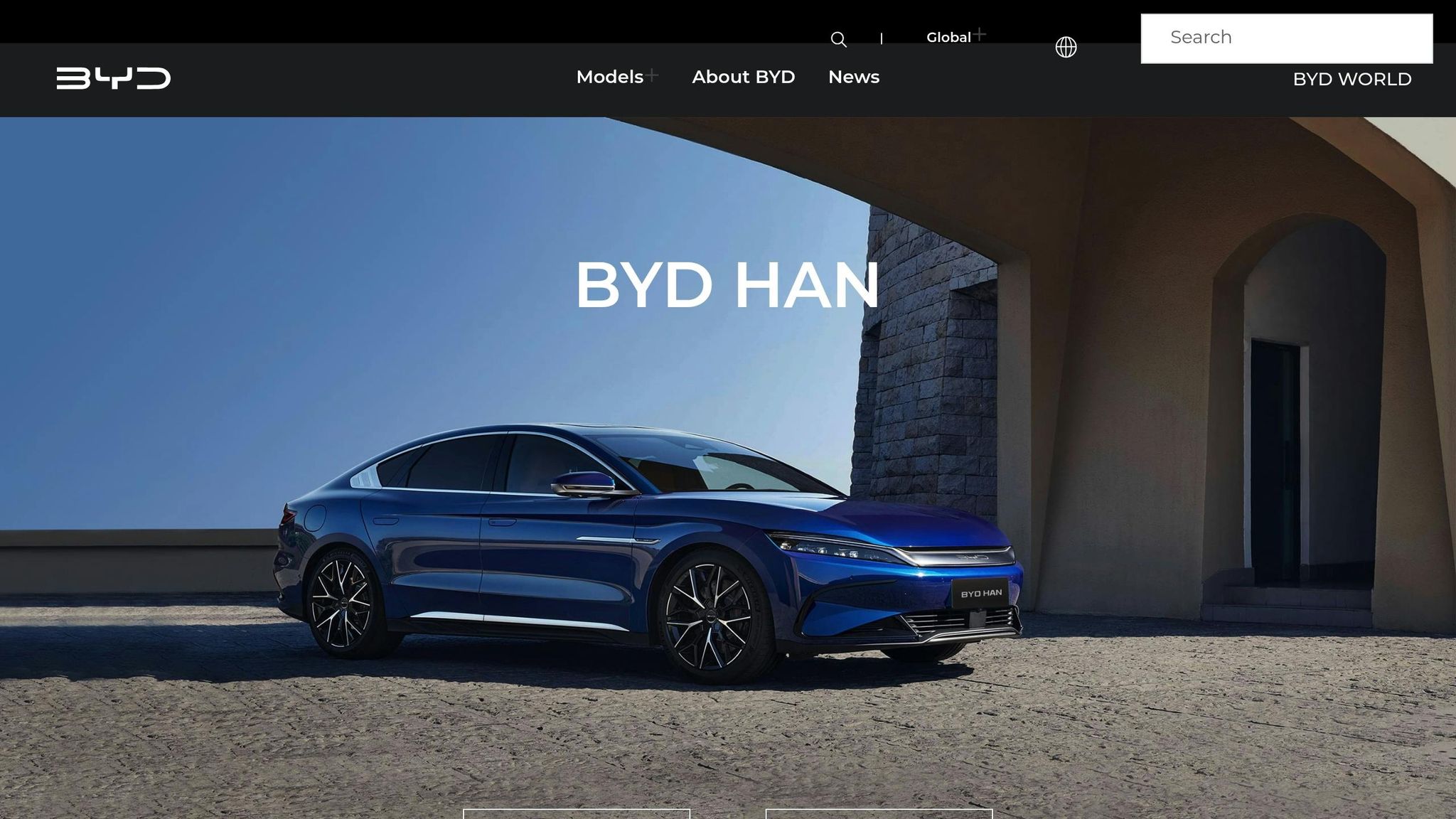
While Tesla leans heavily on efficiency, BYD takes a different approach, prioritizing durability and affordability – qualities that make its vehicles ideal for challenging environments. At the core of BYD’s strategy is its Blade Battery, a lithium iron phosphate (LFP) system known for its impressive thermal stability and safety features. This battery is designed to handle extreme heat, making it a great fit for the hot climates often found in Africa. Its heat-resistant chemistry minimizes the risk of thermal runaway, ensuring reliable performance even in high temperatures. Plus, the Blade Battery boasts over 3,000 charging cycles with minimal capacity loss, adding to its longevity.
BYD Seal
The BYD Seal is positioned as a direct competitor to the Tesla Model 3, offering similar performance but at a lower price point. The Performance AWD variant features an 82.5 kWh Blade Battery that delivers approximately 354 miles (570 km) of WLTP range. It packs a punch with 390 horsepower, 494 lb-ft (670 Nm) of torque, and a 0–60 mph acceleration time of just 3.8 seconds. For those looking for a more budget-friendly option, the RWD Comfort version comes with a smaller 61.4 kWh battery, offering about 227 miles (365 km) of range. While its energy consumption is slightly higher – around 16.5 kWh per 100 km compared to the Model 3’s 14.3 kWh per 100 km – the Seal makes up for it with a sportier driving experience and a more accessible price tag.
BYD also provides generous warranty coverage for the Seal. The vehicle comes with a six-year/93,000-mile (150,000 km) warranty, and the battery is covered for eight years/99,000 miles (160,000 km) – both significantly longer than Tesla’s four-year/50,000-mile basic warranty. This combination of performance, affordability, and extended coverage makes the Seal a strong contender in the EV market.
BYD Dolphin and Other Models
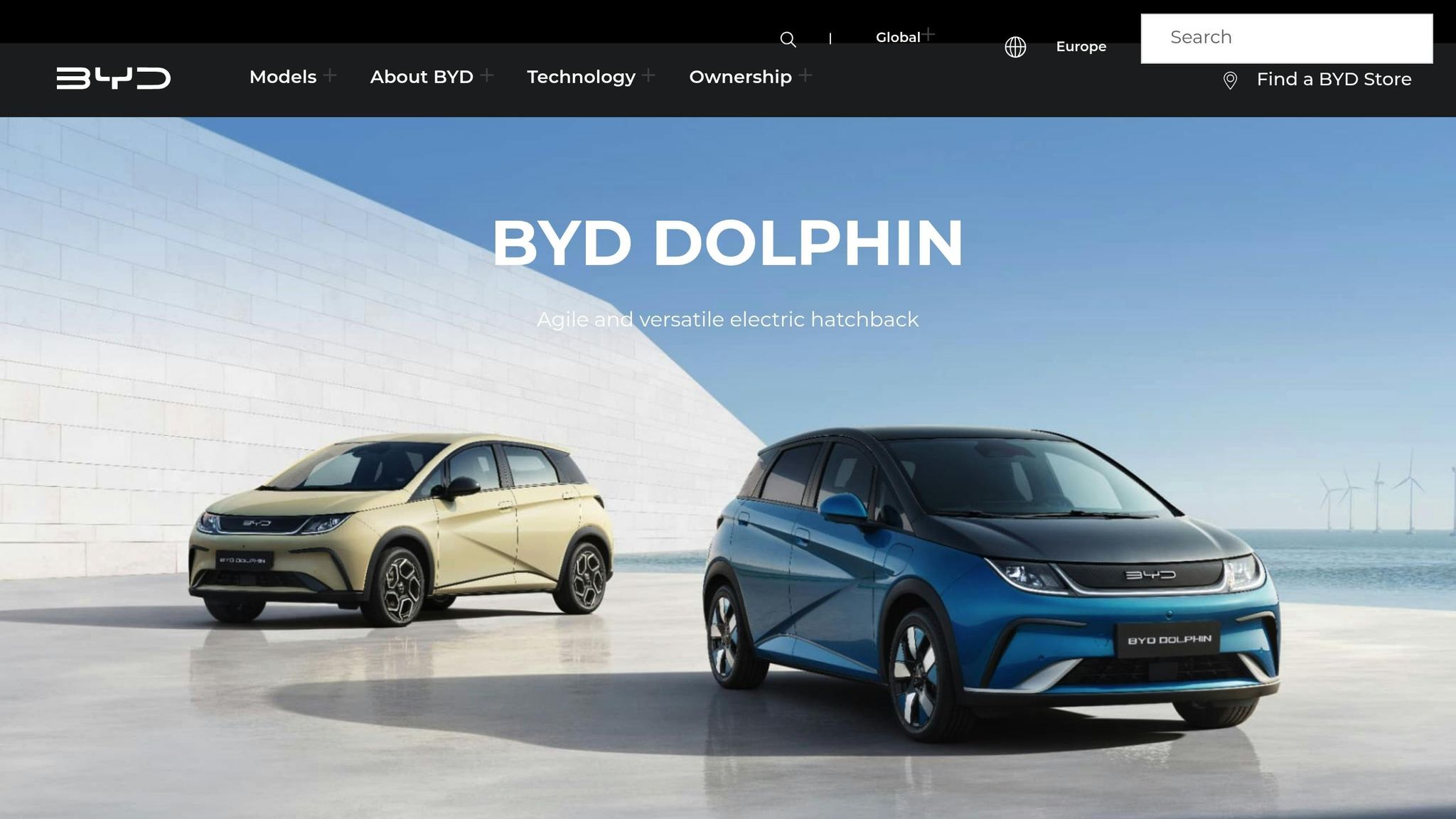
For urban drivers on a budget, the BYD Dolphin Active is an attractive option. It offers 211 miles (340 km) of WLTP range on a 43.2 kWh Blade Battery, all for about $11,800. Beyond the Dolphin, BYD’s lineup includes models like the Song Plus EV, which delivers 314 miles (505 km) of range at a price of $18,680, and the Seal 06 GT, offering 376 miles (605 km) of range for $20,700 [3,7]. These models cater to a wide audience, from ride-hailing drivers to family commuters and fleet operators, by offering a strong balance of range and cost.
For buyers in Africa, where charging infrastructure may be limited and affordability is key, BYD’s vehicles provide a practical solution. With durable battery technology and competitive pricing, these cars are built to handle demanding conditions while keeping costs in check. Whether you’re navigating city streets or taking longer trips, BYD’s lineup offers options that blend range, reliability, and affordability.
sbb-itb-99e19e3
Tesla vs. BYD: Direct Comparison
How We Compare the Models
For this comparison, we’ve zeroed in on the metrics that matter most to African EV buyers: EPA-estimated range and base pricing in U.S. dollars. While Tesla’s pricing isn’t yet available on EV24.africa, the platform does provide detailed pricing for various BYD models. We’ve also factored in how high ambient temperatures – common in many African regions – can reduce EV range by 10–20%. These details are crucial for buyers who need to balance range and cost in challenging climates. Below, we break down the comparisons for sedans and SUVs side by side.
Sedan Comparison: Tesla Model 3 vs. BYD Seal
| Model | EPA Range (miles) | Approx. Range (km) | Base Price (USD) |
|---|---|---|---|
| Tesla Model 3 RWD | ~341 | ~549 | Not available on EV24.africa |
| Tesla Model 3 Long Range AWD | ~348 | ~560 | Not available on EV24.africa |
| BYD Seal 06 GT | ~376 | ~605 | $20,700 |
The Tesla Model 3 delivers an EPA-estimated range between 341 and 348 miles, though its pricing for African buyers remains unavailable on EV24.africa. Meanwhile, the BYD Seal 06 GT stands out with a listed range of approximately 605 km (around 376 miles) and a competitive base price of $20,700. Its Blade Battery technology is designed to handle high temperatures, helping to minimize the 10–20% range loss typically seen in warmer climates.
SUV Comparison: Tesla Model Y vs. BYD Atto 3
| Model | EPA Range (miles) | Approx. Range (km) | Base Price (USD) |
|---|---|---|---|
| Tesla Model Y | ~260* | ~420* | Not available on EV24.africa |
| BYD Atto 3 2025 | ~261 | ~420 | $47,500 |
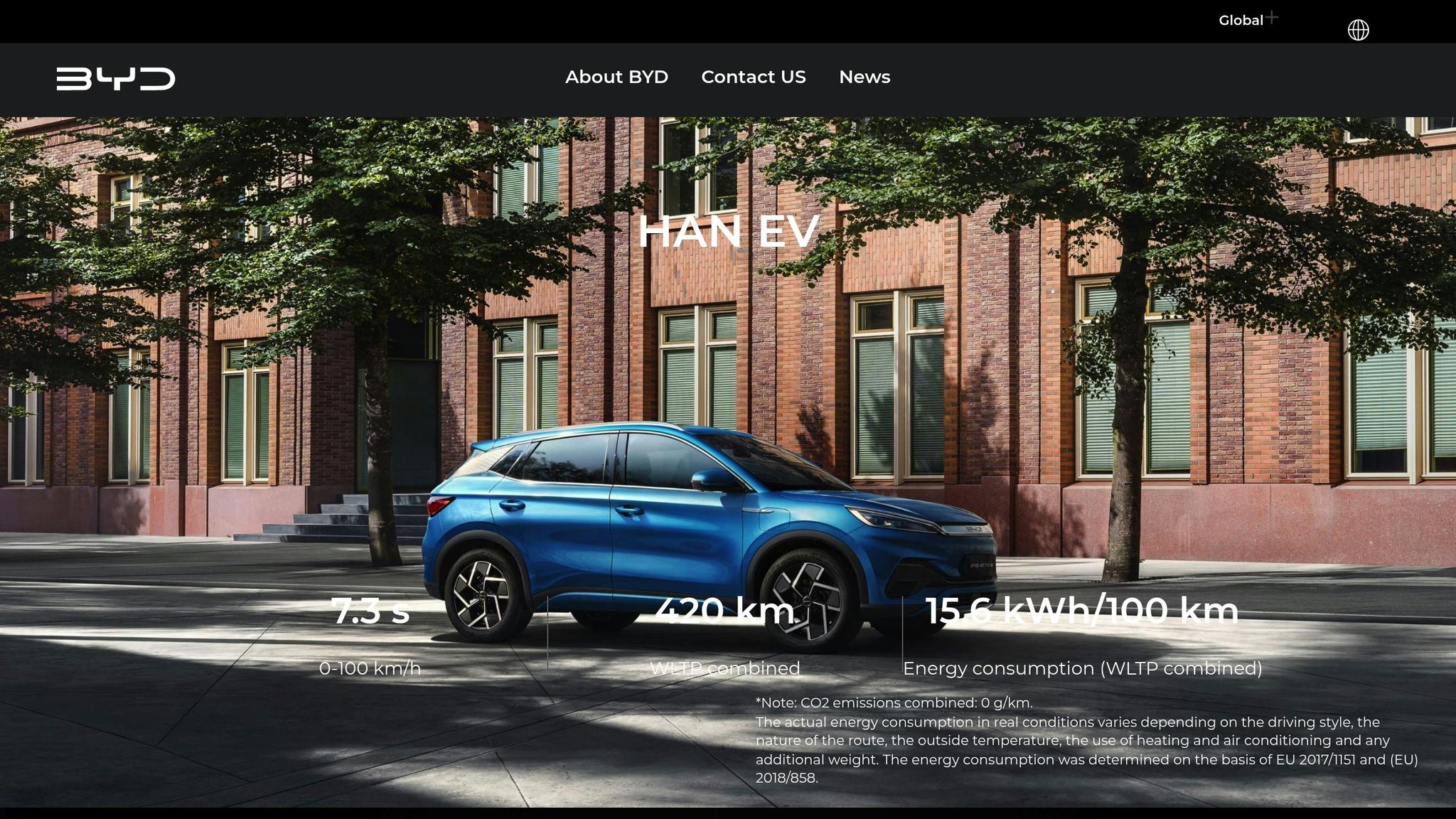
When it comes to SUVs, the Tesla Model Y and the BYD Atto 3 both offer similar ranges – around 260 miles or 420 km. While Tesla’s pricing isn’t listed, the BYD Atto 3 2025 is priced at $47,500 on EV24.africa. With its transparent pricing and strong warranty support, the Atto 3 is an attractive option for families and fleet operators navigating both city and regional routes across Africa.
*Range values for the Tesla Model Y are based on industry estimates from markets outside Africa.
Data sourced from EV24.africa.
What African EV Buyers Should Consider
Charging Infrastructure and Actual Range
Public charging stations in Africa are scarce, primarily found in major cities like Johannesburg, Nairobi, Cairo, and Casablanca. In rural areas and smaller towns, public chargers are essentially non-existent. As a result, most African EV owners depend heavily on home or workplace AC charging, making the daily driving range and overnight charging capacity critical factors to consider.
Without Tesla’s Supercharger network on the continent, both Tesla and BYD rely on emerging third-party DC fast-charging networks in countries such as South Africa, Morocco, Egypt, Kenya, and Rwanda. However, the actual driving range you’ll experience depends more on the battery’s size and efficiency than on the availability of brand-specific charging networks.
These challenges highlight why efficient battery technology is especially important for EV buyers in Africa.
Climate and Battery Longevity
Africa’s hot climate can significantly impact battery performance and lifespan. For example, Tesla’s NMC (Nickel Manganese Cobalt) batteries, while offering high energy density, tend to degrade faster in higher temperatures. Above 95°F, these batteries lose about 2–3% of their capacity annually, which could result in a 10–15% reduction over five years.
BYD’s Blade Battery, on the other hand, is a better fit for extreme heat. Built with LFP (Lithium Iron Phosphate) chemistry, it remains stable even in temperatures as high as 140°F. In African conditions, LFP batteries degrade at a slower rate of 1–2% annually, retaining over 90% of their capacity after a decade. Additionally, the Blade Battery can handle more than 3,000 charge cycles, compared to Tesla’s NMC batteries, which typically last for 1,500–2,000 cycles. This makes the Blade Battery more durable, especially in areas with irregular charging patterns and limited infrastructure. If your EV will often sit in the sun or require frequent full charges to maximize range, BYD’s LFP technology offers clear long-term benefits.
These considerations have a direct impact on real-world performance and long-term cost efficiency for African EV buyers.
Finding Tesla and BYD Models on EV24.africa
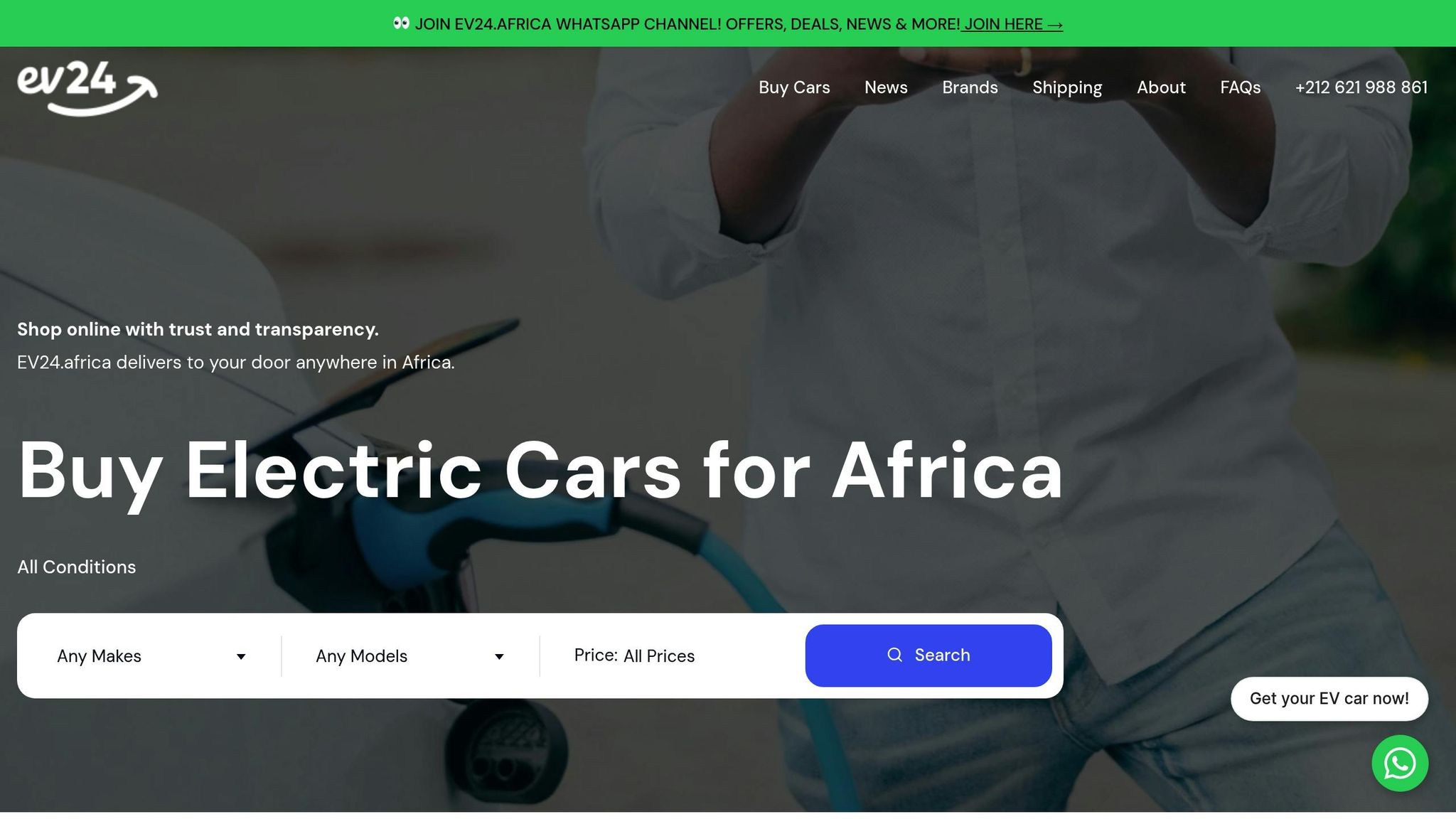
EV24.africa offers both new and used Tesla and BYD models, with clear pricing in US dollars and detailed specifications such as battery chemistry, range estimates, and warranty details. While Tesla pricing isn’t available for all models, BYD’s full lineup is listed, including the Seal 06 GT at $20,700, the Dolphin Active at $11,800, and the Atto 3 2025 at $47,500 – all with costs fully itemized.
The platform simplifies the buying process by handling delivery, customs clearance, and local registration across all 54 African countries. It also provides financing options in local currencies and post-sale support for setting up charging solutions. This makes it easier for buyers to navigate the challenges of purchasing an EV, even in regions where Tesla and BYD lack official dealerships. For those balancing price, efficiency, and range, this transparency and support are invaluable.
Conclusion: Choosing Between Tesla and BYD
Best for Long-Distance Driving and Efficiency
When it comes to highway efficiency and long-range performance, Tesla takes the lead. The Model 3 Long Range AWD boasts an impressive 410 miles (660 km) per charge, with an efficiency of 14.3 kWh/100 km. In comparison, the BYD Seal Performance AWD offers 354 miles (570 km) and consumes 16.5 kWh/100 km. This efficiency means fewer charging stops, a key factor for those traveling through areas with limited charging infrastructure.
On the other hand, if upfront costs and battery longevity are your priorities, BYD emerges as the stronger contender.
Best for Affordability and Durability
BYD stands out for its affordability and resilience, especially in hot climates. For instance, the Seal 06 GT delivers 376 miles (605 km) of range at just $20,700, while the Dolphin Active offers 211 miles (340 km) for $11,800. Additionally, BYD’s Blade Battery comes with a 6-year/93,000-mile warranty, surpassing Tesla’s 4-year/50,000-mile coverage. This makes BYD a solid choice for drivers in regions with extreme temperatures or those seeking a cost-effective option for daily use.
Making Your Decision
Ultimately, the choice between Tesla and BYD depends on your specific driving needs. If long-distance travel and fewer charging stops are high on your list, Tesla’s technology and range might justify the higher price tag. But if you’re working within a tighter budget, drive mostly in urban areas, or need a vehicle built to withstand very hot conditions, BYD’s combination of affordability and durable battery technology makes it a practical option.
EV24.africa simplifies the decision-making process by providing detailed comparisons of both brands, with pricing in U.S. dollars and key specs like battery types and warranties. The platform also handles delivery, customs clearance, and registration across all 54 African countries, and even offers financing options in local currencies, ensuring you can find and secure the right EV without hassle.
FAQs
How do Tesla and BYD batteries differ in technology and performance?
Tesla’s battery technology revolves around its advanced lithium-ion design, including the proprietary 4680 cells. These are engineered to deliver high energy density and enable fast charging, making Tesla vehicles a go-to option for drivers who prioritize longer driving ranges and quicker recharging capabilities.
BYD, in contrast, relies on its Blade Battery, which is built on lithium iron phosphate (LiFePO4) technology. These batteries stand out for their strong safety features, extended lifespan, and affordability, making them an excellent option for those who value durability and cost-effectiveness.
While Tesla focuses on performance and extended range, BYD leans toward safety and budget-friendly solutions, appealing to different driving needs and priorities.
How does Africa’s hot climate affect Tesla and BYD electric vehicles?
Africa’s scorching temperatures and relentless sunlight can impact how Tesla and BYD electric vehicles perform and how long their batteries last. Extended exposure to high heat can speed up battery degradation, which might lead to a decrease in range and overall battery lifespan.
While Tesla and BYD vehicles come with sophisticated thermal management systems designed to keep battery temperatures in check, extreme heat can still present obstacles. To keep your EV running smoothly in such conditions, try parking in shaded spots, using sunshades, and staying on top of regular maintenance. These simple steps can help maintain your vehicle’s performance and durability, even in the hottest climates.
What should African buyers consider when deciding between Tesla and BYD electric vehicles?
When deciding between Tesla and BYD, buyers in Africa should weigh a few critical factors: battery range, cost, and reliability. Start by assessing how far each vehicle can go on a single charge and whether that aligns with your daily commute or occasional long-distance trips. Pricing is another big consideration – make sure the car fits your budget while offering good value.
Don’t overlook local service options, availability of spare parts, and how well the car works with the region’s charging network. Having dependable after-sales support can greatly improve the ownership experience. Lastly, factor in long-term costs, such as maintenance and the car’s potential resale value, to ensure you’re making a smart investment.