
 Thabo Nkosi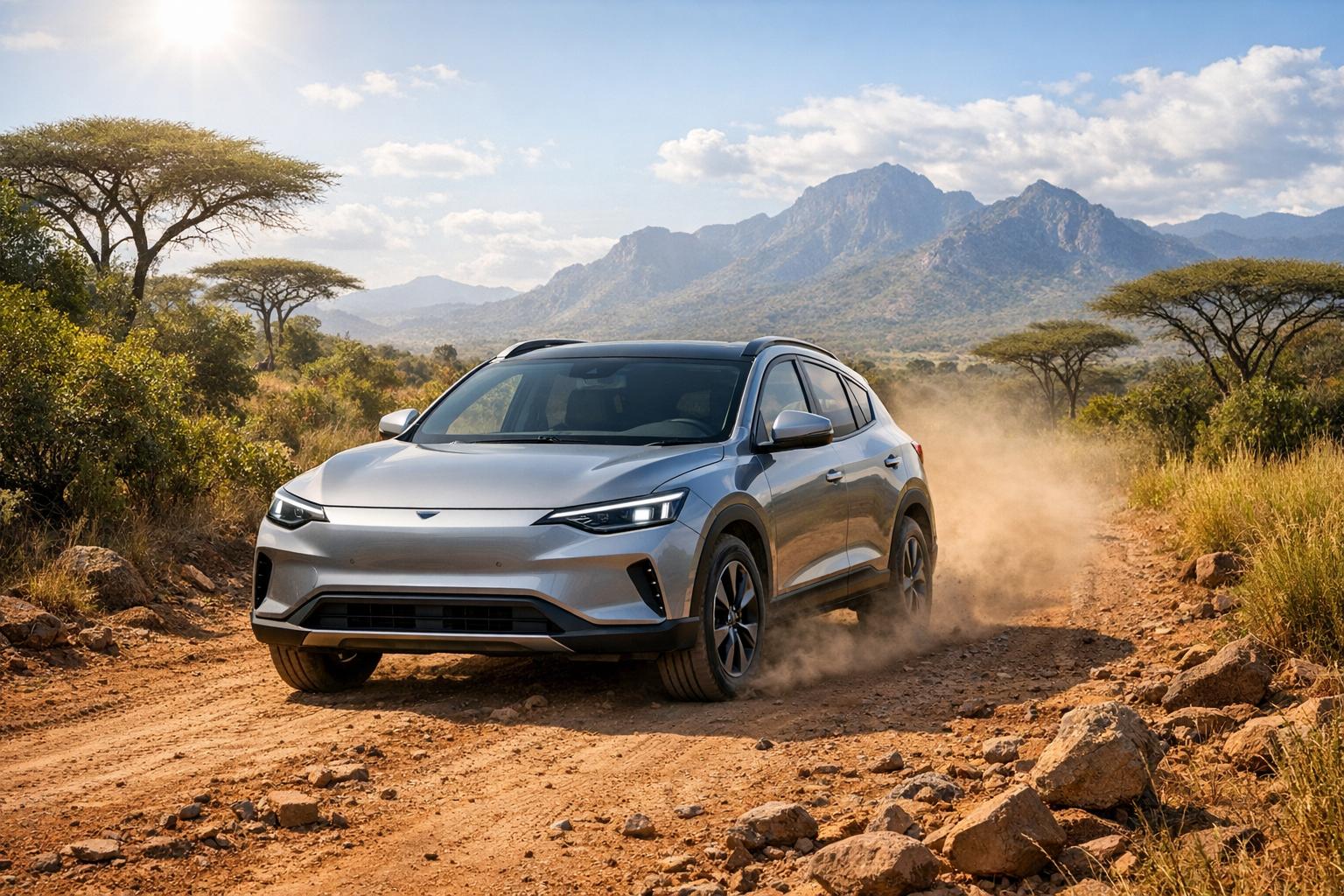
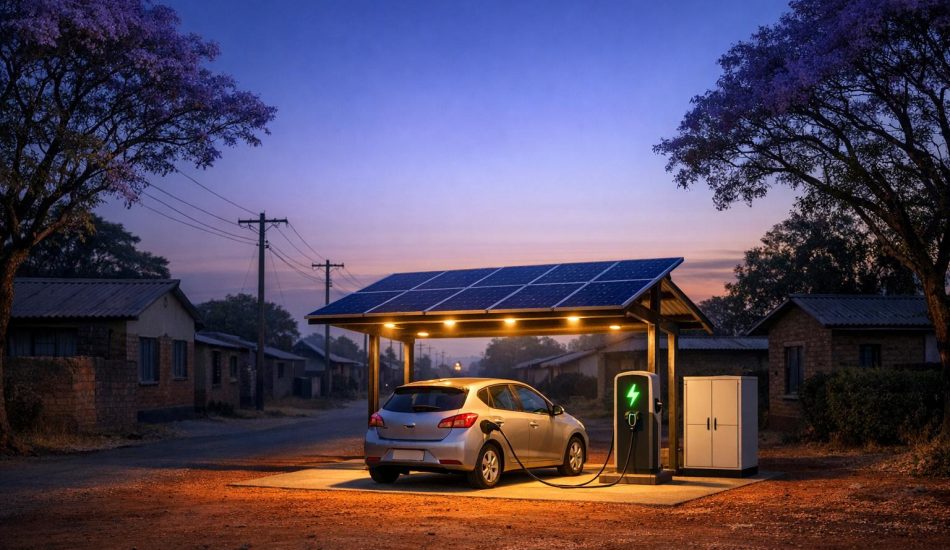
Electric vehicles (EVs) are gaining traction globally, but Africa’s rugged roads, extreme heat, and limited charging infrastructure present unique challenges. This guide highlights five EVs designed to handle these conditions while balancing affordability, durability, and range.
Key Highlights:
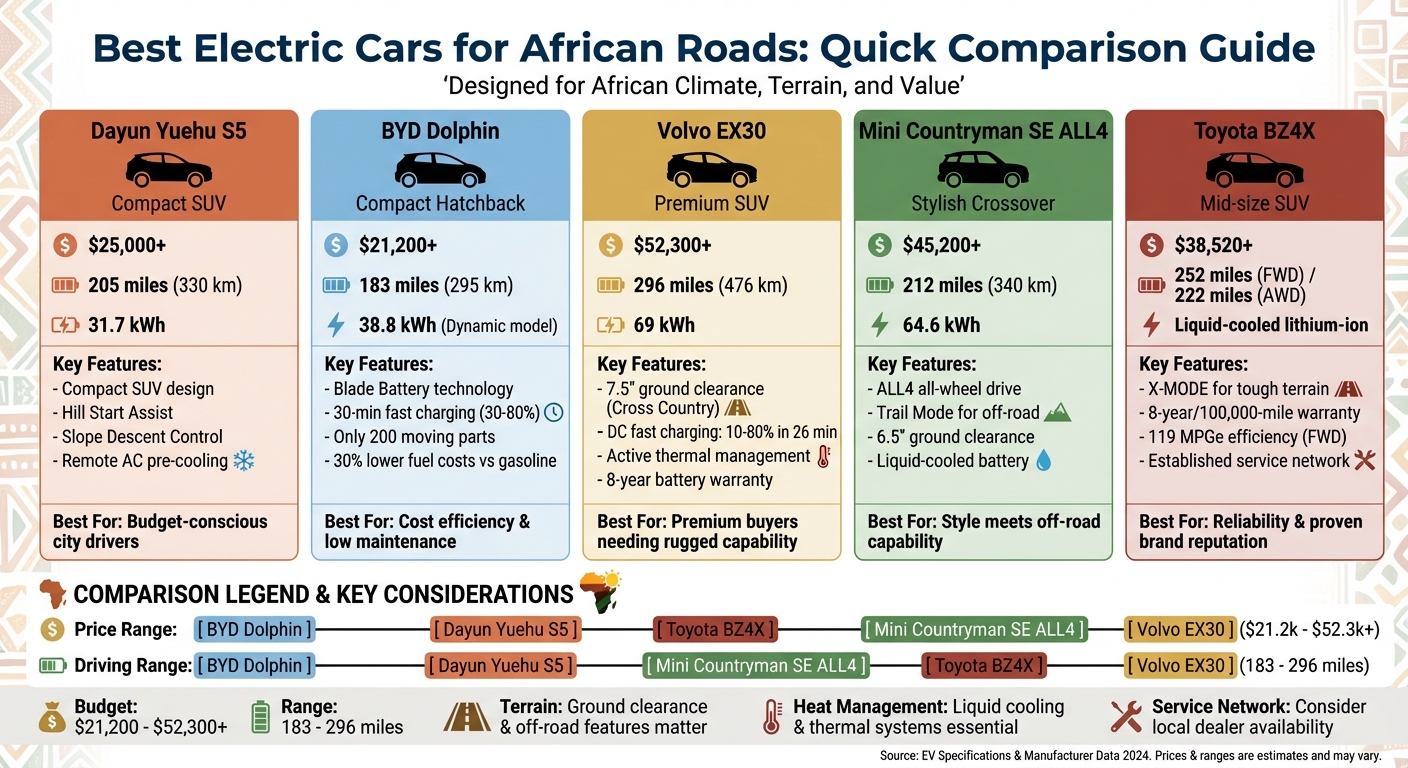
- Dayun Yuehu S5: Compact and budget-friendly ($25,000+), 205-mile range, heat-resistant features.
- BYD Dolphin: Affordable ($21,200+), 183-mile range, durable Blade Battery technology.
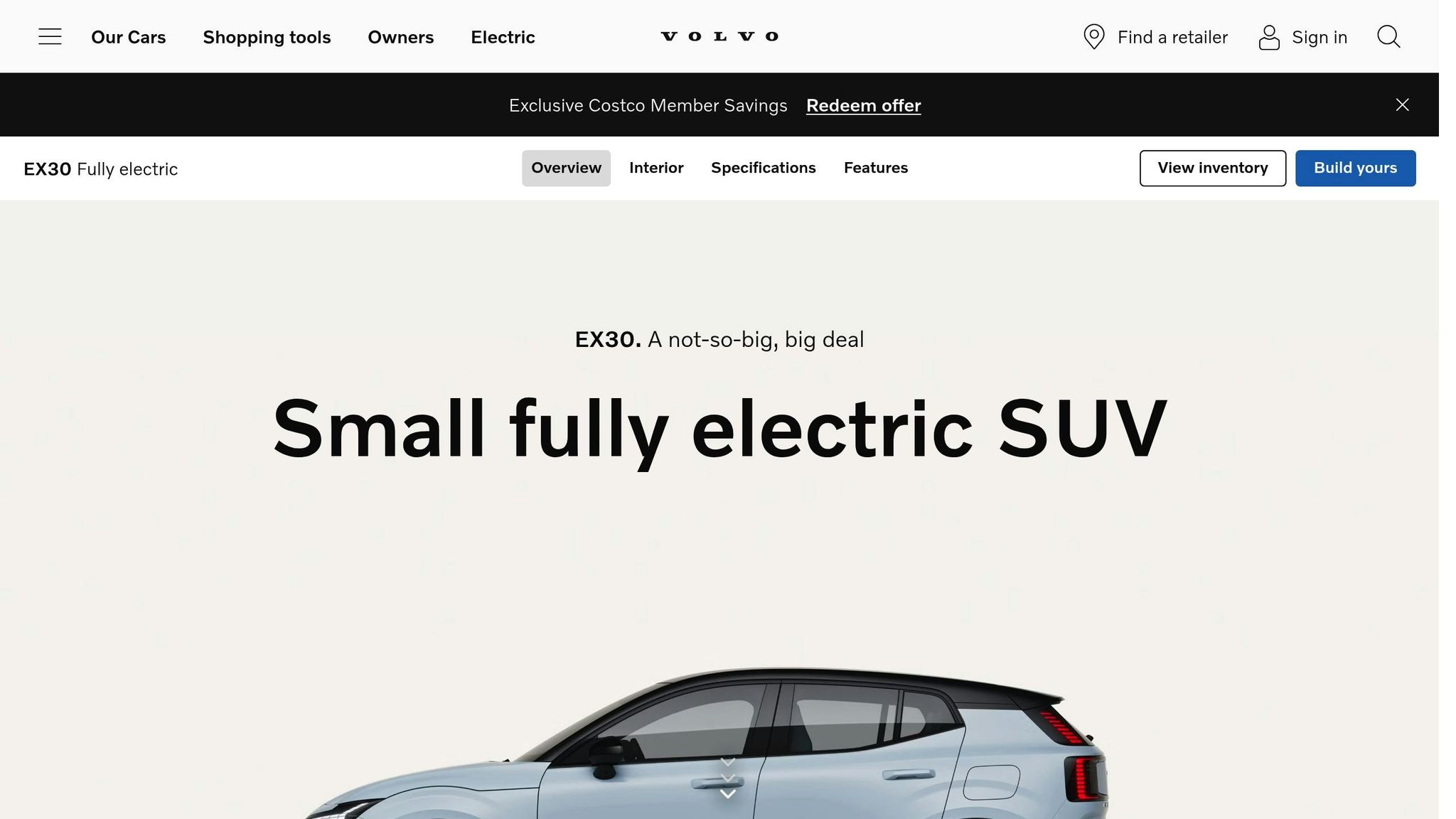
- Volvo EX30: Premium ($52,300+), up to 296-mile range, optimized for tough terrains.
- Mini Countryman SE ALL4: Stylish ($45,200+), off-road capable, 212-mile range.
- Toyota BZ4X: Reliable ($38,520+), up to 252-mile range, designed for African roads.
Quick Comparison
| Model | Price (USD) | Range (miles) | Key Feature |
|---|---|---|---|
| Dayun Yuehu S5 | $25,000+ | 205 | Affordable, compact SUV |
| BYD Dolphin | $21,200+ | 183 | Blade Battery, low maintenance |
| Volvo EX30 | $52,300+ | 296 | Rugged, premium build |
| Mini Countryman SE | $45,200+ | 212 | Off-road capabilities |
| Toyota BZ4X | $38,520+ | 252 | Reliable, heat-resistant |
Each model offers unique strengths tailored to African conditions. Whether you prioritize cost, range, or off-road capabilities, there’s an EV to meet your needs. Let’s dive deeper into their features.
Best Electric Cars for African Roads: Price, Range and Features Comparison
Volvo EX30 Twin Motor SHOCKING Efficiency Results in South Africa
1. Dayun Yuehu S5
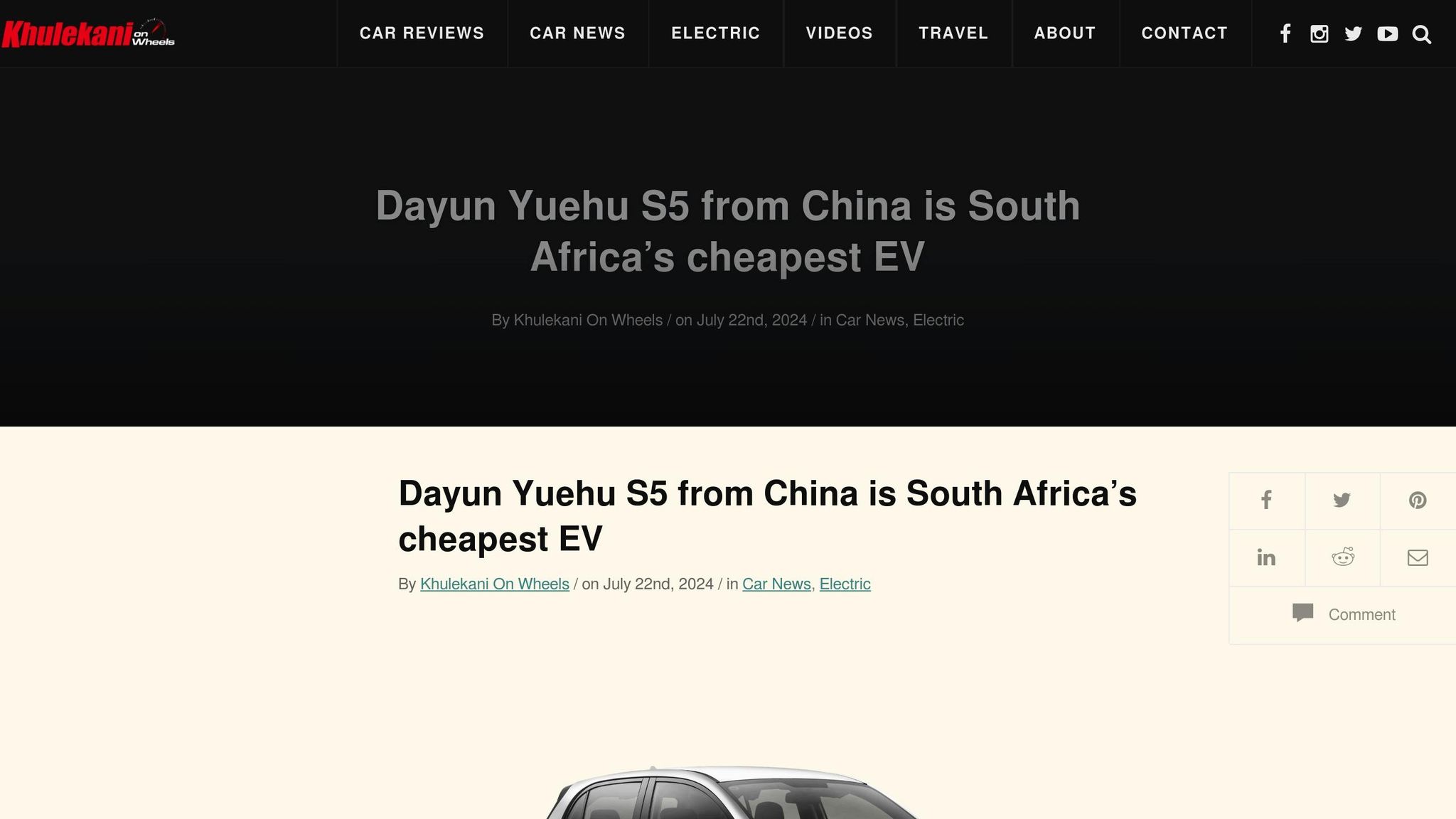
The Dayun Yuehu S5 is a compact electric vehicle (EV) that has made its mark internationally. Since its launch in 2017, over 35,000 units have been sold in more than 20 countries, including regions like the Middle East and Africa, where high temperatures are a constant challenge. At 12.1 feet (3,695 mm) in length, this small SUV is designed with features like Hill Start Assist and Slope Descent Control, making it well-suited for the uneven and hilly terrains often found on African roads.
Range
The Yuehu S5 offers a driving range of 330 km (205 miles) per charge, making it ideal for daily city commutes in Africa. It’s powered by a 31.7 kWh ternary lithium-ion battery and a 35 kW electric motor that delivers 105 Nm of torque. For added convenience, the car supports DC fast charging, allowing the battery to go from 20% to 80% in less than an hour. This is particularly useful in areas where charging infrastructure might still be developing.
Pricing
The Yuehu S5 is one of the more budget-friendly EVs available in South Africa. The base model is priced at about $25,000 USD (R399,900), while the VIP version costs around $28,100 USD (R449,900). For comparison, the BYD Dolphin is priced higher at approximately $33,700 USD (R539,900). Additionally, the Yuehu S5 comes with a 3-year/37,282-mile (60,000 km) service plan and a 5-year/74,565-mile (120,000 km) battery warranty, offering peace of mind to buyers.
Heat Management
To tackle Africa’s intense heat, the VIP model includes a feature called the SmartLink APP. This app lets users remotely activate the air conditioning before stepping into the car. By cooling the cabin while the vehicle is still connected to a charger, it helps conserve battery range. This thoughtful design, combined with its proven performance in hot climates, highlights the vehicle’s ability to handle extreme temperatures effectively.
Next, let’s take a look at another EV built to handle Africa’s diverse road conditions.
2. BYD Dolphin
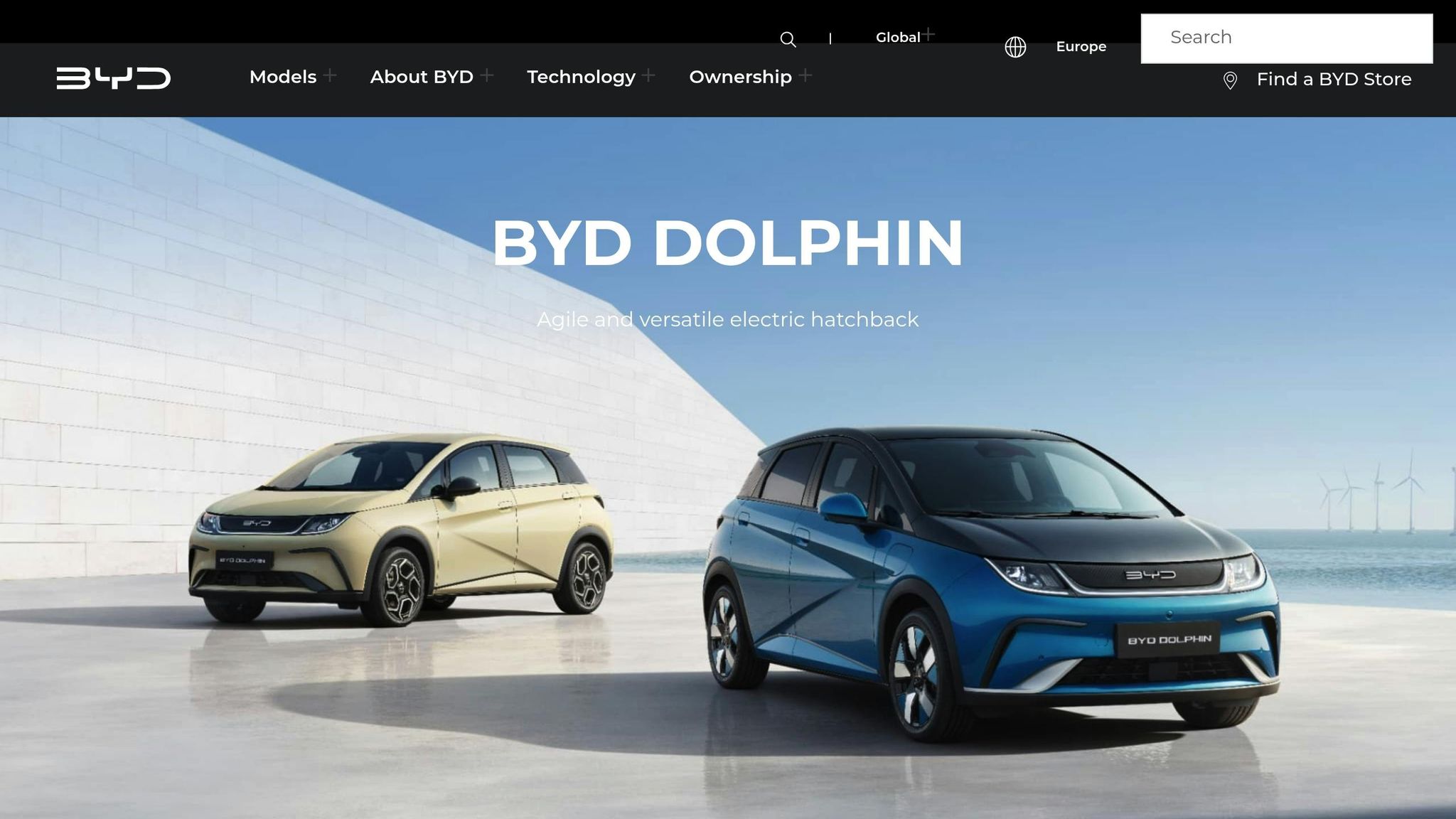
The BYD Dolphin is another smart choice for tackling Africa’s tough driving conditions, following the success of the Yuehu S5. This compact electric vehicle (EV) is steadily gaining traction in South Africa, with plans to triple the number of dealerships by 2026. It comes in two models: the Surf Comfort, priced at roughly $21,200 USD (R339,000), and the Surf Dynamic, available for about $24,400 USD (R389,900). Both versions are powered by BYD’s Blade Battery technology, built to handle harsh conditions.
Range
The range varies depending on the model. The Surf Comfort offers up to 144 miles (232 km) with its 30 kWh battery, while the Surf Dynamic stretches that to 183 miles (295 km) using a 38.8 kWh battery. Fast charging is a standout feature of the Dynamic model, which can go from 30% to 80% charge in just 30 minutes at a maximum rate of 40 kW. The Comfort model supports fast charging as well, though at a slightly slower rate of up to 30 kW. To keep the battery in good shape, it’s recommended to maintain charge levels between 20% and 80%. However, charging to 100% can be useful for longer journeys, especially when charging stations are few and far between.
Cost Efficiency
Owning a BYD Dolphin can save you money in more ways than one. In South Africa, charging an EV costs between $82 and $116 per month, which is about 30% of the cost of fueling a traditional gasoline car. Maintenance expenses are also lower because the Dolphin has only 200 moving parts, compared to over 2,000 in conventional vehicles. This means no oil changes or timing belt replacements to worry about. Pairing the Dolphin with solar panels can cut charging costs even further and provide energy independence in areas where the power grid is unreliable.
Built for Heat
The Dolphin’s Blade Battery is specifically designed to handle high temperatures, a crucial feature for African climates. That said, extreme heat and rough roads can still accelerate battery wear. Replacing the battery could cost anywhere from $5,000 to $15,000. To make the most of the battery’s lifespan, it’s important to follow proper charging habits and avoid exposing the vehicle to extreme heat for extended periods.
3. Volvo EX30
The Volvo EX30 is designed to handle the diverse and often challenging road conditions found in Africa. Starting at around $52,300 USD (R835,500) for the Core model, this compact SUV offers three powertrain options that balance range, performance, and affordability. For those seeking something tougher, the Cross Country variant, priced at approximately $72,900 USD (R1,165,000), is built to tackle rough terrains with ease. Below, we dive into its range, off-road capabilities, and heat management features.
Range
The EX30 lineup offers a range of options to suit different needs. The Single Motor Extended Range model provides up to 296 miles (476 km) on a full charge, making it a solid choice for long trips, particularly in areas with limited charging stations. Meanwhile, the Cross Country variant, equipped with an all-wheel-drive system and a 69 kWh battery, delivers a range of 265 miles (427 km). Thanks to DC fast charging, the battery can go from 10% to 80% in just 26 minutes. Paired with Google Maps–integrated pre-conditioning, charging is optimized even in high temperatures.
Ground Clearance
Built for rugged terrain, the Cross Country model boasts a ground clearance of 7.5 inches (190 mm), which is 0.5 inches (13 mm) higher than the standard version. This added height, along with front and rear skid plates, protects the underbody from damage caused by rocks, potholes, and uneven surfaces. Grant Locke, Managing Director of Volvo Car South Africa, highlighted the significance of this model:
The EX30 Cross Country marks a new chapter for Volvo in South Africa – one that brings our Cross Country legacy into the electric era
. Additionally, the suspension has been fine-tuned with 10% softer springs and a rear anti-roll bar, enhancing comfort on gravel and muddy roads.
Heat Resistance
The EX30 isn’t just built for tough roads; it’s also equipped to handle extreme temperatures. Its active thermal management system preconditions the battery before charging, ensuring optimal performance, though charging times may vary depending on the weather. Higher trims like the Plus and Ultra offer remote cabin pre-conditioning via the Volvo EX30 app, allowing you to cool the interior before stepping in. To further ensure reliability, the battery comes with an 8-year warranty in South Africa, providing peace of mind for long-term use in harsh conditions.
Affordability
Pricing for the EX30 starts at $52,300 USD (R835,500) for the Core model, with the Plus at $60,600 USD (R968,400), the Ultra at $67,600 USD (R1,080,200), and the Cross Country variant topping the range at $72,900 USD (R1,165,000). All models include a 5-year/62,000-mile (100,000 km) warranty, and the Cross Country’s energy consumption of 18.7 kWh per 62 miles (100 km) helps keep running costs manageable. With its combination of rugged durability, advanced features, and competitive pricing, the EX30 stands out as a premium choice for African drivers.
sbb-itb-99e19e3
4. Mini Countryman SE ALL4
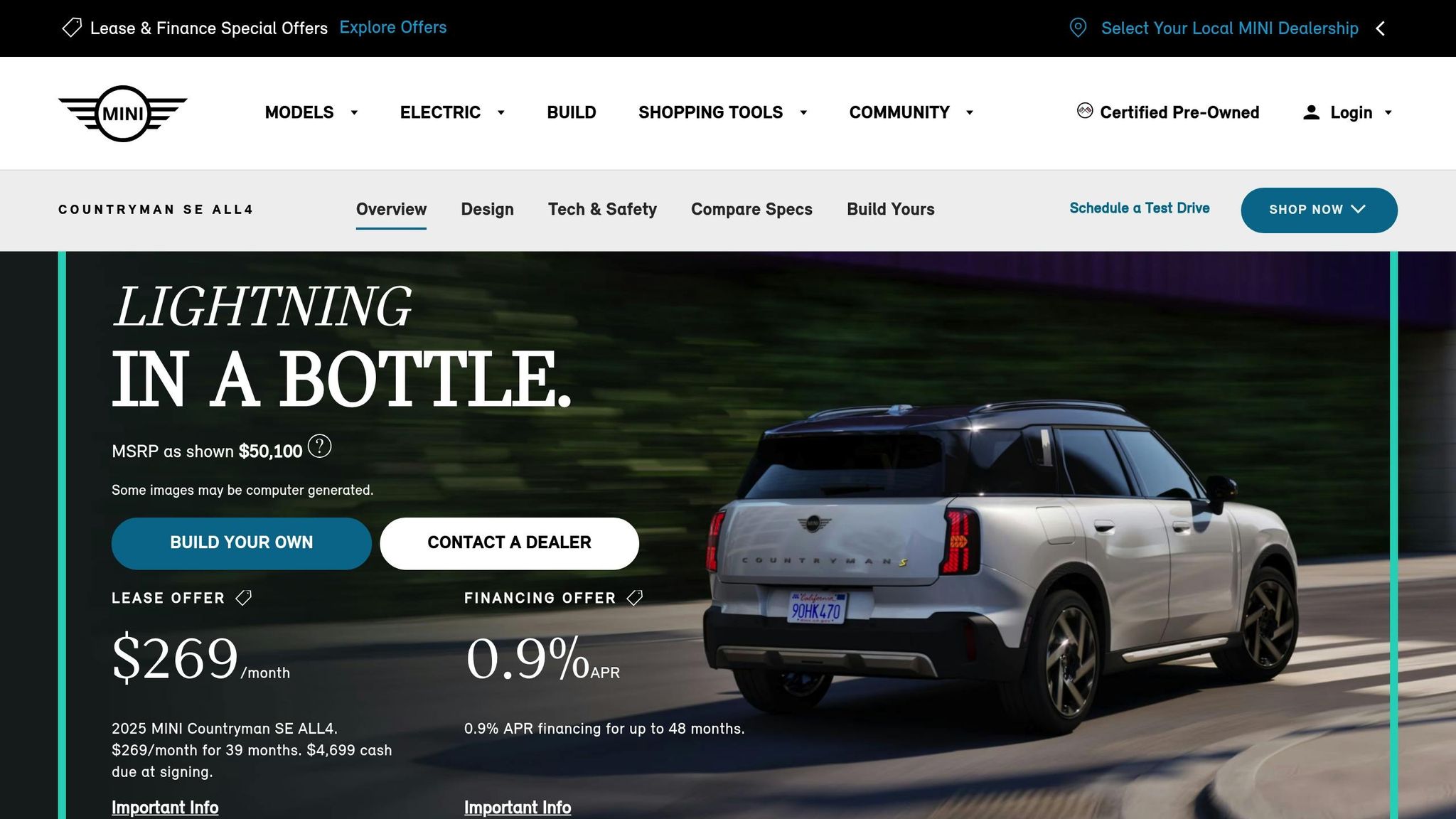
The Mini Countryman SE ALL4 combines urban style with dependable off-road capabilities, making it a practical choice for African drivers. Starting at $45,200, this model offers solid performance and quick acceleration. While it’s the heaviest Mini at around 4,400 lbs, its 64.6 kWh floor-mounted battery keeps the center of gravity low, improving stability on rough terrain. Let’s dive into its range, handling, and heat management to see why it’s suited for Africa’s diverse roads.
Range
The Countryman SE ALL4 delivers an EPA-estimated range of up to 212 miles, with WLTP ratings between 245 and 269 miles (395–433 km). While its range might not outshine competitors like the Tesla Model Y, it compensates with fast-charging capabilities, taking the battery from 10% to 80% in about 30 minutes. For peace of mind, the car comes with an 8-year/100,000-mile battery warranty.
Ground Clearance
With 6.5 inches (165 mm) of ground clearance, the Countryman SE ALL4 is built to handle Africa’s rugged roads. Its ALL4 system distributes torque evenly between the front and rear wheels, and the "Trail Mode" adds real-time vehicle inclination data and an on-screen compass for navigating off-road adventures. This setup is ideal for managing uneven surfaces and challenging conditions.
Heat Resistance
The liquid-cooled lithium-ion battery pack is a standout feature, especially for Africa’s hot climates. This cooling system ensures the battery maintains its performance even in extreme heat, which is a key advantage for drivers in warmer regions. Additionally, with fewer moving parts and fluids compared to traditional combustion engines, the Countryman SE ALL4 is easier to maintain – particularly useful in remote areas with limited service options.
Affordability
Priced between $45,200 and $50,100, the Countryman SE ALL4 comes with several ownership perks: a 3-year/36,000-mile maintenance program, a 4-year/50,000-mile warranty, a 12-year unlimited mileage rust warranty, and a towing capacity of 2,645 lbs. MINI.co.za describes it as:
a practical family car with premium looks but still tough, rugged and versatile enough to let you have serious offroad fun
. These features make it a well-rounded choice for drivers tackling Africa’s varied and demanding terrains.
5. Toyota BZ4X
The Toyota BZ4X brings Toyota’s well-established reputation for reliability into the electric vehicle space. For African drivers seeking a balance of durability and affordability, this mid-size electric SUV is a solid contender. Starting at $38,520, it has become even more appealing after substantial price reductions on the XLE and Limited trims. With an EPA-estimated range of 222 to 252 miles, it’s well-suited for daily commutes, while its all-wheel drive system with X-MODE is designed to handle tough road conditions. Here’s a closer look at its key features, particularly its performance on rugged roads and in extreme heat.
Range
The BZ4X delivers an EPA-estimated range of 252 miles for the front-wheel-drive (FWD) model and 222–228 miles for the all-wheel-drive (AWD) version. Fuel efficiency comes in at 119 MPGe for the FWD and 104 MPGe for the AWD. In real-world highway tests, the range averages around 160 miles. For charging, the vehicle supports DC fast-charging, reaching 80% in about 30 minutes with a 150 kW charger (100 kW for the AWD model). Toyota backs its EV components with an 8-year/100,000-mile warranty, making it a dependable choice for long-term ownership.
Ground Clearance
Built on Toyota’s e-TNGA platform, the BZ4X is engineered for stability and comfort across diverse road conditions. The AWD system, combined with X-MODE, adjusts braking and power distribution to optimize traction on uneven surfaces. This feature is particularly useful for navigating Africa’s unpaved roads and potholes. Testing has shown that the SUV handles bumps smoothly and maintains a steady ride on rough terrain. Additionally, its robust design extends to its battery system, which is built to withstand extreme climates.
Heat Resistance
The BZ4X is equipped with a liquid-cooled lithium-ion battery that prevents overheating and minimizes wear in high-temperature environments. Fewer moving parts in the vehicle also mean reduced maintenance needs. This advanced cooling system ensures reliable performance even in remote areas where service options may be limited.
Affordability
Priced between $38,520 and $45,330, the BZ4X offers excellent value for its features. It comes with a 3-year/36,000-mile limited warranty, a 5-year/60,000-mile powertrain warranty, and an 8-year/100,000-mile warranty for EV components. Toyota also includes complimentary maintenance for the first 2 years or 25,000 miles. The SUV earned a 7.5/10 rating from Car and Driver. As Mark Takahashi, Editor at Car and Driver, remarked:
The bZ4X is more affordable this year, thanks to massive price cuts on the XLE and Limited trims
. With its competitive pricing, reliability, and thoughtful design, the BZ4X stands out as a dependable and economical choice for African drivers.
Advantages and Disadvantages
When it comes to Africa’s diverse terrains and climates, each electric vehicle (EV) model brings its own set of strengths and trade-offs. Here’s a breakdown of their key benefits and challenges to help you navigate the options.
Affordability is a major factor, with prices starting at around $25,000 for the Dayun Yuehu S5 and climbing above $40,000 for premium models like the Volvo EX30. Longer ranges are especially valuable, as they reduce dependence on Africa’s limited charging infrastructure. Models like the BYD Dolphin and Toyota BZ4X strike a reasonable balance between cost and practicality, while the Volvo EX30 delivers outstanding efficiency for those willing to spend more upfront. On the other hand, ground clearance and durability are crucial for navigating unpaved roads, which are often riddled with potholes and rough patches. Additionally, the availability of service networks varies by brand, affecting long-term maintenance and support.
Below is a quick comparison table summarizing each model’s key benefits and drawbacks:
| Model | Benefits | Drawbacks |
|---|---|---|
| Dayun Yuehu S5 | Budget-friendly at around $25,000; compact SUV design; agile performance for city driving | Limited range (under 186 miles); durability on rugged terrain untested; sparse service network outside South Africa |
| BYD Dolphin | Affordable with a solid range for daily use; advanced blade battery for improved safety; expanding dealer presence | Service network still developing in many regions; limited data on long-term performance in extreme heat |
| Volvo EX30 | High build quality; efficient battery with up to 310 miles of range; advanced safety features; handles mixed road conditions well | Premium pricing at $40,000+; limited service options outside key markets like South Africa; battery performance in extreme heat not fully tested |
| Mini Countryman SE ALL4 | Premium build; all-wheel drive for tough terrain; strong brand reputation; good ground clearance for an EV | High price; limited electric-only range; service centers mainly in major cities |
| Toyota BZ4X | Trusted brand with an established service network; X-MODE for off-road capability; liquid-cooled battery for heat management; 8-year/100,000-mile warranty | Moderate highway range of about 160 miles; initial cost between $38,520–$45,330; AWD version has lower range than FWD |
These comparisons tie into earlier discussions on factors like range, durability, and affordability, helping you weigh your options based on what matters most for African roads. Encouragingly, local assembly initiatives – particularly by Chinese manufacturers – are improving parts availability and potentially lowering costs. The success of events like the 2025 South African EV road trip, which spanned over 2,485 miles with six fully electric vehicles, highlights how EVs are becoming increasingly viable for long-distance travel across the continent. This overview gives you a solid foundation for evaluating your next steps before diving into the final conclusions.
Conclusion
Choosing the right EV in Africa comes down to matching your specific needs with the right model. If you’re keeping an eye on your budget, options like the Dayun Yuehu S5 and BYD Dolphin strike a solid balance between price and performance. For those who often face rough roads, vehicles like the Toyota BZ4X and Mini Countryman SE ALL4 are built to handle tougher terrains. Meanwhile, families in search of a spacious and safe ride might lean toward the Volvo EX30, which offers plenty of room and advanced safety features, though it does come with a higher price tag.
As the market diversifies, partnerships are playing a big role in making EVs more accessible and affordable. Chinese brands like BYD and Chery are expanding their footprint across Africa, working with local partners and setting up assembly plants. This not only boosts the availability of parts but also helps bring prices down over time. These efforts are strengthening the infrastructure needed to connect buyers with the right vehicles.
Dealer networks are also growing, making it easier than ever to find the perfect EV. Platforms like EV24.africa now provide a one-stop marketplace for new and used EVs across all 54 African countries, complete with detailed specifications, transparent pricing, financing options, and delivery services.
Before making your choice, think through your daily driving range, charging options, and the types of roads you’ll be navigating. These practical considerations will help you zero in on the EV that best fits your lifestyle.
FAQs
Can electric vehicles handle Africa’s extreme heat and rough roads?
Yes, modern electric vehicles (EVs) are built to perform well in Africa’s hot climate and challenging road conditions. Many EVs are equipped with advanced thermal-management systems, like liquid-cooled batteries, which help maintain optimal battery temperatures even when the mercury rises above 100°F. This technology not only ensures consistent performance but also extends the battery’s lifespan in extreme heat. On top of that, critical components are reinforced and sealed to guard against dust, sand, and sudden shifts in temperature.
When it comes to navigating rough roads, EVs are no slouch. Many models feature higher ground clearance, sturdy suspensions, and specialized driving modes tailored for off-road adventures. Take electric pickups like the Ford F-150 Lightning and Rivian R1T, for example – both offer ground clearance of about 13.8 inches or more, making them well-suited for rugged terrains. Likewise, electric SUVs such as the Toyota bZ4X and BYD Tang EV come equipped with all-wheel-drive systems and durable chassis, ensuring they can handle uneven roads and potholes with ease.
Even more affordable EVs, like the Hyundai Kona Electric and MG4 Electric, don’t compromise on durability. With reinforced frames and ground clearance ranging from 5.5 to 6 inches, these vehicles are designed to tackle tough conditions while remaining efficient and reliable across Africa’s diverse landscapes.
What are the financial benefits of owning an electric car in Africa?
Owning an electric car in Africa can save you a lot compared to sticking with a gas-powered vehicle. For starters, electricity tends to be more affordable and stable than imported fuel, which means you can sidestep those unpredictable gas price hikes. Plus, EVs are easier on your wallet when it comes to upkeep – maintenance costs are typically 30%–50% lower. Why? They have fewer moving parts, don’t need oil changes, and experience less brake wear.
On top of that, EVs come with lower overall running costs and produce zero tailpipe emissions, making them a cleaner choice. Governments across Africa are also stepping in with incentives and financing options to help bring down the initial cost. All in all, electric cars are shaping up to be a smart, budget-conscious, and eco-friendly option for drivers on the continent.
What electric car has the best range for long-distance travel in Africa?
The Changan Hunter, a long-range electric SUV, boasts an estimated range of approximately 640 miles on a single charge. This capability makes it an excellent choice for extended trips across Africa’s varied landscapes, whether you’re cruising highways or navigating remote regions. Built to endure tough roads and adapt to different climates, it offers a reliable and efficient option for long-distance travel.