
 Thabo Nkosi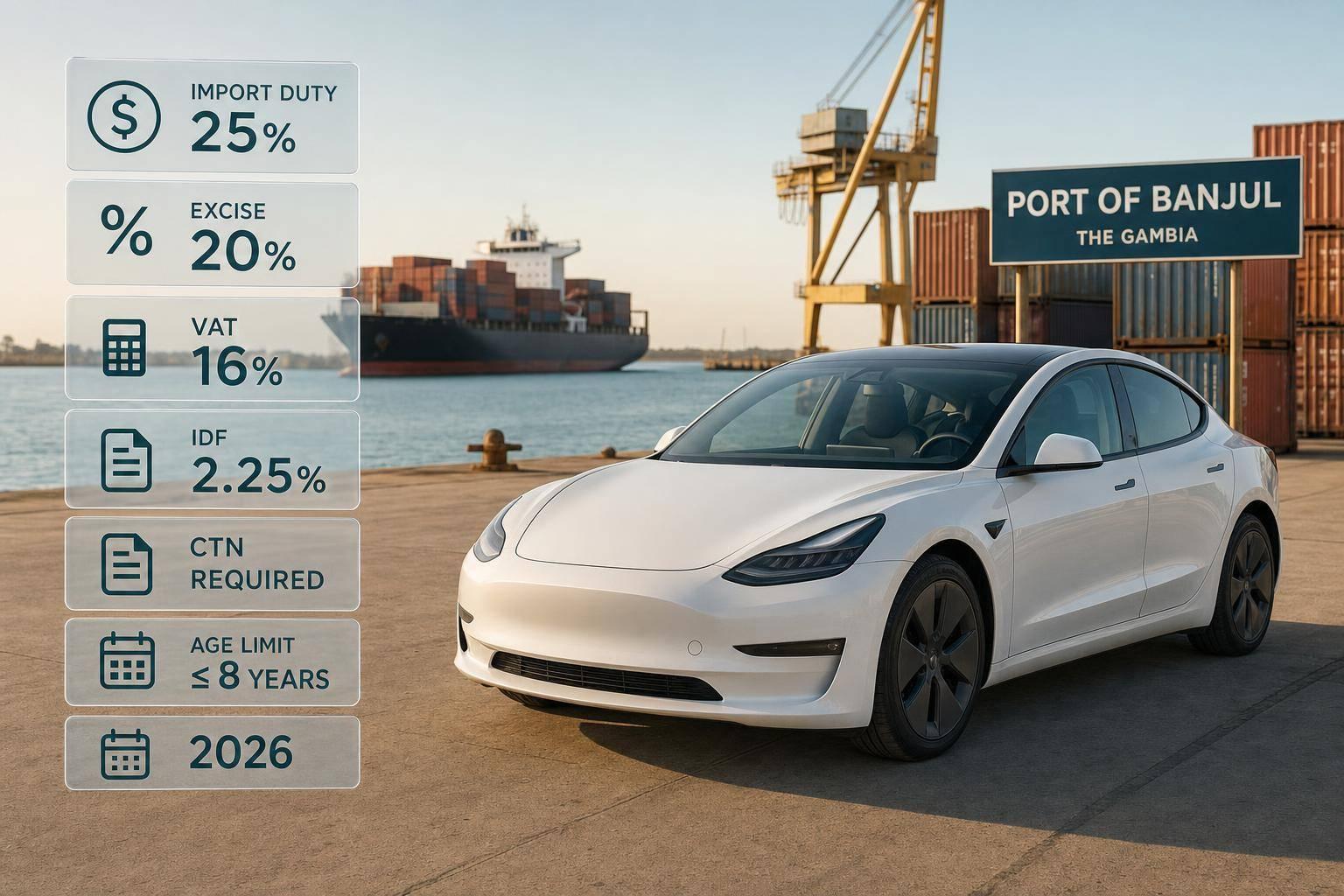
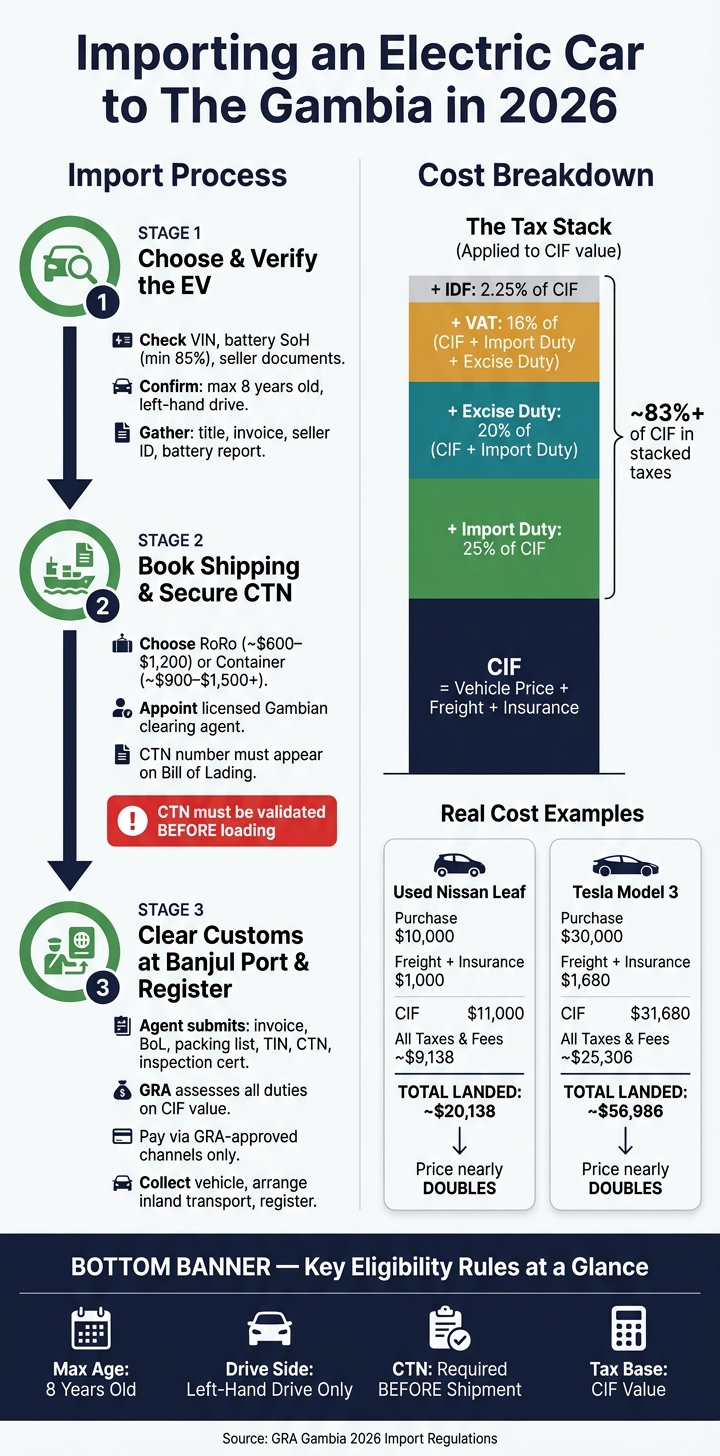
Importing an EV to The Gambia in 2026 can add about 83%+ of CIF in stacked taxes before port, agent, and registration costs. If I were budgeting for a used EV, I’d check four things first: the 8-year age limit, left-hand drive rule, CTN before loading, and the tax stack of 25% duty + 20% excise + 16% VAT + 2.25% IDF.
Here’s the short version:
- You need a Gambian TIN certificate and matching importer details on all papers.
- The EV must usually be 8 years old or newer and left-hand drive.
- A pre-shipment inspection certificate is required.
- The CTN must be issued and validated before shipment.
- Main taxes are charged from CIF = car price + freight + insurance.
- A $10,000 EV can land closer to $20,000 after taxes and fees.
- A $30,000 EV can land near $57,000.
A few numbers matter most. On paper, import duty is 25% of CIF. Then excise is 20% of CIF + duty. Then VAT is 16% of CIF + duty + excise. Add IDF at 2.25% of CIF, plus port charges, clearing fees, storage risk, inland delivery, and registration.
If I wanted to avoid the usual delays, I’d make sure the VIN, invoice, title, Bill of Lading, and CTN all match exactly. One typo can leave the car sitting at Banjul Port while fees keep adding up.
| Item | What to know |
|---|---|
| Age rule | Up to 8 years old |
| Drive side | Left-hand drive for normal registration |
| Tax base | CIF |
| Import duty | 25% |
| Excise duty | 20% |
| VAT | 16% |
| IDF | 2.25% of CIF |
| Entry route | Usually Banjul Port |
| Key risk | Missing or late CTN, or paper mismatch |
So the bottom line is simple: the seller’s price is only the start. I’d treat document accuracy, CTN timing, and full landed-cost math as the three things that decide whether the import goes smoothly or gets expensive fast.
How to Import an Electric Car to The Gambia in 2026: Step-by-Step Cost & Process Guide
1. The Gambia’s 2026 Rules for Importing Electric Cars
In 2026, EVs in The Gambia are taxed much like other motor vehicles unless the GRA or the Ministry of Finance gives you a written exemption before you buy the car.
Here’s how the taxes apply:
| Tax | Rate | Applied To |
|---|---|---|
| Import Duty | 25% | CIF value (Cost + Insurance + Freight) |
| Excise Duty | 20% | CIF + Import Duty |
| VAT | 16% | CIF + Import Duty + Excise Duty |
| Import Declaration Fee (IDF) | 2.25% | CIF value, with some guides noting a minimum of D45,000 |
These charges stack on top of each other, so the landed cost can climb fast. Once you understand the tax side, the next job is making sure the importer and paperwork line up with what customs expects.
Who Can Import and Basic Eligibility Requirements
Both private individuals and registered businesses in The Gambia can import vehicles. Importers need a Gambian TIN and the TIN certificate, not just the number by itself. You should also have the original ownership and purchase papers for the EV ready.
There’s one detail that trips people up: the legal name must match across the invoice, title or logbook, Bill of Lading, and customs declaration. If the importer name doesn’t line up, clearance can drag out and storage charges at the port can start piling up.
Vehicle Age, Condition, and Entry Route Requirements
Imported vehicles must be no more than 8 years old. If a vehicle is older than 8 years, it can’t be imported. For standard registration, GRA accepts only left-hand drive vehicles.
A pre-shipment inspection certificate from the country of origin is also required. That certificate must confirm the EV is roadworthy, including the battery and high-voltage system. If the inspection is missing or too weak, the vehicle may be held at the port.
Sea import through Banjul Port is the standard route. Overland import can also work through border declaration, but transit may call for extra customs guarantees.
Once the vehicle fits these rules, the next step is to pull together the shipping and customs documents before you start the clearance process.
sbb-itb-99e19e3
2. Step-by-Step Process to Import an Electric Car to The Gambia
Once the EV is eligible, the process moves through three main stages: check the car and seller, lock in shipping and the CTN, then clear the vehicle at Banjul Port. Before you book freight, make sure the vehicle file matches the shipping file line by line.
Choose the EV, Verify the Seller, and Gather Required Documents
Start with the VIN. Get it before anything else.
That number lets you check the exact trim, battery spec, mileage, and ownership history. It also helps you confirm that the car being sold is the same car shown in the paperwork. Ask for a battery health report or SOH printout too.
Make sure the seller’s name on the ownership document matches the purchase invoice exactly. If the vehicle details and the paperwork don’t line up, customs clearance can stall fast. Before you send money, collect the title or export certificate, prior registration records, seller ID, VIN, and battery report.
Once the seller file checks out, move on to shipping and CTN review.
Book Shipping, Secure the CTN, and Appoint a Clearing Agent
After the vehicle and documents are confirmed, pick a shipping method. RoRo (Roll-on/Roll-off) is often simpler and can cost less for a standard passenger EV. Container shipping gives the vehicle more protection and may make more sense for a higher-value car.
Compare a few basics before you decide:
- Freight price
- Insurance cost
- Vehicle condition
- Transit security
- Expected port handling time
Do not book the shipment until the Cargo Tracking Note (CTN) is issued and validated. CTN compliance has been required for Gambia-bound cargo since June 15, 2023, and missing CTN references can prevent the original Bill of Lading from being issued or the vehicle from being discharged at Banjul Port. The CTN number should appear in the goods-description and shipment-reference fields of the Bill of Lading.
Small errors can turn into big delays here. If the shipper name, consignee details, or vehicle description is wrong, clearance may slow down or trigger extra checks when the car arrives.
Appoint a licensed Gambian clearing agent early. The agent can file ASYCUDA, estimate duties, work with GRA, and arrange release.
After the CTN is confirmed, the clearance file should be ready before the vessel reaches port.
Clear Customs, Pay Taxes, and Collect the Vehicle from the Port
When the vessel arrives at Banjul Port, your clearing agent submits the import declaration with the invoice, bill of lading, packing list, certificate of origin, TIN, and proof of ownership or export paperwork. Keep the CTN reference ready too. GRA customs may inspect the vehicle and check the declared value against the paperwork.
After inspection, GRA assesses import duty, excise duty, VAT, and IDF on the CIF value. Pay all assessed amounts through GRA-approved channels only. GRA warns against paying duties informally or outside registered clearing agent processes.
If even one document is missing or inconsistent, the vehicle may sit in storage while you fix the file. Once payment is confirmed, customs issues the release order, and your agent can arrange inland transport from the port to your location.
Keep both a digital file and a paper file ready for customs review; the next section lists the exact documents and the delay points that tend to cause trouble.
3. Required Documents and Port Compliance Checklist
Get every document lined up before the vehicle reaches Banjul Port. If even one paper is missing or doesn’t match the others, customs release can stall and storage fees can start piling up.
Owner, Vehicle, and Shipping Documents
The table below shows each document and the first point where you’ll need it.
| Document | Needed First |
|---|---|
| Importer ID or company registration | CTN application and customs declaration |
| Tax Identification Number (TIN) certificate | Customs declaration and duty payment |
| Vehicle title/ownership certificate | CTN application and customs valuation |
| Original vehicle registration card/logbook from the origin country | Customs valuation and physical inspection |
| Purchase invoice or bill of sale | CTN application and customs valuation |
| Original Bill of Lading | Port release and customs declaration |
| Cargo Tracking Note (CTN) confirmation | Pre-shipment, before loading |
| Commercial invoice showing FOB value, freight charges, HS code, and currency | CTN issuance and customs declaration |
| Packing list | CTN filing and customs inspection |
| Freight invoice from the shipping line or forwarder | CIF calculation and duty assessment |
| Pre-shipment inspection certificate | Customs declaration and physical inspection |
| International insurance policy | Customs clearance and port exit |
| Manufacturer’s spec sheet showing battery capacity, motor power, and fuel type | Customs classification and valuation |
GRA requires the import declaration to match the invoice, BoL, packing list, required certificates, and importer TIN. For EVs, the manufacturer’s spec sheet confirming battery capacity, motor power, and fuel type helps customs classify the vehicle correctly.
Port and Customs Issues That Commonly Delay EV Imports
The biggest holdup is usually a VIN or chassis mismatch. The BoL, title, invoice, and CTN need to match exactly. One small typo can stop release until the shipping line issues a corrected BoL, and that delay can lead to storage charges.
CTN timing also matters. The CTN must be validated before loading at the origin port, not after the vessel leaves. If the CTN reference is missing, the original Bill of Lading may not be issued, and the vehicle can be held at Banjul Port with storage charges.
It’s also smart to keep the car empty. Personal items left inside can trigger a customs search and fines. Schedule the pre-shipment inspection early, and make sure the certificate shows the manufacture year.
With the file in order, the next step is calculating the landed cost.
4. EV Import Cost Breakdown for The Gambia
Start with CIF: vehicle price + freight + insurance. In The Gambia, most duties and fees are calculated from that number. That’s why it helps to double-check the seller, VIN, and shipping details before you run the math. A small mistake here can throw off the full estimate.
Full Landed-Cost Formula: From Purchase Price to Registration
CIF – Cost, Insurance, and Freight – is the customs baseline for all duty and tax calculations.
| Cost Line | Base | Typical Cost | When Paid |
|---|---|---|---|
| Vehicle purchase price | Invoice or auction price | Actual purchase price | At purchase |
| Ocean freight | Per vehicle, by route and method | About $600–$1,200 on common RoRo routes; shared container shipping is usually higher | When shipping is booked |
| Marine insurance | Percentage of vehicle value/CIF | About 1–2% of CIF | When shipping is booked |
| CIF value | Price + freight + insurance | – | CIF base |
| Import duty | CIF | 25% | Customs assessment |
| Excise duty | CIF + import duty | 20% | Customs assessment |
| VAT | CIF + import duty + excise duty | 16% | Before customs release |
| Import Declaration Fee (IDF) | CIF or minimum GMD 45,000, whichever is higher | 2.25% | Customs declaration |
| Port handling | Per vehicle flat fee | GMD 500 (saloon) / GMD 750 (jeep or truck) | Port arrival |
| Storage/demurrage | Per day after free period | About $10–$25/day | If clearance is delayed |
| Clearing agent fee | Flat service fee | About $150–$300 | Port clearance |
| Inland transport | Flat or distance-based | About $100–$200 | After customs release |
| Registration, licensing, and plates | National licensing authority | About $150–$250 | Post-clearance |
Here’s the part many buyers underestimate: import duty, excise, and VAT alone often add about 40%–50% of CIF for a standard vehicle import. So a car that looks cheap at auction can end up costing a lot more by the time it’s on the road. Always confirm the rates GRA applies before you depend on any estimate.
RoRo vs. Container Shipping: Cost and Practicality Compared
RoRo is often the lower-cost option and is common for used EVs. Container shipping costs more, but it gives the vehicle more protection and can make sense for pricier models or shipments that include extra parts and chargers.
| Shipping Method | Typical Cost Range (USD) | Protection Level | Transit and Port Considerations | Best Use Case |
|---|---|---|---|---|
| RoRo | About $600–$1,200 per car | Standard – vehicle is stored on open decks with other cars | Simpler port discharge; faster vehicle release in most cases | Used EVs, budget-conscious imports, Nissan Leaf and similar |
| Container | About $900–$1,500+ per car in a shared container | Higher – sealed container protects from weather and tampering | Additional container terminal steps; container stripping adds time; higher terminal handling charges (GMD 750 for a 20-ft container; GMD 1,500 for a 40-ft container) | High-value EVs like Tesla Model 3, shipments with extra parts or chargers |
There’s one catch with containers: delays can get expensive fast. If your container stays at Banjul Port past the free storage period, demurrage can reach up to GMD 23,000 for a 20-ft container. In plain terms, slow customs clearance can wipe out any savings you thought you had. Once you pick the shipping method, drop those numbers into the landed-cost formula below.
Example Landed-Cost Estimates: Used Nissan Leaf and Tesla Model 3
These examples use the standard motor-vehicle tax structure – 25% import duty, 20% excise duty, 16% VAT, and 2.25% IDF. Use them as calculation templates, not quotes. Check all rates with GRA and your clearing agent before you commit money.
Used Nissan Leaf (mid-2010s model, shipped via RoRo from Europe)
Purchase $10,000 + freight $800 + insurance $200 = CIF $11,000. Duty $2,750; excise $2,750; VAT $2,640; IDF $248; other fees about $550; registration $200. Total: about $20,138.
Used Tesla Model 3 (shipped via container from Europe)
Purchase $30,000 + freight $1,200 + insurance $480 = CIF $31,680. Duty $7,920; excise $7,920; VAT $7,603; IDF $713; other fees about $900; registration $250. Total: about $56,986.
After you price the import, use VIN checks, battery reports, and compliance tools to cut risk before payment and shipment.
5. Tools to Lower Risk and Final Steps Before Registration
After you price out the import, do a few checks before you send money. This is where deals can go sideways. A bad VIN, a weak battery, or missing papers can wipe out the savings you worked out in Section 4.
VIN Checks, Battery Reports, Duty Calculators, and EV24.africa Listings
Start with a paid VIN history report. Then match that VIN against the windshield plate, the driver-side door pillar, the title, and the invoice. If one detail is off, stop and sort it out before moving forward.
Battery health matters even more with an EV. Battery replacement can cost $10,000–$20,000+. Always ask for a battery report that shows SoH, usable kWh, and range. If the battery is below 85% SoH, treat it as high risk. And if there is no battery report at all, that risk goes up fast.
Also check the seller like you would check the car. Confirm the business registration, physical address, and bank account in the company’s legal name. Before payment, make sure they can issue export paperwork the right way.
You can also use EV24.africa listings to compare vetted EVs, estimate landed cost ranges, and get shipping support for routes that serve The Gambia.
Final Compliance Checklist and Conclusion
Once the car clears these checks, keep the same document file ready for customs release and registration. Your clearing agent in Banjul should already have copies of every paper: the bill of lading with the chassis number, year, brand, and model; the purchase invoice; the export title; and the CTN reference. Every detail needs to match the physical car exactly.
Here’s the quick-reference summary tied to legal entry, customs release, and registration in The Gambia:
- Before purchase: Confirm the EV model and year qualify under The Gambia’s 2026 import rules. Run VIN checks, review battery SoH documents, verify the seller, and estimate total landed cost with a duty worksheet.
- Before shipping: Make sure all documents show the correct VIN and buyer details. Validate the CTN through an authorized provider before the vessel departs. Appoint a licensed clearing agent and send documents early so they can flag errors and advise on HS codes.
- Before customs clearance: Confirm your agent has originals or endorsed copies of all documents. Have duty and port fee payments ready. Prepare registration documents – proof of identity or company incorporation papers, customs clearance certificates, duty and tax payment receipts, and inspection reports – so there’s no delay between port release and getting the car on the road legally.
FAQs
Can I import an older EV to The Gambia?
Yes, but only if the electric vehicle is less than eight years old. That age cap applies no matter how many miles are on it or what shape it’s in.
Before you buy, check the manufacturing year carefully. If the EV is imported, it also needs to be left-hand drive. Right-hand-drive vehicles are usually not allowed, aside from a few specific cases.
What happens if my CTN is missing or late?
If your Cargo Tracking Note (CTN) is missing or filed late, you may face financial penalties and port delays. In some cases, customs can place the vehicle on hold, which often leads to daily storage fees at the port.
The best way to avoid that mess is simple: get your paperwork ready ahead of time and file the CTN within the required deadline before the vessel arrives.
How do I estimate my EV’s total landed cost?
Start with CIF: the vehicle price, ocean freight, and marine insurance. That matters because Gambian customs uses CIF as the base for tax.
From there, add the main import charges in Gambia:
- Import duty: 25% of CIF
- Excise duty: 20%
- VAT: 16%
- Other processing fees
Then factor in the non-tax costs that often catch people off guard: port handling and clearance, inland transport, registration and plates, and insurance.
It also helps to build everything into a spreadsheet. Add a 10%–15% contingency buffer to cover unknown fees and exchange-rate swings, so you’re not left scrambling if the final bill comes in higher than expected.