
 Thabo Nkosi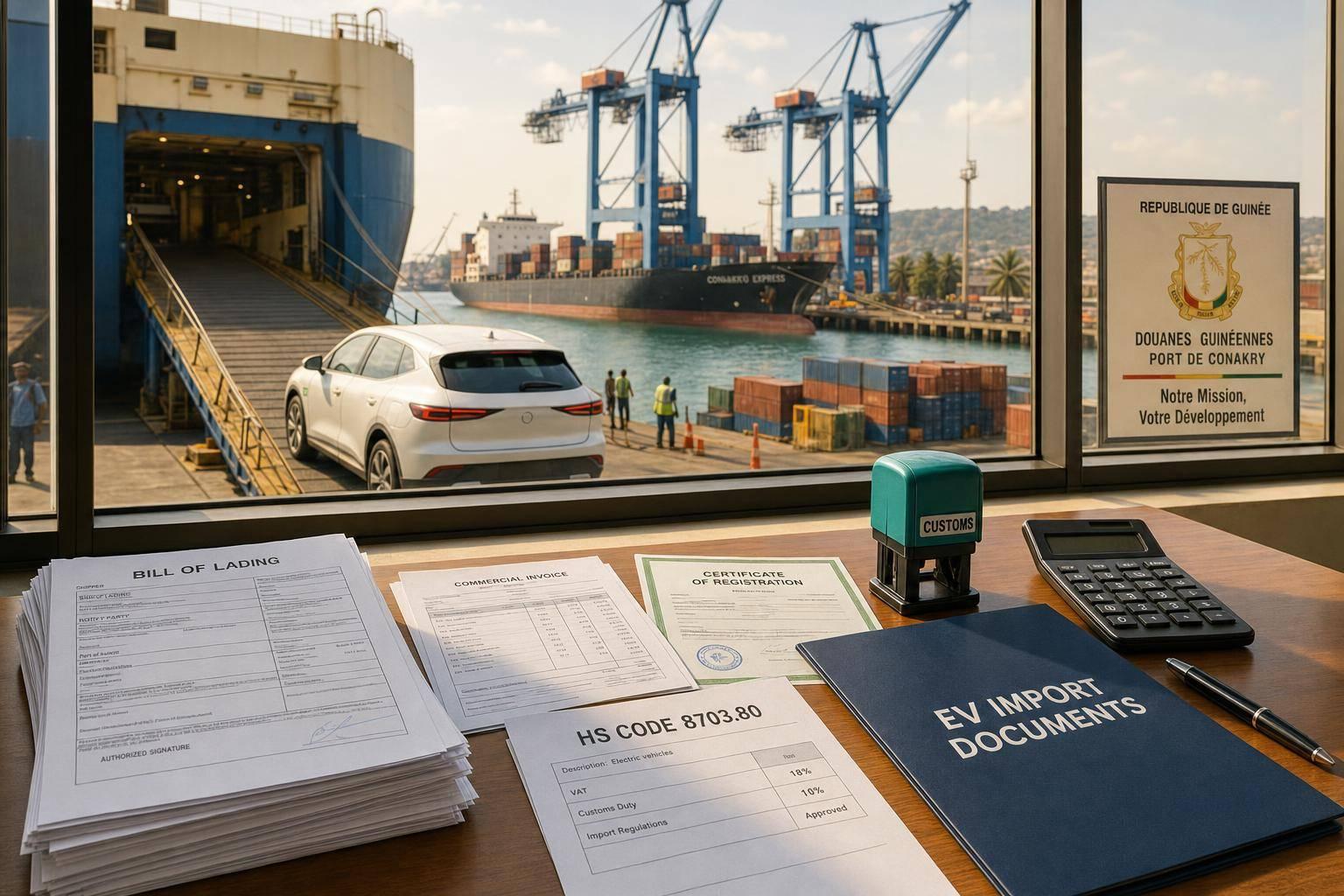
If I import a new EV into Guinea in 2026, the main tax rule is simple: I should budget for a 12.75% customs duty on CIF and 0% VAT. That can make a big difference to my total cost. But the lower tax treatment only applies if Customs accepts the car as new.
Before I buy, I need to check five things fast:
- Is the car new or used?
- Is it left-hand drive? Right-hand drive is banned.
- What is the CIF value? FOB price + freight + marine insurance
- Is the HS code correct? For battery EVs, that is HS 8703.80
- Do I have all documents ready before arrival in Conakry?
I also need to plan for more than tax. My landed cost usually includes:
- Vehicle price
- Ocean freight
- Marine insurance
- 12.75% duty for qualifying new EVs
- Port handling fees
- Clearance agent fees
- Registration and local insurance
- Storage charges if clearance takes too long
For used vehicles, I need to be more careful. They do not get the same tax treatment, they must be no more than 13 years old from first registration, and they need a pre-shipment technical inspection certificate.
A simple rule I’d use: work out the full landed cost before placing the order, then confirm the vehicle status and customs code with a broker in Conakry. That cuts the risk of extra charges at the port.
| Key point | What I need to know |
|---|---|
| New EV duty | 12.75% of CIF |
| New EV VAT | 0% |
| Used vehicle age limit | 13 years max from first registration |
| Battery EV HS code | 8703.80 |
| Main port | Port of Conakry |
| Big risk | Storage fees from delays |
The rest of the article breaks down cost math, shipping options, customs steps, and the paperwork I need to clear an EV in Guinea without getting stuck at the port.
Guinea’s 2026 EV Import Taxes and Customs Rules
Guinea’s 2025 amended finance law lowered duty on new vehicles, including EVs, from about 45% to 12.75% and removed VAT on new imports.
That sounds like a big win, but there’s a catch: the vehicle has to qualify as new. Used vehicles don’t get the same tax treatment, and they also can’t be more than 13 years old from first registration. Before you buy anything, it’s smart to confirm the vehicle’s status with a licensed customs broker in Conakry.
There are a couple of other rules that can trip people up. Right-hand drive vehicles are banned. And if you’re importing a used vehicle, you also need a technical inspection certificate from the country of origin before the car is shipped to Conakry.
| Charge Type | New EVs (2026) | Used Vehicles |
|---|---|---|
| Customs Duty | 12.75% | Higher than 12.75% |
| VAT | 0% (Exempt) | Standard rate applies |
How Reduced Duty and VAT Treatment Affect New Electric Cars
For a new battery electric vehicle, the 12.75% duty rate and 0% VAT can cut the tax bill by a lot compared with the old system. If you’re trying to figure out total landed cost, that change matters.
Still, the final tax treatment depends on whether Guinea Customs accepts the vehicle as new. A transitaire can check the VIN and technical specs before shipment and run a duty simulation, so you have a clearer picture of what may happen at the port.
HS Classification and Why Battery Electric Cars Must Be Declared Correctly
Battery electric vehicles are declared under HS 8703.80. That code matters because it’s tied to the lower duty rate for qualifying new EVs. Use the wrong code, and you could face the wrong duty amount and a delay in Conakry.
Hybrids can fall under other HS codes, including 8703.40 or 8703.60, so they need to be checked on their own. It’s best to confirm the right HS code with your clearing agent before the vehicle leaves for Conakry.
These rates feed straight into the landed-cost calculation in the next section.
sbb-itb-99e19e3
How to Calculate the Full Landed Cost to Conakry
Use CIF plus Guinea-side charges to estimate your total cost before you buy. That matters because the landed cost is higher than the vehicle price alone.
The Landed-Cost Formula to Use Before Placing an Order
Guinea Customs calculates the customs value from the CIF value – the vehicle’s FOB (Free on Board) price, plus freight to Conakry, plus marine insurance. Then you add duty and local charges on top of that amount.
Here’s the basic formula:
CIF = FOB Price + Freight + Marine Insurance
Landed Cost = CIF + Customs Duty (12.75% of CIF) + VAT (0% for new EVs) + Port Handling Fees + Clearance Agent Fees
After customs clearance, set aside extra money for local registration and mandatory insurance.
Freight, port handling, and broker fees can change based on the shipping route and how fast the vehicle clears the port. That’s why it helps to ask for itemized quotes that split out FOB, freight, and insurance. With those numbers, you can run your own calculation before placing an order. It also gives you a clean way to compare one model against another.
Sample Import Cost Calculations for Common EV Models
The table below shows sample landed-cost estimates for three new EVs shipped RoRo to Conakry. These figures use the 2026 duty rate of 12.75% and the VAT exemption for new vehicles.
| Cost Component | BYD Atto 3 (New) | Tesla Model 3 (New) | Hyundai Ioniq 5 (New) |
|---|---|---|---|
| Vehicle Price (FOB) | $24,000 | $35,000 | $32,000 |
| Freight (RoRo to Conakry) | $2,000 | $2,200 | $2,100 |
| Marine Insurance (~1%) | $240 | $350 | $320 |
| CIF Value (Customs Base) | $26,240 | $37,550 | $34,420 |
| Customs Duty (12.75% of CIF) | $3,346 | $4,788 | $4,389 |
| VAT (Exempt for New EVs) | $0 | $0 | $0 |
| Port Handling & Clearance | $1,200 | $1,500 | $1,300 |
| Estimated Total Landed Cost | $30,786 | $43,838 | $40,109 |
These figures are illustrative. Final costs may vary based on port storage duration and local administrative fees.
New vehicles get the lower 12.75% duty rate and the VAT exemption. RoRo shipping usually keeps freight lower, while container shipping often pushes CIF higher, which also increases the duty bill.
Once you know the CIF and duty, the final amount in Conakry comes down to the shipping method and port-side fees.
Using EV24.africa to Check Vehicle Prices and Shipping Options
Use EV24.africa to compare vehicle prices, freight quotes, and delivery terms for Guinea. Before you calculate CIF, check whether the quote is DDP or FOB. That step makes a big difference. If you already have the FOB price, freight, and insurance, you can calculate CIF before you place the order.
Shipping to Guinea and Clearing Your Car at the Port of Conakry
After you’ve worked out CIF and duty, shipping becomes the next big cost factor. The Port of Conakry is the main entry point for imported vehicles into Guinea. With your landed cost in hand, the next step is picking the shipping method that matches your budget and delivery window.
RoRo vs. Container Shipping for Electric Cars
The two main shipping options are Roll-on/Roll-off (RoRo) and container shipping. RoRo is usually the lower-cost option and fits standard, drivable EVs well, since the car is driven onto the ship and then driven off again in Conakry. Container shipping costs more, but the vehicle stays sealed for the trip, which gives it more protection from weather, salt spray, and handling issues.
There’s one detail EV buyers should pay close attention to: RoRo only works if the vehicle can be driven on and off the vessel. If your EV isn’t operable, container shipping is the better fit.
| Feature | RoRo | Container |
|---|---|---|
| Typical Use Case | Single, drivable EVs; budget-focused buyers | New or luxury EVs, multiple vehicles, or non-runners |
| Cost | Usually the lowest-cost option | Higher because of container rental and specialized lashing |
| Exposure to Damage and Theft | Higher – vehicles face more handling exposure | Lower – the container stays sealed until arrival |
| Drivable? | Required for RoRo | Works for non-runners |
For most people bringing in one EV, RoRo helps keep freight costs down. Container shipping tends to make more sense for a high-value model or if you want the most protection during transit.
Port Fees, Storage Risk, and Clearance Timing in Conakry
Your shipping choice affects more than freight cost. It can also shape how smoothly the car clears in Conakry. On top of customs duty, buyers should plan for port-side charges such as terminal handling, unloading, documentation, security, and inspection fees. Those costs can stack up fast, especially if clearance slows down.
The biggest money risk at the port is storage. These fees build daily if the vehicle isn’t cleared soon after unloading. The best way to avoid that headache is simple: have your clearance paperwork ready before the car arrives.
It’s also smart to work with a licensed customs broker for the clearance process. A qualified agent can help make sure the vehicle is classified the right way, which can help you avoid duty mistakes.
Required Documents, Customs Steps, and Compliance Checks
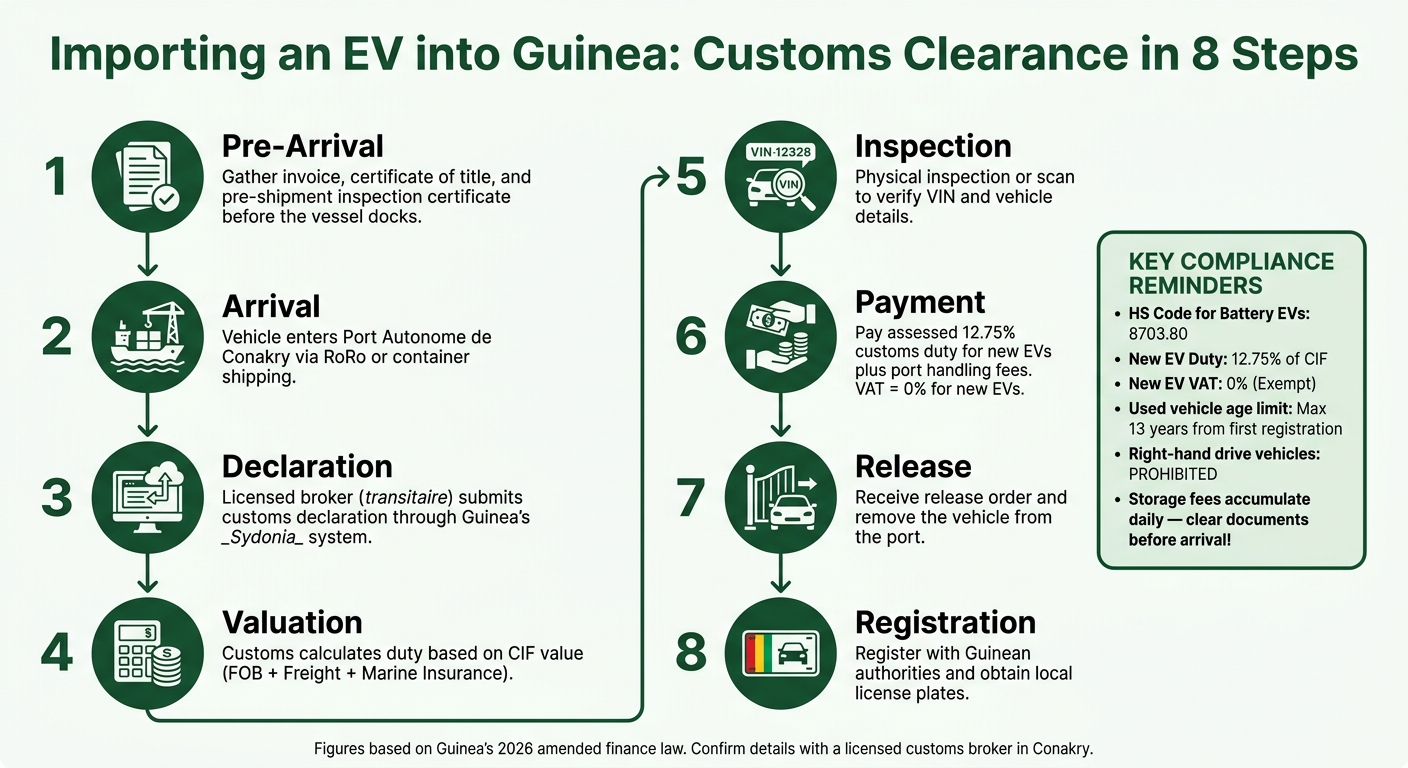
How to Import an Electric Car to Guinea in 2026: Step-by-Step Customs Process
Once the car lands in Conakry, clearance comes down to one thing: clean paperwork and the right customs classification.
Documents Needed to Import an EV into Guinea
Start with the papers Customs checks first.
Guinea Customs requires five core documents: the original purchase invoice, the certificate of title or ownership from the country of origin, a pre-shipment technical inspection certificate, the Bill of Lading (connaissement maritime), and the importer’s identification documents.
If even one document is missing, storage time can stretch out and total import costs can climb. The VIN, vehicle value, and importer name must match exactly across the invoice, Bill of Lading, and customs declaration.
Used vehicles also need a pre-shipment technical inspection certificate issued in the country of origin. And there’s a hard rule here: right-hand drive vehicles are prohibited.
Once those papers are in order, the broker can file the entry before the vessel arrives.
Customs Clearance Steps from Pre-Arrival to Port Release
Clearance moves through a set sequence.
| Step | Action | Result |
|---|---|---|
| 1. Pre-Arrival | Gather invoice, title, and inspection certificate | Documents ready before vessel docks |
| 2. Arrival | Vehicle enters Port Autonome de Conakry via RoRo or container | Port intake recorded |
| 3. Declaration | Licensed broker submits declaration through Guinea’s Sydonia system | Customs file opened |
| 4. Valuation | Customs calculates duty on CIF value | Duty amount confirmed |
| 5. Inspection | Physical inspection or scan | VIN and vehicle details verified |
| 6. Payment | Pay assessed 12.75% duty for new EVs plus port handling fees | Duty cleared |
| 7. Release | Receive the release order and remove the vehicle from the port | Vehicle exits port |
| 8. Registration | Register with Guinean authorities and obtain local license plates | Vehicle legal to drive |
A licensed customs broker (transitaire) should handle the Sydonia filing, and it’s smart to have the full document set ready well before arrival.
How to Avoid Delays, Extra Charges, and Non-Compliance
Most delays don’t come from the ship. They come from small document mistakes.
Use the reduced 12.75% duty and 0% VAT only when Customs classifies the vehicle as new. If the vehicle doesn’t meet that standard, the higher duties for used vehicles apply.
The details also need to line up perfectly. The VIN, invoice value, and importer details must match exactly across all documents.
FAQs
How does Customs decide if my EV is new or used?
In Guinea, Customs decides whether an EV is new or used based on its manufacturing date – not its model year. That detail matters because vehicles more than 13 years old can’t be imported.
At clearance, officials physically inspect the vehicle and check the VIN against your paperwork. If they classify the EV as used, you must provide a valid inspection certificate from an authorized company in the country of origin.
What extra port charges should I budget for beyond duty?
Beyond customs duties and taxes, plan for local handling fees at the Port of Conakry. In most cases, these run about $1,500–$2,500.
Customs broker charges can also change based on your paperwork and the broker you hire. If your documents are incomplete or there are issues during clearance, costs can climb.
It’s also smart to leave room in your budget for storage fees if your shipment gets held up. Getting every document ready ahead of time can help cut down on these extra charges.
Can I import a used EV into Guinea in 2026?
Yes. You can import a used electric vehicle into Guinea in 2026 if it meets the rules.
- The vehicle must be 13 years old or less, measured from its first foreign registration.
- It must be left-hand drive.
- It must pass the required technical inspection before shipping, and you’ll need a valid certificate for customs.