
 Thabo Nkosi
If I were importing an EV into Congo-Brazzaville in 2026, I’d price the taxes, shipping, and port costs before choosing the car. That’s the main point. A $20,000 to $25,000 EV can end up costing 56% to 68% more than CIF once duty, excise, VAT, and port-side charges are added. And if an EV duty/VAT exemption is not formally applied to your car, the bill climbs fast.
Here’s the short version:
- Start with landed cost, not sticker price
- Check the HS code and tax base with a licensed broker in Pointe-Noire
- Pick an EV that fits local roads and charging access
- Make sure your paperwork is complete before shipment
- Plan for home or workplace charging, because public charging is still limited
- Use left-hand drive to avoid registration trouble
A few numbers matter right away:
- Import taxes and related charges often come to about 56%–68% of CIF
- A sample $20,000 CIF EV may land around $31,200–$33,600 before port fees
- Hot weather can cut EV range by about 6% at 86°F (30°C) and 22% at 104°F (40°C)
- For rough roads, I’d look for 170 mm+ ground clearance
- Home charging usually means 230 V, 50 Hz, with a portable charger or a 7.4 kW wallbox
What I’d check first before buying:
- Total budget: car + freight + insurance + taxes + broker + port + registration
- Charging plug type: CCS2, Type 2, or GB/T
- Battery health on a used EV: SOH report, charging history, scan report
- Shipping file: invoice, title, bill of lading, certificate of origin, and BESC/ECTN
- Road fit: range, clearance, tire strength, and parts supply
This guide is about one simple idea: buy the EV that you can clear, charge, register, and use without cost surprises.
1. Understand import rules, taxes, and your total budget before you buy
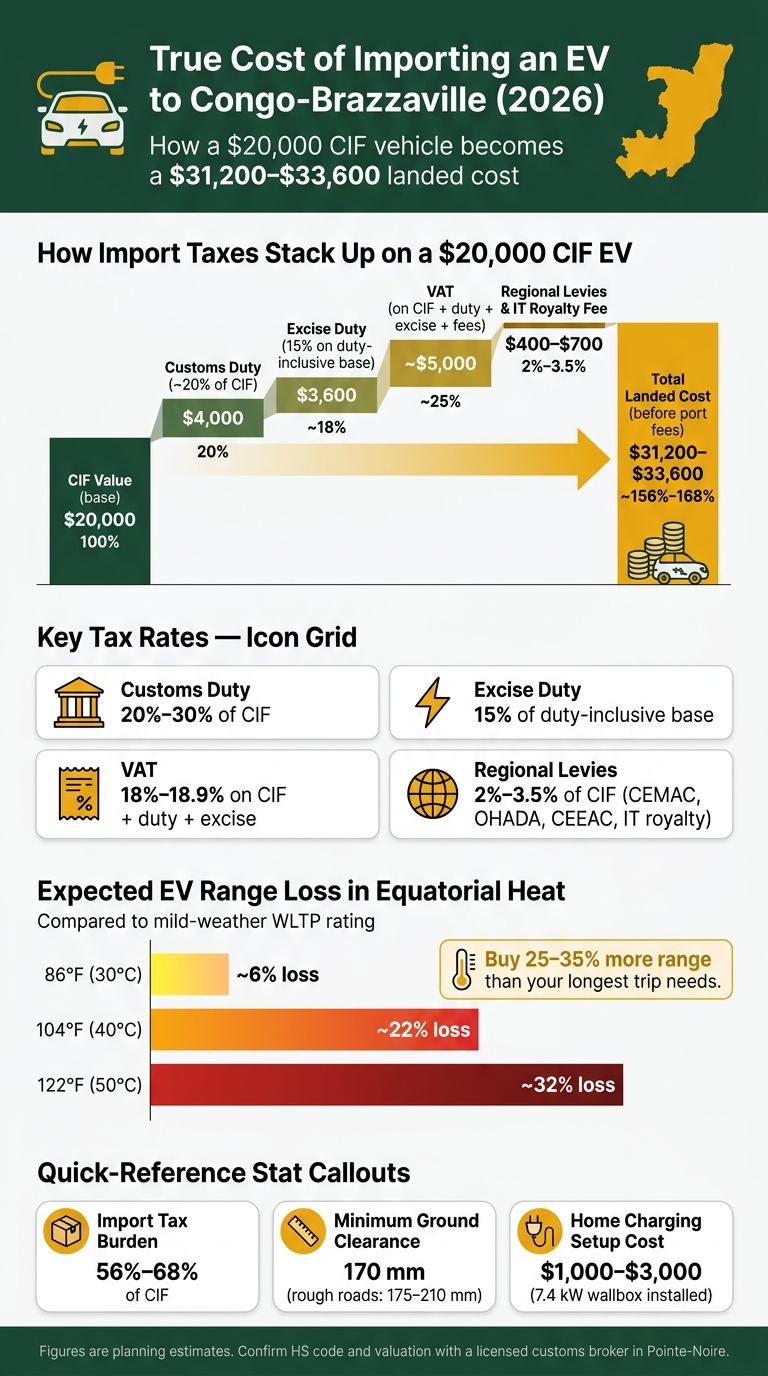
True Cost of Importing an Electric Car to Republic of the Congo (2026)
Before you buy anything, check the HS code and tax base for your exact EV with a licensed customs broker in Pointe-Noire. That step matters more than most buyers expect.
The Republic of the Congo follows CEMAC customs rules, and your EV’s HS code shapes the duty rate and much of the import bill. Passenger EVs are usually taxed as finished vehicles. So don’t bank on any EV tax break unless customs gives it to you in writing. Once you have the tax base, use it to set the highest CIF you can afford before you start comparing models.
Customs duty, VAT, and other vehicle charges explained
Import taxes start with CIF: the vehicle price, freight, and marine insurance.
For a typical imported EV, the total import-related taxes and charges often land at about 56% to 68% of CIF. The main parts of that bill usually include:
- customs duty, often 20% to 30% of CIF for passenger vehicles
- excise duty of 15% on motor vehicles
- VAT of about 18% to 18.9% on a base that includes CIF, duty, excise, and fees
- smaller levies such as the CEMAC integration tax, statistical charges, OHADA and CEEAC contributions, and the IT royalty fee
Here’s the catch: excise and VAT are charged on top of earlier taxes. So the final amount is much higher than a simple add-up of the posted rates.
Use that formula before you commit to a purchase. And before you ship, confirm the exact HS code and valuation method with a licensed customs broker in Pointe-Noire. That matters even more for a used EV, because customs may use a market-based value instead of your invoice price.
Sample landed-cost table for an imported EV
The table below uses a sample EV with a CIF value of $20,000. It shows how the charges stack up and push the landed cost higher. These figures are for planning only, but they give you a solid ceiling for the next step.
| Cost Element | How It’s Calculated | Indicative Share of CIF | Est. Amount (USD) |
|---|---|---|---|
| CIF Value | Vehicle price + freight + marine insurance | 100% (base) | $20,000 |
| Customs Duty | About 20% of CIF for finished goods | 20% | $4,000 |
| Excise Duty | 15% of the base that includes duty | ~18% | $3,600 |
| VAT | Applied to CIF + duty + excise + fees | ~25% | ~$5,000 |
| Regional Levies and IT Royalty Fee | CEMAC, statistics, OHADA, CEEAC, and IT royalty charges | ~2%–3.5% | $400–$700 |
| Estimated landed cost before port fees | CIF + taxes and charges | ~156%–168% | $31,200–$33,600 |
These are planning ranges, not exact invoice figures. If customs places your EV in a higher duty band, or if they use a market-based value for a used car, your final bill will go up.
A simple budgeting rule is to multiply CIF by 0.56 to 0.68 to estimate the import-related tax burden. Then add a separate amount for port handling, broker fees, storage, inspection, and inland transport.
With that budget locked in, the next step is picking an EV that fits Congo-Brazzaville roads and the local charging situation.
sbb-itb-99e19e3
2. Choose an EV that suits Congolese roads, charging access, and your budget
Pick a model that matches how you’ll actually drive. That could mean short city trips in Brazzaville or Pointe-Noire, or regular travel beyond the main paved routes.
What to look for: range, ground clearance, battery health, and charging type
Do not rely on WLTP range alone. On paper, the number can look great. On hot roads in an equatorial climate, it often tells only part of the story.
A hot-climate case study found range losses of about 6% at 86°F (30°C), 22% at 104°F (40°C), and 32% at 122°F (50°C) compared with mild conditions. Then pile on air conditioning, cargo, traffic, rough roads, and battery age, and the gap gets even bigger. A smart rule is to buy an EV with 25%–35% more range than your longest normal trip needs. So a car rated for 200 miles may give you only 130–160 miles in day-to-day use, depending on conditions.
Ground clearance matters too. A hatchback or sedan makes sense for paved city driving. But if you deal with potholes, rough roads, speed bumps, or flooding, a crossover or small SUV is the safer bet. Aim for at least 170 mm of ground clearance, and 175–210 mm is a better fit.
If you’re buying a used EV, don’t just look at the bodywork and mileage. Ask for:
- A battery state-of-health (SOH) report
- The car’s charging history
- A diagnostic scan showing pack errors or module imbalance
If the seller can’t provide the SOH report, or the car has a history of frequent rapid charging, treat that as a warning sign. Battery replacement can be the most expensive repair on an EV. It also helps to check parts support before you buy. Tires, suspension parts, 12V batteries, cabin filters, and brake parts should be easy to find.
Charging setup is another big piece of the puzzle. Public EV charging in Congo-Brazzaville is still very limited and is centered mainly in Brazzaville, often through hotel-linked or private sites. In plain terms, home or workplace AC charging will usually do most of the work. Make sure the car comes with its original portable charging cable, works with your household voltage, and that your home has proper grounding and breaker capacity. It’s usually smarter to choose a model that charges well overnight on AC and avoid one that leans too heavily on DC fast charging.
For DC charging standards, CCS2 is the main option for European and African-market vehicles. Chinese-market models often use GB/T. Check charger and adapter fit before shipping. It’s a small detail that can become a big headache later.
EV comparison table for Congo-Brazzaville buyers
The table below covers examples often discussed for African import markets, from low-cost city cars to more capable crossovers and SUVs.
| Model | Approx. WLTP Range | Ground Clearance | Charging Type | Best Use Case in Congo |
|---|---|---|---|---|
| Wuling Hongguang Mini | 120–170 km | ~125 mm | Type 2 / GB/T | Budget city driving in Pointe-Noire |
| Leapmotor T03 | 280–400 km | ~140 mm | Type 2 / GB/T | Daily commuting in Brazzaville |
| BYD Atto 3 | 420 km | 175 mm | Type 2 / CCS2 | Mixed urban and suburban roads |
| Volkswagen ID.4 | 500+ km | 210 mm | Type 2 / CCS2 | Rougher roads and inter-city travel |
| Tesla Model Y | 455–533 km | 167 mm | Tesla / CCS2 | Premium urban use and long-range trips |
When you compare models, look past the sticker price. Focus on usable range, ground clearance, charging fit, repairability, cargo space, and the total landed cost.
For a buyer who stays in the city, charges at home, and rarely leaves Brazzaville, a lower-cost EV like the Wuling Hongguang Mini, Leapmotor T03, or a used Nissan Leaf can keep costs down and make parking easier. If you travel between cities or spend time on unpaved roads, the BYD Atto 3, Volkswagen ID.4, or Tesla Model Y give you the extra clearance and range buffer that can make the higher purchase price worth it.
Once you choose the EV, gather the documents needed to ship it to Pointe-Noire.
3. Gather your documents and ship the EV to Pointe-Noire
Once you’ve picked your EV, the next step is to build the import file and book shipment to Pointe-Noire. This part matters more than many buyers think. If the paperwork is wrong before the vehicle leaves the origin port, you can end up paying extra for delays and port storage when it arrives.
Required documents and pre-shipment checks
Your customs broker will need a basic file to clear the vehicle. At a minimum, you should have:
- Commercial invoice or purchase contract
- Original title or registration from the exporting country
- Bill of lading
- Export declaration, if the origin country requires it
- Passport or company registration
- Broker authorization
For Congo, you also need the BESC/ECTN cargo tracking note before departure. If it’s missing, clearance at Pointe-Noire can stop cold.
Most clearance problems come from simple document errors. A VIN doesn’t match. The buyer name is slightly different. The model year is off. The declared value isn’t the same across the file. Those small mistakes can turn into a headache fast, so check every document before loading.
For an EV, add a few extra items to the file: battery-condition records, an accessory list, pre-loading photos, and proof of about 30% state of charge if the carrier asks for it.
Once the file is ready, you need to choose how the EV will move to Pointe-Noire.
RoRo vs. container shipping and the Pointe-Noire process flow
RoRo (roll-on/roll-off) means the car is driven onto the vessel and driven off at the destination. It’s simpler, usually cheaper, and often a good fit for a standard used EV when keeping cost down is the main goal. The downside is less protection during handling and from weather. You also can’t load accessories or spare parts inside the vehicle.
Container shipping places the vehicle inside a sealed metal container. It costs more, but it offers better protection and gives you room to ship charging gear, spare parts, or other items with the car. RoRo may qualify for Special Provision 961 if the battery is intact. Container shipping usually calls for Class 9 dangerous-goods (DG) documentation. If you’re moving a high-value EV or sending accessories with it, container shipping is often the safer pick. If it’s a plain used EV shipment, RoRo is often enough.
Here’s how the process usually moves from booking to customs handoff:
| Step | Who Handles It | Key Documents / Actions |
|---|---|---|
| 1. Sourcing & booking | Buyer / freight forwarder | Proforma invoice, VIN verification, RoRo vs. container decision |
| 2. Pre-shipment inspection | Authorized inspection agency | Inspection certificate, battery condition report |
| 3. Export clearance | Seller / shipper | Export declaration, original title |
| 4. BESC/ECTN issuance | Buyer / agent | Cargo tracking note tied to bill of lading – must be done before loading |
| 5. Sea transit | Shipping line | Bill of lading, DG declaration if container |
| 6. Arrival at Pointe-Noire | Port authority | Arrival notice, manifest submission, port handling fees |
| 7. Broker submission | Buyer / broker | Full document file: invoice, title, bill of lading, BESC/ECTN, packing list, insurance if purchased |
After the shipment arrives, that same file becomes the base for customs clearance. Send the full set to your broker as soon as the bill of lading and arrival notice are issued. An early review can cut clearance time and help you avoid extra port storage charges. From there, customs clearance and tax payment can start.
4. Clear customs, pay taxes, and register the EV for road use
Once the EV reaches Pointe-Noire, customs clearance is the next step. At that point, your broker files the entry using the document set from Section 3. Customs reviews the HS code, CIF value, and the vehicle’s condition, then issues the duty notice. You pay that amount at an approved bank or payment office, and the broker handles gate-out before storage charges start piling up. In some cases, customs may also order a physical inspection to confirm the VIN, model, or declared condition.
Most clearances take anywhere from a few days to two weeks. When things get stuck, the usual causes are pretty simple: missing papers, mismatched details across documents, valuation disputes, wrong tariff classification, or slow payment. If you want to avoid extra port storage costs, send the full document file to your broker before the vessel arrives.
Customs clearance at Pointe-Noire and a sample tax calculation
Before you buy, confirm that the 100% EV duty and VAT exemption has been officially published and applies to your VIN. If that exemption is formally gazetted, the landed-cost picture changes a lot, as shown below.
| Cost Component | Standard Scenario | With EV Exemption Scenario |
|---|---|---|
| CIF value | $18,000 | $18,000 |
| Customs duty | Depends on CET band | $0 if the exemption applies |
| VAT | Assessed on CIF plus duty | $0 if the exemption applies |
| IT/computerization fee | 2% of CIF | 2% of CIF |
| Regional levies, broker fees, port handling, and storage | Variable | Variable |
| Estimated landed cost | Higher once taxes and fees are added | Lower if the exemption is formally in force |
Registration, left-hand-drive compliance, and annual ownership costs
After customs releases the EV, registration should begin right away at the DTT. You’ll register the vehicle with the Direction des Transports Terrestres (DTT). The file usually includes the quitus douanier, title, ID, inspection certificate, and local insurance.
Before plates are issued, the EV must pass the visite technique d’admission. Inspectors check the basics like brakes, lights, steering, and tires, but they also look at EV-specific items such as high-voltage damage and charger safety. That extra step matters. An EV can look fine on the outside and still have issues where it counts.
Because the Republic of the Congo drives on the right, imported EVs should be left-hand drive. A right-hand-drive car can run into registration trouble and may also cost more to insure.
Once the vehicle passes inspection, you submit the full dossier to the DTT, pay the registration fees, and receive the carte grise and license plates. Local motor vehicle insurance is required before the car can legally use public roads. Private cars up to 4 years old are inspected every 2 years after admission. Older vehicles are inspected annually.
5. Get the EV road-ready: charging, maintenance, insurance, and final checks
Once customs and registration are done, the last step is simple: make the EV fit daily life.
Set up charging and protect long-term battery health
In the Republic of the Congo, public charging is still too limited to count on day to day. That means home or workplace charging needs to carry most of the load.
The country uses 230 V, 50 Hz power, along with Type C and Type E/F outlets. Before you buy any charging gear, check that your EV’s connector matches local equipment and that the onboard charger can handle 230 V, 50 Hz. It’s also smart to have a qualified local electrician inspect the setup before the car arrives. Ask them to verify grounding, breaker capacity, RCD protection, and surge suppression.
For shorter daily use, this can be pretty straightforward. If you usually drive under 30–40 miles (50–65 km) per day, a good portable charger on a 230 V circuit can add about 8–12 miles of range per hour, which is usually enough overnight. If your driving needs are heavier, or you want the car ready again sooner, a dedicated 7.4 kW wallbox can add around 10–20 miles of range per hour. Plan on about $1,000–$3,000 for the hardware and installation.
Once charging is sorted out, battery care becomes the next job.
A few habits go a long way. Try to keep daily charging between 20% and 80%, set charging to finish close to departure instead of letting the car sit full for hours, and save DC fast charging for road trips or urgent situations. Heat is hard on battery packs too, so parking in shade or in a covered garage helps over time.
Charging is only part of road readiness. The car also has to deal with the road itself.
Rough surfaces can be hard on EVs, especially on tires and the underside. Use stronger-sidewall tires with a higher load index to cut down the risk of cuts and bulges. Add underbody protection plates over the battery casing and low-hanging suspension parts before the vehicle touches any unpaved road. Keep a spare tire rated for the EV’s weight, a compatible jack, and a basic tool kit in the car.
It also pays to set up maintenance early, not after something goes wrong. Find at least one local mechanic for non-high-voltage jobs like brakes, suspension, and alignment. For battery or inverter work, arrange certified high-voltage service outside Congo. Before shipment, order key wear items such as brake pads, wiper blades, a 12V battery, and coolant hoses.
Final checklist before you commit to the purchase
Before you send money or sign a shipping contract, check these six areas:
| Checklist Area | Key Action |
|---|---|
| Import eligibility | LHD, vehicle age, title, invoice, export paperwork |
| Full landed cost | Vehicle price + shipping + port fees + taxes + registration + installation, plus a contingency buffer |
| Charging compatibility | Connector type and voltage (230 V, 50 Hz) |
| Vehicle suitability | Ground clearance, tire type, battery health, range |
| Insurance coverage | Marine cargo insurance for transit; local coverage that includes the battery and electronics |
| Service and parts | Service access in Congo and neighboring countries; spare-parts kit ordered before shipment |
FAQs
How much cash should I budget beyond the car price?
Beyond the car’s purchase price, set aside money for shipping, marine insurance, port or terminal fees, customs duties and taxes, and customs broker or clearing agent fees. There’s also one cost that can sneak up on people: demurrage. If the vehicle sits at the port after the free storage window ends, those charges can add up fast.
Once the car arrives, the spending doesn’t stop. You’ll still need to plan for registration, administrative fees, inland transport, home charging equipment ($800 to $1,500), and possible spare-parts or specialized maintenance costs.
What kind of EV is safest to import for Congo roads?
For roads in the Congo, the safest and most practical EVs are usually crossovers or SUVs, like the Tesla Model Y or BYD Atto 3. They sit higher off the ground, which helps on uneven roads and the potholes drivers deal with all the time.
Focus on models with sturdy suspension, a durable battery that can handle tropical heat, left-hand drive for local registration, and a real-world range of 180 to 250 miles.
What can delay customs clearance at Pointe-Noire?
Customs clearance at Pointe-Noire usually gets held up for one main reason: paperwork problems.
The most common issues are mismatched VINs, conflicting model years, or gaps between the shipping documents and the vehicle’s declared value. Even a small mismatch can slow things down.
Missing documents can stop the process too. The biggest trouble spots are:
- MSDS for lithium-ion batteries
- CTN/BSC
- CNCA/ARCCLA
When these items are missing or don’t match, clearance can stall and storage fees can start adding up.