
 Thabo Nkosi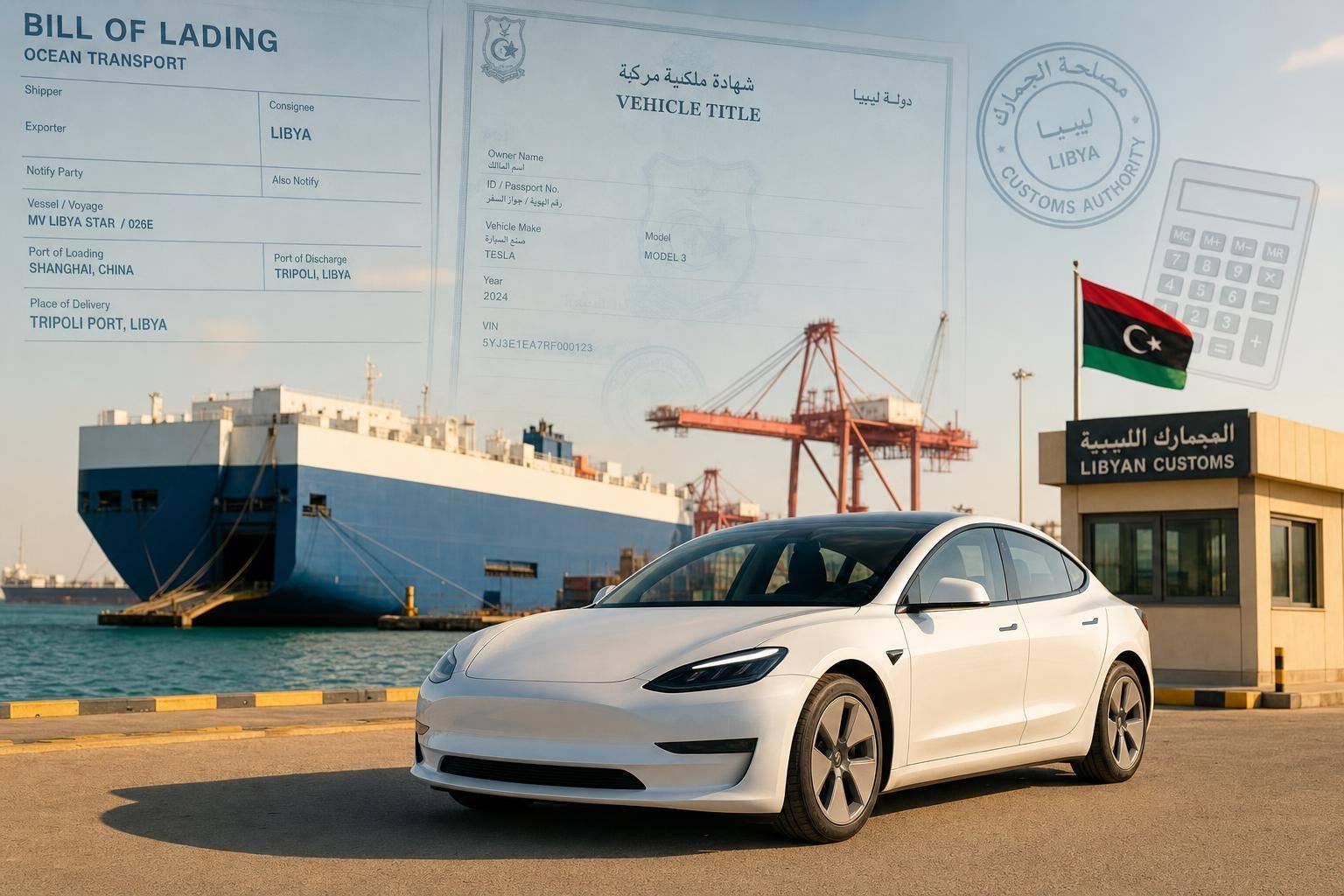
If your car is a qualifying 100% battery-electric vehicle, Libya currently gives it 0% customs duty and 0% internal consumption tax through February 9, 2031. That can cut thousands of dollars from your import bill. But you still need the right car, matching documents, shipping papers, customs clearance, and local registration.
Here’s the short version:
- Battery-electric cars can get tax-free import treatment in Libya if they qualify.
- Hybrids and plug-in hybrids should not be treated as full EVs for this rule.
- Left-hand drive is the safe choice. Right-hand-drive cars can run into customs trouble.
- Used-car age rules still matter, so I would check them before buying.
- You’ll still pay shipping, insurance, port fees, broker fees, and registration costs.
- Customs clearance often takes about 7 to 10 days if the file is clean.
- Ocean freight can range from about $1,300 to $1,600 by RoRo on some routes, while containers can cost more.
- Port handling and local clearance charges can still add $1,500 to $2,500, even when duty is 0%.
- A small EV may land around $16,000+ total, while a higher-value model can go past $30,000 after freight and local fees.
What I’d check first is simple: Is the car a 100% EV, left-hand drive, within Libya’s age rules, and backed by clean paperwork? If the answer is yes, the process is mostly about keeping every document aligned from purchase to port release.
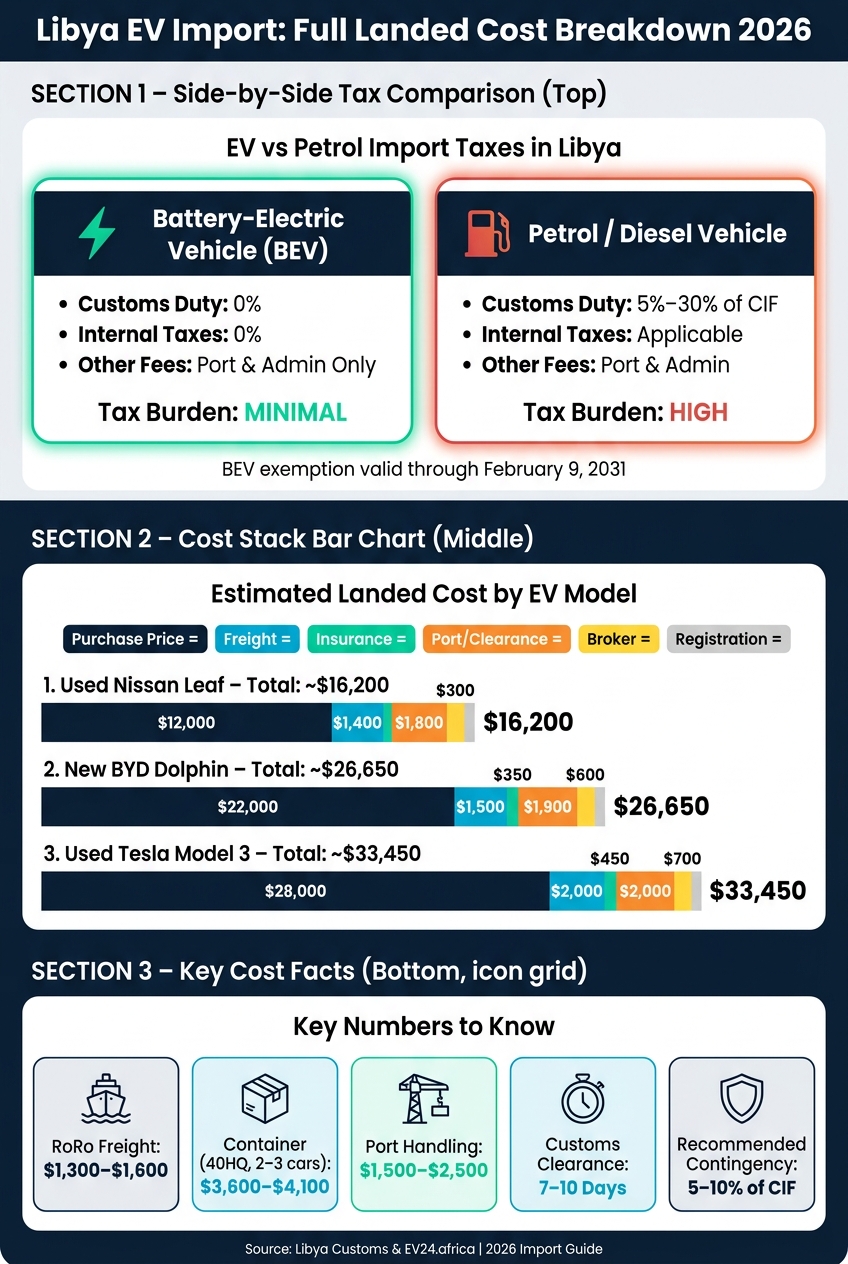
Libya EV Import Cost Breakdown 2026: BEV vs Petrol & Model Scenarios
Quick comparison
| What to check | What it means for you |
|---|---|
| Vehicle type | Must be 100% battery-electric to seek the tax break |
| Customs duty | 0% for qualifying BEVs |
| Internal tax | 0% for qualifying BEVs |
| Drive side | Left-hand drive is the safer route |
| Used vehicle rules | Age and condition limits may apply |
| Main documents | Title, invoice, bill of lading, certificate of origin, permit, EV battery papers |
| Arrival costs | Port fees, broker fees, storage risk, registration |
| Timing | About 7–10 days for customs if papers match |
Bottom line: I’d budget from the full landed cost, not the car price. Even with the 2026 EV tax waiver, your final number still depends on freight, port charges, paperwork, and whether customs accepts the file without delays.
sbb-itb-99e19e3
1. Check Whether Your Electric Car Can Be Imported Into Libya
Before you pay or book shipping, make sure the car can clear Libyan customs. The safest option is a 100% electric, left-hand-drive, roadworthy car with paperwork that matches from start to finish.
Vehicle eligibility rules for private and commercial imports
Libya applies age limits to used passenger cars, and the cutoff can change by vehicle type and port. Check that rule before you buy. New EVs are usually easier to process. Used EVs still have to meet Libya’s current age and condition rules.
The car also needs to be left-hand drive. Right-hand-drive vehicles can get stuck at customs.
Age is only part of the picture. Condition matters just as much. The vehicle should be roadworthy and have a clean ownership record. It’s smart to avoid salvage cars, flood-damaged vehicles, or heavily modified units unless a local customs broker has already signed off on them. With EVs, flood damage is a major red flag because it can affect the battery pack and high-voltage systems. Before you commit, get a full vehicle history report and check that the VIN on the car matches the title, invoice, and shipping papers.
Some guidance also says Libyan citizens and residents can import one personal-use vehicle every three years, with payment made through the banking system. If you’re importing as a returning Libyan citizen, look into whether a separate relocation rule applies. Some rules use a 5-year age cap and a 10% duty on the customs-assessed value.
Eligibility comes first. Documents come right after that.
How EVs are classified under Libya’s customs rules
Libya treats battery-electric vehicles as their own customs category. That means your paperwork should clearly state that the car is a 100% electric vehicle, not a hybrid or plug-in hybrid.
When working with a customs broker, send over the spec sheet, VIN, battery details, and gross weight. Ask them to confirm the correct HS code and check whether any exemption applies before the vehicle ships.
Importer status: citizens, residents, and temporary imports
Your importer status can change the duty treatment, deposit rules, and clearance steps. Put simply, who you are on paper affects both the documents you need and the fees you may face.
- Private buyers usually need standard ID, ownership records, shipping documents, and proof that the car meets Libya’s import rules.
- Companies need business registration papers, a tax ID, and a commercial invoice. They should also keep a full paper trail, since commercial imports may be audited.
- Foreign workers and other temporary importers may be allowed to bring in a vehicle on a temporary basis, but this often means a refundable deposit or other guarantee. The vehicle must leave the country when the temporary period ends. These cases can change whether the car is taxed, held against a deposit, or sent back out of the country.
- Diplomats may qualify for duty exemptions under diplomatic exemption, but approval and the right exemption paperwork are still required.
Once eligibility is confirmed, move straight to the documents. A mismatch in the paperwork can stop clearance fast.
2. Gather the Required Documents Before Shipping
Get your identity, ownership, sales, and shipping papers ready before the car leaves the export port. Once the vehicle qualifies, every document needs to show the same VIN, buyer name, and EV status. If one detail is off, customs can hold the shipment.
Core ownership and shipping documents
Start with a valid passport and, if needed, your Libyan national ID and residency papers. Customs uses these to confirm who the importer is.
You’ll also need the original title or registration from the exporting country. It should show the VIN, owner name, make, model, and model year. If there’s a lien on the car, clear it before shipping.
The commercial invoice should be detailed. Include the buyer, seller, sale date, price, currency, and any separate charges for accessories or a charger. Keep the sales contract in the same file.
Add a packing list that describes the vehicle by VIN, make, and model, along with any accessories or loose parts included in the shipment.
You also need a certificate of origin certified by the exporting-country chamber of commerce and legalized by the Libyan embassy before shipment. Then get the original bill of lading showing the shipper, consignee, VIN, weight, ports, and ACI/ECTN number.
EV-specific and Libya-specific approvals
Ask the manufacturer or dealer for the battery MSDS/SDS. You should also confirm whether the carrier wants a UN 38.3 test summary or a statement saying the vehicle is a BEV.
After the battery papers are ready, line up the Libyan import permit and pre-arrival filing. Get the Ministry of Economy import permit before shipment. The VIN, declared value, and HS code should match the commercial invoice, and the ACI/ECTN must be filed before departure.
How to check document accuracy before the car ships
A single mismatch can stop clearance. Before the car is loaded, compare these details across the full document set.
| Detail to Check | Where It Must Match |
|---|---|
| VIN | Title or registration, invoice, packing list, bill of lading, certificate of origin, manufacturer letter |
| Buyer/consignee name | Invoice, bill of lading, customs declaration, passport or ID |
| EV classification | Invoice, packing list, bill of lading – must clearly identify the car as battery-electric |
| Invoice value and currency | Invoice, customs declaration, and any pre-arrival filing – freight and insurance should be accounted for |
Send this checklist to your customs broker before loading. And be precise with the vehicle type: mark the car as 100% electric on every document. If it’s labeled as a hybrid, that can block EV treatment.
3. Ship the Car and Clear It Through Libyan Customs
With the paperwork done, the next part is pretty simple on paper: ship the car, clear customs, and register it for road use.
Choose a shipping method and port of entry
Pick the route that gives you the right mix of price, protection, and port dependability. RoRo is usually the lower-cost option. Container shipping costs more, but it gives the car better protection from rough handling, theft, and salt corrosion. That choice affects both transit risk and your total landed cost.
For EVs, the battery should be shipped at a reduced state of charge. Carriers often ask for about 30% to 50% charge, and some want just enough power to drive the car on and off the vessel while still staying under the allowed limit. Check the exact rule with your carrier before loading.
Tripoli is the main port for EV imports. Misurata, Al-Khums, and Benghazi are also used, and Benghazi is often the easier option for buyers in eastern Libya. In practice, it makes sense to use the port your forwarder handles most dependably, then add inland trucking costs to wherever the car needs to go.
Customs clearance steps at the Libyan port
After the vehicle arrives, customs clearance usually takes 7 to 10 days if the documents are complete and match each other. The process usually moves through five steps:
- Filing confirmation
- Inspection
- Valuation
- Payment
- Release
Customs checks the VIN, verifies the filing, assigns the CIF value, and releases the vehicle after payment. Fully electric vehicles are currently exempt from customs duty and internal consumption tax. That said, port handling charges still apply. At some ports, a port service tax of about 4% of CIF value may also apply.
Once payment is done, customs issues a release note that lets the vehicle leave the port yard. Keep several certified copies on hand. You may need them again during registration and inspection.
Registration and on-road steps after port release
Once customs releases the car, registration is the last legal step before you can drive it on public roads.
After collecting the vehicle, submit the customs release note and the rest of the required registration documents to the traffic authority. Proof of insurance is also part of the process.
When registration is approved, you should receive a registration book, license plates, and a road sticker. All three are required before the vehicle can be driven legally in Libya. If the car arrives on foreign plates, temporary customs plates may be issued while you finish the full registration process. It’s smart to handle registration right after port release so you don’t run into penalties or extra delays.
4. Calculate the Full Landed Cost in Libya
Once the car is cleared and registered, it’s time to add up every cash cost before you buy. Your landed cost is the full amount to buy, ship, clear, and register the car in Libya.
For qualifying battery-electric vehicles, Libya currently exempts customs duty and internal taxes. That strips out the biggest tax item from the budget. What remains are the shipping, port, clearance, and registration costs that can still move your total more than you might expect.
Cost breakdown: from purchase price to port release
A practical budget usually moves through three stages: FOB, CIF, and then landed cost.
- FOB (Free on Board) = vehicle price plus loading at the export port
- CIF (Cost, Insurance, and Freight) = FOB + ocean freight + marine insurance
- Landed cost = CIF + customs duty + taxes + port charges + broker fees + storage or demurrage + inland delivery from the Libyan port + registration and roadworthiness costs
| Cost Item | Estimated Amount | Share of Total |
|---|---|---|
| Vehicle purchase price | Varies by model | 70% – 85% |
| Inland transport to export port | Varies by origin | Varies |
| Ocean freight (RoRo or container) | $1,313 – $1,563 per car by RoRo to Misrata; $3,600 – $4,100 for a 40HQ container with 2–3 cars | 8% – 15% |
| Marine insurance | Varies by quote | 1% – 2% |
| Import duty + internal taxes (BEVs) | 0% | 0% |
| Port handling, service charges, and clearance | About 2,000 LYD in one fee example; local charges can run about $1,500 – $2,500 | 2% – 4% |
| Customs broker / clearing agent | Varies by broker | 1% – 2% |
| Registration, plates, and roadworthiness | Varies by locality | 1% – 2% |
It also makes sense to build in a 5% to 10% contingency on your CIF value. That buffer helps cover demurrage, extra inspections, or document re-processing. Flat port fees can hit lower-priced EVs harder, so don’t look only at the sticker price. Use CIF as the base in your spreadsheet, even when duty is zero, because some port charges may still depend on the vehicle’s size or value.
How duties and taxes differ for EVs versus fuel cars
This is where EVs can look much cheaper on paper. BEVs pay 0% duty and internal taxes, while fuel cars do not. For petrol and diesel vehicles, published estimates vary a lot. Some sources put duty at about 5% of CIF for standard passenger cars and about 10% for SUVs and 4WDs. Other commercial guides give much broader ranges, such as 10% – 25% or 20% – 30%, depending on the vehicle and how customs classifies it.
| Vehicle Type | Customs Duty | VAT / Internal Taxes | Other Fees | Indicative Tax Burden |
|---|---|---|---|---|
| Battery-electric (BEV) | 0% (exempt) | 0% (exempt) | Port and admin fees | Minimal |
| Petrol / diesel | Varies by classification; published estimates range from about 5% to 30% of CIF | Applicable internal taxes | Port and admin fees | High |
Even with the EV exemption, you’re not off the hook for port service fees and clearance costs. One sample fee example shows a 4% port services tax on a 50,000 LYD base, plus about 2,000 LYD for port handling and clearance.
Example landed-cost scenarios for specific EV models
These examples show how the same fee stack changes as vehicle value changes. The figures are illustrative and assume the vehicle is compliant, customs clears it without trouble, and there are no storage delays. Before you buy, swap in your own freight and broker quotes.
Used Nissan Leaf (approx. $12,000 purchase price)
| Item | Estimated Cost |
|---|---|
| Purchase price | $12,000 |
| Ocean freight (RoRo) | $1,400 |
| Marine insurance | $200 |
| Port handling and clearance | $1,800 |
| Customs broker | $500 |
| Registration and plates | $300 |
| Estimated landed cost | ~$16,200 |
Used Tesla Model 3 (approx. $28,000 purchase price)
| Item | Estimated Cost |
|---|---|
| Purchase price | $28,000 |
| Ocean freight (container) | $2,000 |
| Marine insurance | $450 |
| Port handling and clearance | $2,000 |
| Customs broker | $700 |
| Registration and plates | $300 |
| Estimated landed cost | ~$33,450 |
New BYD Dolphin (approx. $22,000 purchase price)
| Item | Estimated Cost |
|---|---|
| Purchase price | $22,000 |
| Ocean freight (RoRo) | $1,500 |
| Marine insurance | $350 |
| Port handling and clearance | $1,900 |
| Customs broker | $600 |
| Registration and plates | $300 |
| Estimated landed cost | ~$26,650 |
A small jump in freight, a few extra days of demurrage, or a different customs reading can change your total by a lot. That’s why written quotes matter. Get one from the freight forwarder and one from the customs broker before you commit to the purchase.
5. Use EV24.africa to Find an EV That Meets Libya’s Import Rules
Once you’ve set your budget, use EV24.africa to build a shortlist of EVs that already line up with Libya’s import rules. The platform lists more than 200 EV models from dozens of manufacturers across different body styles and price points, with supply coming from China, Europe, North America, and Japan.
Filter for vehicles that are easier to import
Start with the filters that matter most for Libya. Look for left-hand-drive, 100% battery-electric vehicles, and listings with clean paperwork. EV24.africa also includes models picked with African road and climate conditions in mind, which makes it easier to narrow your options without wasting time on cars that may be a poor fit.
From there, compare listings by:
- Price
- Model year
- Certification
Then request a shipping quote for the vehicles that make your short list.
Use listed pricing to plan your import budget
Each listing shows a vehicle price you can use as the starting point for your own landed-cost math. For example, listed vehicles include a Leapmotor T03 from around $12,000, a BYD Atto 3 (2025) at about $47,500, and a Dongfeng eπ 008 EV at about $28,700.
You can also request a shipping quote through the platform and choose between Delivered Duty Paid (DDP) and Free on Board (FOB), depending on how much of the shipping process you want to handle yourself. That makes it easier to see, early on, whether the deal works on paper before you move ahead.
Conclusion: Confirm Rules, Documents, and Total Cost Before You Import
Before you buy, confirm that the EV is 100% battery-electric, matches Libya’s model-year and vehicle-condition rules, and still fits your full landed-cost budget.
FAQs
Do used EV age limits vary by port in Libya?
No. Libya’s used vehicle age limit is a national policy, so it stays the same no matter which port you use.
All imported vehicles must meet the same 10-year maximum age limit from the date of manufacture to qualify for import.
Can a right-hand-drive EV clear Libyan customs?
The available information does not clearly confirm whether a right-hand-drive EV can clear Libyan customs.
Current guidance covers import permits and compliance standards, but it does not spell out rules on drive-side setup. Check this with the Libyan Ministry of Economy or a local customs office before you buy.
What fees still apply if EV duty is 0%?
Even when customs duty is 0%, you still need to pay a 5% service fee and a 0.5% tax based on the total Cost, Insurance, and Freight (CIF) value.
That’s not all. You should also set aside money for customs brokerage fees, possible bank charges for international wire transfers and currency conversion, plus shipping and insurance costs.