
 Thabo Nkosi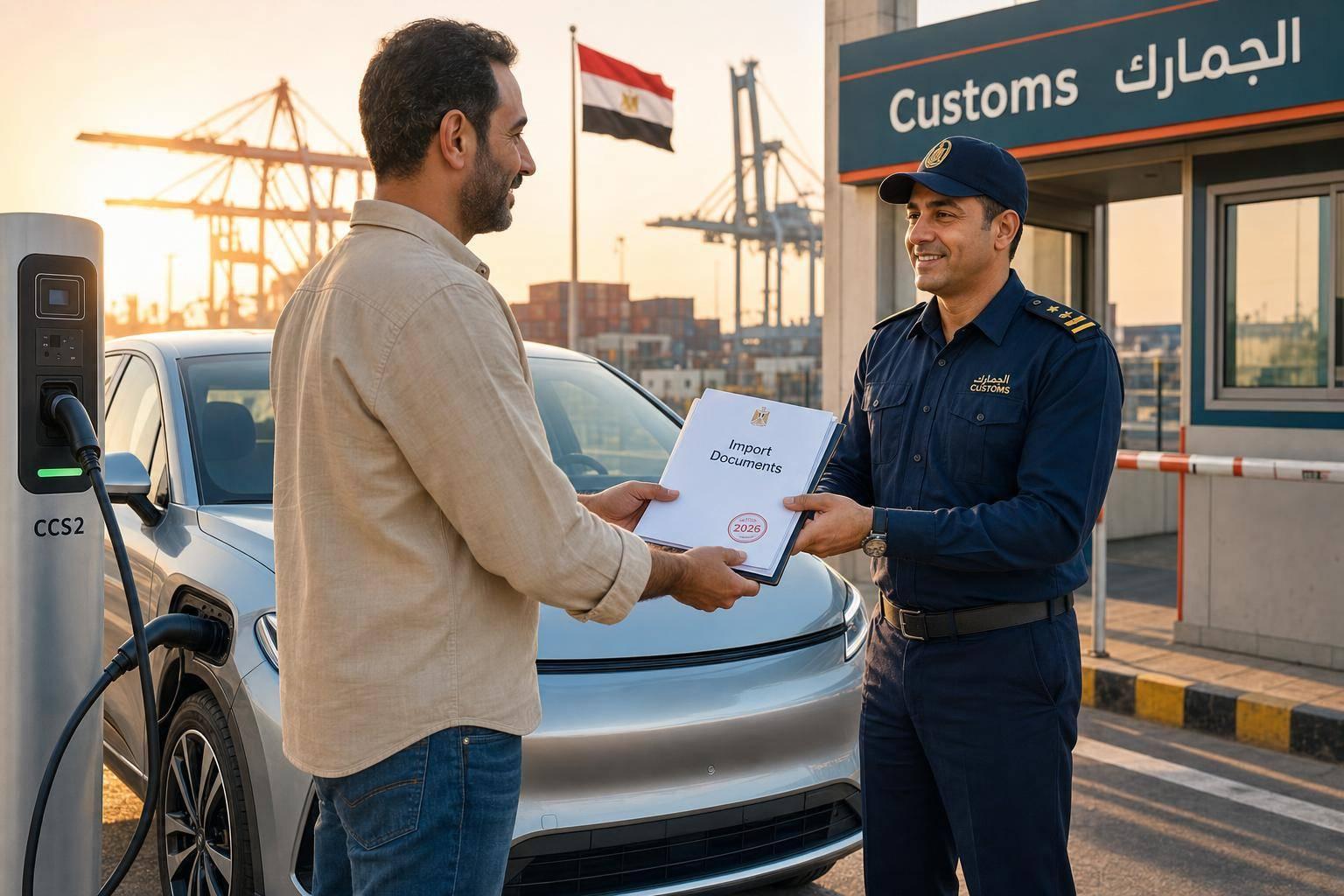
If I import a pure electric car to Egypt in 2026, I may pay 0% customs duty and 0% VAT – but only if the car is a true BEV and the paperwork matches exactly.
Here’s the short version: I need to confirm the car is a 100% battery-electric vehicle, check that it meets CCS2 charging rules, budget for shipping, port, broker, inspection, plates, and insurance, and make sure the VIN, model year, importer name, and value match across all documents.
Before I ship, I should check:
- Vehicle type: BEVs get the tax break; PHEVs do not
- Charging port: Egypt requires CCS2 compatibility
- Paperwork: Any mismatch can delay release
- Extra costs: Duty may be 0%, but port and registration fees still apply
- Used EVs: Allowed, but document checks are strict
A few numbers stand out:
- BEV customs duty: 0%
- BEV VAT: 0%
- GB/T-to-CCS2 fix: about $1,500
- ICE vehicle customs duty: up to 65%
- Example BEV price: BYD Dolphin at about $17,600
Quick comparison
| Vehicle type | Customs duty | VAT | Main point |
|---|---|---|---|
| BEV | 0% | 0% | Lowest tax cost if it qualifies |
| PHEV / Hybrid | Reduced or progressive | Applies | Not treated like a full EV |
| ICE | Up to 65% | Applies | Highest import tax load |
So if I want to keep costs and delays down, I need to verify the car, budget the non-tax fees, and line up every document before the car reaches port.
sbb-itb-99e19e3
Check Whether the EV Qualifies for Import
Before you buy or ship the car, make sure the EV meets Egypt’s import and customs rules. Miss just one item and customs can hold the vehicle up or stop the release altogether. It’s much cheaper to sort this out now than to deal with delays later.
Who Can Import and Under What Status
Private individuals and companies can both import EVs, but the identity and residency papers you need depend on the importer’s status.
After that, the next step is the car itself. Even if the buyer is eligible, the vehicle still has to meet customs conditions.
Vehicle Rules That Affect Customs Release
Three issues can stop an EV from clearing customs: a charging connector that doesn’t comply, missing New Energy Vehicle certification, or paperwork that doesn’t match.
Start with the powertrain. The car must be a 100% battery-electric vehicle (BEV) to get the full VAT and customs exemption. Plug-in hybrids (PHEVs) don’t get the same treatment. They are subject to internal taxes and get only a progressive cut in import duties, not the full exemption.
Then check the charging connector. Egypt requires CCS2-compatible charging equipment. If the car uses GB/T, you may need an adapter, and that can cost about $1,500 or around EGP 72,000. That’s not a small add-on, so it’s worth checking before the car leaves port.
Used cars are allowed too. Both new and used EVs can be imported. But with a used EV, the paperwork has to line up exactly. The model year, vehicle condition, and VIN records should match with no gaps or mix-ups, since any mismatch can delay customs clearance or registration.
Once the vehicle checks out, the next step is to work out the taxes and fees before shipping.
Calculate Taxes, Customs Duties, and Import Fees
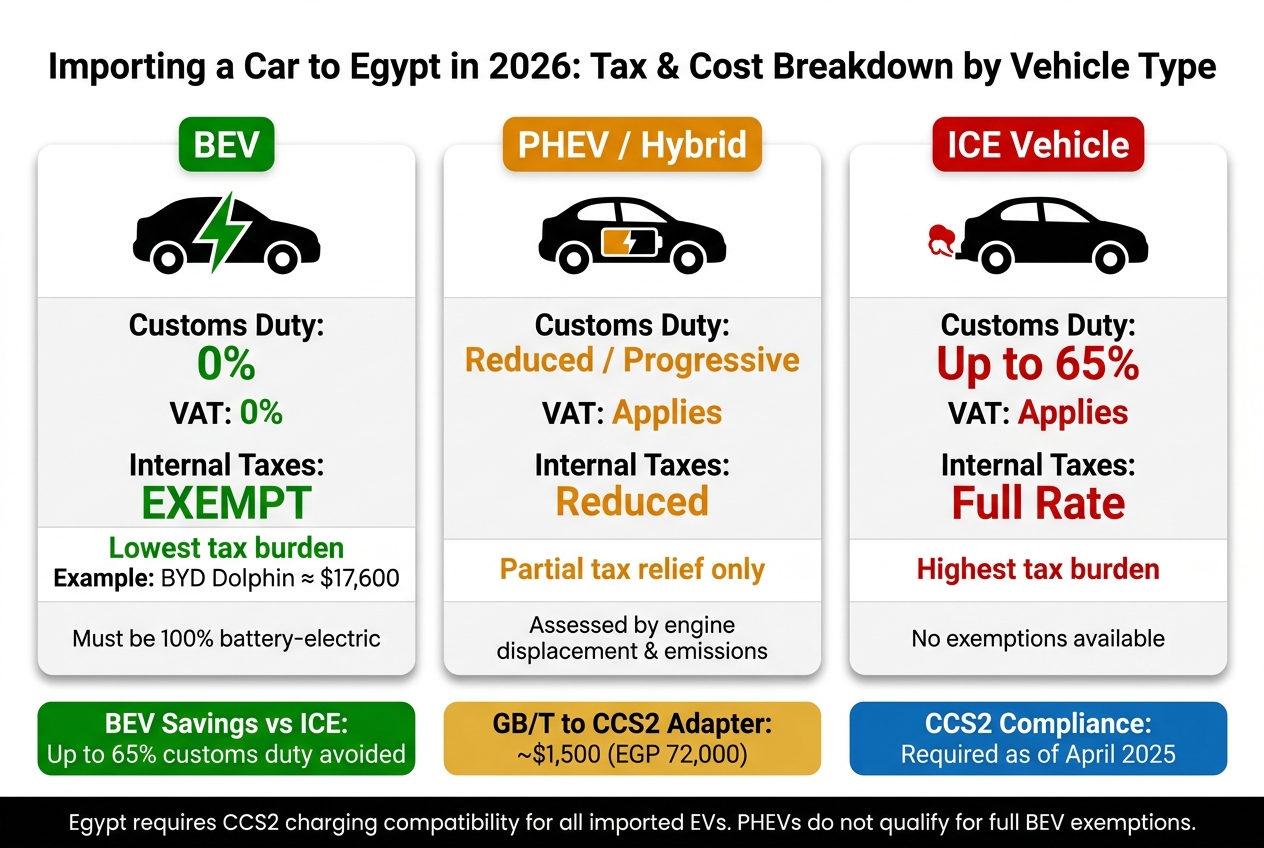
Egypt EV Import 2026: BEV vs PHEV vs ICE Tax & Cost Comparison
Once the EV qualifies, most of what’s left comes down to shipping, handling, and registration.
Which Charges Apply to a Pure Electric Car
A qualifying BEV pays no customs duty, no VAT, and no internal taxes.
That said, the bill doesn’t drop to zero. You should still set aside money for port handling, cargo release, inland transport, customs broker fees, inspection charges, and demurrage if the shipment sits at the entry port for too long. Those costs can still show up even when customs duty and VAT are exempt.
How BEVs, PHEVs, and Non-Electric Vehicles Are Taxed Differently
The type of vehicle makes the biggest difference in the customs bill. A fully built non-electric vehicle can face customs duty of up to 65%, while a BEV is exempt.
| Vehicle Type | Customs Duty | VAT | Internal Taxes | Key Cost Note |
|---|---|---|---|---|
| Pure EV (BEV) | 0% (Exempt) | 0% (Exempt) | Exempt | Lowest tax burden; customs and VAT are exempt |
| Plug-in Hybrid (PHEV) / Hybrid | Reduced / progressive | Applies | Reduced | Assessed using engine displacement and emissions |
| ICE vehicle | Up to 65% | Applies | Full rate | Highest overall tax burden |
How to Estimate the Total Landed Cost Before You Buy
The landed cost is the vehicle price plus shipping, insurance, customs clearance, port handling, and registration costs in Egypt.
Take the BYD Dolphin BEV as an example. It’s priced at about $17,600 (EGP 849,000). Then add shipping, insurance, customs clearance, port handling, broker fees, and any inspection charges. If the car comes with a GB/T charging port instead of CCS2, add another $1,500 (EGP 72,000) for an adapter.
Put simply, the sticker price is only the start. The full cost comes from adding each import and delivery charge on top of it.
Once the landed cost is clear, the next step is matching the shipment documents to customs requirements.
Prepare Documents and Clear Customs at the Port
Once you’ve worked out the landed cost, get the clearance file ready before the car leaves for Egypt. Do the paperwork early, then check it line by line before the vehicle reaches Alexandria. A small mismatch can slow everything down.
Documents Needed for Customs Clearance
Every imported EV needs the same core paperwork to move through customs.
| Document | What It Must Show |
|---|---|
| Commercial Invoice | VIN, model year, declared value, importer name |
| Bill of Lading (BoL) | VIN, importer name, shipping marks |
| Certificate of Origin | Country of manufacture |
| Export Certificate / Title | VIN, model year, technical specs, ownership proof |
| Customs Declaration | Must match the invoice, BoL, title, and origin data exactly |
| Importer ID or Passport | Valid importer ID or passport |
| Power of Attorney | Required if a customs broker is filing on your behalf |
The key fields must match across every document:
- VIN
- model year
- importer name
- declared value
If even one of those details is off, customs can hold the car. That’s why it’s smart to review the full set before shipment, not after arrival.
Port Clearance Steps from Arrival to Release
Once the file is complete, the port process moves in a set order. At Alexandria, clearance follows this sequence:
- Manifest arrival – The shipping line files the cargo manifest with port authorities.
- Customs declaration filing – Your broker submits the import declaration using the documents above.
- Document review – Customs officers check that the invoice, BoL, certificate of origin, and title match.
- Valuation and classification – For a qualifying BEV, customs still reviews the declared value to guard against under-invoicing.
- Physical inspection – Officers confirm the VIN, battery type, and CCS2 compatibility. As of April 2025, imported EVs must be compatible with European CCS2 charging standards.
- Payment of remaining fees – Local port fees are paid at this stage. For a qualifying BEV, customs duty and VAT are zero.
- Customs release – After payment is cleared and all checks are done, the vehicle is released for inland transport.
One mistake here can get expensive. If a PHEV is filed as a BEV, customs may stop the release and assess taxes you weren’t expecting. Make sure the export certificate and customs declaration state clearly that the vehicle is a pure BEV.
Register the EV and Get It Road-Legal in Egypt
Once customs releases the car, licensing is the last step before you can use it on public roads in Egypt. That means going to the traffic office, completing the vehicle inspection, getting mandatory insurance, and receiving the plates. Until those steps are done, the EV can’t be driven legally.
Documents and Checks Required at the Licensing Office
Bring the full set of paperwork to the traffic department:
| Document | Why It’s Needed |
|---|---|
| Customs Release Papers | Proves the vehicle cleared customs and all required fees were settled |
| Proof of Ownership | Confirms the importer is the legal owner |
| Importer ID or Passport | Required for identity verification at the licensing authority |
| CCS2 Compliance Proof | Shows the EV meets Egypt’s CCS2 charging requirement |
| Mandatory Insurance Certificate | Required before plates can be issued |
If even one document is missing, the process can stall. It’s a good idea to check everything in advance so you don’t end up making an extra trip for one paper.
Registration, Plates, Insurance, and Final Local Fees
After the inspection and document review, the rest of the costs are local admin charges. Plan for plate issuance, registration, inspection, broker, and local service fees. In many cases, these are billed as one package.
Mandatory insurance must be active before plates are issued. Once that is confirmed, the plates are released and the vehicle can be driven legally.
Before shipping, include these post-clearance costs in your full budget.
Conclusion: Verify the Rules and Budget in Full Before You Ship
Importing an EV to Egypt in 2026 only works when eligibility, taxes, customs, and registration are all sorted out before the car ships.
Check the charging port before shipment. A GB/T car may need an adapter, and that can add about $1,500 (EGP 72,000) to your cost.
Tax treatment matters too. A qualifying BEV gets a full exemption from customs duty and VAT, while hybrids are taxed under a different set of rules. Make sure the vehicle is classified as a BEV before anything moves forward.
Your paperwork also has to match up exactly. The documents should line up with the VIN, model year, and declared value with no gaps or mix-ups.
Then there’s the part many people underestimate: once customs clears the car, you’re not done paying. Set aside a separate budget for registration, plates, and insurance.
FAQs
How can I confirm a car qualifies as a true BEV?
Check that the listing says the vehicle has a battery-electric drivetrain and that it’s filed under the right customs code for battery-electric vehicles.
You should also review the manufacturer’s conformity documents and battery safety records, including UN38.3 test reports. Before shipment, verify the VIN against official records.
What fees will I still pay if customs duty and VAT are zero?
Even if customs duty and VAT are 0%, you should still set aside money for the required costs of getting the vehicle cleared and registered in Egypt.
That usually includes:
- shipping fees
- import paperwork and admin fees
- port handling fees and possible storage charges
- vehicle registration costs
You may also need charging adapters so the vehicle works with local charging setups. And if you’re paying from abroad, bank fees for international transfers can add to the total.
What mistakes most often delay EV customs clearance in Egypt?
Delays usually happen for two reasons: paperwork mistakes and technical non-compliance.
On the paperwork side, the usual trouble spots are missing or incorrect documents, details that don’t match between the bill of lading and the commercial invoice, VIN errors, and the wrong HS code. That last one can cause revaluation or classification disputes, which can slow things down fast.
Issues can also start before the vehicle even ships. If the EV doesn’t meet local electrical, safety, or environmental requirements, clearance can get stuck later in the process. That’s why it helps to use NAFEZA the right way and work with an experienced customs broker. Doing both can cut down on avoidable delays and storage fees.