
 Thabo Nkosi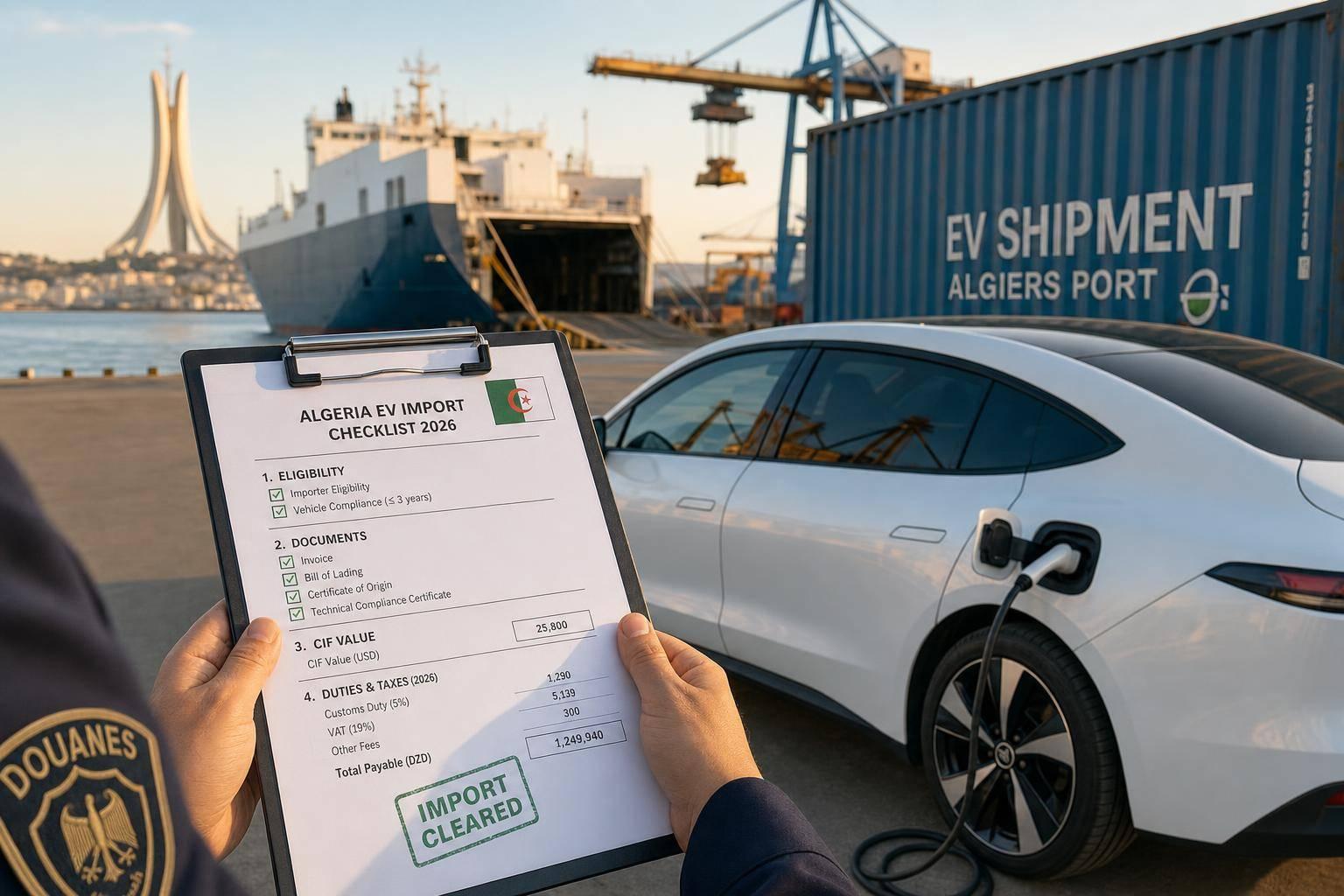
Yes – you can import an electric car to Algeria in 2026, but only if you meet a short list of hard rules. For most private buyers, that means 1 car every 3 years, the EV must be under 3 years old at arrival, diesel is not allowed, and the invoice must be registered through an Algerian bank before customs will release the car.
Here’s the short version:
- I can import one personal-use vehicle every 3 years
- The EV must be less than 3 years old
- I need key papers like the invoice, original registration, COC, and technical inspection certificate
- I must pay about 6% customs duty for EVs, plus 19% VAT and a 3% solidarity fee
- My total cost is based on CIF = car price + shipping + insurance
- Delays can add storage, broker, and port fees
A simple landed-cost example from the article:
- A $25,000 used EV can end up near $36,913
- A $45,000 EV can land near $63,537
If I were planning this import, I’d check the car’s age, match every document to the VIN, confirm the bank step early, and leave extra room in the budget for port delays and exchange-rate swings.
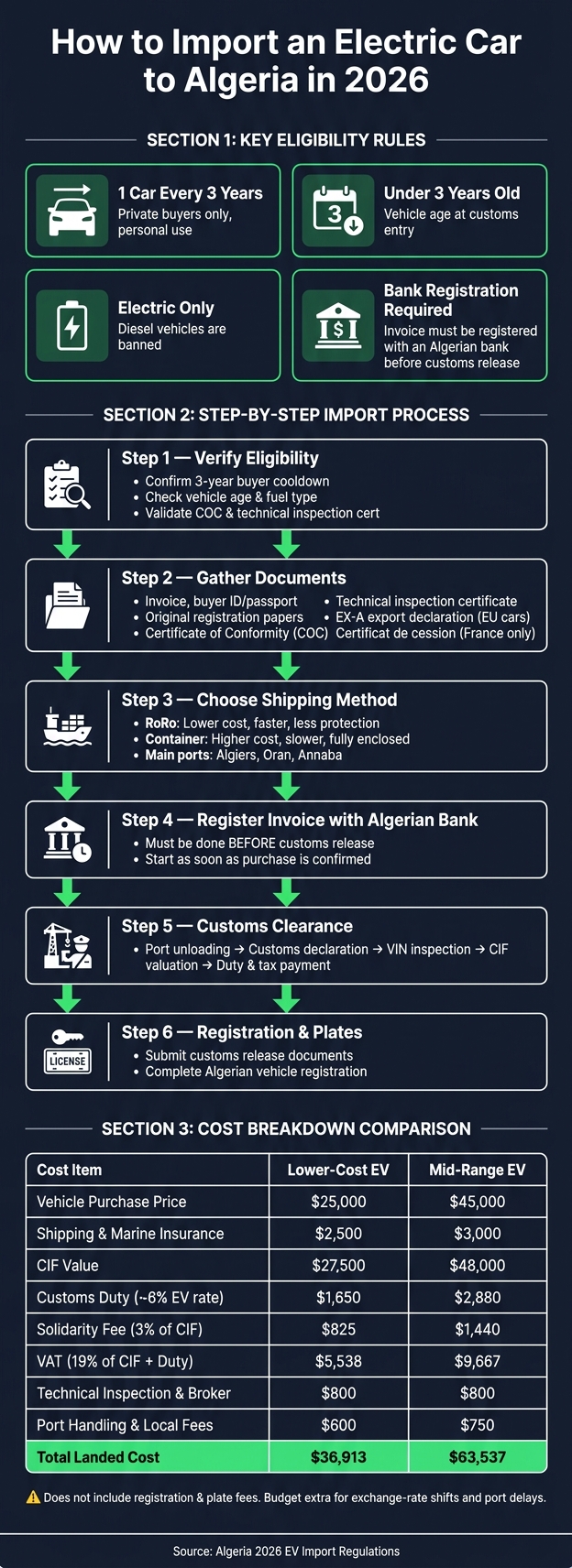
How to Import an Electric Car to Algeria in 2026: Step-by-Step Process & Costs
1. Algeria‘s 2026 EV Import Rules: Who Can Import and Which Cars Qualify
Algeria’s import rules come down to three checks: who’s importing the car, which vehicle is being imported, and how old the car will be when it reaches customs. If one of those checks fails, customs can reject the import.
1.1 Buyer Eligibility: Resident and Change-of-Residence Import Pathways
Private buyers may import one vehicle for personal use every three years. Dealers follow a separate commercial import process. For private buyers, the route applies to both residents and change-of-residence imports.
Once the buyer is eligible, the next step is to make sure the EV itself fits Algeria’s rules.
1.2 Vehicle Rules: EV Types, Age Limits, and Fuel Restrictions
For this guide, the main point is simple: EVs are allowed, and diesel is banned. The car must still be under three years old when it enters customs. It also needs a valid Certificate of Conformity and a technical inspection certificate.
| Rule | Requirement |
|---|---|
| Banned fuel types | Diesel |
| Age at customs entry | Under 3 years old |
If the EV checks those boxes, look at the paperwork before you commit to the deal.
1.3 How to Check Whether an EV Qualifies Before You Buy
Before you pay, check the VIN, production date, first registration date, and vehicle specs against the original registration papers. Then compare the first registration date with the car’s expected arrival date. Build in time for shipping and port delays so the car still falls within the three-year limit when it reaches customs.
Before shipment, gather these documents:
- Invoice
- Buyer ID or passport
- Original registration papers
- Certificate of Conformity
- Technical inspection certificate
- EX-A export declaration for EU-origin cars
Once those checks are done, move on to the shipping and customs documents before booking transport.
sbb-itb-99e19e3
2. The Import Process: Documents, Shipping, Customs, and Registration
2.1 Documents to Gather Before the EV Leaves the Export Country
Before the EV ships, go through every document line by line. The buyer name, VIN, and vehicle specs need to match across the invoice, title, bill of lading, and customs file. If those details don’t line up, customs can reject the file. In practice, that’s one of the most common reasons imports get held up.
If you’re buying from France, you’ll also need the mandatory Certificat de cession. The Certificate of Conformity and the technical inspection certificate must both be less than three years old at the time of import. That timing matters. A car can look fine on paper when it leaves, then run into trouble if delays push arrival too far out.
The technical inspection is usually handled before export and typically costs about €300 to €400. It’s also smart to confirm translation rules with Algerian customs before shipment. A French invoice may not be accepted automatically, so check whether Arabic translations are required.
Once the paperwork is in order, the next call is shipping method. That’s where cost, protection, and timing start to pull in different directions.
2.2 Shipping to Algeria: RoRo vs. Container, Port Options, and Timing Risks
With the documents ready, you can choose between RoRo and container shipping. RoRo is usually the lower-cost option, and it’s often faster because the vehicle is simply driven onto the ship. Container shipping costs more, but it gives the car more protection, which can make it the better choice for a higher-value EV.
| Feature | RoRo | Container |
|---|---|---|
| Cost | Lower | Higher |
| Protection | Exposed to elements | Fully enclosed |
| Transit speed | Generally faster | Can be slower due to consolidation |
| Best for | Standard passenger EVs | Luxury or high-value EVs |
The main vehicle entry ports in Algeria are Algiers, Oran, and Annaba. Timing matters here too. Port delays can lead to extra storage fees, and they can also create a bigger problem: the car still needs to meet the under-three-years import rule when it arrives. A small buffer in your schedule can save a lot of hassle.
2.3 Customs Clearance and Registration After the Car Arrives
After the car arrives, customs clearance moves through a set sequence. That usually means port handling and unloading first, then the customs declaration, then inspection and VIN check, and finally valuation based on CIF.
There’s also a banking step that can’t be skipped. Before customs releases the vehicle, all payments must go through an Algerian bank, and that bank must officially register the invoice. After that, you pay the duties, 19% VAT, and the 3% solidarity fee.
Once those amounts are paid, customs issues the release documents. You then submit those papers to the registration office to finish the process and get the plates.
3. Full Import Cost Breakdown: Purchase Price, Shipping, Duties, Taxes, and Registration
3.1 Cost Formula: From Vehicle Price to CIF and Total Landed Cost
Once the vehicle qualifies, the next step is to work out the full landed cost. The purchase price is just the starting line.
Import costs begin with CIF, which means the vehicle price plus shipping and marine insurance. From there, customs duty and the 3% solidarity fee are applied to the CIF value. VAT is then charged on CIF plus customs duty. After that, you still need to add local costs like port handling, broker fees, and registration.
| Cost Component | Calculation Base | Rate |
|---|---|---|
| Vehicle Price | Overseas sale price | Variable |
| Shipping + Insurance | Freight + insurance | Variable |
| CIF Value | Vehicle Price + Shipping + Insurance | Customs value |
| Customs Duty (EV) | CIF Value | ~6% |
| Solidarity Fee | CIF Value | 3% |
| VAT | CIF Value + Customs Duty | 19% |
| Port & Handling | Local logistics | Variable |
| Registration + Plates | Algerian government fees | Variable |
That structure matters because each layer builds on the one before it. A car that looks affordable at first can end up costing much more once taxes and local charges are added.
3.2 EV Duty and Tax Relief Available in 2026
EVs get up to 80% off the standard duty rate of roughly 30%, which brings the EV duty down to about 6% of CIF. The 3% solidarity fee and 19% VAT still apply.
Before you lock in your budget, confirm the exact duty rate with your customs broker. That one step can save you from a nasty surprise later.
3.3 Sample Cost Scenarios for Private Buyers and Small Dealers
The table below shows two landed-cost examples: a lower-cost used EV and a mid-range EV. Both use the 6% EV duty rate and include local costs that often get missed in early estimates.
| Cost Item | Lower-Cost Used EV | Mid-Range EV |
|---|---|---|
| Vehicle Purchase Price | $25,000 | $45,000 |
| Shipping & Marine Insurance | $2,500 | $3,000 |
| CIF Value | $27,500 | $48,000 |
| Customs Duty (~6% for EV) | $1,650 | $2,880 |
| Solidarity Fee (3% of CIF) | $825 | $1,440 |
| VAT (19% of CIF + Duty) | $5,538 | $9,667 |
| Technical Inspection & Broker | $800 | $800 |
| Port Handling & Local Fees | $600 | $750 |
| Total Estimated Landed Cost | $36,913 | $63,537 |
These totals do not include registration and plate fees, which are separate variable costs. And there’s another catch: port handling and storage fees can climb fast if customs clearance is delayed.
In plain English, the first quote is almost never the final number. Exchange-rate moves, delays, and broker charges are usually where extra cost slips in.
4. How to Avoid Delays, Penalties, and Unexpected Charges
4.1 Common Mistakes That Block EV Imports
A solid budget won’t save the deal if your paperwork is late, incomplete, or doesn’t match. In most cases, import trouble starts before the car even ships.
One of the biggest mistakes is buying a vehicle that doesn’t qualify. In Algeria, imported vehicles must be less than three years old at the time of import, and diesel-powered vehicles are not allowed. Miss that rule, and the whole process can get stuck before it starts.
Another common problem is missing approval documents. Without a valid COC or technical inspection certificate, customs clearance can stall. If the seller can’t provide a valid COC, get one before shipment. Otherwise, clearance can stall, and the car can fall under standard customs rules.
Small document errors can cause big slowdowns too. If names, dates, or vehicle details don’t line up across the file, customs may pause the process. The same goes for EX-A. File EX-A only after freight is final, because the border-crossing detail cannot be changed.
Start bank invoice registration as soon as you buy the car.
Once the paperwork is locked in, the next issue is money. And this is where costs can quietly climb.
4.2 Budget Risks: Exchange Rates, Storage Fees, and Broker Costs
Import costs don’t stay fixed just because your first estimate looked fine. They can shift due to exchange-rate moves, storage fees, inspection charges, and broker costs.
Exchange-rate risk matters because the vehicle is priced in euros or dollars, but the payment is processed through an Algerian bank. A small currency move can change your final out-of-pocket cost more than expected.
Port charges are another easy place to lose money. If clearance is delayed, fees can start stacking up fast. If bank registration, translations, or document checks aren’t ready when the car arrives, storage and handling fees can begin adding up.
There may also be extra inspection costs before export. If you still need a pre-export technical inspection, budget about €300 to €400 for it.
It helps to leave room in your plan for costs like:
- Exchange-rate changes
- Port storage and handling fees
- Inspection charges
- Broker or clearance service fees
Budget a contingency reserve.
Conclusion: A Pre-Import Checklist for Buying an EV in Algeria
Use this checklist to confirm the deal before you send money or book shipping. It helps you verify eligibility, budget, and paperwork before you pay.
Start with eligibility. The car must be less than three years old when it arrives at the port. Diesel is banned. The vehicle also needs a valid COC and a technical inspection certificate, and both must be less than three years old.
Once that part checks out, build the real cost picture. Start with CIF. Then add the reduced EV duty, 19% VAT, the 3% solidarity fee, and local port charges. That final number is your true landed cost.
If each item below is confirmed, the import can move ahead.
| Step | What to Confirm |
|---|---|
| Buyer eligibility | One import per 3 years; personal use only |
| Vehicle age | Less than 3 years old at port arrival |
| Fuel type | Electric only; no diesel |
| Documents ready | Invoice, COC, technical inspection, original registration papers |
| Bank registration | Invoice registered with an Algerian bank before customs release |
| EX-A declaration | Filed only after the exit port is finalized |
| Full cost estimate | CIF + EV duty + VAT + solidarity fee + local fees |
Check the rules. Confirm the budget. Then buy. Skip neither step.
FAQs
What if my EV turns 3 years old before it clears customs?
In Algeria, a vehicle’s age is counted from the date the customs declaration is registered, not the date you bought it or shipped it. That detail matters more than it might seem.
If your EV turns three years old before that customs paperwork is filed, it no longer qualifies. And yes, that can mean the car is refused entry at the port.
The safest move is to buy a vehicle that’s around 2 years and 10 months old. That gives you a small buffer for shipping delays and customs processing, which can be the difference between a smooth import and a nasty surprise.
Can I import a used EV from any country, or do some origins require extra documents?
You can import a used EV from several countries, as long as it’s left-hand drive, meets Algeria’s technical rules, and is less than three years old.
Some source countries call for extra paperwork. For instance, imports from France need a Certificat de cession to confirm the transfer of ownership. In every case, you’ll need a Certificate of Conformity (CoC), and all documents must be original and match across the file.
How long does the full import and registration process usually take?
Importing and registering an electric vehicle in Algeria usually takes 4 to 8 weeks from the purchase date. That window covers shipping, customs clearance, and registration.
Timing matters here. Transit and customs processing can change from one shipment to the next, so buyers need to plan ahead. The goal is simple: make sure the vehicle still falls within the mandatory three-year age limit when the customs paperwork is submitted.