
 Thabo Nkosi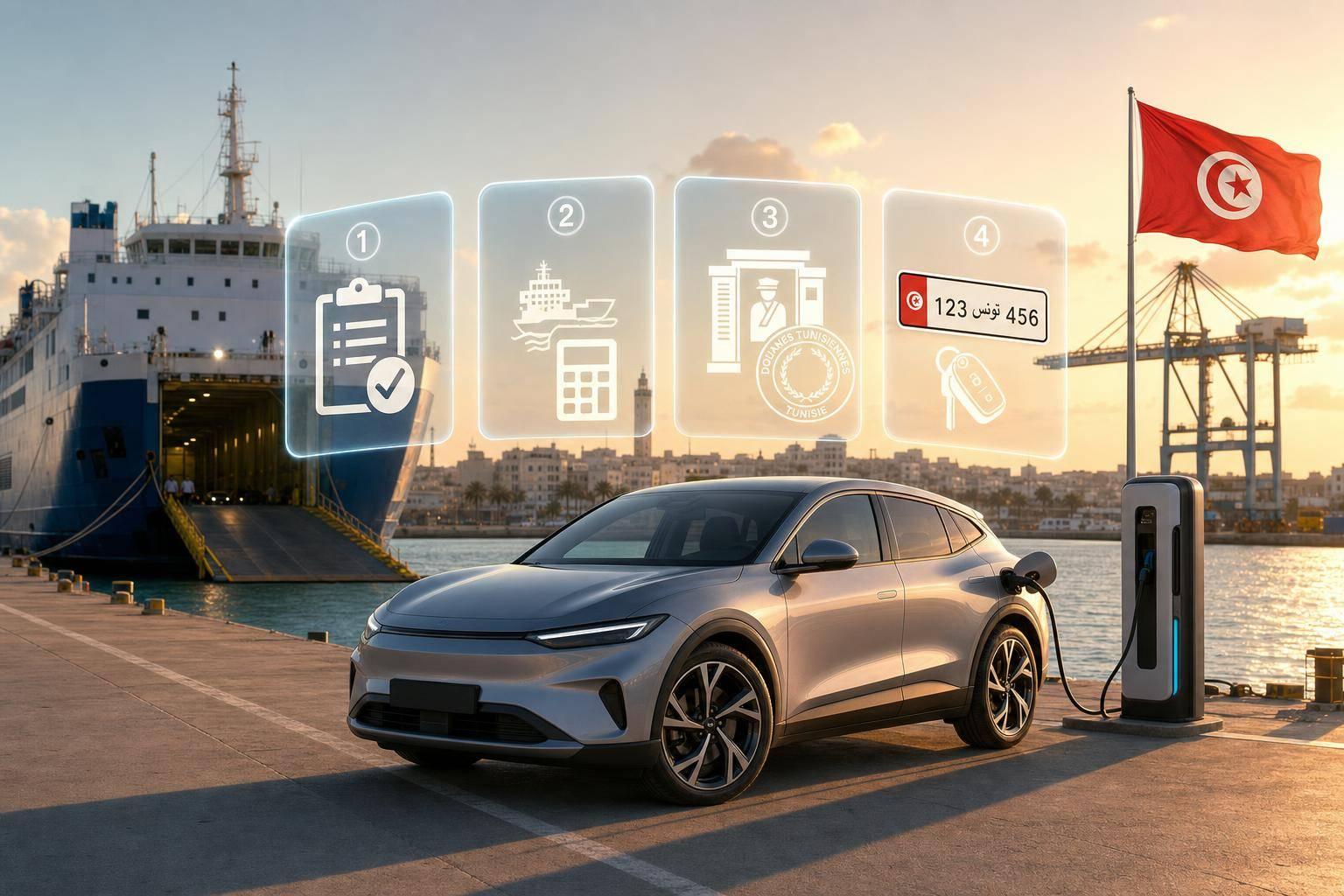
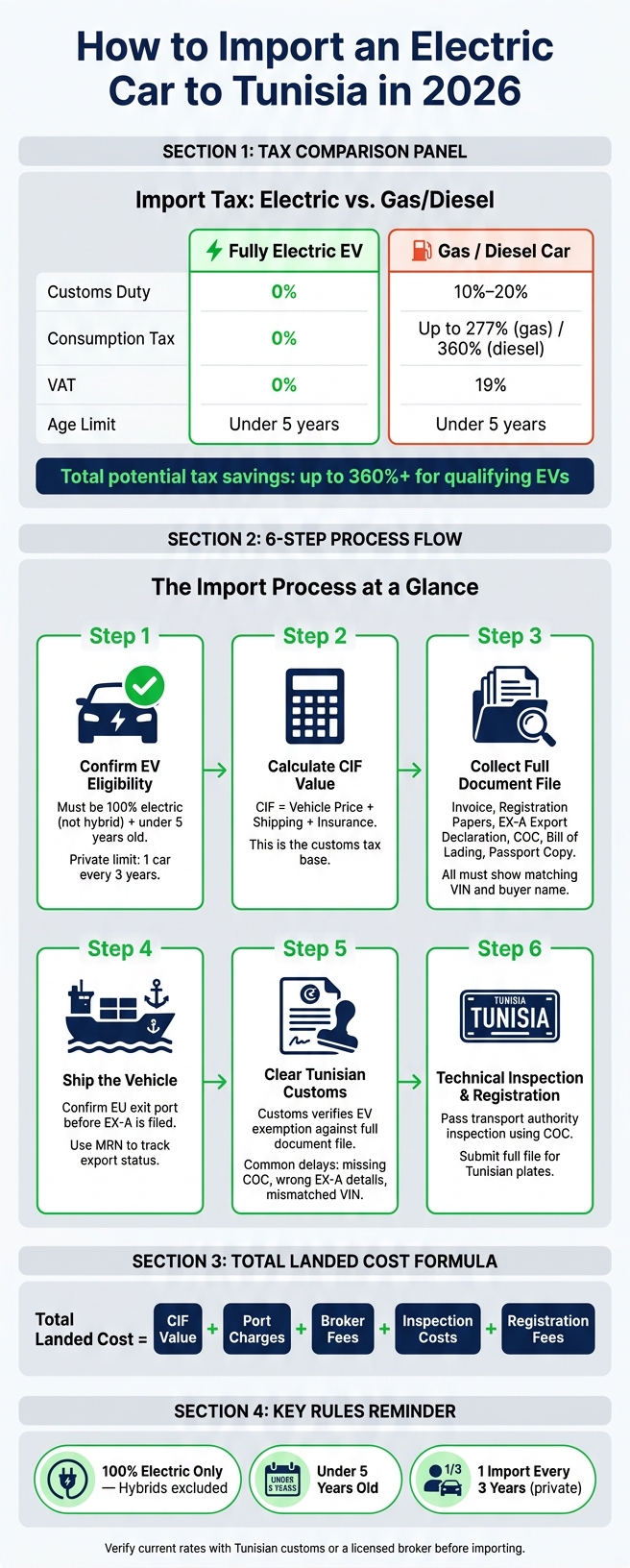
If your car is fully electric and under 5 years old, you may pay 0% customs duty, 0% VAT, and 0% consumption tax in Tunisia in 2026. That is the main thing I’d check before buying, because gas and diesel cars can face total tax loads of 277% to 360%.
Here’s the short version: I’d confirm the car is 100% electric, make sure the VIN and buyer name match on every document, get the EX-A and COC before shipping, and build my budget from the CIF value – not just the sale price. Then I’d plan for the last steps: customs, inspection, and registration.
What matters most:
- EV-only tax break: hybrids do not get the same treatment
- Age rule: the car must be under 5 years old
- Private import limit: usually 1 car every 3 years
- Customs base: CIF = vehicle price + shipping + insurance
- Main documents: invoice, registration papers, EX-A, COC, bill of lading, passport/ID copy
- Common delay points: missing COC, wrong EX-A details, or mismatched VIN data
- Final cost: not just taxes – add port charges, broker fees, inspection, and registration fees
A simple way to think about it: first check eligibility, then lock down the paperwork, then ship. If I skip that order, costs and delays can pile up fast.
| Item | Fully Electric EV | Gas/Diesel Car |
|---|---|---|
| Customs duty | 0% | 10%–20% |
| Consumption tax | 0% | Up to 277% / 360% |
| VAT | 0% | 19% |
| Age limit | Under 5 years | Under 5 years |
If you want the process in one line, it’s this: check EV status, calculate CIF, collect the full file, clear customs, pass inspection, and register the car for Tunisian plates.
How to Import an Electric Car to Tunisia: Step-by-Step Process & Tax Guide
قداش تخلص كيف تجيب سيارة كهربائية لتونس 🇹🇳
sbb-itb-99e19e3
1. Confirm EV Eligibility and Estimate Taxes Before You Buy
Before you buy, make sure the car is classified as 100% electric. In Tunisia, that single detail changes a lot. It affects whether the car qualifies for current EV exemptions, how much tax you may owe, and which documents customs will ask for next.
Fully Electric vs. Hybrid: Why Customs Classification Matters
Tunisian customs requires proof that the vehicle is fully electric to qualify for the current exemptions. Hybrid and plug-in hybrid vehicles may not get the same tax treatment.
If the car is not documented as 100% electric, you can lose the EV exemptions. That’s why your paperwork needs to line up from the start. Use the invoice, registration documents, and COC to prove the vehicle’s powertrain. The invoice should clearly show the VIN, make, model, and year of first registration. If the seller doesn’t provide a COC, order one before shipment from a recognized COC provider.
How to Estimate Import Tax Using CIF Value
CIF means purchase price + shipping + insurance to the Tunisian port. Think of it as the base number customs uses to size up your import costs. If you know the CIF value before you commit, you have a much better sense of the full landed cost.
For non-EVs, Tunisia applies duty first, then consumption tax, then VAT on CIF. Fully electric vehicles currently pay 0% customs duty, 0% consumption tax, and 0% VAT.
| Tax Component | ICE Vehicle | Electric Vehicle |
|---|---|---|
| Customs Duty | 10%–20% | 0% (Exempt) |
| Consumption Tax | Up to 277% (gasoline) / 360% (diesel) | 0% (Exempt) |
| VAT | 19% | 0% (Exempt) |
| Age Limit | Under 5 years | Under 5 years |
Always verify current rates directly with Tunisian customs or a licensed customs broker before making any payment.
After you estimate CIF-based taxes, the next move is to put together the purchase and shipping file.
Standard Private Import vs. Special Regimes
Your import regime affects both how often you can import and who can use the standard private route. Private imports are generally limited to one car every three years. Businesses are not subject to that same limit. Special diaspora or FCR-type regimes come with separate eligibility rules, so it’s smart to confirm those in writing with a customs broker.
Once the regime is clear, you can move to the core file: invoice, title, COC, and shipping documents.
When eligibility and tax treatment are sorted out, gather the purchase file and shipping documents before shipment.
2. Gather Your Purchase File and Shipping Documents
Once the EV is confirmed eligible, get the paperwork locked down before shipment. If the file is missing documents or the details don’t line up, customs can hold the vehicle.
Documents to Collect Before Shipment
Every document needs to show the same VIN, buyer, and vehicle details. The VIN must match exactly across the purchase invoice, the original registration papers, and the export declaration. The importer name also needs to match across the invoice, registration papers, and passport copy.
| Document | What It Must Show |
|---|---|
| Commercial Invoice | VIN, make, model, year of first registration, sale price, currency, buyer/seller details |
| Original Registration Papers | Ownership history, VIN |
| EX-A Export Declaration | Buyer details, EU exit port, MRN |
| Certificate of Conformity (COC) | Technical specs, safety and emissions compliance |
| Bill of Lading | Shipping details for port release |
| Importer ID or passport copy | Name must match all other documents exactly |
The EX-A export declaration must be issued before the vehicle leaves the EU. Missing EX-A paperwork is a common reason for customs delays in Tunisia. You also need to give the seller your chosen EU exit port before they file it, since that detail has to appear on the document. After it’s issued, use the MRN to track the export status.
If the seller doesn’t provide a COC, order one before shipment.
Shipping Terms and Port Charges: What to Budget For
The shipping term you agree on with the seller has a direct effect on your customs calculation. Under FOB, you pay freight and insurance separately. Under CIF, those costs are included in the customs base.
Then there are the non-tax port costs. At Rades, or any other entry port used, plan for terminal handling charges, storage fees, and customs broker fees. Those charges can add up fast if the file isn’t ready and the car sits at port longer than planned.
How EV24.africa Can Help You Source a Vehicle With the Right Documentation
EV24.africa can coordinate sourcing, shipping, document checks, and Battery State of Health inspections. That can cut down on customs mistakes and help avoid delays that didn’t need to happen.
With the file complete, the next step is customs declaration and conformity checks at the port.
3. Clear Customs and Meet Technical Requirements in Tunisia
Customs Clearance: Declaration, Review, and Release
When the vehicle reaches Tunisia, customs reviews the declaration and the supporting paperwork. Officers compare the file against the same VIN, invoice, registration, and export records collected earlier. If everything lines up, customs verifies the EV exemption and releases the vehicle.
Once the exemption is approved, customs issues the release document so you can move on to registration.
After customs clears the file, the EV goes to technical inspection.
Conformity Checks With Tunisia’s Transport Authority
After customs release, the EV must pass the required technical inspection before registration. This check makes sure the vehicle meets local safety and technical standards.
The COC is the main document for technical conformity and registration. If it’s missing, get a replacement before shipment. Only after customs release and technical inspection can the vehicle move into registration. In plain terms, the technical inspection is the last checkpoint before plate registration.
Common Customs and Conformity Problems That Delay Release
Most delays come down to paperwork that is missing or doesn’t match. It’s usually not one big issue. It’s small document errors that trip the file up.
| Problem | Why It Happens | How to Avoid It |
|---|---|---|
| Incomplete document file | Missing invoice, registration papers, passport copy, or EX-A | Prepare the full file before shipment |
| Missing COC | Seller did not provide the COC | Order a replacement before shipment |
| Incorrect EX-A details | The seller listed the wrong exit port | Confirm the exit port before export |
| Mismatched vehicle details | VIN or key information does not match across documents | Double-check every document before submission |
Fix these issues before the vehicle arrives, and customs and inspection tend to move much more smoothly.
4. Register the EV and Calculate Your Total Landed Cost
Once customs release and inspection are done, registration is the last admin step before you can legally drive the EV in Tunisia.
Registration Paperwork for Tunisian Plates
After customs release and inspection, submit your file to get Tunisian plates and put the EV on the road. The file should include the customs release, inspection record, invoice, original registration, EX-A declaration, COC, and passport copy.
Registration Taxes and Special Regime Plate Types
Taxes are only one part of the bill. Port and registration fees also shape the final amount you’ll pay. Start with the CIF value, then add port handling, storage, broker fees, inspection costs, and registration fees.
If the vehicle falls under diaspora-linked FCR rules, it may receive RS-series plates, which come with a different fee setup.
Hypothetical Landed-Cost Example and Final Document Checklist
The total landed cost follows a simple formula:
Total landed cost = CIF + port charges + broker fees + inspection costs + registration fees
Before you submit the file, check that you have:
- Invoice
- Original registration
- EX-A declaration
- COC
- Passport copy
- Customs release
- Inspection record
Conclusion: Follow the Right Order to Save Time and Money
Start with the first filter: make sure the EV is fully electric and less than five years old before you commit to buying it. That one check shapes your tax treatment and tells you whether the car qualifies for the EV exemptions. Get the powertrain classification right first, and everything after that turns into a paperwork review instead of a nasty surprise.
Then close out the file before shipment. The documents need to match up. The EX-A export declaration has to be filed before the car leaves Europe, and the Certificate of Conformity (COC) needs to be in the file for Tunisian technical approval.
Your budget should follow that same logic. Build it from the CIF value, not the sticker price, when you estimate landed cost before the vehicle ships.
There’s also a hard limit for private imports: one car every three years.
Stick to the order – eligibility, documents, shipping, customs, inspection, registration – and the process is much easier to manage. Skip one piece, and delays usually show up fast.
FAQs
How do I prove a car is fully electric?
Provide the manufacturer’s documents that clearly state the car’s propulsion type, battery specs, and other key technical details.
You should also include the battery’s MSDS and any certificates that show it meets safety and quality standards, such as UN Regulation R100.
Tunisian customs may also check the vehicle through its VIN. In some cases, they can ask for extra documents or require a physical inspection to confirm that the car is electric and that it meets the required safety rules.
What costs should I expect beyond CIF?
Beyond the CIF value, set aside money for a few extra costs:
- shipping and marine insurance
- customs agent fees
- port handling and terminal charges
- technical inspection, homologation, and registration paperwork
It’s also smart to keep a small buffer – often around 3% of the cargo value – for possible demurrage or storage fees if customs clearance gets delayed.
What happens if my documents don’t match?
If your import documents don’t match, you can run into customs delays, fines, shipment holds, or even have the vehicle turned away at the border.
A small mismatch can snowball fast. If the VIN, importer name, vehicle value, or model details differ from one document to another, customs may stop the shipment and ask for more proof. That can lead to extra storage charges or demurrage fees while the vehicle sits and waits.
Before the vessel leaves, check that your bill of lading, commercial invoice, customs declaration, and ownership papers all show the same details. It’s a simple step, but it can save you a lot of hassle later.