
 Thabo Nkosi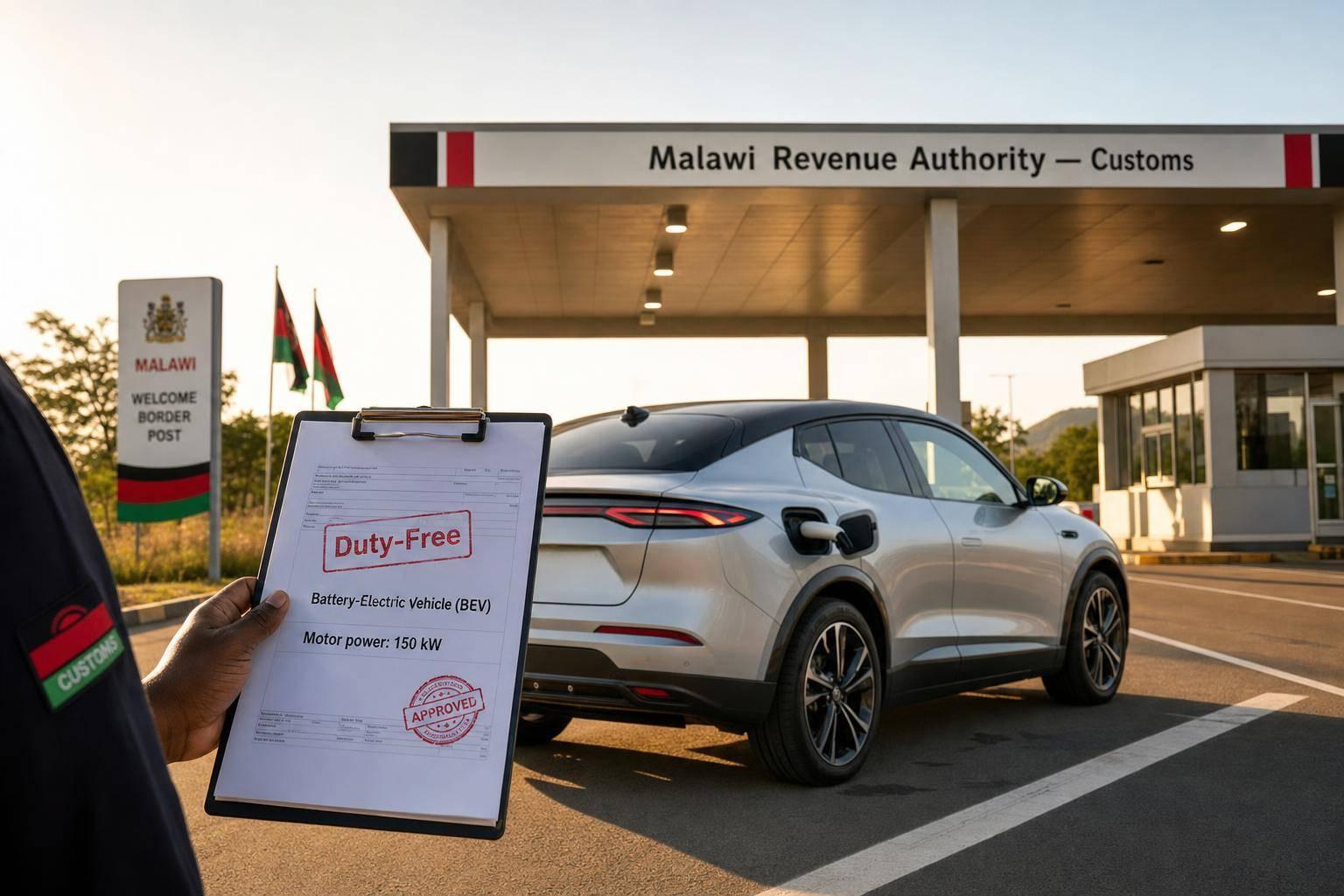
If I import a battery electric vehicle into Malawi in 2026, I pay 0% import duty and 8% VAT in many cases. That is the main thing I need to know before I buy. But there’s a catch: hybrids and plug-in hybrids do not get the same tax treatment.
Here’s the short version:
- I need to buy a 100% battery electric vehicle
- I should check the motor output, since excise is 0% if it is under 100 kW
- Malawi taxes the car based on CIF: purchase price + insurance + freight
- I need clean paperwork: invoice, Bill of Lading, title, roadworthiness certificate, and pre-shipment inspection report
- Most cars come through Beira or Durban, then go by road into Malawi
- The full import process often takes about 4 to 6 weeks
- After customs, I still need police verification, RTD registration, plates, and a logbook
I’d also budget for more than the car price. My total cost can include:
- Vehicle price
- Shipping
- Transit insurance
- Port charges
- Inland transport
- 8% VAT
- Clearing agent fees
- Registration fees
One mistake can get expensive fast. If I buy a hybrid by mistake, miss an inspection paper, or submit documents with a VIN mismatch, the car can sit longer and add extra charges.
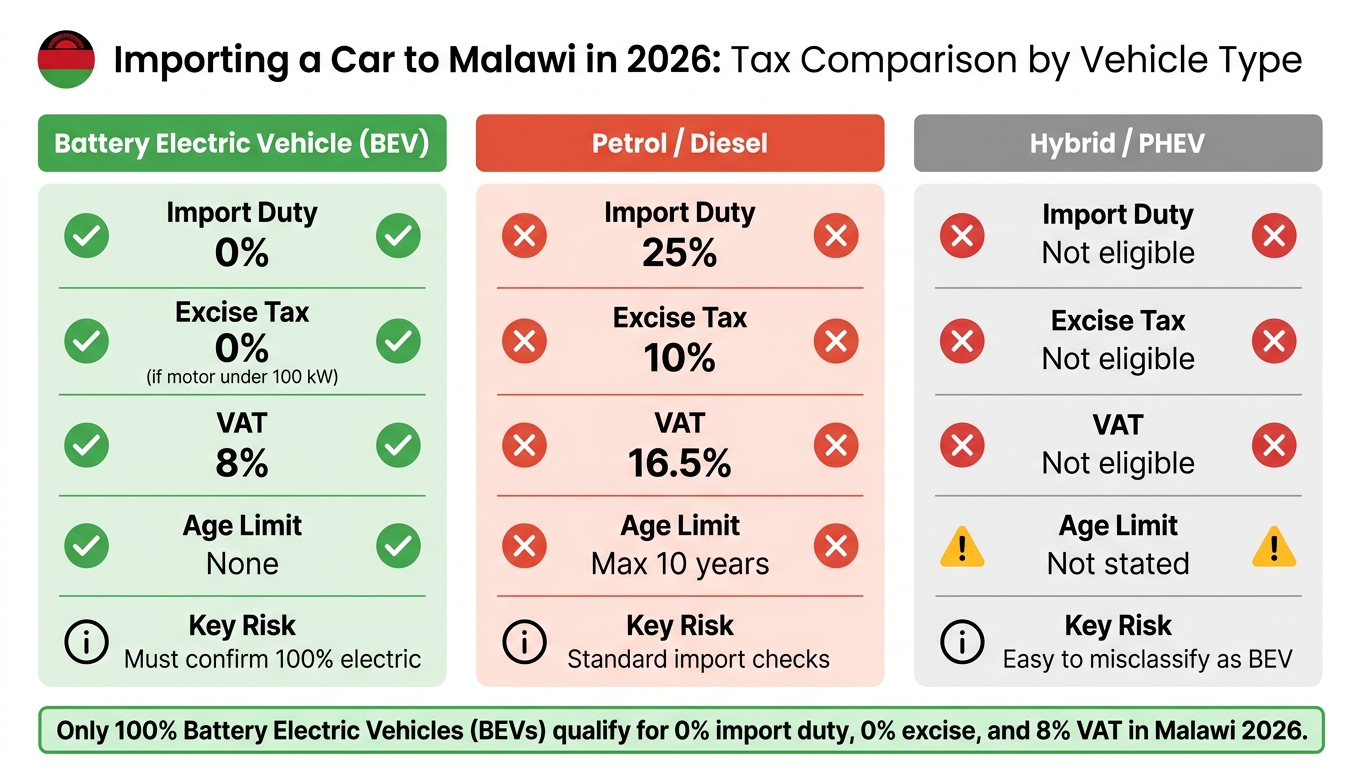
Malawi 2026 EV vs Petrol vs Hybrid Import Tax Comparison
Malawi’s government scraps taxes on Electric Vehicles
sbb-itb-99e19e3
Quick Comparison
| Item | Battery EV | Petrol/Diesel | Hybrid/PHEV |
|---|---|---|---|
| Import duty | 0% | 25% | Not covered by EV tax treatment |
| VAT | 8% | 16.5% | Not covered by EV tax treatment |
| Excise | 0% under 100 kW | 10% | Not covered by EV tax treatment |
| Age limit | No statutory age limit | 10 years | Not stated here as EV-qualified |
| Main check before buying | Confirm 100% electric | Standard import checks | Easy to misclassify |
If I want the import to go smoothly, I should first confirm the car is a BEV, then verify the documents, battery condition, shipping route, and total landed cost before I send payment.
Malawi’s 2026 EV import rules, taxes, and eligibility
How Malawi classifies full EVs, hybrids, and conventional vehicles
Malawi Customs treats BEVs, hybrids, and ICE vehicles as separate categories. Only BEVs get the 0% duty and reduced VAT. Hybrids and PHEVs are not included. That distinction shapes what you can bring in, what taxes you owe, and whether the vehicle clears customs at all.
During clearance, customs may check the drivetrain using the VIN and the model documents. That’s why it’s smart to verify the drivetrain type in the seller’s paperwork before you send any money.
2026 taxes and age-limit rules that apply to imported EVs
For BEVs that qualify, these are the main 2026 charges:
| Tax Component | 2026 EV Rate |
|---|---|
| Import Duty | 0% |
| Excise Tax | 0% if motor rated output is under 100 kW |
| VAT | 8% |
| Age Limit | No statutory age limit |
Check the exact motor rated output before you buy. A small detail on paper can change what you pay at the border.
Vehicle requirements before purchase: drive configuration, inspection, and condition
Buy only a vehicle that is clearly documented as 100% electric. If you’re buying a used EV, ask for a battery health certificate or diagnostic report before you finalize the deal.
You’ll also need an export-country roadworthiness certificate and a pre-shipment inspection certificate for customs clearance. Taxes are charged on cost, insurance, and freight (CIF), so the invoice and Bill of Lading need to match the vehicle price and freight amount. When those documents line up, clearance usually goes more smoothly.
Once you’ve confirmed eligibility, the next step is picking a model that suits Malawi’s roads, charging access, and parts support.
How to choose the right EV and prepare import documents
Choosing an EV that works in Malawi: range, charging, clearance, and parts
Once you’ve confirmed the car is a BEV, the next step is to cut down your shortlist based on range, charging, and parts support. That matters because not every EV is a good fit for Malawi’s roads, weather, and still-growing charging network.
Before you buy, look closely at the car’s real-world range, battery health, ground clearance, and climate fit. On paper, some models look great. In day-to-day use, they can feel very different.
A solid target is a real-world range of at least 250 km. That gives you more breathing room for trips between major cities and rural areas. If your driving is mostly in town, the Nissan Leaf can be a practical option. If you want more range or a more upmarket model, the Hyundai Kona Electric, BYD Atto 3, and Tesla Model 3 are all sensible picks.
Charging is another big filter. It makes sense to favor vehicles with a Type 2 or CCS port. Public charging is already available at Lilongwe City Centre, Blantyre CBD, Mzuzu Mall, and selected TotalEnergies stations. Many EVs can also charge from a standard 3-pin home outlet while the public network keeps growing.
Using EV24.africa to compare models and pricing for Malawi imports
Before you commit, use a source that shows Malawi-specific landed costs. That helps you avoid surprises after purchase.
EV24.africa lists new and used EVs with pricing tailored for Malawi. You can compare model specs, battery condition, and seller details before sending payment.
The platform also helps with shipping and customs clearance through Beira Port in Mozambique or Durban Port in South Africa, plus door-to-door delivery to Lilongwe and Blantyre.
Documents to collect before shipment
Get the export paperwork ready before shipment so customs can check the vehicle without delays. These documents help move the process along at customs and during registration:
| Document | Purpose |
|---|---|
| Commercial invoice | Shows purchase price |
| Bill of lading | Confirms freight details |
| Roadworthiness certificate | Proves export-country roadworthiness |
| Pre-shipment inspection report | Confirms condition before departure |
| Proof of ownership / title | Proves export rights |
| National ID or valid passport | Importer ID for MRA processing |
| Import permit (recommended) | Supports customs processing |
Before the car ships, make sure the VIN, title, and seller invoice all match and clearly identify the vehicle as a battery electric vehicle. For paperwork help, EV24.africa can handle document collection and submission to the Malawi Revenue Authority (MRA) and Road Traffic Department (RTD) for you.
The import process step by step: purchase, shipping, customs, and registration
From purchase to shipment: payment, pre-shipment checks, and transit routes
After you buy a BEV, gather the purchase and inspection papers before the car ships. In some export countries, you’ll also need a pre-shipment inspection report.
Most EVs headed to Malawi go by sea to Beira Port in Mozambique or Durban Port in South Africa. From there, they’re moved inland by truck. Once the vehicle arrives in Malawi, customs clearance starts right away.
Customs clearance in Malawi: CIF value, required documents, and clearing agents
At this stage, MRA checks the car against the shipping and purchase records. Import tax is based on CIF, which means the vehicle price, insurance, and freight up to the port of entry. During clearance, MRA checks the VIN, drivetrain, and papers against the invoice. Any VIN or drivetrain mismatch can delay clearance.
A clearing agent can help file the MRA Declaration and handle document submission. Here’s what’s usually needed at each stage:
| Stage | Required Documents |
|---|---|
| Purchase / Pre-Shipment | Invoice, Roadworthiness Certificate, National ID/Passport, Pre-shipment Inspection Report |
| Shipping | Bill of Lading |
| Customs Clearance | MRA Declaration, Bill of Lading, Invoice, EV verification (VIN, battery type) |
| Registration | MRA Release Order, RTD Registration Forms |
Once clearance is done, MRA issues the release. After that, the process moves to RTD for registration.
Registration after customs: police checks, plates, and logbook
After MRA release, the vehicle goes through a police verification check before it moves to RTD for registration. Police confirm the VIN and vehicle identity against the MRA Release Order. Then the vehicle is submitted to RTD for registration.
EVs follow the standard RTD registration process. RTD then issues the number plates and logbook.
Landed cost examples, common mistakes, and a final import checklist
Estimating the landed cost of a Nissan Leaf or BYD Dolphin
After you understand the clearance process, the next step is simple: figure out what it will cost to get the car into Malawi.
The landed cost is more than just the purchase price. If you’re importing a used Nissan Leaf or BYD Dolphin, the total amount includes every charge from the seller to final registration.
| Cost Component | What it Covers |
|---|---|
| Purchase price (FOB) | Vehicle cost |
| Shipping & freight | Ocean freight to the port |
| Insurance | Transit insurance |
| Port fees | Port handling and related charges |
| Inland transport to Malawi | Trucking from the port to Malawi |
| VAT | 8% of CIF value |
| Clearing agent fees | Customs processing |
| Road Traffic Department registration | Registration after clearance |
So the rough formula looks like this:
Nissan Leaf or BYD Dolphin landed cost = purchase price + freight + insurance + port charges + inland transport + 8% VAT + clearing and registration fees
This cost stack gives you a clean way to compare a qualifying BEV against a petrol or diesel import using the same CIF value.
EV vs. petrol or diesel import: cost comparison
The tax gap can be pretty stark.
| Tax Type | Battery Electric Vehicle | Petrol/Diesel |
|---|---|---|
| Import Duty | 0% | 25% |
| Excise Tax | 0% (under 100 kW) | 10% |
| VAT | 8% | 16.5% |
| Age Limit | None | 10 years |
For a buyer, that difference can change the math fast. A battery electric vehicle that meets the rules can avoid import duty and excise tax, while also getting the lower VAT rate.
Common mistakes that raise import costs and what to check before you buy
One of the biggest mistakes is buying a hybrid or plug-in hybrid and assuming it qualifies for EV tax treatment. It doesn’t. In Malawi, the EV incentives apply only to battery electric vehicles, so you need to confirm that before sending any money.
Paperwork issues can also get expensive. If the Roadworthiness Certificate or Pre-shipment Inspection Report is missing, the car may sit at the port longer than planned, and storage charges can start piling up. A VIN mismatch, or even a drivetrain description that doesn’t match across the invoice and shipping documents, can also slow clearance and add more cost.
Before you commit, check that the vehicle is listed as 100% electric on every document and that the paperwork matches line by line.
Final pre-purchase and pre-shipment checklist
- Vehicle is 100% electric, not a hybrid or PHEV.
- Battery health certificate or diagnostic report is available.
- Charging port is Type 2 or CCS.
- Roadworthiness Certificate is complete.
- Pre-shipment Inspection Report is complete.
- Bill of Lading, commercial invoice, and National ID/Passport are ready.
- Transit route confirmed.
- Range matches your daily use.
EV24.africa can verify eligibility, review battery diagnostics, and support compliance and door-to-door delivery.
FAQs
How do I confirm a car qualifies as a BEV?
To qualify as a BEV in Malawi, the vehicle must be 100% electric. A hybrid does not qualify. Your import documents need to clearly show that the car runs only on electric power.
During customs inspection, the Malawi Revenue Authority (MRA) checks the battery system, VIN, and technical details against your paperwork. This helps confirm that the vehicle meets the rules for any tax incentives that may apply.
What if my EV is over 100 kW?
If your EV has a power rating of 100 kW or higher, it doesn’t qualify for the specific excise tax exemption meant for smaller electric vehicles.
That said, fully electric vehicles are still exempt from import duty and still qualify for the reduced 8% VAT rate, no matter the power output.
The catch is simple: EVs rated at 100 kW or above are subject to the standard excise tax for their vehicle class.
How much should I budget beyond the car price?
Beyond the vehicle price, set aside money for a few extra charges:
- Processing: MK 30,000
- Destination inspection: MK 45,000
- Escort and cargo tracking: MK 60,000
- Customs clearing agent: MK 200,000
You should also factor in transit insurance, which is usually 1%–2% of the declared value. And if your car sits at the port longer than planned, storage can cost MK 10,000 per day.
On top of that, there’s 8% VAT on the vehicle’s value. Those added costs can pile up fast, so it helps to plan for them early instead of getting caught off guard.