
 Thabo Nkosi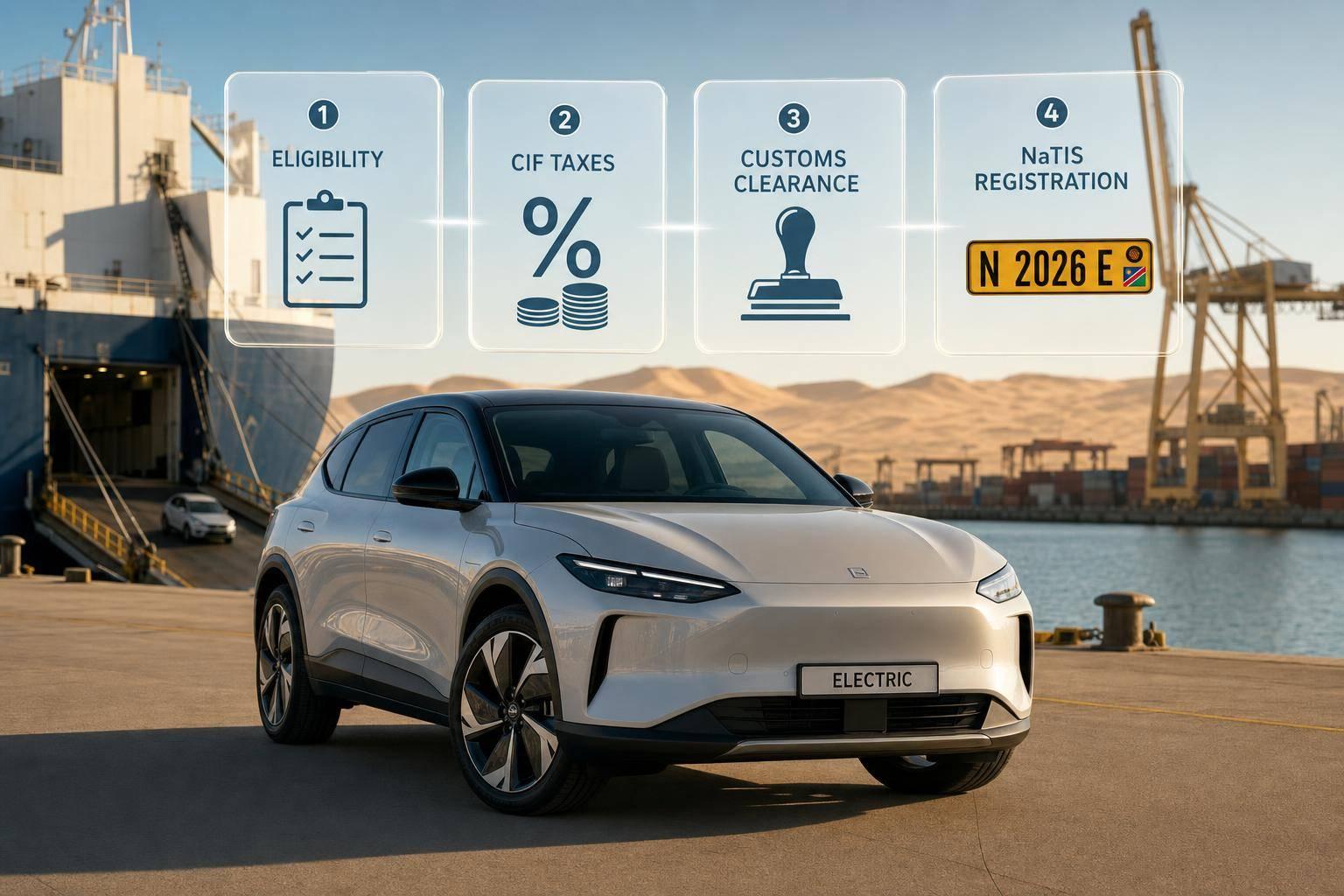
If you want to import an EV into Namibia in 2026, I’d focus on four things first: age limit, origin, taxes, and paperwork. As of August 22, 2026, imported passenger and light commercial vehicles are generally limited to 12 years old or newer, and that one rule can decide whether the deal works at all.
Here’s the short version:
- I need to check that the car is fully electric and within the 12-year import window.
- I should confirm whether it comes from SACU or outside SACU, because that can change duty treatment.
- I need to budget from the CIF value: vehicle price + freight + insurance.
- I should expect import duty first, then VAT on CIF plus duty.
- I must have matching documents, especially the VIN/chassis number, invoice, shipping papers, title, and deregistration records.
- I can’t drive the car after customs release until it passes roadworthy inspection, then completes NaTIS registration, licensing, and number plate issue.
The main cost trap is simple: the purchase price is only part of the bill. My total spend can also include duty, VAT, port charges, clearing fees, inland transport, insurance, and registration fees. A used EV from outside SACU may look cheaper at first, but extra duty and document checks can narrow that gap fast.
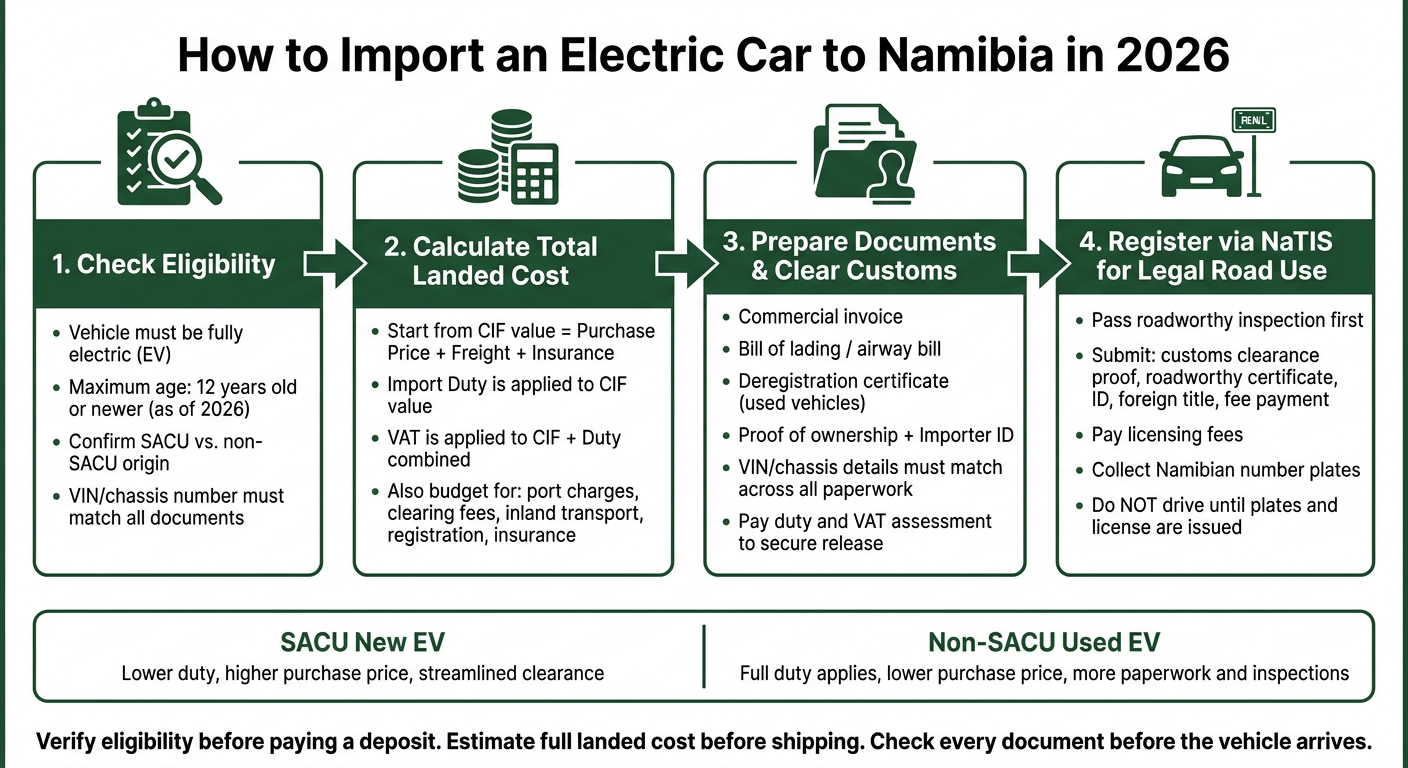
How to Import an Electric Car to Namibia: Step-by-Step Guide (2026)
BUSINESS TODAY | UNDERSTANDING NAMRA VEHICLE IMPORTING REGULATIONS – nbc

sbb-itb-99e19e3
Quick comparison
| Item | SACU New EV | Non-SACU Used EV |
|---|---|---|
| Age-rule risk | Lower | Must still fit the 12-year rule |
| Duty exposure | Often lower, sometimes exempt | Usually full duty applies |
| Paperwork load | Standard import papers | More ownership and age proof |
| Border checks | Lighter | Closer inspection |
| Base price | Higher | Lower |
| Total landed cost | Lower tax, higher buy price | Higher tax, lower buy price |
Bottom line: I’d verify eligibility before paying a deposit, estimate the full landed cost before shipping, and check every document line by line before the vehicle reaches Namibia.
1. Check Whether Your EV Can Be Imported
Before you pay a deposit or line up shipping, make sure the vehicle fits Namibia’s import rules. Namibia currently limits imported passenger and light commercial vehicles to 12 years old or newer. The vehicle’s origin matters too, since SACU and non-SACU vehicles may be handled differently at customs.
New vs. Used EVs, SACU vs. Non-SACU Origin
New EVs are usually simpler to verify. Their condition is easier to confirm, and the ownership trail is often much clearer.
Used EVs get a closer look, especially vehicles coming from markets like Japan. Inspectors check VIN/chassis details, condition, and roadworthiness before the vehicle is released.
Origin plays a part as well. Vehicles sourced from within the Southern African Customs Union (SACU) may face different customs treatment than vehicles from non-SACU markets.
Private Import vs. Fleet Import
For a private import, check the title, deregistration papers, and VIN/chassis number against each other before shipping. If even one detail is off, that can turn into a headache later.
Fleet imports usually take more prep. Business buyers should expect closer review of their paperwork.
Quick Eligibility Decision Path
Use these four checks before you buy:
- Is it fully electric? Make sure the vehicle is correctly listed as an EV.
- Is it young enough? Confirm that the manufacture date puts it within Namibia’s 12-year import window.
- Is the VIN/chassis number consistent? Match the vehicle number to the title and deregistration documents before shipping.
- What is the origin? Check whether the vehicle is coming from a SACU or non-SACU market, since that can affect customs treatment.
Once these checks are clear, move on to taxes and landed cost.
2. Calculate Taxes and Total Landed Cost
Once your EV passes the eligibility checks, the next job is simple: figure out what you’ll actually pay. The purchase price is just the starting point. You still need to add duty, VAT, port charges, clearing fees, inland transport, registration, and insurance before the car is legal to drive. That’s why it makes sense to estimate your landed cost before the vehicle ships.
How Customs Value, Duty, and VAT Are Calculated
Namibian customs works from the CIF value – the vehicle’s invoice price plus freight and insurance. That CIF amount becomes the taxable base.
Here’s how the math works:
- Import duty is charged on the CIF value first.
- VAT is then charged on the combined amount of the CIF value plus the duty.
So the tax stack builds in layers. And because EVs can face higher import duty, it’s smart to budget for more than just CIF plus VAT.
Cost Breakdown Table for a Typical EV Import
The table below shows the main cost items that can show up in a standard EV import budget. The exact numbers will change from one shipment to another, but the landed-cost structure stays the same.
| Cost Item | Calculation Basis / Description | Budget Note |
|---|---|---|
| Purchase Price | Invoice value | Base price of the vehicle |
| Freight & Insurance | Shipping and insurance charges | Included in the CIF value |
| Customs Value (CIF) | Invoice price + freight + insurance | Used to calculate duty and VAT |
| Import Duty | Applied to the customs value | Added before VAT is calculated |
| VAT | Applied to customs value + duty | Calculated after duty |
| Port charges | Handling fees at the port of entry | Part of total landed cost |
| Clearing fees | Customs brokerage services | Part of clearance costs |
| Inland Transport | Delivery from the port to your final destination | Depends on distance and route |
| Registration and licensing | Annual fees for legal road use | Required to operate lawfully on local roads |
| Insurance | EV premiums are often higher because parts and repairs are more specialized | Add to your total budget |
Scenario Comparison: SACU New EV vs. Non-SACU Used EV
Where the vehicle comes from – and whether it’s new or used – can change the final bill by a lot.
| Feature | New EV (SACU Source) | Used EV (Non-SACU Source) |
|---|---|---|
| Duty Exposure | Generally lower or exempt under SACU agreements | Subject to full import duties |
| Document Burden | Standard registration and SACU certificates | Ownership history, age verification, export documents, and roadworthiness checks |
| Border Checks | Streamlined customs clearance | More rigorous roadworthiness inspection |
| Purchase Price | Higher purchase price | Lower purchase price, but subject to the 12-year age limit |
| Total landed cost | Lower tax burden; higher vehicle price | Higher duty burden; lower vehicle price |
A used EV from outside SACU can look like a bargain at first glance. But once duty, inspections, and paperwork enter the picture, that price gap can shrink fast.
Once your budget is mapped out, you can move on to the customs paperwork and get ready for clearance.
3. Prepare Documents and Clear Customs
Once you know the landed cost, the next job is customs. At this stage, paperwork does most of the heavy lifting. Every document needs to match the vehicle exactly. The goal is no longer to estimate taxes. It’s to show that the EV can be released without problems.
Customs Document Checklist
Your clearing agent needs a complete set of documents before filing the declaration. If even one item is missing, the shipment can be put on hold.
| Document | Notes |
|---|---|
| Commercial invoice | Shows the vehicle’s purchase details and description |
| Bill of lading or airway bill | Issued by the shipping carrier and should match the invoice |
| Deregistration certificate | Required for a used vehicle from the country of origin |
| Proof of ownership | Helps confirm the ownership history |
| Importer ID | Passport or national ID |
| Proof of roadworthiness | Needed before the vehicle is released for local use |
| VIN/chassis number details | Must match the invoice, shipping papers, and vehicle |
Border Inspection and Release Process
When the shipment reaches the port or border post, the clearing agent submits the customs declaration. Customs officers then compare that declaration with the full document package. They check that the VIN, or chassis number, and the vehicle description match across the paperwork and the vehicle itself.
If everything lines up, customs issues the duty and VAT assessment. Once you pay that amount, you can move to registration. Roadworthiness approval is needed before the vehicle can be used on local roads, but it comes after customs release.
After customs release, registration becomes the last legal step.
Common Delays at the Port or Border
Most clearance issues come from a small set of mistakes that can be avoided. The most common one is a mismatch between the VIN or chassis number on the invoice and the number shown on the vehicle or shipping documents. One wrong digit is enough to stop the process.
Other delays often come from:
- Missing deregistration records for used vehicles
- Incomplete ownership history
- Vague vehicle descriptions that do not clearly identify the EV model
It helps to cross-check every document before shipping. Fixing a mismatch after the vehicle arrives is where things usually get messy.
4. Register Your EV in Namibia for Legal Road Use
After customs releases the vehicle, NaTIS registration is the last legal step before you can use the EV on public roads. Until registration and licensing are complete, the vehicle can’t be driven legally.
Documents Needed for Registration
Customs clearance doesn’t finish the process. NaTIS has its own set of paperwork before it will issue registration. One thing comes first: pass the roadworthy inspection before you hand in the registration file.
The main documents NaTIS asks for are:
- Proof of customs clearance
- Roadworthy certificate
- Importer ID (passport or national ID)
- Foreign title or deregistration papers
- Proof of registration and licensing fee payment
Commercial fleets may need extra permits.
The table below shows the split between documents used at customs and documents NaTIS still needs.
Customs vs. Registration Document Checklist
| Document / Requirement | Customs | Registration |
|---|---|---|
| Importer Identification (ID/Passport) | ✓ | ✓ |
| Foreign Title / Deregistration Papers | ✓ | ✓ |
| Proof of Duty/VAT Payment | ✓ | – |
| Proof of Customs Clearance | – | ✓ |
| Roadworthy Certificate | – | ✓ |
| Registration & Licensing Fee Payment | – | ✓ |
| Issuance of Namibian Number Plates | – | ✓ |
Last Steps Before Road Use
Submit the registration file to NaTIS, pay the licensing fees, and collect the number plates. Do not drive the vehicle until it has both plates and a valid license.
After registration, the costs shift to ongoing compliance: annual licensing and insurance.
Conclusion: The Shortest Safe Path to Importing an EV Into Namibia
Importing an EV into Namibia in 2026 comes down to four steps: confirm eligibility, budget for duty and VAT, clear customs with matching documents, and register the vehicle before road use.
Once the vehicle qualifies, work out the full landed cost before you buy. That means the purchase price, freight, duty, VAT, port charges, clearing fees, and registration.
Then move to customs paperwork. At customs, every document needs to match the vehicle exactly. Even a small VIN or ownership mismatch can hold up release and lead to storage fees.
Once customs clears the vehicle, complete registration before driving it. After registration, set aside money for insurance and annual licensing.
FAQs
How do I verify the car’s age before I buy?
Check the vehicle’s registration papers from the country of origin. They should show the year of manufacture.
Then look at the bill of lading and make sure it shows the same year. Your shipping and registration documents need to match so you can help confirm the vehicle meets Namibian import rules.
What costs are usually missed in the import budget?
Beyond the purchase price and base shipping, there are a few extra costs that often catch buyers off guard.
One of the big ones is destination and port handling charges, which average about $400. You may also need to pay for ocean freight insurance, which is usually around 1.5% of the cargo value.
A few other charges are easy to miss too:
- Customs broker fees
- Certification costs for Namibian standards
- Demurrage fees if the vehicle sits at the port too long, often estimated at 3% of cargo value
These costs can add up fast, so it helps to factor them in early instead of treating them like last-minute surprises.
What happens if my VIN details don’t match?
If the VIN or chassis number on your documents doesn’t match the vehicle or the bill of entry, customs will likely hold up clearance.
Check that the chassis number, brand, model, year of manufacture, and engine number match across every document. That includes the bill of lading, registration papers, and bill of entry.
Even one missing detail or a small mismatch can slow things down and may lead to extra fees.