
 Thabo Nkosi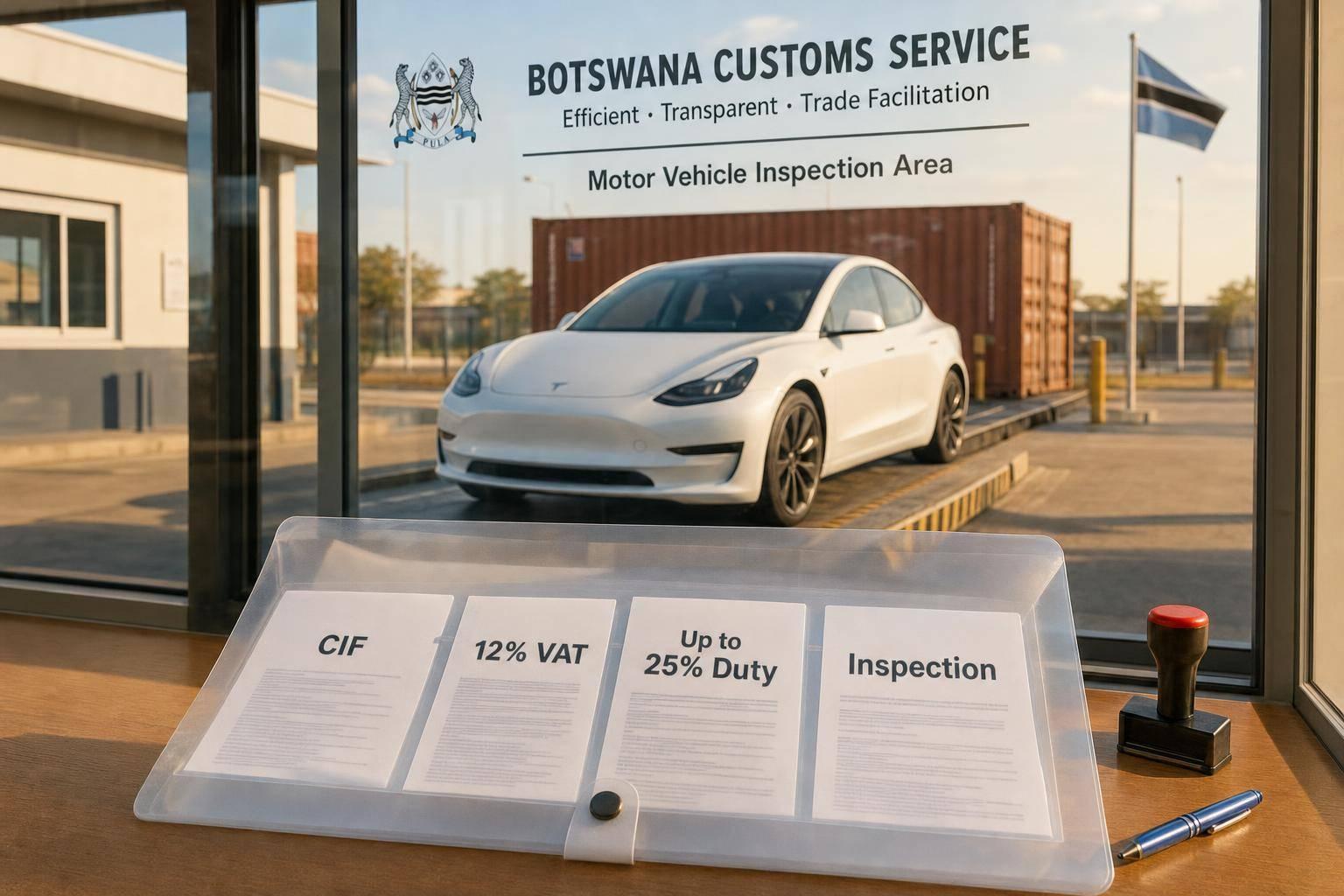
If you import an EV into Botswana in 2026, your total cost is usually much more than the car price. You need to budget for shipping, insurance, customs duty if the car is from outside SACU, 12% VAT, clearance, inspection, and registration.
Here’s the short version:
- If the EV qualifies as SACU-origin, customs duty is usually 0%
- If it’s from Japan, the UK, China, the UAE, or other non-SACU markets, duty is often about 25% to 27% of CIF
- VAT is 12%
- Botswana customs use CIF value: car price + insurance + freight
- You usually need:
- title or registration papers
- invoice or bill of sale
- customs release
- police clearance
- roadworthiness certificate for vehicles 3 years old or older
- registration papers and ID
- Clearance often takes 2 to 5 working days if the paperwork matches
What matters most is origin, paperwork, and the CIF value. A non-SACU import can cost thousands more than a SACU-origin car because duty is added before VAT. For example, a used EV bought for about $7,500 can end up closer to $13,240 landed before any buffer for delays, exchange-rate changes, or storage.
Quick comparison
| Item | SACU-origin EV | Non-SACU EV |
|---|---|---|
| Customs duty | 0% if origin rules are met | About 25% to 27% of CIF |
| VAT | 12% of CIF | 12% of CIF + duty |
| Main tax base | CIF | CIF |
| Clearance risk | Lower if origin proof is in order | Higher tax bill if origin proof does not apply |
| Landed cost | Lower | Higher |
The process is simple on paper: buy the car, arrange shipping, clear it with BURS, get police clearance, pass roadworthiness if needed, and register it. Below, I’ll walk through the costs, documents, and steps in plain English so you can budget before you send money.
sbb-itb-99e19e3
Botswana Import Rules That Apply to Electric Cars
Botswana handles EV imports much like any other motor vehicle import. The main thing that changes your tax bill is where the car comes from, not whether it runs on gasoline or electricity. For customs, the value used is CIF: the purchase price, insurance, and freight to Botswana. That CIF figure is the starting point for your duty and VAT bill before the car even ships.
SACU Origin Rules and How They Affect Your Duty Bill
Botswana is part of the Southern African Customs Union (SACU), along with South Africa, Namibia, Lesotho, and Eswatini. If a vehicle originates within SACU and meets SACU origin rules, it can move between member states duty-free.
That has a big effect on what you pay.
- An EV that meets SACU origin rules enters Botswana at 0% customs duty.
- A vehicle from outside SACU is charged about 25% to 27% of CIF in customs duty.
- After that, 12% VAT is charged on CIF plus duty.
| EV Origin | Customs Duty Treatment | VAT Base |
|---|---|---|
| South Africa (SACU origin) | 0% customs duty if origin rules are met | CIF value |
| Namibia / Lesotho / Eswatini (SACU origin) | 0% customs duty if origin rules are met | CIF value |
| Japan (non-SACU) | About 25% to 27% of CIF | CIF + customs duty |
| United Kingdom (non-SACU) | About 25% to 27% of CIF | CIF + customs duty |
| China (non-SACU) | About 25% to 27% of CIF | CIF + customs duty |
| UAE (non-SACU) | About 25% to 27% of CIF | CIF + customs duty |
A car from South Africa can land very differently, tax-wise, than the same model from Japan. That’s why origin matters so much here.
Customs Duty, VAT, and How They Are Calculated
BURS works out duty first. Then it applies VAT to the total of CIF + duty. The calculation is simple on paper:
Duty = CIF × duty rate; VAT = 12% × (CIF + duty).
So if the car is non-SACU, duty gets added first, and VAT is charged on top of that amount, not just on the CIF value.
Roadworthiness, Safety, and Registration Requirements
To clear and register the vehicle, you’ll need proof that you own it. That usually means the original title or registration papers from the country of origin, plus a bill of sale or invoice. If those papers aren’t in English, they need to be translated into English.
You also need BURS to issue a stamped customs release after all duty and VAT have been paid. On top of that, a Police Clearance Certificate is required to check the chassis and motor numbers against the import papers.
If the vehicle is three years old or older, counted from the year it was made, it must pass a roadworthiness inspection at a DRTS-authorized testing station. EVs do not need emissions testing as part of that inspection.
For registration, submit:
- Original title or registration papers
- Bill of sale or invoice
- Customs release
- Police Clearance Certificate
- Roadworthiness certificate
- RV1 form
- Proof of identity
With those rules in place, the next step is the import process itself and the order the paperwork needs to follow.
Step-by-Step: How to Import an Electric Car Into Botswana
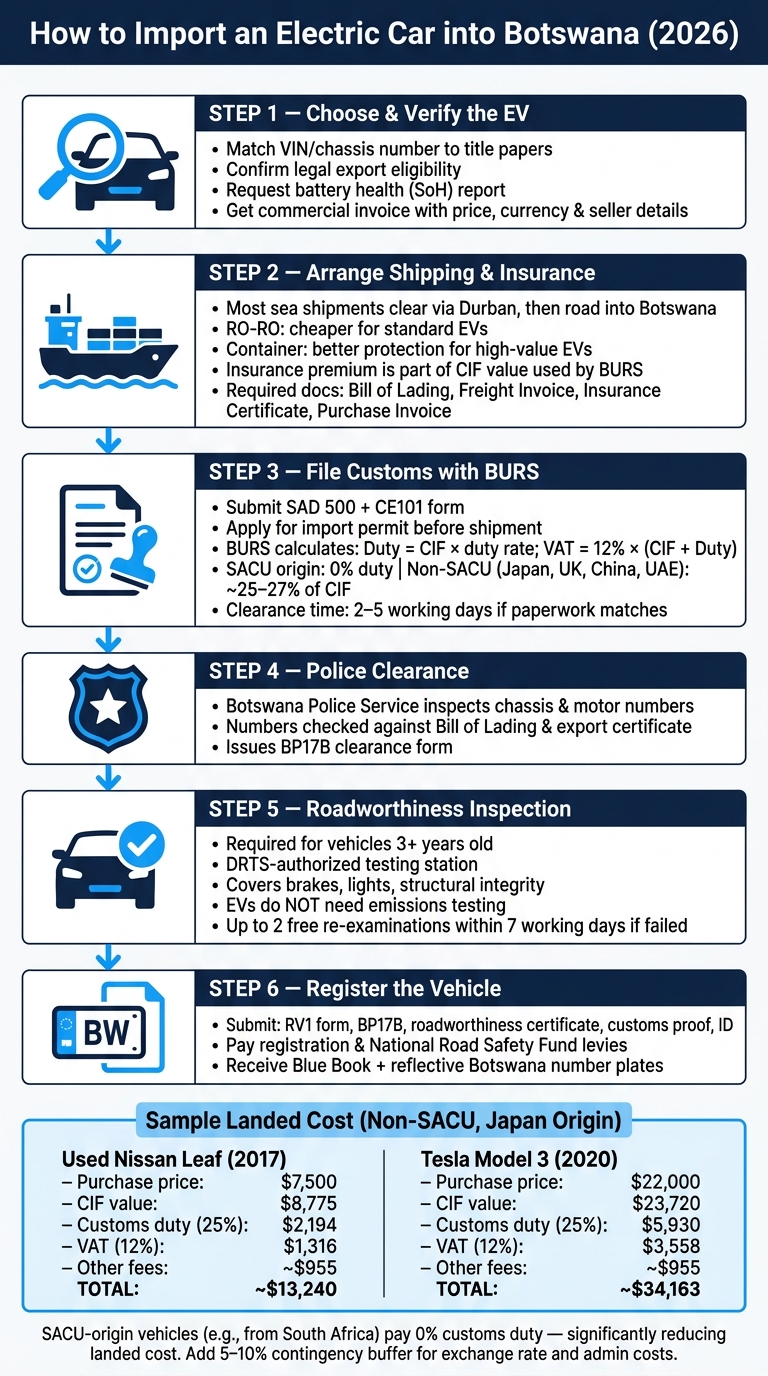
How to Import an Electric Car to Botswana: Step-by-Step Process & Costs
Importing an EV into Botswana follows a set order. Skip one part, and the vehicle can get stuck at customs or stopped during registration.
Choose the EV and Check the Seller Before You Pay
Start by checking both the car and the seller before sending any money. Make sure the VIN or chassis number matches the title and registration papers exactly. You also need to confirm that the vehicle can legally be exported from the country it’s coming from.
If you’re buying a used EV, ask for a few extra details up front:
- Battery size
- Battery health report
- Charging port type
- Service history
That small bit of homework can save you from ending up with an EV that’s tough to charge or service in Botswana.
You should also ask for a commercial invoice that shows the price, currency, seller details, and proof of payment. BURS uses these papers to value the car. If the numbers or details don’t line up, they may reassess the value.
Arrange Shipping, Insurance, and Import Documents
Most sea shipments clear through Durban and then move by road into Botswana. Vehicles bought from South Africa usually come in by truck.
If you’re weighing RO-RO against container shipping, the trade-off is pretty simple. RO-RO is often cheaper for standard-size EVs. Container shipping gives more protection for higher-value vehicles.
Set up shipping insurance before the car moves. That premium becomes part of your CIF value, which BURS uses when working out duty and VAT. If freight or insurance costs are declared too low, that can lead to penalties and reassessment.
Your main shipping papers need to match across the board:
- Bill of lading
- Freight invoice
- Insurance certificate
- Purchase invoice
Send these to your clearing agent before the vessel arrives. That gives them time to prepare the SAD 500 customs declaration and CE101 form in advance. You also need to apply for the import permit before shipment through your clearing agent. Once the shipping papers match the invoice, your agent can move ahead with the customs filing.
Clear Customs, Pass Inspection, and Register the Car
When the vehicle arrives, the order matters: customs first, then police clearance, roadworthiness, and registration. Submit the SAD 500 with the supporting papers, pay the duty and VAT assessed, and then move to inspection and registration.
With everything in order, clearance usually takes two to five working days. If papers are missing or don’t match, it can drag on for several weeks.
After BURS releases the vehicle, take it to the Botswana Police Service for a physical inspection. Officers check the motor and chassis numbers against the bill of lading and export certificate. They then issue the BP17B clearance form.
If the vehicle is three years old or older, it must then go to a DRTS-authorized testing station for a roadworthiness test. That check covers brakes, lights, and structural integrity. If the car fails, you can get up to two re-examinations within seven working days at no extra cost.
To register the vehicle, submit the RV1 form, BP17B, roadworthiness certificate, customs clearance proof, and your ID to the licensing office. After you pay the registration and National Road Safety Fund levies, you’ll receive the Blue Book and reflective Botswana number plates.
| Stage | Key Documents Needed |
|---|---|
| Purchase | Commercial invoice, proof of payment, VIN verification, battery health report, service history |
| Shipping | Bill of lading, freight invoice, insurance certificate |
| BURS customs | SAD 500, CE101, import permit, export certificate, ID |
| Police clearance | BP17B, bill of lading, export certificate, customs release |
| Roadworthiness | DRTS inspection certificate (vehicles 3+ years old) |
| Registration | RV1 form, BP17B, roadworthiness certificate, customs proof, ID |
These filings determine your final landed cost, which comes next.
How to Calculate the Total Landed Cost of an EV in Botswana
Once customs, inspection, and registration are sorted out, the next thing to figure out is the full landed cost. And this is where many buyers get caught off guard.
The final amount is often much higher than the vehicle’s sticker price. So before you commit, it helps to run the numbers with a simple formula.
A Step-by-Step Landed Cost Formula
Use this formula after you confirm origin status and duty treatment.
Outside SACU, calculate duty at 25% of CIF, then calculate VAT at 12% of (CIF + duty).
Within SACU, duty is 0, and VAT is 12% of CIF.
After that, add the Botswana-side costs:
- Clearing-agent fees
- Port or terminal handling
- Inland transport
- Police clearance
- Roadworthiness inspection
- Registration
- License plates
- Storage charges if the vehicle is delayed
It also makes sense to add a 5% to 10% contingency for exchange-rate movement and small admin charges.
Use this as a budgeting estimate. Customs may still adjust the taxable base.
Sample Cost Breakdown: Used Nissan Leaf and Tesla Model 3
The examples below show how the formula changes by vehicle value. These hypothetical examples show how the formula changes by vehicle value. Both assume the vehicles are sourced from Japan and shipped through Durban, so the budget includes the 25% duty assumption and 12% VAT.
All amounts are in USD for the calculation stage. Buyers will pay BURS in Botswana Pula at the exchange rate in effect at the time.
| Cost Component | Used Nissan Leaf (2017, ~40 kWh) | Tesla Model 3 (2020, Long Range) | Notes |
|---|---|---|---|
| Purchase price | $7,500 | $22,000 | Hypothetical examples only |
| International shipping & export handling (RoRo, Japan → Durban) | $1,200 | $1,500 | Includes freight, export paperwork, and seller pickup in this example |
| Marine insurance | $75 | $220 | Illustrative only |
| CIF value | $8,775 | $23,720 | Basis for BURS calculations |
| Customs duty (25% of CIF, non-SACU origin) | $2,194 | $5,930 | 0% if SACU-origin paperwork qualifies |
| Duty-inclusive value | $10,969 | $29,650 | CIF + duty |
| VAT (12% of duty-inclusive value) | $1,316 | $3,558 | Applied after duty |
| Clearing-agent fees | $165 | $165 | Illustrative only |
| Port & terminal handling | $275 | $275 | Illustrative only |
| Inland transport (Durban → Gaborone) | $350 | $350 | Illustrative only |
| Roadworthiness inspection | $55 | $55 | Re-test may be extra if needed |
| Registration, plates & Blue Book | $110 | $110 | Illustrative only |
| Estimated total landed cost | $13,240 | $34,163 | Before contingency buffer |
The Nissan Leaf example shows how a $7,500 purchase can turn into about $13,240 before contingency. The Tesla Model 3 lands at about $34,163.
That gap matters. A car that looks cheap at purchase can end up costing much more by the time it reaches your driveway.
If SACU-origin paperwork applies, the duty line drops out, and the VAT bill also falls. For a safer budget ceiling, add another 5% to 10% on top of the totals above.
Extra Charges Buyers Often Overlook
Duty and registration are only part of the story. Small admin costs can quietly push the bill higher.
Port storage is one of the most common surprises. If your customs paperwork isn’t ready when the vehicle arrives, storage fees can start piling up fast. Have your invoice, bill of lading, proof of insurance, and origin documents ready before the vessel arrives.
You should also budget for bank charges and exchange-rate losses when estimating your full cash outlay.
And leave a small cushion for re-tests and minor compliance fixes. Those costs may look small on their own, but they add up.
How to Buy Smarter and Avoid Common Import Mistakes
How EV24.africa Can Help You Source and Import an EV
Once you understand the landed-cost formula, the next move is picking a vehicle that can clear without trouble and handle Botswana conditions. That part matters more than many buyers expect. Not every EV is a good fit for local heat, gravel roads, and charging limits.
EV24.africa lists new and used EVs with the details Botswana buyers should check before they commit, including:
- Charging port type
- Onboard charger power
- DC fast-charging support
- Ground clearance
If you’re looking at a used EV, don’t stop at photos and a walkaround. Ask for battery SoH, inspection reports, mileage verification, service history, and accident history. EV24.africa can also help line up export paperwork and shipment details before the vehicle leaves the origin country.
After you’ve shortlisted a car, the biggest trouble spots usually come down to paperwork and battery checks.
Mistakes That Lead to Delays or Higher Costs
A lot of buyers lowball the final tax bill because they calculate duty and VAT from the sticker price alone. That’s where things go sideways. Both are based on CIF, not just the vehicle price.
Paperwork errors are another common cause of delays. If the VIN, chassis number, or motor number doesn’t match across the commercial invoice, bill of lading, and export certificate, the vehicle can run into police clearance problems.
And here’s a big one: a visual check won’t tell you much about battery condition. A used EV can look fine and still have a weak battery. Ask for a proper SoH report before you send payment.
Conclusion: Documents, Costs, and Steps to Sort Out First
Before you send money, pin down the facts that affect duty, clearance, and registration. Confirm origin status, CIF value, and duty treatment before paying a deposit.
Then get your paperwork lined up before shipment:
- Invoice
- Bill of lading
- Export certificate
- Insurance proof
- Origin documents
From there, follow the process in the right order: clear customs first, complete inspection next, and register last.
FAQs
How do I prove SACU origin?
Use documents that show the EV came from within the SACU area, and add them to your customs clearance file.
Keep your registration or title papers, along with any certificate or other proof of origin from the home country. Your purchase invoice and shipping papers should line up with those origin claims when you file with BURS, including the SAD 500.
If you can’t clearly prove SACU origin, Botswana will treat the vehicle as an external import.
Can BURS change my declared EV value?
Yes. BURS can reassess your electric vehicle’s declared value if it believes the amount is inaccurate.
That’s because import duty and VAT are based on the CIF value. So BURS may check your invoice, proof of purchase, and the vehicle’s condition. It may also inspect the car before release to make sure the taxes are calculated correctly.
What delays EV clearance in Botswana?
EV clearance in Botswana often gets held up when BURS or customs paperwork is missing, incomplete, or doesn’t line up across documents.
The usual trouble spots are:
- Missing or wrong import permits or residence permits
- Form IC.2
- Form CE101
- The purchase invoice
- The police clearance certificate
- Customs declaration paperwork, such as SAD 500
Delays can also happen when the vehicle hasn’t been inspected or verified before release. And if key customs processing deadlines are missed, that can slow things down too.