
 Thabo Nkosi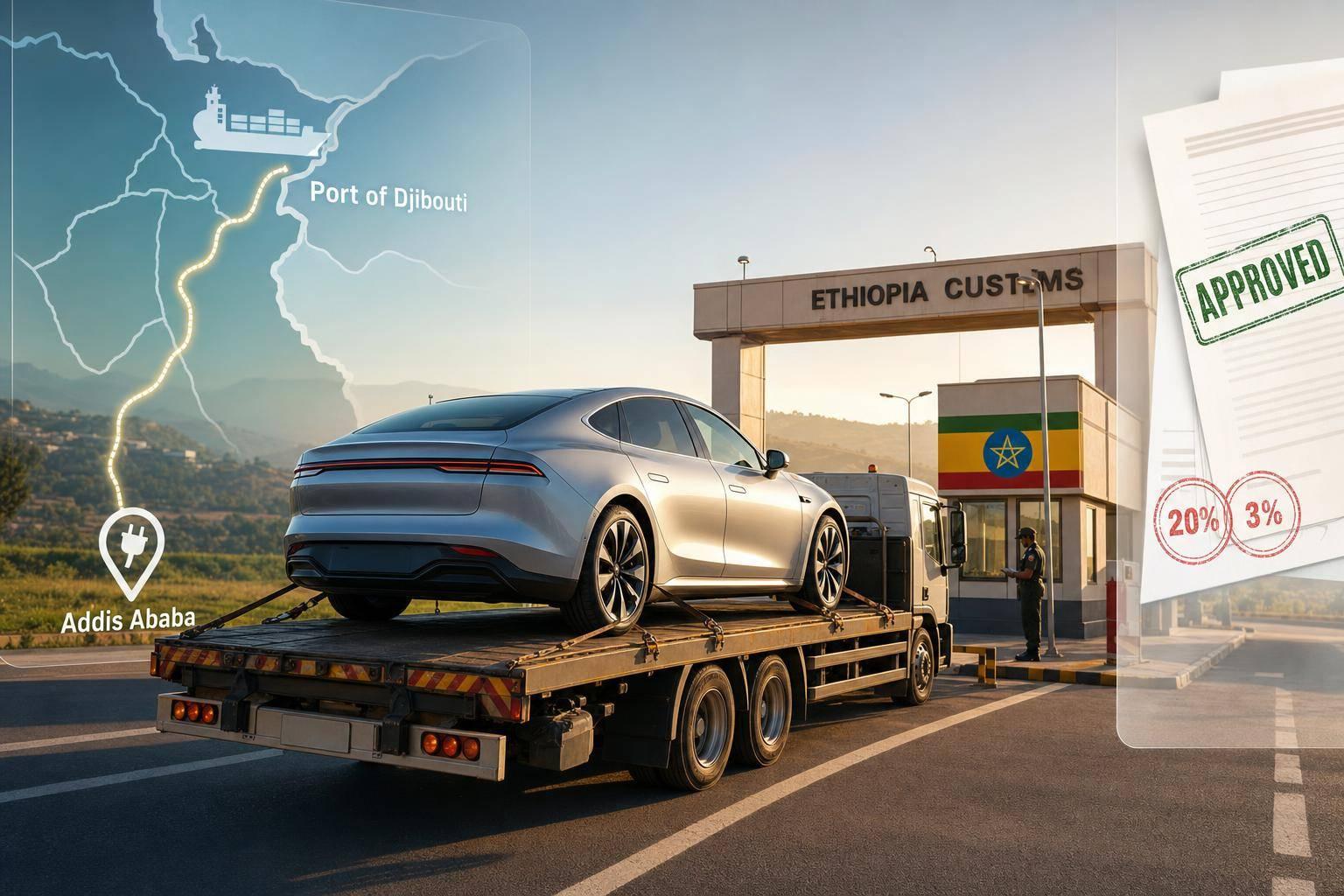
If the car is not a pure battery electric vehicle, you cannot import it into Ethiopia in 2026. That is the first thing I’d check before paying a seller, booking shipping, or sending a deposit.
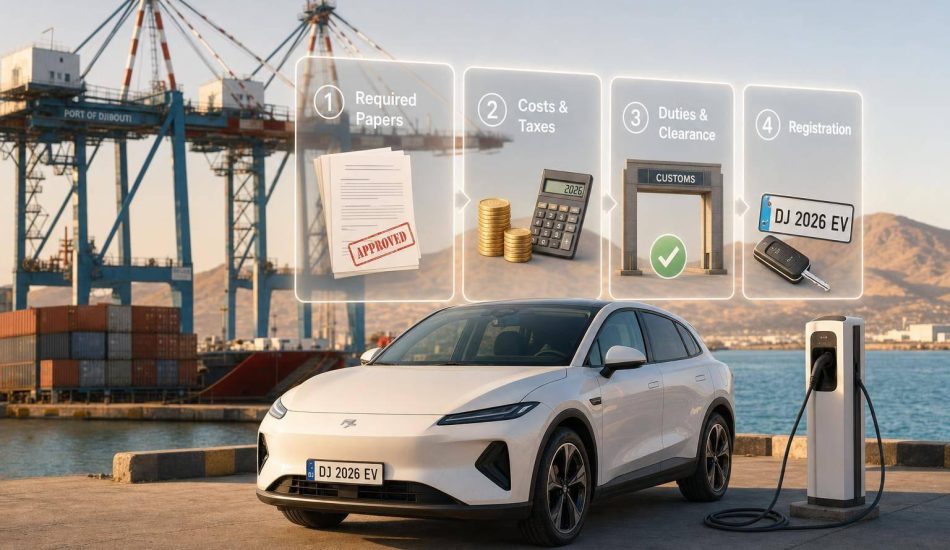
Here’s the short version: only BEVs are allowed for private import. Hybrids, plug-in hybrids, gasoline cars, and diesel cars are banned. For a fully built EV, I’d budget for 20% customs duty on CIF value, 3% withholding tax, shipping through Djibouti, inland delivery to an Ethiopian dry port, and ETB 44,500 ($365) for RFID “ETH” plates.
Before I buy, I’d make sure of these points:
- Vehicle type: pure BEV only
- Drive side: left-hand drive only
- Documents: VIN, invoice, bill of lading, title, and EV specs must match
- Taxes: 20% duty + 3% withholding
- Tax breaks: 0% VAT, 0% excise tax, 0% surtax for BEVs
- Route: ship to Djibouti, then move inland to Ethiopia
- Used EV check: ask for a battery health report
- Registration: inspection comes before plates are issued
A simple cost example: if your EV’s CIF value is $25,000, customs duty would be $5,000, withholding would be $750, and your other local costs would still need to be added on top. So the final landed cost can move well past the sticker price.
If I were planning this import, I’d treat it as a paperwork and cost-control job first, and a car purchase second.
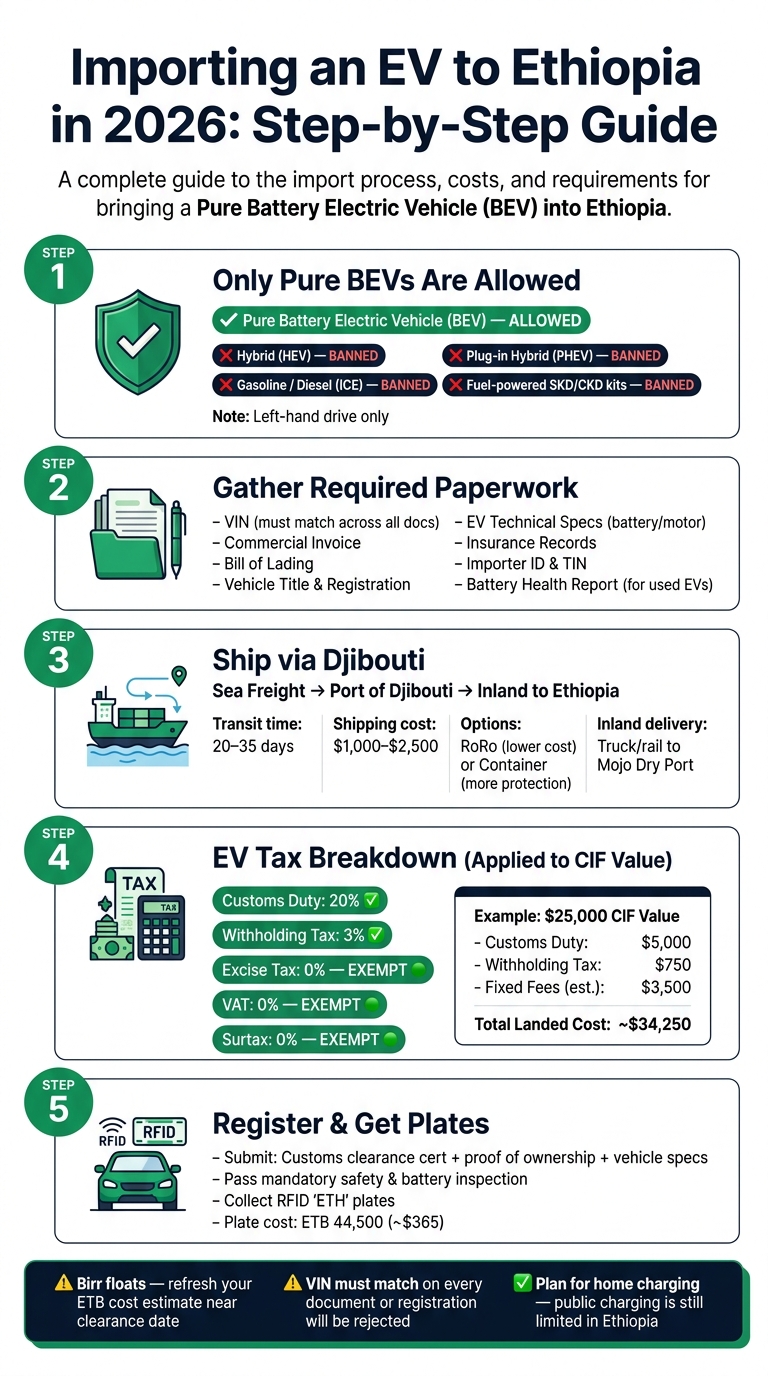
How to Import an Electric Car to Ethiopia in 2026: Step-by-Step Process & Costs
1. Check Whether the Electric Car Qualifies for Import
Pure BEVs Are Allowed; ICE and Hybrid Vehicles Are Not
The first filter is simple: the car must be a pure battery electric vehicle. Customs rejects any vehicle with an internal combustion engine, which means hybrids, PHEVs, and gasoline or diesel vehicles are out. The same rule applies to fuel-powered SKD and CKD kits, so importing parts for later assembly doesn’t get around the ban.
Here’s the quick check:
| Vehicle Type | Import Status |
|---|---|
| Pure Battery Electric Vehicle (BEV) | ✅ Allowed |
| Hybrid (HEV) | ❌ Banned |
| Plug-in Hybrid (PHEV) | ❌ Banned |
| Gasoline / Diesel (ICE) | ❌ Banned |
| Fuel-powered SKD / CKD kits | ❌ Banned |
VIN, Model Year, Battery Condition, and Technical Document Checks
If the car is a pure BEV, pause before sending money and check the paperwork line by line.
Start with the Vehicle Identification Number (VIN). Match it against the commercial invoice, bill of lading, and the vehicle title and registration from the country of origin. Even one mismatch can lead to delays or a flat-out customs rejection.
For a used EV, ask for a certified battery-health report. That step matters because battery replacement can be expensive, and parts may be hard to find in Ethiopia. You should also confirm the charging port type and the vehicle’s voltage requirements. On top of that, make sure the model year and technical documents meet Ethiopian standards before the vehicle ships.
Once those checks are done, the next step is to pull together the shipping and customs documents.
sbb-itb-99e19e3
2. Prepare Your Documents and Follow the Import Process Step by Step
Documents to Collect Before Shipping
Once the EV qualifies, the process moves into three parts: document prep, shipping through Djibouti, and customs clearance at the dry port. This is the stage where small mistakes can turn into big headaches. Before the car ships, check that every document matches on the VIN, model year, and declared value. Even minor differences can lead to customs disputes and hold up clearance at the dry port.
Here’s who handles each document:
| Document | Who Prepares It |
|---|---|
| Importer ID & Tax Identification Number (TIN) | Buyer |
| Commercial Invoice | Seller |
| EV Technical Documents (battery/motor specs) | Seller |
| Bill of Lading (BoL) | Shipping Company |
| Insurance Records | Buyer / Insurance Provider |
One more thing: Ethiopia does not allow right-hand-drive vehicles. Confirm that the EV is left-hand drive before you send payment.
Shipping Through Djibouti and Inland Delivery to Ethiopia
Because Ethiopia is landlocked, sea freight usually comes in through the Port of Djibouti. That’s the standard entry point for Ethiopian vehicle imports. After arrival, the vehicle is moved by truck or rail to Ethiopian dry ports, with Mojo Dry Port being the most common destination.
Sea freight usually takes 20–35 days and costs about $1,000–$2,500, depending on where the vehicle ships from and whether you use RoRo or a container. RoRo (roll-on/roll-off) is often the lower-cost option. Container shipping, on the other hand, gives the vehicle more protection in transit, which can matter for EV electronics.
Once the inland transfer is done, customs clearance starts at the dry port.
Customs Clearance From Arrival to Vehicle Release
At the dry port, your clearing agent files the customs declaration with ERCA. Duties are calculated on a CIF basis, which means customs uses the vehicle’s purchase price plus insurance and freight costs to set the customs value.
For a fully built EV (CBU), the customs duty is 20%. VAT, excise tax, and surtax are 0%, and a 3% withholding tax also applies. After ERCA checks the documents and you pay the assessed charges, it issues a customs clearance certificate. You’ll need that certificate, along with the bill of lading, for the next step: vehicle registration.
These charges go straight into your landed cost, which the next section breaks down.
3. Calculate EV Import Taxes, Fees, and Total Landed Cost
Main Cost Items: Vehicle Price, Shipping, Duty, Clearance, and Registration
Your landed cost starts with CIF: the vehicle price, freight, and insurance. Once you have that number, you add duty, withholding, and the local charges that come with getting the car from Djibouti to registration in Ethiopia.
| Cost Item | What It Covers |
|---|---|
| Purchase Price | What you pay the seller in the country of origin |
| Freight & Insurance | RoRo or container shipping to Djibouti, plus transit insurance |
| Customs Duty | 20% of the CIF value for fully built (CBU) EVs |
| Withholding Tax | 3% of the CIF value |
| Clearance, port, and broker fees | Port of Djibouti handling, Ethiopian dry port charges, and clearing agent filing fees |
| Inland Transport | Trucking from Djibouti to Addis Ababa or your region |
| Registration and plates | Private vehicle registration, including RFID "ETH" plates |
| Pre-registration inspection | Mandatory technical and safety checks before registration |
How Ethiopia’s EV Tax Incentives Affect the Total Cost
For BEVs, the tax picture is better than many buyers expect. You still pay customs duty and withholding tax, but excise tax, VAT, and surtax are exempt. That can make a big difference to the final bill, even though customs charges don’t disappear.
| Tax Component | Battery Electric Vehicle |
|---|---|
| Customs Duty | 20% (CBU) |
| Excise Tax | 0% – exempt |
| VAT | 0% – exempt |
| Surtax | 0% – exempt |
| Withholding Tax | 3% |
Worked Cost Example
Here’s how the math looks for two common BEV imports. The standard approach is simple: start with CIF, add 20% customs duty, add 3% withholding, then include your fixed fees. Use the exchange rate on the customs-clearance date to convert the totals into ETB.
| Model | CIF Value | Customs Duty (20%) | Withholding (3%) | Fixed Fees (est.) | Total Landed Cost (est.) |
|---|---|---|---|---|---|
| BYD Atto 3 | $25,000 | $5,000 | $750 | $3,500 | ~$34,250 |
| Tesla Model 3 (SR) | $35,000 | $7,000 | $1,050 | $3,500 | ~$46,550 |
Fixed fees include clearance, port handling, inland transport, broker charges, and registration. The final number can shift based on where the seller is located, whether you use RoRo or a container, and what your broker charges.
With the landed total in hand, the next step is inspection and registration.
4. Register the Car in Ethiopia and Avoid Common Import Mistakes
Inspection, Registration, and Number Plate Requirements
Once customs clearance is done, registration is the last legal step before you can use the car on public roads. After customs release, you need to register the vehicle with the Ministry of Transport and Logistics before driving it in Ethiopia.
At this stage, submit the customs clearance record, proof of ownership, and the vehicle’s specs. The car also has to pass a mandatory safety and battery inspection before plates are issued. After it passes inspection, you can collect the RFID "ETH" plates. Set aside 44,500 ETB ($365) for the plates.
Mistakes That Raise Costs or Delay Clearance
Most delays here come down to simple issues: documents that don’t match and fees that weren’t planned for. It’s the kind of stuff that seems small until it stops the whole process.
| Common Mistake | Correct Approach | Impact |
|---|---|---|
| Undervaluing the purchase invoice | Declare the accurate, verified purchase price | Customs penalties, audits, and clearance delays |
| Missing or mismatched VIN on documents | Match the VIN exactly across all shipping and technical documents | Registration rejected by the transport authority |
| Ignoring inland transport costs | Budget for trucking from Djibouti to your destination | Unexpected expenses and delays during inland delivery |
| Forgetting the new plate fee | Include 44,500 ETB in your total budget | Surprise cost at the final registration stage |
The biggest mistake is buying anything other than a pure BEV.
Using EV24.africa to Source and Ship Your EV
EV24.africa can source BEVs, coordinate shipping, and handle customs and delivery under FOB or DDP terms.
Conclusion: A 2026 Checklist for Importing an EV to Ethiopia
Importing a BEV to Ethiopia in 2026 works only if you check eligibility, paperwork, shipping, and taxes before you buy.
| Step | What to Do |
|---|---|
| 1. Eligibility | Confirm the vehicle is a pure BEV. Hybrids and ICE vehicles are banned from import. |
| 2. Documents | Collect the VIN, model year, battery report, and technical specs. |
| 3. Shipping | Ship via Djibouti, then move it inland. |
| 4. Customs | Apply 20% duty to CIF; VAT, excise tax, and surtax stay exempt. |
| 5. Registration & Plates | Complete registration and budget ETB 44,500 for RFID "ETH" plates. |
Once the car clears customs, the last big costs are charging access and maintenance.
One thing can throw off your math: the birr floats. That means your USD-based CIF value can change in ETB terms between the day you buy the car and the day it clears customs. So it makes sense to refresh your cost estimate close to the clearance date.
Public charging is still limited, so plan for home charging and keep some money set aside for maintenance.
FAQs
How do I prove an EV is a pure BEV?
Use the customs compliance documents for the technical review: the Certificate of Conformity (COC) and the supporting documents listed in it, including the Vehicle Type Approval Certificate, Vehicle Inspection Report, and Environmental Compliance Sheet.
Customs also checks that the VIN and battery specs match the submitted paperwork and confirms that the vehicle is electric-only.
What costs are not included in CIF?
CIF (Cost, Insurance, and Freight) covers the purchase price, shipping, and insurance up to the destination port.
It does not cover VAT charged on the CIF value (for example, 15%) or other border, port, and clearance costs. That includes port handling fees, storage charges if clearance is delayed, and customs clearance or agent fees.
How long does the full import process take?
Importing an electric car to Ethiopia usually takes several weeks from start to finish.
Shipping and overland delivery, often through the Port of Djibouti, usually take 20 to 35 days. Once the vehicle arrives, customs clearance often takes 1 to 2 weeks if the paperwork is accurate.
After that, registration, inspection, and plate issuance add extra time. Delays can also happen if documents are incomplete or if shipping and transport run into problems.