
 Thabo Nkosi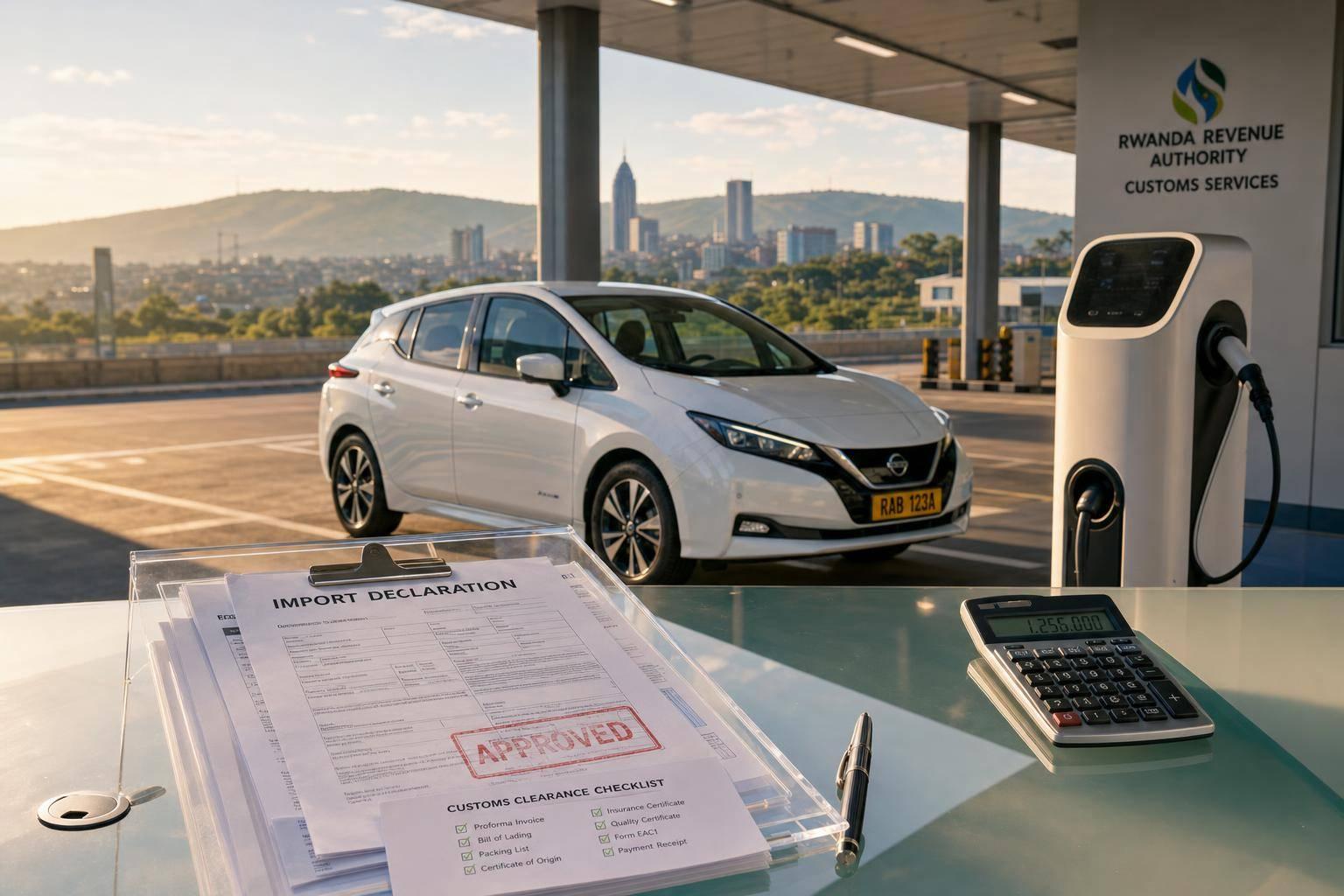
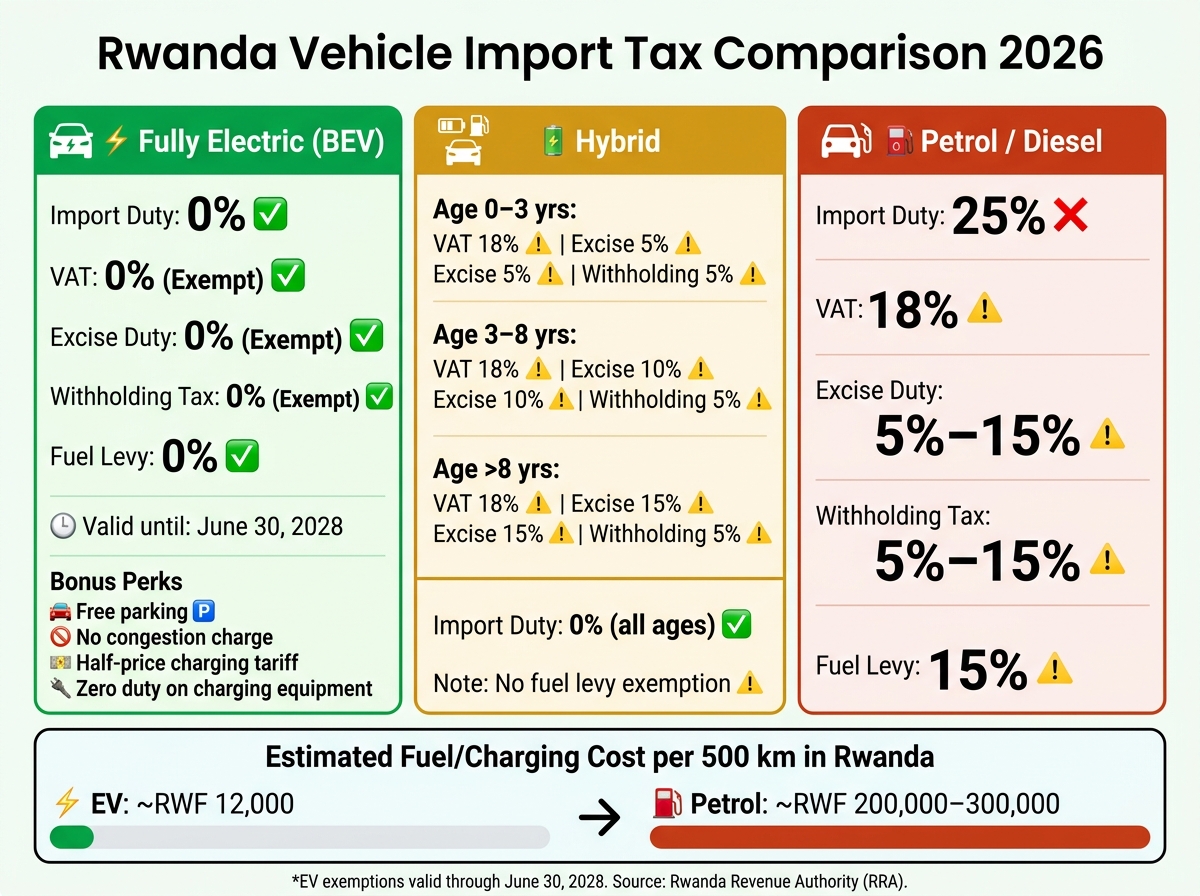
If you import a fully electric car into Rwanda in 2026, you can pay 0% import duty, 0% VAT, 0% excise duty, 0% withholding tax, and 0% fuel levy through June 30, 2028. That is the main reason many buyers are looking at EVs now.
If I were checking whether an EV import makes sense, I would focus on five numbers first: the car price, freight, insurance, local fees, and charger setup. A fully electric car can cost far less to bring in than a petrol or diesel car, but I would still verify the HS code, CIF value, inspection papers, and battery health before paying a deposit.
Here’s the article in plain terms:
- Fully electric vehicles get the full tax break in Rwanda through June 30, 2028
- Hybrids do not get the same deal; they still pay 18% VAT plus age-based taxes
- Rwanda Customs uses CIF: car price + freight + insurance
- You still need to budget for:
- port handling
- inland transport to Kigali
- clearing agent fees
- registration
- inspection
- wheel alignment
- home charging setup
- A Level 2 home charger can add about RWF 1,000,000 to RWF 2,000,000
- Charging an EV for about 500 km can cost around RWF 12,000, versus about RWF 200,000 to RWF 300,000 for petrol
- Before shipping, I would confirm:
- the car is a BEV, not a hybrid
- the papers match
- the battery state-of-health report is available for a used EV
- the car fits Rwanda’s charging network
Quick Comparison
| Vehicle type | Import duty | VAT | Excise duty | Withholding tax |
|---|---|---|---|---|
| Fully electric (BEV) | 0% | Exempt | Exempt | Exempt |
| Hybrid (0–3 years) | 0% | 18% | 5% | 5% |
| Hybrid (3–8 years) | 0% | 18% | 10% | 5% |
| Hybrid (>8 years) | 0% | 18% | 15% | 5% |
| Petrol/diesel | 25% | 18% | 5%–15% | 5%–15% |
Bottom line: if I wanted the lowest import tax bill in Rwanda in 2026, I would start with a fully electric vehicle, then check the paperwork line by line before sending money.
sbb-itb-99e19e3
Rwanda EV Import Taxes and Incentives in 2026
Rwanda EV vs Hybrid vs Petrol Import Taxes 2026: Full Comparison
Which vehicles qualify for EV tax treatment in Rwanda
Fully electric vehicles qualify for full tax exemption. But don’t assume the badge on the car is enough. In Rwanda, the Rwanda Revenue Authority (RRA) assigns each vehicle an HS tariff code, and that code decides which tax lines apply.
So before you send a deposit, check the basics first: the vehicle’s HS code, manufacture year, CIF value, and the inspection documents required for clearance. A small mismatch on paper can lead to the wrong tax bill at customs. Use those details to confirm the tax treatment before you buy.
Import duty, VAT, excise, and other tax lines to check before you buy
Fully electric vehicles are exempt from import duty, VAT, excise duty, withholding tax, and the fuel levy until June 30, 2028. Hybrids and petrol or diesel vehicles do not get the same treatment.
Here’s the current tax setup by vehicle type:
| Vehicle Type | Import Duty | VAT | Excise Duty | Withholding Tax |
|---|---|---|---|---|
| Fully Electric (BEV) | 0% | Exempt | Exempt | Exempt |
| Hybrid (0–3 years) | 0% | 18% | 5% | 5% |
| Hybrid (3–8 years) | 0% | 18% | 10% | 5% |
| Hybrid (>8 years) | 0% | 18% | 15% | 5% |
| Petrol/Diesel (ICE) | 25% | 18% | 5%–15% | 5%–15% |
You should also leave room in your budget for customs processing and local admin fees. And yes, paperwork matters more than most buyers expect. Make sure your CIF documents match the pre-shipment inspection records so you don’t run into valuation disputes at customs.
Non-tax incentives that can lower EV ownership costs
Rwanda doesn’t stop at tax relief. EV owners also get a few day-to-day perks that can trim ownership costs.
Green license plates come with free parking and no congestion charges in designated zones. That can make a noticeable difference if the vehicle is used often in urban areas.
Power costs are lower too. Rwanda offers EV charging tariffs at about half the standard electricity rate. On top of that, charging equipment gets zero import duty.
Step-by-Step: How to Import an Electric Car to Rwanda
Once you’ve confirmed the tax treatment, the process moves in a pretty clear order: source the car, ship it, clear customs, and then register it.
Step 1: Choose a compliant EV and confirm eligibility before paying
Make sure the vehicle is a battery electric vehicle (BEV) before you send any money.
Use the VIN to verify the model year and drivetrain. If you’re buying a used EV, ask for a battery state-of-health report too. That matters because RTDA checks high-voltage safety, braking, and regenerative function during the mandatory vehicle inspection (visite technique).
EV24.africa can help you compare listings and prices for Rwanda-bound imports, which makes it easier to narrow down a few options before you commit.
Step 2: Gather export, shipping, and Rwanda import documents
Get the paperwork lined up before the car leaves port. If documents are missing or don’t match, customs valuation at Gikondo can get held up.
Here are the main documents you need:
- Invoice or sale agreement – this should match the vehicle’s CIF documentation
- Bill of lading or airway bill
- Export title or deregistration certificate
- Pre-shipment inspection report – this can help cut down valuation disputes before the vehicle leaves the export country
- Battery state-of-health report – especially helpful for used EVs
- Tax exemption certificate – needed if you want to claim the EV incentives
Before shipment, check that the invoice, shipping papers, and inspection report all match. That step can help you avoid customs valuation delays.
When the documents line up, customs can move straight into valuation once the car arrives.
Step 3: Clear customs, pay assessed charges, and register the vehicle
After shipping, you’re down to the last two stages: customs clearance and inspection before registration.
Clear customs at Gikondo using the CIF value, which includes the vehicle price, freight, and insurance.
Once customs releases the car, take it for the mandatory vehicle inspection (visite technique) at RTDA. EVs don’t go through the emissions part, but inspectors still check high-voltage insulation, mounting, and regenerative braking.
Before you show up for inspection, do a basic check of:
- lights
- seatbelts
- tire tread
The legal minimum tread depth is 1.6 mm. Inspection fees depend on the vehicle category and can be paid by Mobile Money or at the on-site cashier.
If the vehicle passes, you’ll get a valid inspection certificate, a windscreen sticker, and green license plates. Those green plates give you access to free parking and congestion-charge exemptions in designated zones.
How to Calculate Your Total Landing Cost Before You Import
With the clearance steps covered, the next job is to price the import before you commit. Your landed cost is the full amount you pay to get the car delivered, cleared, and road-legal in Rwanda.
It starts with the CIF value – Cost, Insurance, and Freight – because Rwanda Customs uses CIF as the base for assessment. In simple terms:
CIF = purchase price + ocean freight + marine insurance
The full cost breakdown: purchase, freight, insurance, customs, transport, and local fees
CIF is just the starting point. You also need to budget for the other charges that show up between the port and registration.
These usually include:
- Port handling fees at Mombasa or Dar es Salaam
- Inland transport from the port to Kigali
- Clearing agent fees for paperwork and customs clearance at Gikondo
- Registration fees
- Post-shipment wheel alignment (approximately RWF 50,000)
- Home charger installation if you need one
This is where many buyers get tripped up. The car may look affordable at first glance, but the final bill depends on all of these moving parts, not just the auction or seller price.
Sample cost calculations for a used EV and a newer EV
The EV tax exemptions change the math in a big way. For a fully electric vehicle, import duty, VAT, excise duty, and withholding tax are all exempt until June 30, 2028.
Scenario A – Used EV
Taxes are effectively zero. So your total landed cost is mostly your CIF value, plus the non-tax logistics and local fees listed above.
Scenario B – Newer EV
The same tax exemption still applies to EVs. That means you take your CIF value and add the same non-tax charges to estimate your total landed cost.
EV vs. gasoline vs. hybrid import cost comparison
The same CIF value can lead to very different import costs depending on the powertrain. That’s the part that often surprises people.
| Cost Component | Electric Vehicle (EV) | Hybrid (0–3 yrs) | Gasoline/Diesel |
|---|---|---|---|
| Import Duty | 0% | 0% (Exempt) | 25% |
| VAT | 0% (Exempt) | 18% | 18% |
| Excise Duty | 0% | 5% (Age-based) | 5%–15% |
| Withholding Tax | 0% (Exempt) | 5% | 5%–15% |
| Fuel Levy | 0% | No | 15% |
That difference doesn’t stop at import. Charging an EV for 500 km costs approximately RWF 12,000, compared to over RWF 200,000 for a petrol car covering the same distance. Over time, that gap adds up fast.
Once you have a realistic landed-cost estimate, the next step is avoiding import mistakes that can delay clearance or push costs higher.
Import Mistakes to Avoid, How to Source with EV24.africa, and a Final Checklist
Common mistakes that delay EV imports or raise customs costs
Once you know the landed cost, the next job is simple: avoid the mistakes that turn a tax-free EV import into a costly headache.
Most problems start before the vehicle even ships. One of the biggest errors is classifying a hybrid as a BEV. If the powertrain is listed the wrong way, or if key paperwork is missing, customs may apply the wrong tax treatment and hold up clearance at Gikondo. That can cost both time and money. If you’re buying a used EV, check the battery state of health before you send payment. Skip that step, and you could end up with a car that looks fine on paper but falls short where it matters.
How to use EV24.africa to shortlist models and prepare for import
EV24.africa helps you narrow down options by range, battery size, charging standard, model year, and price. That gives you a solid starting point. But don’t stop at specs alone.
Match each vehicle to how driving works in Rwanda. Think about your access to charging, the distance of your usual trips, and whether the car qualifies for the tax treatment you expect. Fast-charging stations are now operating in Kigali, Musanze, Rubavu, and Rwamagana as of 2026. So, depending on where you drive, a shorter-range EV may work just fine. Use those checks before sending any deposit.
Key steps and numbers to confirm before you import
Before you lock in the purchase, confirm these points:
- Tax eligibility: Make sure the vehicle is fully electric so it qualifies for zero import duty, VAT, excise duty, and withholding tax until June 30, 2028.
- Document accuracy: Check that your CIF paperwork is complete, and pair it with a pre-shipment inspection before the car leaves the port.
- Battery health: If the EV is used, verify battery SOH before purchase.
- Landed cost: Work out the full landed cost before you pay, including RWF 50,000 for post-shipment wheel alignment.
- Charging compatibility: Make sure the vehicle works with Rwanda’s charging network.
- Latest RRA guidance: Review the Rwanda Revenue Authority’s latest guidance before payment, since incentive windows and classification rules can change.
FAQs
How do I prove my car qualifies as a BEV?
To qualify as a Battery Electric Vehicle (BEV) for Rwanda’s tax exemptions, you need to show at customs that the vehicle is fully electric.
This is done during customs clearance through the One Single Electronic Window system.
Include:
- The relevant Duties and Taxes Exemption Certificates
- Proof of the vehicle’s manufacturing date
- Emissions data
Your import documents should also clearly state that the vehicle is a 100% electric model.
What costs will I still pay if EV taxes are 0%?
Even when customs duty, VAT, excise duty, and withholding tax are waived, the car is not free. You still need to pay for the vehicle itself, international shipping, and final delivery.
Once the car arrives, there are more costs to handle. These include admin fees such as registration and the required technical inspection certificate. After that, you’ll also need to budget for ownership costs like insurance and annual road tax, which is about RWF 50,000 for standard cars.
Can I import a used EV with a weak battery?
Yes, but it’s a smart move to check the battery’s condition before you buy.
Rwanda requires a technical inspection for imported vehicles. That includes a safety check of the high-voltage battery system and other electrical parts.
Battery degradation can cut driving range and hurt resale value. So before you finalize the import, ask for a formal battery health report or have a mechanic inspect the car.
There’s also some good news on the cost side: tax exemptions on imported EV batteries may help lower future replacement costs.