
 Thabo Nkosi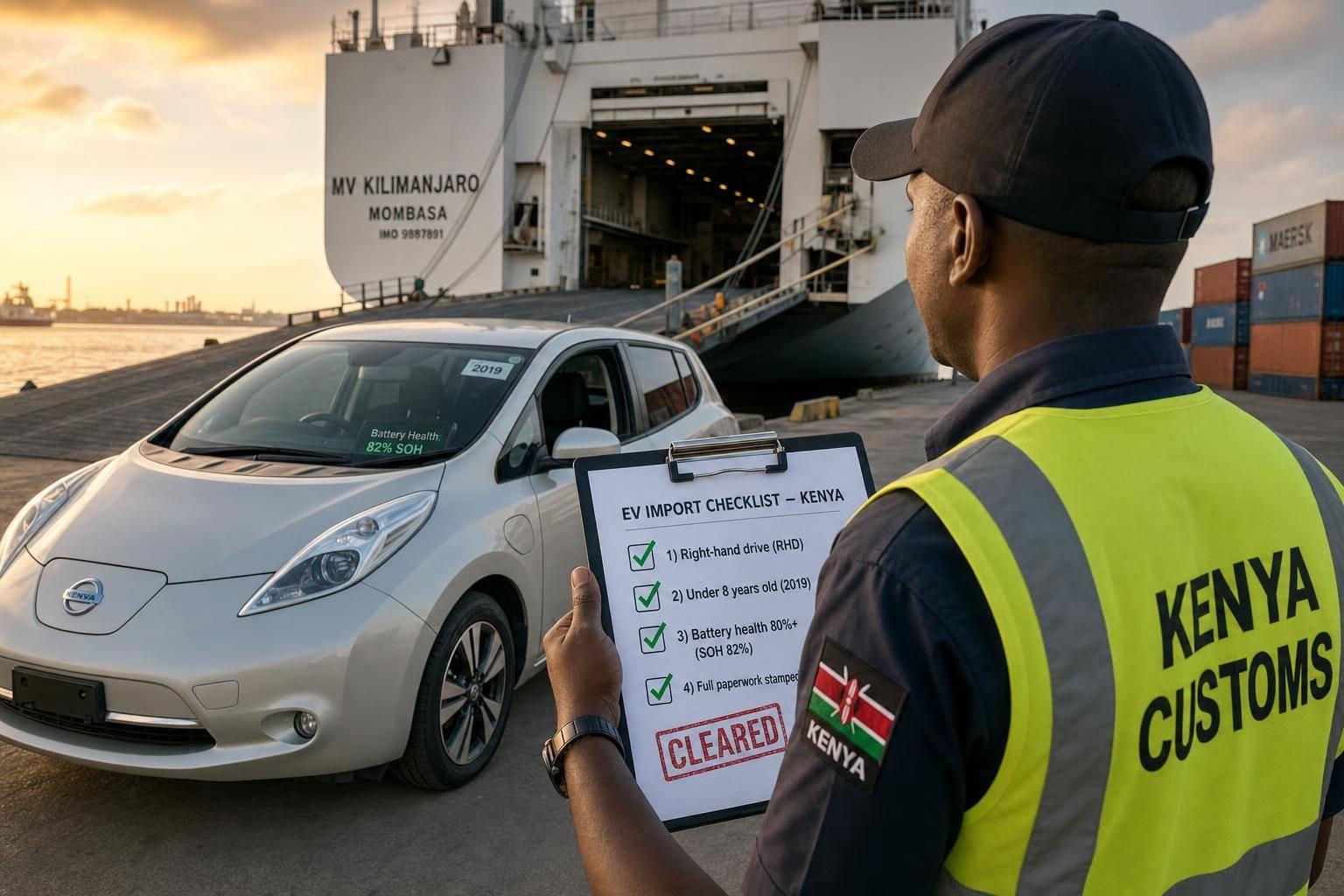
If I want to import an EV into Kenya in 2026, I need to clear four checks first: RHD only, 8-year age limit, battery SOH of 80%+, and full import paperwork. If one of those fails, I should stop before I send money.
Here’s the short version:
- I must confirm the EV is right-hand drive
- I must check it is no more than 8 years old
- I must get proof the battery is at 80% State of Health or higher
- I must secure the CoC, logbook/export paper, invoice, Bill of Lading, and KRA PIN
- I should expect taxes and fees to add well over half of CIF, and in many cases 70%+
- I must clear the car through KEBS, KRA, and NTSA
- I should plan for home charging, since that’s how most EV owners in Kenya charge day to day
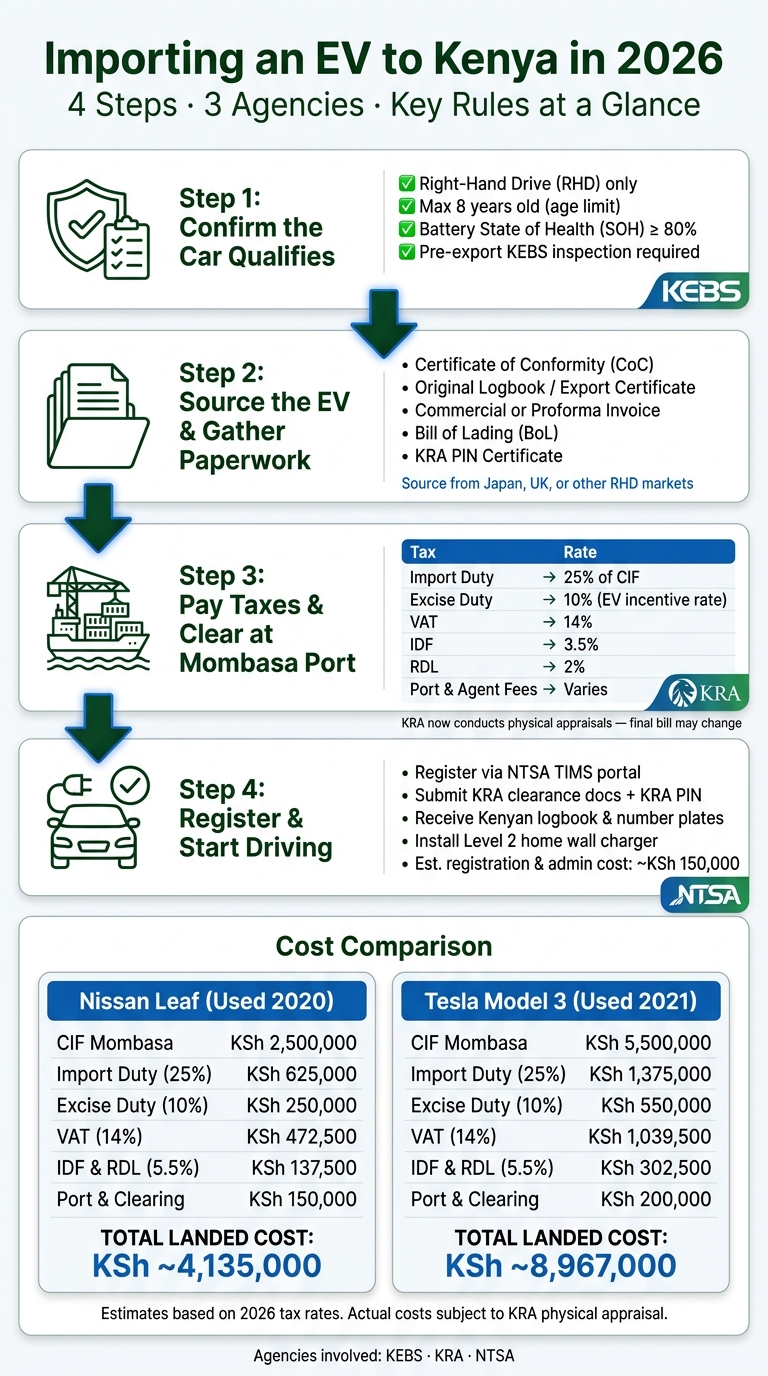
The cost part is where many buyers get caught. Even with the 10% EV excise duty, I still face 25% import duty, 14% VAT, 3.5% IDF, and 2% RDL, plus port and agent fees. In the article’s examples, a used Nissan Leaf lands at about KSh 4,135,000, while a used Tesla Model 3 lands near KSh 8,967,000.
How to Import an Electric Car to Kenya in 2026: Step-by-Step Process
Quick comparison
| Check | What I need to confirm | Why it matters |
|---|---|---|
| Vehicle type | Right-hand drive | Kenya import rule |
| Age | Within 8 years | Older units can be blocked |
| Battery | 80% SOH or more | EV-specific import rule |
| Inspection | KEBS pre-shipment check + CoC | Needed before shipment |
| Taxes | Duty, excise, VAT, IDF, RDL | Drives total landed cost |
| Clearance | Mombasa via KRA | Final tax bill may change after inspection |
| Registration | NTSA TIMS, logbook, plates | Needed before road use |
| Charging | Home Level 2 setup | Daily use starts here |
So if I’m thinking about importing an EV, the safe path is simple: check legality, check battery health, check landed cost, then move to shipping and clearance. The rest of the article walks through that process in plain steps.
sbb-itb-99e19e3
Step 1: Check whether the EV can legally enter Kenya
Before you buy, make sure the car can clear Kenyan customs. If you buy first and check later, that mistake can get expensive fast.
Kenya’s 2026 import rules for used EVs
In 2026, three main rules apply. The car must be right-hand drive (RHD). It must be within Kenya’s 8-year import age limit. And it must pass a pre-export inspection before it leaves the source country.
EV-specific checks: battery health and standards compliance
EVs have one extra rule that ICE vehicles don’t. The battery must have a State of Health (SOH) of 80% or higher to qualify for import.
So don’t just look at the price, mileage, and photos. Ask for a battery health report before you commit. Kenya requires an SOH of at least 80%, and that reading needs to be part of the conformity process. If it isn’t documented, you’re taking a risk.
You should also check the vehicle’s title and registration history in the source country. That helps you spot liens, salvage flags, or ownership disputes that could stop the car from clearing.
The roles of KEBS, KRA, and NTSA
Three agencies touch every EV import, and each handles a different part of the process.
| Agency | What They Handle | Key Document |
|---|---|---|
| KEBS | Pre-shipment inspection and standards compliance in the source country | Certificate of Conformity (CoC) |
| KRA | Customs valuation, physical inspections at Mombasa, and tax collection | Payment Slip / Release Order |
| NTSA | Roadworthiness testing, TIMS registration, logbook issuance, and number plates | Logbook and Number Plates |
Get these agency requirements sorted before the car is loaded onto a vessel, not after. That’s the safer move.
One more thing: KRA inspectors have moved toward more frequent physical inspections instead of relying only on customs reference values. That can change the final tax bill in a big way.
Once the EV clears this first screen, you can move on to the source-country search and shipping documents.
Step 2: Choose the right EV abroad and prepare shipment documents
How to choose a compliant EV from Japan, the UK, or other source markets
Once you’ve confirmed the car is eligible, the next step is picking an EV from Japan, the UK, or another right-hand-drive market.
This is where charging can make or break the deal. Before you buy, check that the vehicle’s charging standard matches how you plan to charge it in Kenya. That could mean Level 2 home charging or public charging stations.
If you’re buying a Tesla, take one extra step: confirm that software updates are supported in Kenya. Those updates help keep key features working and support battery efficiency.
How to verify condition before you buy
Before sending any money, ask for a recent battery health report and full service history.
You should also verify:
- Mileage
- Accident history
- Flood exposure
- Ownership status
- VIN consistency
A clean-looking listing doesn’t tell the full story. The paperwork usually does.
Documents and pre-shipment inspection requirements
Every EV headed to Kenya must pass a KEBS pre-export inspection in the source country so it can get a Certificate of Conformity (CoC).
Have these documents ready before shipping:
| Document | Who Issues It | Why It’s Needed |
|---|---|---|
| Certificate of Conformity (CoC) | KEBS / Authorized Inspection Agent | Confirms the vehicle meets Kenyan safety and technical standards |
| Original Logbook / Export Certificate | Exporting-country authority | Proves ownership and deregistration from the source country |
| Commercial or Proforma Invoice | Vehicle seller / dealer | Used by KRA to determine customs value |
| Bill of Lading (BoL) | Shipping line | Confirms the shipment contract and cargo details |
| KRA PIN Certificate | Kenya Revenue Authority (KRA) | Identifies the importer of record |
Missing documents, mismatched names, or VIN errors can slow down clearance at Mombasa. It’s also smart to check KRA’s CRSP before purchase so you don’t get hit with a valuation reassessment during clearance.
With the shipment file complete, the car is ready for Mombasa clearance. Next, clear the car at Mombasa and calculate the landed cost.
Step 3: Clear the EV at Mombasa and calculate total landed cost
Customs clearance steps at Mombasa Port
Once the EV arrives in Mombasa, KRA starts valuation and customs entry processing. The manifest is checked against the Bill of Lading, then the vehicle is moved to a Container Freight Station (CFS) while clearance is handled.
At that stage, a licensed clearing agent files the customs entry using the documents prepared in Step 2. In 2026, KRA moved more of its review to physical, on-site inspections at Mombasa, with closer invoice checks instead of leaning only on the Current Retail Selling Price (CRSP) list. That matters because those inspections can push the final tax bill up by a lot.
This is the moment where an import can still make sense on paper – or suddenly get too expensive. Once the taxes are paid, KRA releases the vehicle from the port or CFS.
Taxes, duties, IDF, RDL, and port charges for EV imports
EVs get a lower excise duty rate of 10% as an incentive, while regular combustion vehicles face higher excise brackets. The rest of the charges still apply, and port, storage, and agent fees depend on the operator and how long the car stays at the port.
| Tax / Fee | Rate | Notes |
|---|---|---|
| Import Duty | 25% | Calculated on CIF value |
| Excise Duty | 10% | EV incentive rate |
| VAT | 14% | Applied on CIF + Import Duty + Excise Duty |
| Import Declaration Form (IDF) | 3.5% | Import Declaration Form |
| Railway Development Levy (RDL) | 2% | Railway Development Levy |
| Port, storage & agent fees | Varies | Charged separately by the CFS / clearing agent |
Rates shown above reflect the current EV incentive framework and standard levies.
Note: EV tax treatment can shift. Always verify current rates directly with KRA before committing to a purchase, especially given KRA’s 2026 shift toward physical appraisals.
Cost comparison: Nissan Leaf vs. Tesla Model 3
Use the tax formula below to estimate your total landed cost.
Estimated landed cost breakdown (KSh)
| Cost Component | Nissan Leaf (Used 2020) | Tesla Model 3 (Used 2021) |
|---|---|---|
| Estimated CIF Mombasa | 2,500,000 | 5,500,000 |
| Import Duty (25%) | 625,000 | 1,375,000 |
| Excise Duty (10%) | 250,000 | 550,000 |
| VAT (14%) | 472,500 | 1,039,500 |
| IDF & RDL (5.5%) | 137,500 | 302,500 |
| Port & clearing fees | 150,000 | 200,000 |
| Total Landed Cost | ~4,135,000 | ~8,967,000 |
Figures are estimates based on 2026 tax rates and general market values. Actual costs depend on KRA’s physical appraisal at the port.
Here’s the key thing: when CIF goes up, every tax line goes up with it. That’s why a Tesla Model 3 can land at such a much higher final cost than a Nissan Leaf, even when both get the same EV excise rate. The EV tax edge mainly comes from the lower excise duty. Import Duty, VAT, IDF, and RDL still add up fast.
After you know the landed cost, the final step is registration and daily use.
Step 4: Register the car with NTSA and set it up for daily use
NTSA registration, TIMS, logbook, and number plates
Once KRA releases the EV, NTSA registration is the last legal step before you can use the car on the road. You’ll do this through the Transport Integrated Management System (TIMS).
Before you submit anything, check that the VIN on the dashboard or driver-side door frame matches the purchase invoice and import documents. If the numbers don’t match, registration can get held up.
To complete the process, you’ll need:
- Your KRA PIN
- KRA clearance documents
- Proof that all taxes and duties have been paid
After NTSA checks the file, it issues the Kenyan logbook and number plates. Registration and admin costs are estimated at about KSh 150,000, including NTSA fees, number plates, and agent charges.
Once that’s done, the next job is simple: get charging sorted before the car becomes part of your daily routine.
Charging, home setup, and battery care in Kenya
After the plates and logbook are issued, set up home charging first. In Kenya, most EV charging happens at home, so this part matters more than many buyers expect.
The usual setup is a Level 2 wall charger. Before installation, have a certified electrician inspect your home’s power supply. That check can help you avoid trouble later. If charging at home isn’t an option, you can use public AC and DC chargers.
For battery care, a few habits go a long way. Regenerative braking and smooth driving can help stretch range in city traffic. Also, keep the battery report with your import file.
How EV24.africa can help at each stage of the import process
Importing an EV means dealing with sourcing, inspections, shipping, customs, registration, and the setup that comes after delivery. EV24.africa helps across that full chain, from verified listings to support after the car arrives.
| Import Stage | EV24.africa Support |
|---|---|
| Sourcing & Planning | Verified RHD listings with battery reports |
| Pre-Shipment | KEBS inspection coordination |
| Shipping | Shipping options and Incoterms support |
| Customs Clearance | Customs and duty coordination |
| Registration | NTSA registration support |
| Post-Delivery | Home charging guidance |
Conclusion: The shortest safe path to importing an EV into Kenya
After sourcing, shipping, and clearance, the last call still comes down to three checks.
Start with eligibility. The car needs to be right-hand drive, fall within Kenya’s 8-year age limit, and show 80% battery SOH.
Before you send money, make sure the paperwork is lined up: battery report, CoC, logbook, Bill of Lading, IDF, and KRA PIN.
Then look at cost. Even with the EV excise break, taxes and levies can climb fast once duty, VAT, and levies are added. Check the CRSP before you commit, because port inspection can still change the final bill.
A low sticker price doesn’t help much if the battery is weak, the tax bill gets out of hand, or the car isn’t a good fit for local roads and charging access. If even one of those checks fails – battery below 80%, car outside the age limit, or a landed cost that no longer adds up – walk away.
If the numbers hold, move from port release straight into NTSA registration and charging setup. After clearance, complete NTSA registration through TIMS, collect the plates and logbook, and install a Level 2 home charger .
FAQs
How do I prove an EV battery is above 80% SOH?
You prove it with a mandatory pre-export inspection from a KEBS-approved agent. For a used EV, the official proof is the inspection paperwork issued after the vehicle is checked.
Before you buy, ask the seller for battery health reports and maintenance records. If the EV passes, the agent issues a Certificate of Conformity (CoC) and a pre-inspection certificate for customs clearance.
Can KRA change my tax bill after the car reaches Mombasa?
Yes. The Kenya Revenue Authority (KRA) can revise your tax bill after your vehicle reaches the Port of Mombasa.
This happens more often now because KRA has been doing more physical inspections at the port. If customs decides your vehicle is worth more than the earlier estimate, your tax bill can jump by a lot.
You can ask a KRA clearing officer to review the assessment. That said, doing so may slow down the clearance process.
What should I check before buying a Tesla for Kenya?
Before you buy a Tesla for import to Kenya, check a few non-negotiables first.
Make sure the car is right-hand drive, was built in 2019 or later, and falls within Kenya’s 8-year age limit.
Then look closely at the battery. It should still have at least 80% of its original capacity, and you should get a battery health report before you commit. That step matters more than most people think.
You’ll also want to check charging access in your area and confirm that certified EV specialists are available for maintenance. Tesla doesn’t have any official service centers in Kenya, so local support can make a big difference.