
 Thabo Nkosi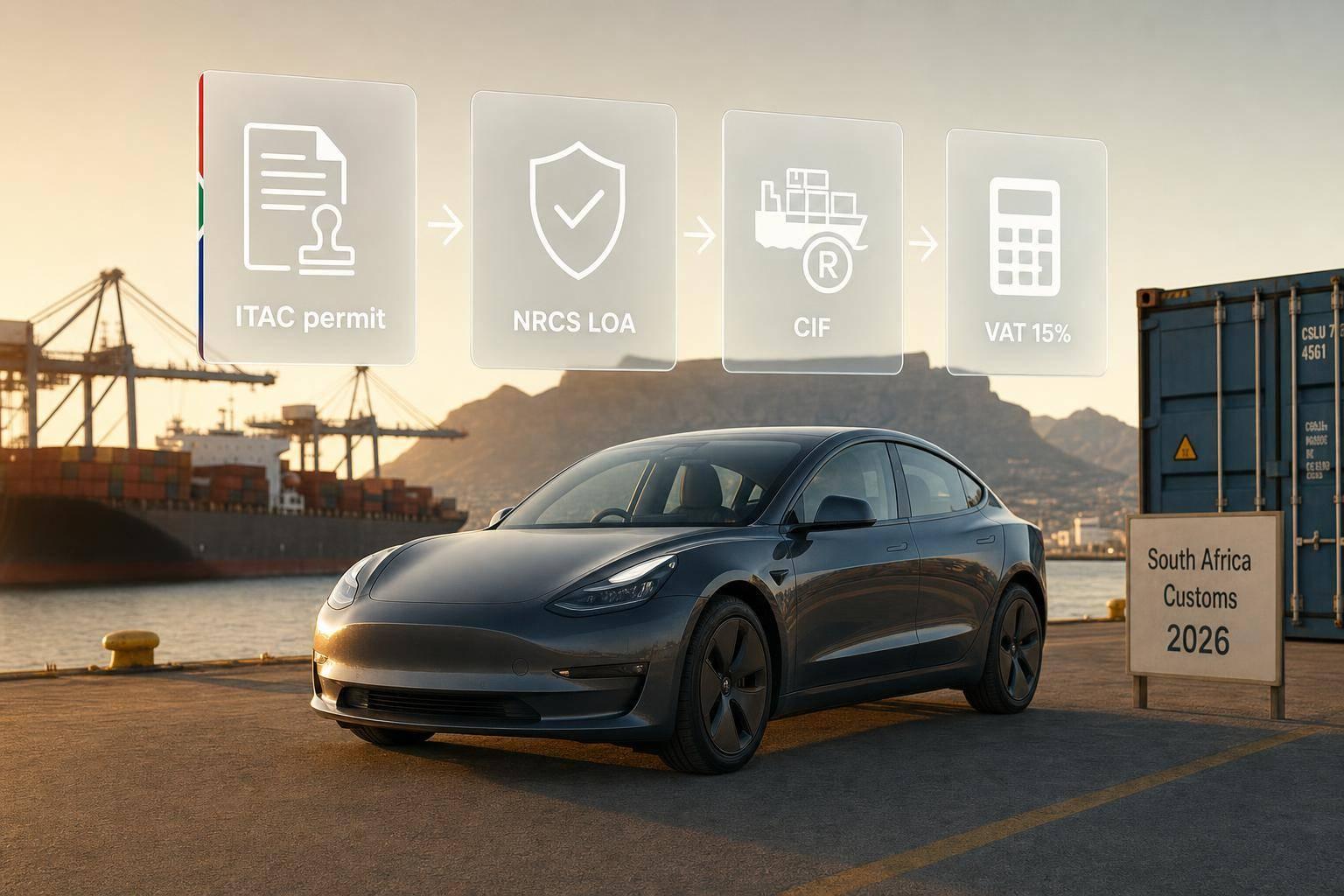
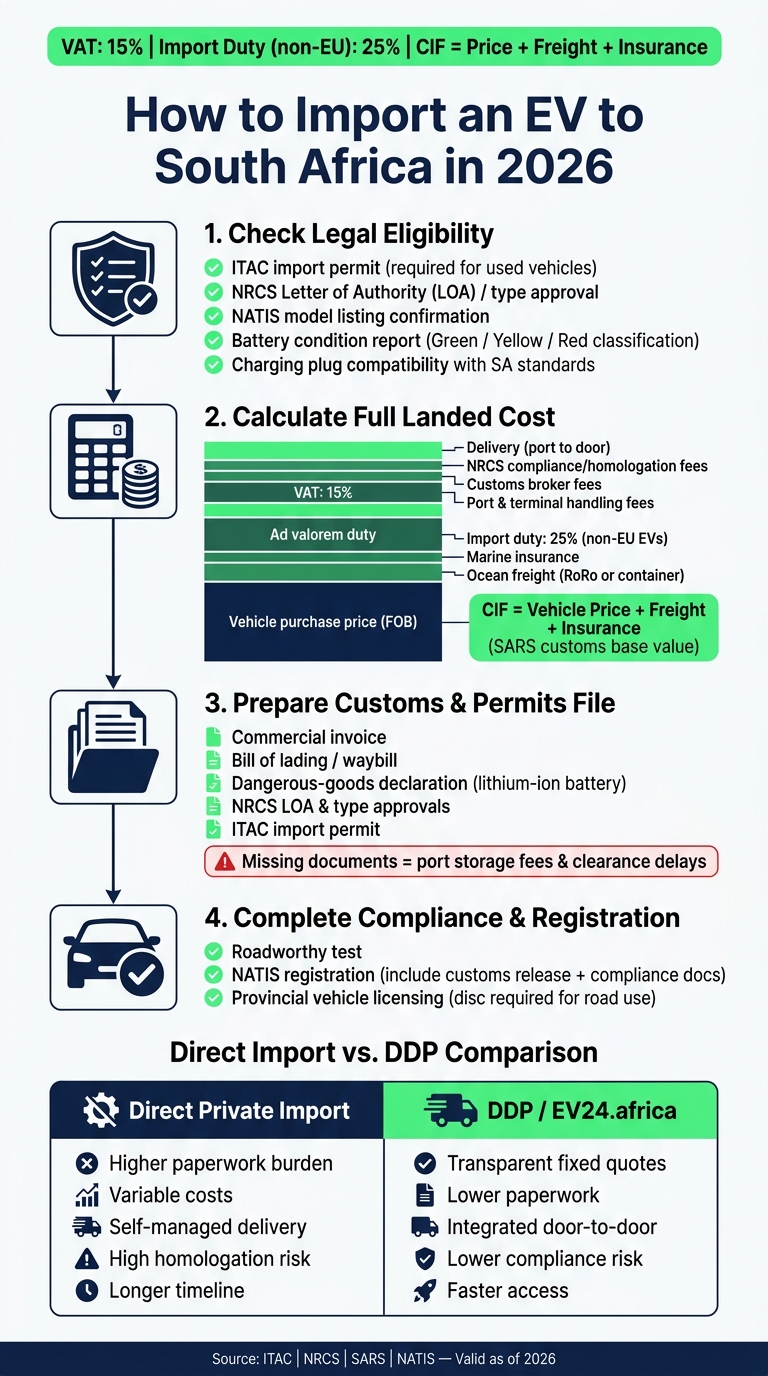
Yes, you can import an EV into South Africa in 2026 – but I’d only do it after checking legality, tax treatment, and registration risk first. One wrong step can lead to port storage fees, customs delays, or a car that cannot go onto NATIS.
Here’s the short version:
- I’d confirm the car can be imported and registered before paying any deposit.
- I’d check ITAC permit rules, NRCS LOA/type approval, and whether the model can be recorded on NATIS.
- I’d calculate the full landed cost, not just the vehicle price.
- I’d include CIF, import duty, 15% VAT, ad valorem duty, port charges, broker fees, roadworthy, and registration.
- I’d make sure the EV’s plug type works in South Africa and get a battery-condition report before shipping.
- I’d compare a direct import with a seller that offers DDP so I know whether the lower sticker price is still worth the admin.
A few numbers stand out fast:
- VAT: 15%
- Import duty for non-EU EVs: 25%
- CIF = vehicle price + shipping + insurance
- Final cost also includes ad valorem duty, port handling, customs clearance, and local registration fees
If I were making the decision today, on August 14, 2026, I’d treat this as a paperwork-and-math exercise first, and a car purchase second.
How to Import an Electric Car to South Africa: Step-by-Step Cost & Compliance Guide
Quick comparison
| What I’d check | Why it matters |
|---|---|
| ITAC permit eligibility | Used vehicles face tight import rules |
| NRCS LOA / type approval | Without it, the car may not clear compliance |
| NATIS listing | If the model is not recognized, registration may stall |
| CIF and taxes | This is where the true import cost shows up |
| Battery report and DG paperwork | Lithium-ion battery status can affect shipping and port handling |
| Direct import vs. DDP seller | Helps me compare admin load, cost control, and delay risk |
So the main question isn’t just “Can I import it?” It’s “Can I import it, clear it, register it, and still come out ahead on total cost?”
sbb-itb-99e19e3
Step 1: Check whether the EV can legally be imported
Before you buy anything, make sure the EV can enter South Africa and be registered. If a vehicle fails ITAC, NRCS, or NATIS checks, you’re not just dealing with a delay. You could end up with an import that makes no financial sense. If the car can’t clear those checks, stop there and don’t place the order.
Used EV restrictions and narrow exemptions
Used EVs face strict ITAC controls and usually need an import permit. In some cases, returning residents and immigrants may qualify to bring in one personally owned used vehicle under ITAC rules.
NRCS compliance approval and NATIS feasibility before you buy

NRCS approval is required before clearance. If a model doesn’t have it, the vehicle can’t be registered. Check NATIS recognition before you buy too. If the model isn’t listed, you may need extra proof from the manufacturer, plus testing.
EV-specific checks before you ship
You’ll also want to check a few EV-specific details before shipping.
- Confirm the plug type and charging standard work with South African chargers.
- Get a battery-condition report before shipment. Carriers classify battery packs as green, yellow, or red. That rating affects handling and dangerous-goods paperwork.
| Pre-Purchase Check | Authority | Why It Matters |
|---|---|---|
| Import permit eligibility | ITAC | Required for used vehicles; strict eligibility rules apply |
| LOA / type approval | NRCS | Confirms the vehicle meets South African safety standards |
| NATIS listing | NATIS | Unlisted models may require extra evidence or testing |
| Battery condition report | Carrier / Customs | Determines dangerous-goods handling requirements |
| Charging standard compatibility | Buyer check | Confirms plug type matches South African chargers |
If the vehicle clears these checks, move on to landed cost.
Step 2: Calculate the full landed cost before placing the order
After your EV passes the legal checks in Step 1, the next step is straightforward: work out what it will cost to get the car to your driveway. And yes, that number is usually higher than the sticker price.
Start with the CIF value: vehicle price, shipping, and insurance
Start with the CIF value, which stands for cost, insurance, and freight. This is the customs value SARS uses when working out duty and tax. It includes the vehicle price, ocean freight to Durban or Cape Town, and marine insurance.
You’ll need to convert the CIF amount into South African rand (ZAR) using the current exchange rate. That CIF figure becomes the starting point for import duty, VAT, and ad valorem tax.
Shipping usually happens in one of two ways:
- RoRo (Roll-on/Roll-off)
- Container shipping
Import duty, VAT, ad valorem duty, and applicable levies
If the EV comes from outside the EU, plan for 25% import duty before VAT, ad valorem tax, and port charges.
Landed-cost breakdown
The easiest way to avoid a nasty surprise is to map the landed cost line by line:
| Cost Component | Includes |
|---|---|
| Vehicle purchase price (FOB) | The EV price at the export point |
| Ocean freight | Shipping to a South African port such as Durban or Cape Town |
| Marine insurance | Transit insurance premium |
| CIF value | Vehicle price + freight + insurance; the base customs value |
| Import duty | 25% for non-EU EVs |
| Ad valorem duty | Value-based duty applied on top of import duty |
| VAT | 15% on the customs value plus duties |
| Port and terminal handling fees | Charges levied at the port |
| Customs broker fees | SARS clearance and documentation fees |
| NRCS compliance/homologation fees | Compliance-related fees |
| Delivery costs | Port-to-door transport |
Once you’ve pinned down the landed cost, move on to the permits and clearance paperwork in Step 3.
Step 3: Prepare permits, customs paperwork, and the clearance file
Once you’ve set the landed cost, put the clearance file together. This is the paperwork that gets the vehicle from port arrival to customs release. If even one document is missing, release can stall and storage fees can start piling up.
Core import documents for SARS customs clearance
SARS releases the vehicle only when the clearance file is complete and every detail lines up.
| Document | What It Proves |
|---|---|
| Commercial invoice | Purchase price and transaction value; used by SARS to calculate ad valorem duties and VAT |
| Bill of lading / waybill | Ownership of the cargo and the shipping route details, including whether the vehicle moved by RoRo or container |
| Dangerous-goods declaration | Safety status and classification of the lithium-ion battery pack |
| NRCS Letter of Authority (LOA) and type approvals | Compliance with South African safety and environmental standards |
| ITAC import permit | Legal permission to bring the specific vehicle into South Africa |
For lithium-ion batteries, a dangerous-goods declaration is required. If the pack is damaged or unstable, the vehicle may be pulled aside for isolated handling at the port.
Next, make sure those documents match the permits that need to be in place before shipping.
Permits and approvals from ITAC and NRCS
ITAC grants import permission. NRCS issues the LOA and type approvals needed for compliance and registration.
Timing matters here. Get ITAC and NRCS approvals in place before the vehicle arrives. If not, it may end up sitting in storage while the paperwork catches up.
Once those permits are in hand, the HS code shapes how SARS clears the vehicle.
Tariff classification, broker support, and port release
Use the right HS code on the customs declaration. It decides how SARS classifies the vehicle and how any duty treatment is applied.
A licensed customs broker can help keep the HS code and the clearance file in line with SARS rules. Under Delivered Duty Paid (DDP), the shipper takes care of clearance, duties, and taxes.
After SARS release, the next step is compliance and registration.
Step 4: Complete compliance, registration, and make the final import decision
Roadworthy test, NATIS registration, and licensing
Once customs releases the vehicle, there are three things left to do: the roadworthy test, NATIS registration, and licensing.
First, the car needs to pass a roadworthy test.
Next, register it on NATIS in your name. Include the customs release papers and the compliance documents in the registration file.
Then, license the vehicle through your provincial authority so you can get a valid disc. Without that disc, the car can’t legally be driven on public roads.
Compare direct import cost against EV24.africa listings and delivery options
This is the point where the numbers need to be crystal clear. Before making the call, work out the total landed-and-registered cost. Not just the purchase price.
Add up:
- the purchase price
- shipping
- insurance
- port charges
- clearing fees
- roadworthy costs
- registration fees
Then compare that total with EV24.africa listings and delivery options. If you’d rather avoid most of the admin, a Delivered Duty Paid (DDP) setup can make life easier because the provider handles logistics and compliance for you. If you want more control over shipping and final spend, Free on Board (FOB) may suit you better.
The table below shows where these two paths differ most:
| Factor | Direct Private Import | Buying Through EV24.africa |
|---|---|---|
| Cost Visibility | Variable; hidden port and clearing fees can appear | Transparent; fixed quotes available via DDP |
| Paperwork Burden | High; the owner handles ITAC, NRCS, and SARS | Lower; handled by logistics professionals |
| Delivery Coordination | Self-managed; requires multiple contractors | Integrated Door-to-Door or Port-to-Port options |
| Homologation Risk | High; the owner bears the compliance risk | Lower; vehicles are verified for South African standards |
| Time to Access | Usually longer because of individual clearing delays | Streamlined through established local networks |
Conclusion: Key numbers, documents, and checks to remember
Before you commit, check these five items:
- Verified legal eligibility for the specific EV model
- Confirmed homologation feasibility with NRCS before the vehicle ships
- Calculated the full landed-and-registered cost, not only the purchase price
- Kept customs and compliance documents ready for NATIS registration
- Compared total cost and handling burden before choosing a route
Direct import can still make sense for the right model, but only if each compliance step is done in the right order.
FAQs
How much does it really cost to import an EV into South Africa?
The total landed cost is far higher than the purchase price. That’s because you’re not just paying for the vehicle itself. You also need to account for taxes, shipping, paperwork, and compliance costs.
Plan for 25% import duty, 14% VAT, and shipping in the range of $1,200–$2,500. You should also set aside about $2,100 for SABS certification, along with insurance and an ITAC import permit. If the EV is priced above $50,000, it may face ad valorem tax of up to 30%. On top of that, a 3% contingency is recommended to cover extra costs that can pop up along the way.
Can I import a used electric car into South Africa?
Yes, but only if it meets South Africa’s strict rules.
The vehicle must be right-hand drive. Left-hand drive vehicles can’t be registered.
Before you ship the car, you need an Import Permit from ITAC and a Letter of Authority (LOA) from the NRCS. The car also has to meet local safety, emissions, and roadworthiness standards to be used on public roads.
What documents do I need to clear and register an imported EV?
To clear an imported EV in South Africa, you’ll usually need:
- ITAC Import Permit
- NRCS Letter of Authority (LOA)
- Purchase invoice, Bill of Lading, certificate of origin, battery safety data sheet, proof of duty/VAT payment, and ID
For registration, you’ll need the original certificate of compliance, a valid roadworthy certificate, and proof of registration fee payment.
One small mismatch can slow the whole process down, so check that the VIN and vehicle details line up across every document before you submit anything.