
 Younes Rabeh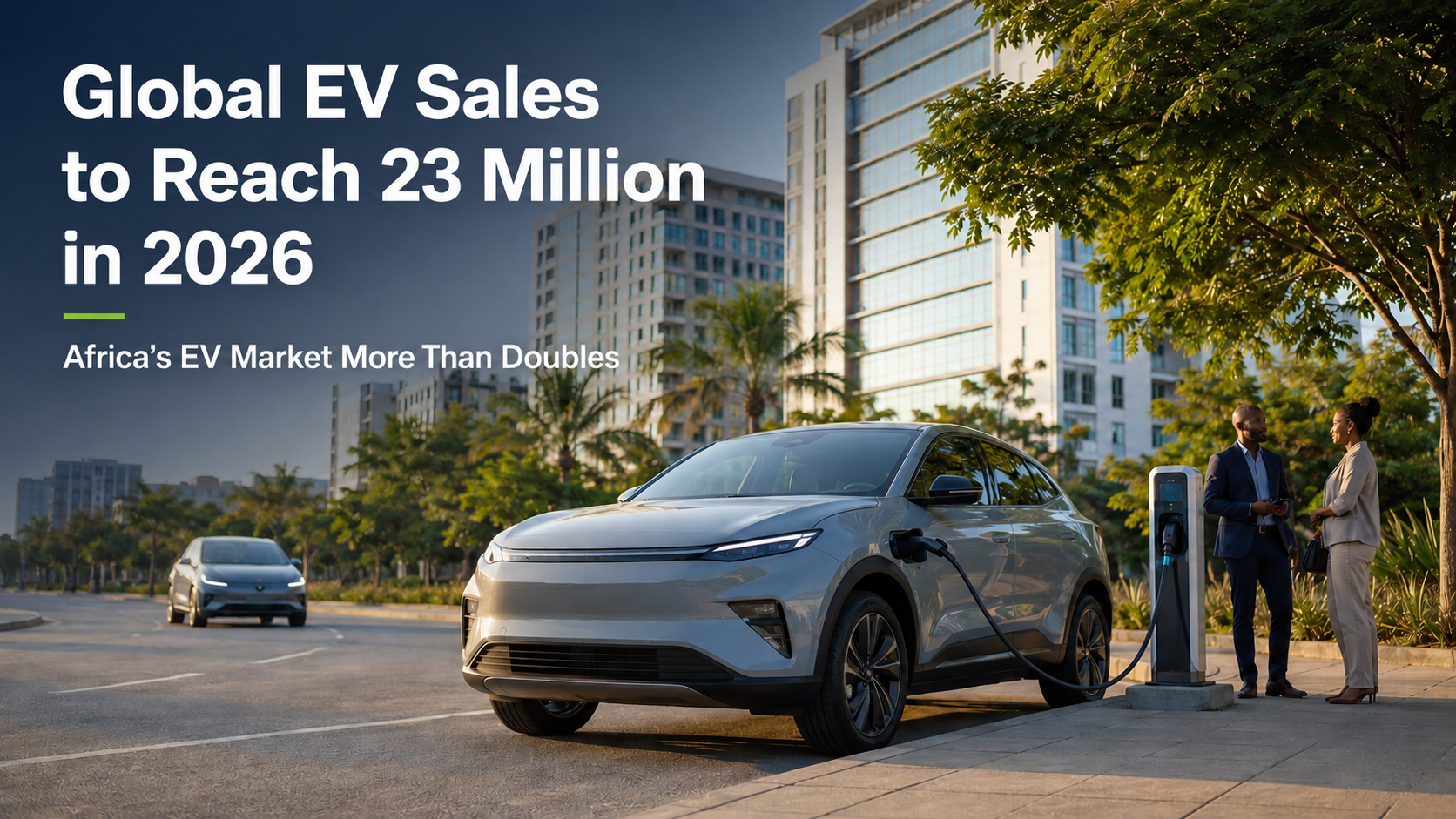
Global electric vehicle sales are heading towards another historic milestone in 2026, with approximately 23 million electric cars expected to be sold worldwide.
Africa is becoming an increasingly important part of this transformation. Electric car sales across the continent more than doubled during the first half of 2026, driven by stronger demand in South Africa and Egypt, expanding government support and the growing availability of affordable electric vehicles.
According to the International Energy Agency, electric cars are now expected to represent 29% of all new cars sold worldwide in 2026. The revised forecast comes despite economic uncertainty, geopolitical tensions and a weakening global automotive market.
For Africa, the latest figures send a clear message: the continent’s transition to electric mobility is accelerating.
📊 Global Electric Vehicle Sales Remain Resilient in 2026
The global automotive market experienced a difficult start to 2026. Total car sales declined by approximately 5% year-on-year during the first six months, primarily because of weaker demand in China and the United States.
Electric vehicles, however, demonstrated greater resilience.
EV sales increased by 4% year-on-year during the second quarter and were approximately 35% higher than in the first quarter of 2026. This rebound almost entirely compensated for the decline recorded at the beginning of the year.
Electric vehicles represented around 24% of global car sales during the first half of 2026, slightly above their share during the same period in 2025.
Based on this momentum, the IEA expects global electric car sales to grow by approximately 10% in 2026 and reach close to 23 million units.
🔢 Key Global EV Market Figures
- 🚘 23 million electric cars expected to be sold in 2026
- ⚡ 29% projected global electric car market share
- 🌐 More than 90 countries recorded EV sales growth
- 📈 Second-quarter EV sales increased 35% compared with Q1
- 🔋 Electric cars represented 24% of global H1 vehicle sales
- 🌍 Emerging markets are becoming major drivers of EV growth
The figures confirm that electric mobility is continuing to expand even as the wider automotive market faces pressure.
🚗 Africa Becomes One of the Fastest-Growing EV Markets
Africa remains a relatively small electric vehicle market in absolute numbers, but its growth rate is among the fastest in the world.
More than 30,000 electric vehicles were reportedly sold across Africa during the first six months of 2026, representing more than twice the volume recorded during the same period in 2025.
This acceleration reflects a combination of economic, technological and environmental factors.
African consumers and businesses are increasingly looking for alternatives to petrol and diesel vehicles because of:
- ⛽ Rising and unpredictable fuel prices
- 💰 High vehicle operating and maintenance costs
- 🌱 Growing interest in cleaner transportation
- 🔋 Lower electric vehicle battery prices
- 🚙 A wider selection of affordable EV models
- 🏢 Increasing demand from corporate and public fleets
- ☀️ Opportunities to charge vehicles using renewable energy
Electric mobility is particularly attractive in African countries that rely heavily on imported petroleum. Replacing part of this fuel demand with locally produced electricity could strengthen energy security and reduce exposure to international oil price shocks.
🇿🇦 South Africa Leads the Continent’s EV Growth
South Africa recorded one of the strongest electric vehicle market performances in Africa during the first half of 2026.
Electric car sales increased more than fivefold compared with the same period in 2025.
Several factors are supporting this growth:
- Greater availability of electric vehicle models
- Stronger consumer awareness
- Expansion of public charging networks
- Increasing adoption by businesses and commercial fleets
- Entry of competitively priced Chinese manufacturers
- Growing interest in reducing long-term mobility costs
South Africa also illustrates the growing influence of Chinese automotive brands. Chinese-made vehicles reportedly accounted for around 90% of new electric car sales in the country during the period.
Affordable pricing, competitive driving ranges and advanced onboard technology have helped these manufacturers appeal to buyers seeking alternatives to traditional European, Japanese and American models.
🇪🇬 Egypt’s Electric Vehicle Sales More Than Triple
Egypt is another rapidly developing African EV market.
Electric car sales in the country more than tripled year-on-year during the first half of 2026, demonstrating growing consumer interest despite challenges related to vehicle financing, charging infrastructure and import regulations.
Egypt has several advantages that could support further EV adoption:
- A large automotive market
- High urban vehicle demand
- Significant renewable energy potential
- Opportunities for local vehicle assembly
- Strong demand for affordable mobility
- Growing interest from international EV manufacturers
Continued investment in charging infrastructure and supportive regulations could position Egypt as one of North Africa’s most important electric mobility markets.
⚡ African Governments Introduce New EV Policies
Government support will be essential for accelerating electric vehicle adoption in Africa.
According to reports citing the IEA, Kenya has moved to waive import duties on up to 100,000 electric vehicles, while Rwanda has directed public institutions to ensure that electric vehicles represent at least 30% of newly procured vehicles.
Across Africa, governments are exploring policies such as:
💰 EV Tax and Import Incentives
Reducing import duties and registration taxes can help narrow the price difference between electric and internal combustion vehicles.
🔌 Charging Infrastructure Investment
Public charging networks are required to support long-distance mobility and give potential buyers greater confidence.
🚌 Public Transport Electrification
Electric buses, taxis and ride-hailing vehicles can generate significant fuel savings because of their high daily mileage.
🏢 Government Fleet Programmes
Public-sector purchasing commitments can create early demand and help establish reliable EV maintenance and charging ecosystems.
🏭 Local Vehicle and Battery Assembly
Local production could reduce import costs, create employment and develop new industrial capabilities across the continent.
The long-term success of these policies will depend on consistent implementation, stable regulations and cooperation between governments, energy companies, vehicle suppliers and financial institutions.
🌎 Emerging Markets Drive the Next Phase of EV Adoption
Africa is not the only emerging region experiencing rapid electric vehicle growth.
During the first half of 2026:
- 🌎 Electric car sales in Latin America more than doubled
- 🇮🇳 India recorded growth exceeding 90%
- 🌏 Southeast Asia expanded by approximately 75%
- 🇦🇺 Australia roughly doubled its EV sales
- 🇧🇷 Brazil also recorded significant acceleration
- 🇰🇷 South Korea experienced strong growth
- 🇻🇳 Vietnam continued its rapid transition towards electric mobility
More than 90 countries reported year-on-year electric vehicle sales growth, showing that the global transition is becoming increasingly diversified.
The next phase of EV adoption will therefore not be limited to established markets. Africa, Latin America, Southeast Asia and other emerging regions are expected to play a much larger role.
🇨🇳 Chinese Electric Vehicles Expand Across Africa
China remains the largest electric vehicle manufacturing centre in the world.
Chinese manufacturers benefit from integrated battery supply chains, large-scale production and manufacturing costs estimated by the IEA to be approximately 35% lower than those of manufacturers in advanced economies.
During the first half of 2026:
- Total Chinese car exports increased by around 65%
- Chinese electric car exports rose by more than 120%
- EVs represented over 45% of China’s car exports
- Chinese brands expanded rapidly across emerging markets
The growing presence of Chinese electric cars in Africa is increasing the number of models available to local buyers.
African customers can now access a broader selection of:
- 🚗 Affordable electric city cars
- 🚙 Electric SUVs and crossovers
- 🚐 Electric vans and minibuses
- 🛻 Electric commercial vehicles
- 🚕 Models designed for taxis and ride-hailing
- 🏢 Vehicles suitable for corporate and government fleets
However, vehicle availability must be supported by reliable warranties, spare parts, diagnostic equipment and technicians trained to service high-voltage systems.
🔋 Why Electric Vehicles Matter for Africa
Electric mobility represents more than an environmental opportunity for Africa. It can also support economic development, energy independence and technological innovation.
1. Reduced Dependence on Imported Fuel
Many African countries spend significant amounts of foreign currency importing petrol and diesel. Electric vehicles can transfer part of this demand to domestic electricity networks.
2. Lower Vehicle Operating Costs
Electric motors contain fewer moving components than combustion engines. This can reduce maintenance requirements and long-term operating expenses.
3. Renewable Energy Integration
Africa has enormous solar, wind and hydroelectric potential. Electric vehicles can increasingly be powered by energy generated locally.
4. Cleaner African Cities
Replacing petrol and diesel vehicles with electric alternatives can help reduce urban air pollution, noise and transport-related emissions.
5. New Industrial Opportunities
EV adoption can create demand for charging infrastructure, battery services, vehicle assembly, software, technical training and specialised maintenance.
6. More Efficient Commercial Fleets
Delivery companies, taxis, ride-hailing services and corporate fleets can benefit from the lower energy and maintenance costs associated with electric vehicles.
🚧 What Could Slow EV Adoption in Africa?
Despite rapid growth, several barriers must still be addressed.
The main challenges include:
- Limited public charging infrastructure
- High initial purchase prices
- Expensive or unavailable vehicle financing
- Electricity reliability in certain markets
- Limited access to trained EV technicians
- Uncertainty about battery durability and replacement
- Inconsistent import and homologation rules
- Lack of consumer awareness
- Limited availability of spare parts
- Weak after-sales support in some countries
Addressing these obstacles will require cooperation throughout the electric mobility ecosystem.
Governments must establish clear policies, banks must develop suitable financing products, suppliers must provide dependable after-sales support and infrastructure operators must expand charging networks.
🌐 EV24.africa Supports Africa’s Electric Mobility Transition
As Africa’s electric vehicle market expands, buyers need access to reliable information, suitable vehicles and trusted support.
EV24.africa is helping individuals, companies, transport operators and institutions discover electric vehicles adapted to African markets.
Through a growing pan-African network, EV24 supports access to:
- 🚘 New electric cars from recognised manufacturers
- 🚙 Electric SUVs for private and professional use
- 🚐 Electric commercial vehicles and fleet solutions
- 📦 Vehicle sourcing and international delivery
- 📋 Technical specifications and model comparisons
- 💬 Guidance throughout the purchasing process
- 🔌 Information about charging and EV ownership
Whether a customer is searching for an affordable city car, a long-range electric SUV or a commercial fleet, EV24 aims to make the transition to electric mobility simpler and more accessible.
⚡ Ready to Switch to Electric?
Explore electric vehicles available for delivery across Africa on EV24.africa.
Compare models, driving ranges, battery capacities and prices, then contact the EV24 team for a personalised quotation.
❓ Frequently Asked Questions About Electric Vehicles in Africa
How many electric vehicles will be sold worldwide in 2026?
The International Energy Agency expects global electric car sales to reach approximately 23 million units in 2026, representing around 29% of all new cars sold worldwide.
Is the electric vehicle market growing in Africa?
Yes. Electric vehicle sales across Africa more than doubled during the first half of 2026, reportedly exceeding 30,000 units.
Which African countries are leading EV adoption?
South Africa and Egypt recorded some of the strongest EV sales growth during the first half of 2026. Kenya and Rwanda have also introduced measures designed to support electric mobility.
Why are Chinese electric cars popular in Africa?
Chinese EV manufacturers offer a wide range of competitively priced vehicles with modern technology, strong battery performance and multiple body styles. Their lower production costs also make many models more accessible to emerging markets.
Are electric vehicles suitable for African roads?
Many electric SUVs, crossovers and commercial vehicles offer sufficient ground clearance and suspension systems for African driving conditions. Buyers should evaluate each model according to road quality, climate, daily mileage and charging availability.
Can electric vehicles be charged at home?
Yes. Most electric vehicles can be charged using a compatible home charging system. Charging speed depends on the vehicle, electricity supply and charger capacity.
Are electric cars cheaper to maintain?
Electric vehicles generally require less routine maintenance because they do not need engine oil, spark plugs or many of the mechanical components found in combustion vehicles.
Where can customers buy electric cars in Africa?
EV24.africa provides access to a selection of electric vehicles for individuals, companies and fleets, with delivery solutions covering multiple African markets.
🌍 Africa’s Electric Future Is Accelerating
Africa’s electric vehicle market is still developing, but its rapid growth in 2026 marks an important turning point.
Increasing fuel costs, improved vehicle availability, supportive public policies and the expansion of Chinese EV manufacturers are creating new opportunities across the continent.
The next stage will depend on affordability, financing, charging infrastructure and strong after-sales support. If these conditions continue to improve, Africa could become one of the most dynamic electric mobility markets of the coming decade.
For African consumers and businesses, the transition is already beginning.
The future of mobility is electric—and Africa is becoming part of that future. ⚡🌍
SUGGESTED IMAGE ALT TEXT: Electric vehicles charging in an African city as global EV sales reach 23 million in 2026
SUGGESTED FEATURED IMAGE TITLE: Africa Electric Vehicle Market Growth 2026
SUGGESTED IMAGE CAPTION: Electric vehicle sales across Africa more than doubled during the first half of 2026 as global EV adoption continued to expand.
SOURCES: International Energy Agency, “Electric Car Markets in a Time of Uncertainty,” published 30 July 2026; IEA Global EV Outlook 2026; Arise News, published 3 August 2026.