
 Thabo Nkosi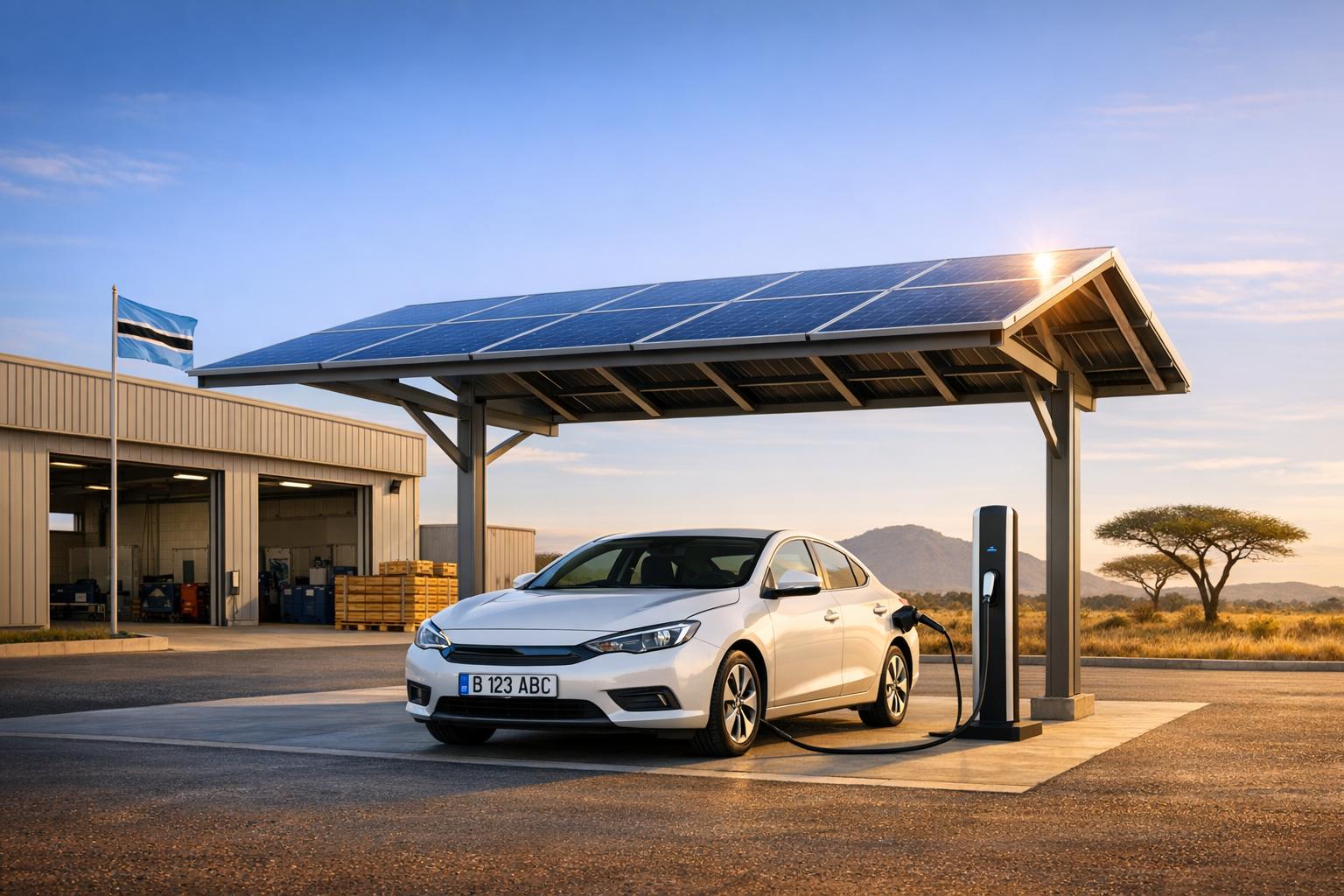
Botswana is making progress in its electric vehicle (EV) market, moving from importing EVs to assembling them locally. Key highlights include:
- Local Production: The Botswana Institute for Technology Research and Innovation (BITRI) is assembling electric SUVs and buses, producing three vehicles daily as of 2026.
- Government Initiatives: The eMobility program, launched in October 2024, aims to produce 50 EVs and 30 buses, with tax exemptions and subsidies to encourage adoption.
- Mineral Resources: Botswana’s rich deposits of battery materials create opportunities for local battery production and supply chains.
- Challenges: Limited charging infrastructure, coal-based electricity, and high upfront costs remain barriers.
- Future Plans: Solar-powered charging stations, improved financing options, and public-private partnerships are being explored to address these issues.
Botswana’s EV market still has a long way to go, but its focus on local production and resource utilization positions it as a growing player in Africa’s EV industry.
Botswana Launches First Locally Manufactured Electric Vehicles | SnapFlash News
sbb-itb-99e19e3
EV Adoption Rates in Botswana
Botswana’s electric vehicle (EV) market, though currently making up less than 1% of Africa’s on-road fleet as of 2025, is undergoing a transformation. The country took a significant step forward in October 2024 by launching its first locally assembled EVs, moving away from its traditional reliance on imports. This shift signals a new phase in Botswana’s approach to EVs, emphasizing local production as a foundation for future growth.
At present, the BITRI assembly plant produces three vehicles daily, focusing on electric SUVs and buses tailored for government and commercial use. While consumer adoption remains low, the advanced state of EV technology suggests strong growth potential. Botswana’s strategy is centered on leveraging local resources and production capabilities, though financing continues to be a major hurdle.
Interestingly, Botswana is considered a "lower-risk" country for EV investment, alongside Mauritius and South Africa. ETH Zürich researchers Christian Moretti and Bessie Noll highlighted this by stating, "in lower-risk countries such as Botswana, Mauritius and South Africa, the financing conditions today are already close to making costs the same for electric and fossil fuel cars". For buyers paying upfront (excluding taxes), EVs in Botswana are already competitive with traditional combustion-engine vehicles.
How Botswana Compares to Other African Countries
Africa’s EV market was valued at $17.4 billion in 2025 and is expected to grow to $28 billion by 2030. However, adoption rates differ widely across the continent. Kenya and Rwanda are leading the way with electric two- and three-wheelers, driven by innovative models like battery-swapping and pay-as-you-go systems. Botswana, on the other hand, is focusing on four-wheeled vehicles and public transport.
One of Botswana’s standout advantages is its favorable financing environment. For EVs to achieve cost parity with traditional vehicles in more than half of African countries by 2030, financing costs need to drop by 7 to 15 percentage points. Botswana is already closer to this benchmark compared to many of its neighbors. The primary challenge lies in creating the financial infrastructure that would make EVs more accessible to the average consumer, rather than advancing the technology itself.
Who Is Buying EVs in Botswana
Currently, Botswana’s EV market is dominated by government agencies and commercial operators. The first batch of locally assembled EVs, launched in October 2024, was primarily aimed at public sector use and commercial transport. Private consumer interest remains limited, largely due to the lack of financing options and barriers to market entry.
The government has outlined a three-phase eMobility strategy to address these challenges. Dr. Patrick Sebudubudu, BITRI’s Project Electric Engineer, explained, "the eMobility programme will be implemented in three phases, the first phase focuses on capacity building, the second on retrofitting, and the third will establish an assembly plant to scale-up electric mobility". The final phase aims to involve the private sector more actively and improve financing options through measures like credit guarantees and concessional loans. Until these initiatives take off, EV ownership will likely remain concentrated among government departments, public transport operators, and wealthier individuals who can afford upfront purchases.
Charging Station Infrastructure
As electric vehicle (EV) adoption grows, Botswana’s charging network is under the spotlight.
Current and Future Charging Stations
As of April 2026, Botswana’s public charging infrastructure remains sparse. Most of the charging facilities are concentrated in Gaborone, where only two fast AC chargers are available for long-distance travelers. For example, BMW Capital Motors on Plot 1279 Luthuli Road in Gaborone provides a Level 2 charging station (Type 2 socket), but access is limited to staff, visitors, and customers.
For now, most EV owners rely on portable 3kW home chargers, which cost about R2.07 per kWh. However, charging a 63-kWh battery pack from empty can take up to 20 hours. A recent test in March 2026 highlighted these challenges: a GWM Ora 03 GT traveling from South Africa to Gaborone arrived with only 6% battery remaining after a 260-kilometer journey. This highlights the difficulty of long-distance EV travel in areas with limited charging options.
There is some progress, though. Locally assembled SUVs by BITRI are equipped with fast-charging systems that can fully charge from zero in just 20 minutes. These vehicles boast a 150-kilowatt motor and offer a range of approximately 520 kilometers (about 323 miles) on a full charge. This aligns with Botswana’s eMobility program, which aims to assemble an initial fleet of 50 electric vehicles and 30 buses. To address infrastructure gaps, innovative solutions like solar-powered charging are being explored.
Solar-Powered Charging Solutions
With urban charging infrastructure still limited, solar-powered charging presents a practical alternative. Botswana’s abundant solar energy provides a way to address grid reliability issues while extending charging access to rural areas. Research from ETH Zürich suggests that combining EVs with off-grid solar charging could make them more affordable to operate than gasoline or diesel vehicles in the near future. Senior researchers Christian Moretti and Bessie Noll explained:
"Our new research shows that EVs, particularly when paired with off-grid solar charging, may be cheaper than petrol- or diesel-powered cars in many African countries in the not-so-distant future".
Solar-powered charging stations offer independence from the national grid, which is especially valuable in regions with unstable or limited power infrastructure. These systems also provide predictable cash flows, making them attractive for private investors. As Botswana moves forward with its three-phase eMobility program – focusing on capacity building, retrofitting, and full-scale vehicle assembly – integrating solar charging infrastructure will be key to supporting the transition to electric mobility.
Government and Private Sector Support
Botswana is making strides in electric mobility, thanks to a combination of government initiatives and private sector collaboration.
Government Programs and Tax Incentives
A major driver of this shift is the Presidential Directive CAB 5EX0/2024, which mandates the use of electric vehicles (EVs) for government operations. The Ministry of Communications and Innovation leads the national e-Mobility Project, with the Botswana Institute of Technology Research and Innovation (BITRI) handling vehicle procurement and technical execution.
In March 2025, BITRI acquired 33 electric buses and 20 SUVs as part of this directive. These vehicles were assembled in a privately owned factory rented by the government. Minister David Tshere highlighted the arrangement:
"The newly established electric vehicle factory is owned by a private entity which the government has rented for the assembly of electric vehicles".
To make EVs more affordable, the government has introduced indirect subsidies, such as tax and import duty exemptions, which aim to reduce purchase costs. This approach tackles one of the key barriers to EV adoption – financing. Researchers Christian Moretti and Bessie Noll noted:
"In lower-risk countries such as Botswana, Mauritius and South Africa, the financing conditions today are already close to making costs the same for electric and fossil fuel cars".
While these policies set the stage, the private sector plays a critical role in turning this vision into reality.
Private Companies Driving EV Sales
Private companies from China and Europe are stepping up by partnering with the government to train local workers in EV assembly and maintenance. In October 2024, President Mokgweetsi Masisi oversaw the handover of Skywell electric vehicles for local test-driving, a milestone in a broader agreement with Chinese manufacturers to assemble 50 electric cars and 30 buses locally.
Beyond local assembly, private sector efforts are driving regional growth. Botswana-based manufacturers are now producing EV components for export to neighboring markets. These partnerships not only boost technical expertise but also create jobs, reinforcing Botswana’s role as a key player in the regional EV industry. Together, public and private initiatives are reshaping Botswana’s automotive sector and building a solid foundation for the future of electric mobility.
EV Models Available in Botswana
Top EV Models for Botswana’s Market
The electric vehicle (EV) market in Botswana is gradually expanding, though choices remain somewhat limited. A key source for EVs in the country is secondhand imports, primarily from Asia and the United Kingdom. For those seeking brand-new models, options from Tesla, BYD, Hyundai, Toyota, and Suzuki are available through EV24.africa. This platform not only provides detailed specifications but also facilitates delivery services across Africa, making it easier for buyers to access a range of vehicles.
Pricing and Financing Plans
When it comes to purchasing EVs, understanding the pricing landscape and financing options is essential. In Botswana, EVs are approaching price parity with traditional vehicles. For buyers paying upfront, EVs are cost-competitive, and temporary exemptions on taxes and import duties make them even more appealing for those financing their purchase.
EV24.africa also provides financing solutions tailored to the unique needs of African consumers. These include options like favorable loan terms or leasing arrangements, which can make EV ownership more accessible. Even a slight reduction in financing costs can lead to savings of thousands of dollars over the vehicle’s lifetime.
Challenges and Growth Opportunities
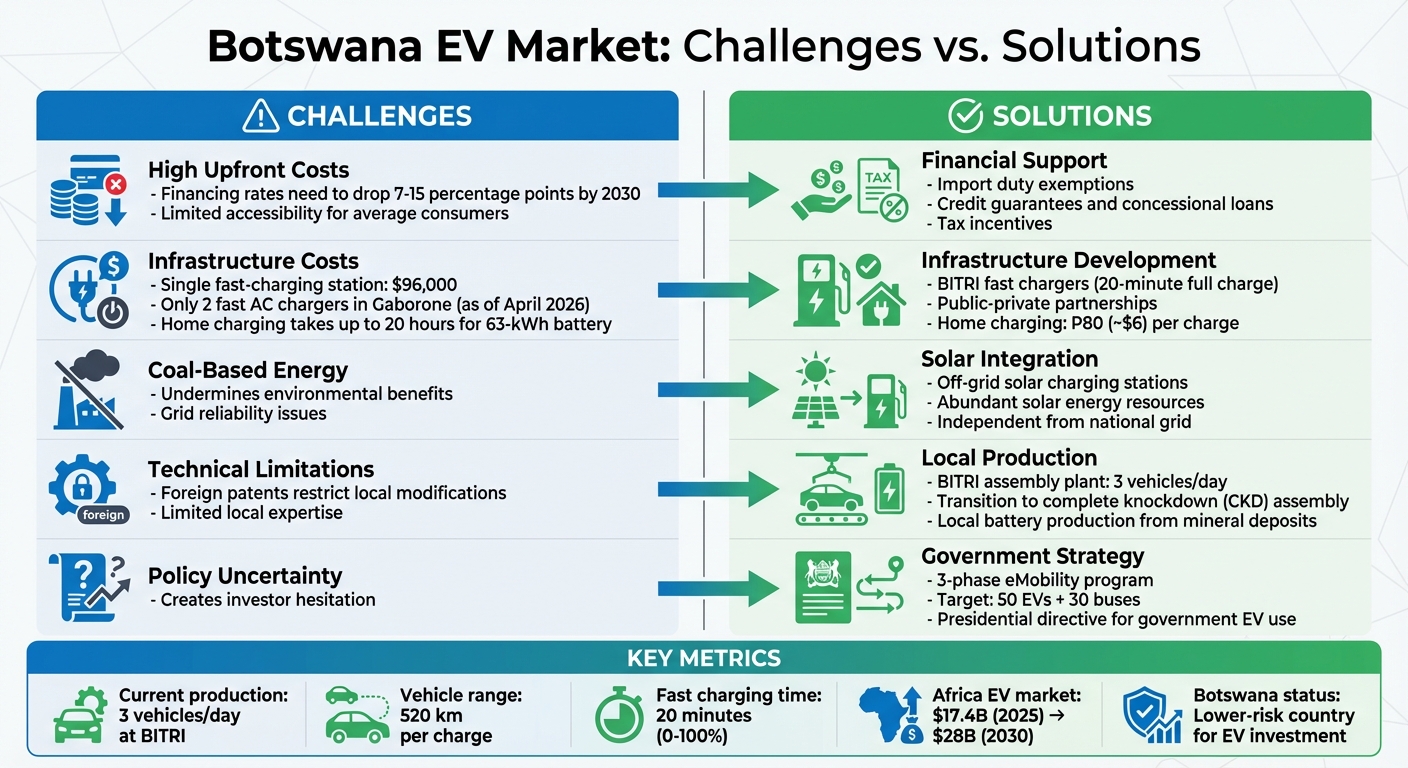
Botswana EV Market: Key Challenges and Solutions Comparison
Main Barriers to EV Adoption
Botswana’s electric vehicle (EV) market faces several challenges that slow its progress. One of the biggest hurdles is the high upfront cost of EVs, paired with steep financing rates. To achieve cost parity with traditional vehicles by 2030, financing rates would need to drop by 7–15 percentage points.
Another major issue is the high cost of infrastructure. For example, installing a single fast-charging station costs roughly $96,000, which limits the expansion of charging networks. Adding to this, Botswana’s reliance on coal-based electricity undermines the environmental benefits of EVs. Minister of Communications and Innovation, David Tshere, illustrated this concern:
"In my view, it’s pointless to claim we are pursuing renewable energy while still relying on fossil fuels to charge electric cars. It defeats the whole purpose".
Policy uncertainty also creates hesitation among investors. On top of this, there are technical challenges, as local modifications to EVs are restricted due to patents held by foreign manufacturers.
Growth Potential in Botswana
Despite these obstacles, there are areas where Botswana could achieve significant progress in the EV sector. The country’s rich deposits of energy transition minerals provide a strong base for developing local battery production and related supply chains. Vice President Slumber Tsogwane highlighted this potential:
"What is important is that this will create value chains such as production of batteries, even mining companies will produce materials used for production of batteries".
The Botswana Institute for Technology Research and Innovation (BITRI) has already made strides with its assembly plant, which produces three vehicles daily and plans to scale up. These locally assembled SUVs can travel about 520 kilometers (323 miles) on a full charge and achieve full capacity through fast charging in just 20 minutes. Additionally, the government’s phased eMobility program aims to strengthen the industry by focusing on capacity building, retrofitting existing vehicles, and eventually establishing large-scale assembly plants.
Solar energy integration offers another promising path. While building charging stations is costly, charging an EV at home using a standard outlet costs just P80 (around $6), making EVs a practical option for daily use. Addressing these barriers could open up new opportunities, speeding up Botswana’s EV transition.
Advantages vs. Disadvantages Comparison
The following table summarizes key factors influencing Botswana’s EV market and possible solutions to overcome challenges:
| Factor | Impact on Botswana EVs | Mitigation Strategies |
|---|---|---|
| Purchase Price | High upfront costs limit accessibility | Import duty exemptions, targeted incentives, and local assembly to lower prices |
| Financing | High interest rates make EVs less affordable | Introduce credit guarantees and concessional loans to reduce financial risks |
| Energy Source | Coal-dominant grid reduces environmental benefits | Invest in solar-powered charging stations and off-grid energy solutions |
| Infrastructure | Limited charging network discourages long-distance use | Expand networks through public-private partnerships, including BITRI’s fast chargers |
| Technical Skills | Foreign patents restrict local modifications | Transition from semi-knockdown (SKD) to complete knockdown (CKD) to build expertise |
Conclusion
Botswana is taking important steps toward shaping its electric vehicle (EV) future through local assembly efforts, improved infrastructure, and supportive policies. Although the country’s EV market is still in its infancy, milestones like the launch of the first locally assembled EVs at BITRI in October 2024 show a clear commitment to progress. This event marked a shift from vision to action, paving the way for broader EV adoption.
Challenges such as high initial costs and dependence on a coal-heavy energy grid remain significant hurdles. However, Botswana’s abundant reserves of energy transition minerals and a government-backed strategy aimed at capacity building and vehicle assembly provide a strong foundation for growth. Developing a local battery production value chain is a key opportunity, and transitioning from semi-knockdown to complete knockdown assembly could help build the technical expertise needed to sustain this industry. As Minister Thulagano Segokgo aptly stated:
"The completion of the first batch of eMobility vehicles marks a pivotal moment in Botswana’s journey toward a sustainable future".
In this journey, platforms like EV24.africa play a crucial role by offering transparent pricing, financing solutions, and delivery services to support the EV market’s expansion. By leveraging its mineral wealth and fostering public-private partnerships, Botswana is not only tackling current challenges but also creating a roadmap for a vibrant EV industry in the region.
FAQs
Can I road-trip across Botswana in an EV yet?
Yes, taking a road trip across Botswana in an electric vehicle (EV) is possible, but it requires thoughtful planning. While the EV market is expanding, the charging infrastructure is still in its early stages. This means you’ll need to carefully map out your route based on the locations of available charging points. Both government initiatives and private companies are working to improve this infrastructure, which will make long-distance EV travel easier down the line. For now, double-check access to charging stations before hitting the road.
How much does it cost to charge an EV at home in Botswana?
Charging an EV at home in Botswana usually costs between $0.05 and $0.10 per kilowatt-hour, depending on the local electricity rates. This makes it an affordable option for EV owners looking to save on energy costs.
Are EVs actually greener in Botswana with a coal-powered grid?
Electric vehicles (EVs) tend to have a smaller environmental impact in Botswana, even though the country’s electricity grid is primarily powered by coal. While coal-based energy does limit some of the ecological benefits, EVs still stand out for producing zero tailpipe emissions and being more energy-efficient compared to traditional internal combustion engine vehicles. As Botswana gradually shifts toward renewable energy sources like solar power, the environmental edge of EVs will only grow. In the meantime, they already contribute by cutting down on local air pollution and reducing dependency on imported oil.