
 Thabo Nkosi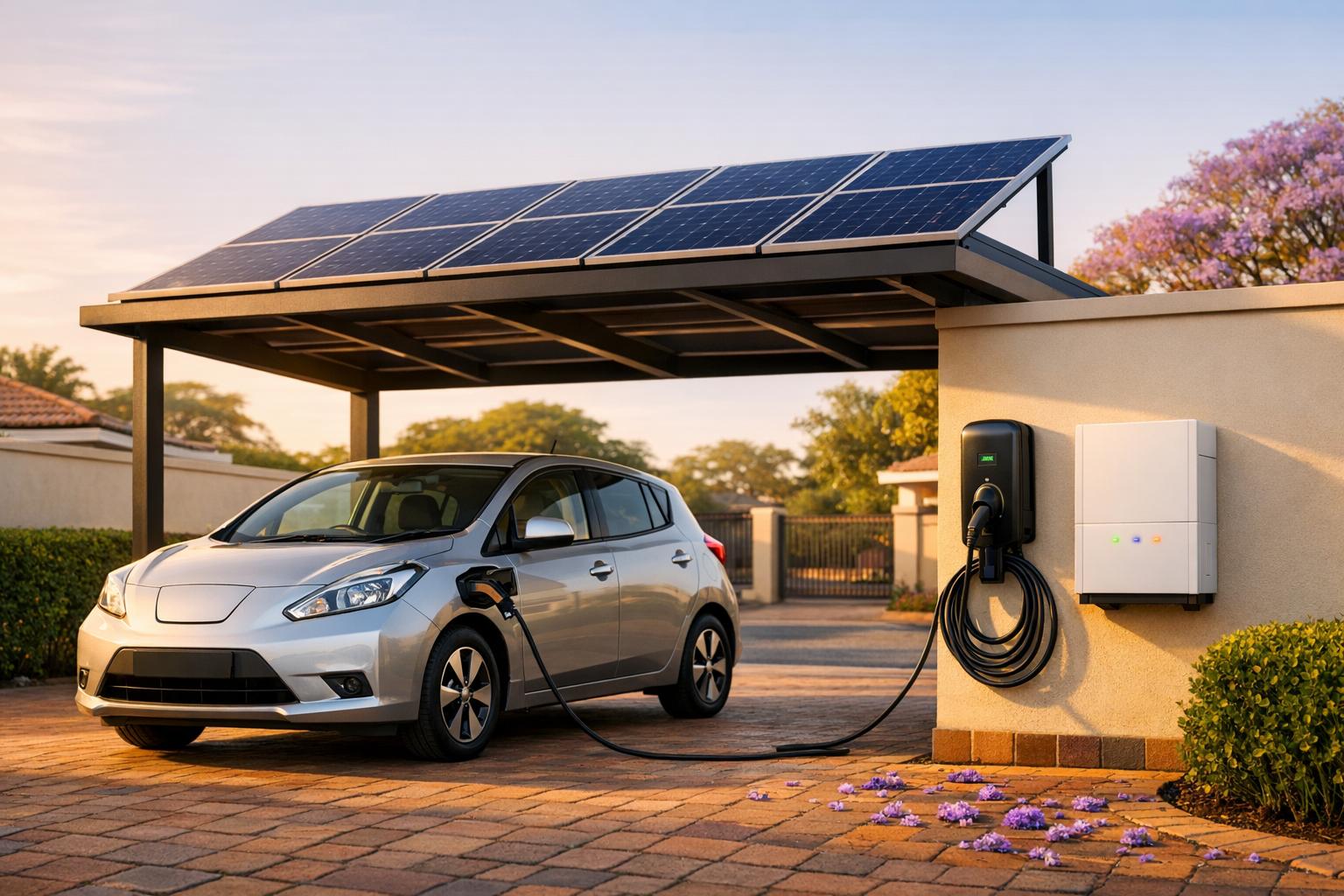
Zimbabwe’s electric vehicle (EV) market is growing, but charging remains a challenge due to frequent power outages and limited infrastructure. Here’s what you need to know about charging an EV in Zimbabwe:
- Public Charging Stations: Limited to urban areas like Harare, Bulawayo, and Mutare. ZUVA Petroleum leads the network, but coverage along highways and rural areas is minimal.
- Home Charging: A reliable option, especially with a Level 2 charger. Costs include equipment ($300–$700) and installation ($800–$3,000+). Solar integration is increasingly popular due to grid instability.
- Solar-Powered Charging: Ideal for overcoming power outages. A basic 5kW solar system costs around $1,650+, with government duty rebates available on solar equipment.
- Government Incentives: Import duty on EVs reduced from 40% to 25% (as of 2025). Rebates on solar equipment for approved operators.
To ensure reliable charging, consider solar-powered setups or charging during off-peak hours (midnight–4:00 AM). With proper planning, EV ownership in Zimbabwe is becoming more achievable.
Finding Public Charging Stations
Zimbabwe’s public charging network is still in its early stages, with most stations concentrated in Harare, Bulawayo, and Mutare. The primary network stems from a partnership between ZUVA Petroleum and Electric Vehicle Centre Africa (EVCA), also known as BYD Zimbabwe. In June 2022, ZUVA introduced the country’s first public EV charging station on Piers Road in Borrowdale, Harare. This station features a 60 kW DC fast charger with a CCS 2 connector, conveniently located near Sam Levy’s Village, allowing drivers to charge their vehicles while shopping. This development highlights ongoing efforts to address infrastructure challenges and align with government strategies.
ZUVA has ambitious plans to expand its charging network across its 80+ service stations nationwide, focusing on major cities and key highways. The chargers use the CCS Type 2 standard, compatible with BYD vehicles, BYD electric buses, and most European EVs. For example, a 60 kW DC charger can fully recharge a BYD E6 (with a 70 kWh battery) in about 1.5 hours. While a few additional stations have been added in urban areas, coverage along highways and in rural regions remains limited.
How to Find Working Charging Stations
As the network develops, ensuring a station is functional before heading out is crucial. ZUVA stations are a reliable starting point, particularly in Harare’s Borrowdale area. Since the infrastructure is still expanding, it’s a good idea to call the ZUVA branch ahead of time to confirm that the charger is operational. Keep in mind that grid instability can sometimes leave chargers out of service.
Another resource is the Zimbabwe Energy Regulatory Authority (ZERA), which oversees energy projects and approves official charging station operators. While ZERA directories list approved operators, they don’t always provide real-time updates on station status. Additionally, make sure your EV is compatible with the CCS Type 2 connector, as this is the standard for the ZUVA/EVCA network. Despite these precautions, users should remain prepared for common challenges.
Common Problems with Public Charging
Even with location guidance, availability remains a major obstacle. Charging stations are concentrated in urban areas, leaving highways and rural regions underserved. Economic analyst Carlos Tadya underscores the importance of addressing this issue:
Addressing this infrastructure gap through strategic investment in public and private charging networks, including solar-powered options in remote areas, is crucial for building consumer confidence and accelerating the transition to electric mobility in Zimbabwe.
Power outages also pose significant challenges. Some areas experience blackouts lasting up to 18 hours, meaning finding a charger doesn’t always guarantee power availability. This has led many EV owners to explore solar-powered charging stations as a more reliable alternative – an option that will be discussed further in a later section.
sbb-itb-99e19e3
Installing a Home Charging Station
For EV owners in Zimbabwe, setting up a home charging station often provides a more dependable solution compared to public charging options. With the country’s public grid being somewhat unpredictable, a home charging station ensures a steady energy source for your vehicle. You’ll need either a Level 1 charging cable (which plugs into a standard 3-pin socket) or a dedicated Level 2 wall box for faster charging. Most modern EVs, including those from BYD Zimbabwe and many European brands, use Type 2 connectors for home AC charging.
To install a home charging station, you’ll need proper electrical infrastructure. This includes a correctly rated circuit breaker, compliant electrical wiring, and protective conduit to safeguard the wires. Before installation, it’s crucial to have a licensed electrician perform a load calculation to confirm whether your home’s electrical panel can handle the additional power demand – usually 30–50 amps for a Level 2 charger. Older homes with 60–100 amp panels may require an upgrade to accommodate this load.
Local resources, such as Electric Vehicle Centre Africa (EVCA), also known as BYD Zimbabwe, can supply the necessary equipment and expertise. To save on costs, it’s best to install the charging station as close to your electrical panel as possible since wiring expenses often make up a significant portion of the installation cost. A dedicated 7kW home charger offers a noticeable improvement, delivering about three times the power of a standard 3-pin socket, which is limited to roughly 2.3kW.
Equipment and Installation Steps
When setting up a home charging station, you have two main options:
- Level 1 Charging: This uses your existing 3-pin domestic socket and doesn’t require special installation. However, it’s slow, adding only 3–5 miles of range per hour.
- Level 2 Charging: This involves installing a dedicated wall box and requires professional help. It’s much faster, typically adding 20–35 miles of range per hour.
The installation process involves several steps. First, an electrician assesses your panel’s capacity to ensure it can handle the load. Then, they install a new circuit with compliant wiring protected by a conduit. The wall box is mounted with a manual isolation feature and placed on a dedicated circuit.
Many homeowners are also choosing to integrate solar panels and battery storage during the installation process. This setup provides backup power during outages, ensuring your EV can charge even when the grid is unavailable.
Costs and Safety Requirements
Once you’ve decided on the setup, it’s essential to consider the costs and safety standards involved. Installation expenses depend on your home’s electrical system. Here’s a breakdown of typical costs:
| Factor | Cost Range |
|---|---|
| Charging Equipment (Level 2) | $300 – $700 |
| Installation Labor & Materials | $800 – $3,000 |
| Electrical Panel Upgrade | $1,500 – $4,000+ |
| New Circuit Installation | $60 – $150 |
The Zimbabwean government has introduced incentives to help offset these costs. Under Statutory Instrument 35 of 2025, duty rebates are available for imported equipment used in solar-powered EV charging stations. These rebates cover items such as solar panels, inverters, chargers, and monitoring systems. To qualify, operators must gain approval from the Zimbabwe Energy Regulatory Authority (ZERA). Additionally, starting January 1, 2025, the import duty on electric vehicles was lowered from 40% to 25%.
Safety is equally important. Installations must comply with wiring regulations and standards like BS EN 61851-1. Avoid using extension cables for EV charging, as they pose a fire risk. Ensure the charging area is well-ventilated and free of flammable materials within a 2-meter radius. Before each use, check the station, cables, and plugs for damage. Lastly, store charging cables securely when not in use to prevent theft.
Using Solar Power for EV Charging
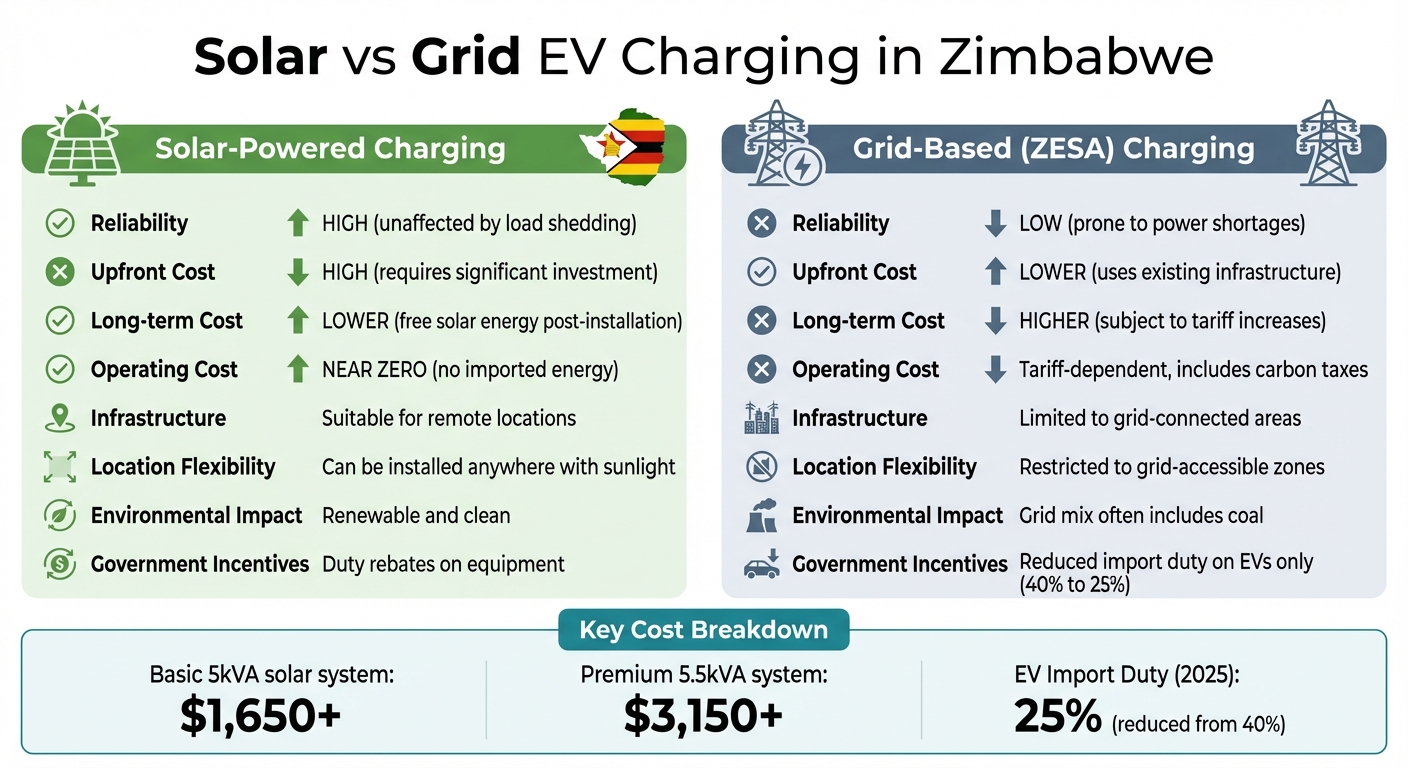
Solar vs Grid EV Charging in Zimbabwe: Cost and Reliability Comparison
In Zimbabwe, where grid failures and power outages are common, solar power presents a reliable alternative for charging electric vehicles (EVs). With 25 solar photovoltaic projects underway, set to add 403 MW to the national energy supply, solar energy is becoming a practical solution. Solar charging systems provide a dependable, independent power source, freeing users from ZESA’s frequent outages and load shedding.
Investing in solar-powered charging stations, especially in remote areas, is key to boosting consumer confidence and speeding up the adoption of electric mobility in Zimbabwe. Solar charging not only ensures reliability but also reduces reliance on imported fuel, potentially saving the country billions in foreign currency over the lifespan of EVs. For rural areas and major transport routes lacking grid connectivity, solar-powered stations are often the only feasible option. With these benefits in mind, let’s explore the essential components and setup process for a solar charging system.
Required Components and Setup Process
Setting up a solar charging system involves several components: solar panels, inverters, EV chargers, battery storage, mounting hardware, wiring, monitoring tools, and grounding equipment. Under Statutory Instrument 35 of 2025, these items qualify for duty rebates if approved by the Zimbabwe Energy Regulatory Authority (ZERA).
Given Zimbabwe’s climate, a 48V system is recommended to handle the high amperage needed for EV charging. A 24V system won’t suffice. For daily energy needs – such as replacing 16 kWh (enough to recharge 80% of a 20 kWh EV battery) – you’ll need about 5,400W of solar panels, assuming three peak sun hours during winter. A 6,000W or higher pure sine-wave inverter is ideal for Level 2 charging at 240V, and it should be sized at least 25% above your peak load.
Hybrid inverters are widely used in Zimbabwe due to their ability to manage multiple power sources. As ProSolar Media explains:
The hybrid inverter is the most popular choice in Zimbabwe due to its unmatched versatility. It intelligently manages power from multiple sources: solar panels, batteries, the ZESA grid, and even a backup generator.
For urban areas, hybrid inverters efficiently juggle power from solar panels, batteries, the grid, and generators. In off-grid rural areas, however, standalone inverters are necessary.
Battery technology is another critical factor. Lithium Iron Phosphate (LiFePO4) batteries are preferred in Zimbabwe because they withstand daily cycling caused by load shedding. These batteries last 6,000 to 10,000 cycles, equating to over 15 years of daily use. They also allow for an 80-100% depth of discharge (DoD), meaning almost all stored energy can be used without damaging the battery.
Here’s a breakdown of typical costs for solar components:
| Component | Specifications | Price Range |
|---|---|---|
| Solar Panels | 585W Jinko panels | $80 each |
| Solar Panels | 405W JA panels | $56 each |
| Hybrid Inverter | 5kVA to 6kVA (Must or Growatt) | $300 – $400 |
| Hybrid Inverter | 8kVA high-end units | $700 – $800 |
| Lithium Battery | 51.2V 100Ah (~5kWh) Evolt | $550 |
| Lithium Battery | 51.2V 100Ah (~5kWh) Svolt | $750 |
| Complete System | Basic 5kVA solar package | $1,650+ |
| Complete System | Premium 5.5kVA Deye system | $3,150+ |
To size your system correctly, calculate your daily energy consumption. List all appliances, including your EV charger, multiply their wattage by daily usage hours to get watt-hours (Wh), and divide by 1,000 to determine your daily kWh needs. For off-grid setups, include a battery storage buffer to maintain charging during cloudy periods, as power fluctuations can disrupt EV chargers.
The installation process involves a few key steps: Start with an energy audit to assess your daily mileage and energy needs. Register with ZERA to qualify for duty-free equipment imports. Install at least 5kW–6kW of solar panels to ensure sufficient power, even during shorter winter days. Use a 48V LiFePO4 battery bank (approximately 500Ah) for energy storage. Add a 6kW+ split-phase inverter for Level 2 charging speeds. Finally, connect a solar-aware EV charger capable of prioritizing solar energy over battery use.
Opt for a "solar smart" AC-powered EVSE (Electric Vehicle Supply Equipment) that can adjust its power draw to match solar production, down to 6A (around 1.4kW). Standard AC chargers typically need 1,400W to 1,500W to start a charging session. Hiring a professional installer ensures accurate load assessments and a system tailored to Zimbabwe’s unique conditions.
Solar vs. Grid Charging: Comparison
Here’s a comparison of solar and grid-based charging in Zimbabwe:
| Feature | Solar-Powered Charging | Grid-Based (ZESA) Charging |
|---|---|---|
| Reliability | High; unaffected by load shedding | Low; prone to power shortages |
| Upfront Cost | High; requires significant investment | Lower; uses existing infrastructure |
| Long-term Cost | Lower; free solar energy post-installation | Higher; subject to tariff increases |
| Operating Cost | Near zero; no imported energy | Tariff-dependent, includes carbon taxes |
| Infrastructure | Suitable for remote locations | Limited to grid-connected areas |
| Location Flexibility | Can be installed anywhere with sunlight | Restricted to grid-accessible zones |
| Environmental Impact | Renewable and clean | Grid mix often includes coal |
| Government Incentives | Duty rebates on equipment | Reduced import duty on EVs only |
Solar charging systems offer minimal operating costs after the initial investment, while grid-based charging remains subject to fluctuating tariffs. Solar’s independence from load shedding makes it far more reliable, especially given ZESA’s ongoing challenges. These benefits are further enhanced by government incentives promoting solar energy.
Government Incentives for Solar Energy
Zimbabwe’s government has introduced several incentives to encourage solar-powered EV charging. Starting January 1, 2025, Finance Minister Mthuli Ncube announced:
In order to incentivise the use of Electric Vehicles, I, further, propose to extend Rebate of Duty on equipment used for setting up Electrical Vehicle Solar Powered Charging Stations, imported by Approved Operators.
To qualify, operators must receive approval from ZERA. Additionally, import duty on EVs has been reduced from 40% to 25%, effective January 1, 2025. This reduced rate applies exclusively to EVs, while hybrids and standard vehicles remain at the 40% duty rate.
Operators benefiting from duty rebates cannot sell or transfer the equipment without permission from the ZIMRA commissioner and payment of the waived duty.
Solving Common Charging Problems
Addressing the challenges of unreliable grid supply, this section focuses on practical solutions for common EV charging issues. Power outages, high costs, and infrastructure limitations can all be tackled with the right strategies and equipment.
Backup Options During Power Outages
In Zimbabwe, load shedding can last up to 20 hours in extreme cases. For instance, during late 2022, electricity was often available only between midnight and 4:00 AM. Fortunately, a four-hour charging window is enough to charge a 24 kWh Nissan Leaf to 80-100% capacity.
To make the most of this limited supply, consider automating your charging schedule with timers set for the midnight-to-4:00 AM window. This ensures your EV is ready for daily use, even during severe droughts that disrupt hydropower generation.
For those seeking full independence from the grid, battery storage systems are invaluable. These systems store energy from solar panels or during brief periods of grid availability, providing a reliable power source during outages. Under Statutory Instrument 35 of 2025, ZERA-approved operators can claim duty rebates on imported battery storage units, inverters, and solar panels, reducing the cost of these solutions.
Another option is captive solar power systems, which are gaining popularity among businesses and individuals looking to bypass the unstable grid entirely. With 25 solar projects in progress that will add 403 MW to the national grid, solar-powered charging solutions are becoming more accessible.
These backup methods work hand-in-hand with cost-saving and maintenance strategies discussed below.
How to Lower Charging Costs
Statutory Instrument 35 of 2025 offers duty rebates on solar charging equipment for ZERA-approved operators, making solar integration more affordable. Additionally, the government has reduced import duty on EVs from 40% to 25% as of January 1, 2025, lowering the cost of entry for new EV owners.
To qualify for these benefits, approval from ZERA is required. It’s important to note that equipment imported under the rebate program cannot be resold or transferred without written consent from ZIMRA and repayment of the waived duty.
Charging during off-peak hours, such as the midnight-to-4:00 AM window, helps manage costs by avoiding higher tariffs during peak demand periods. Combining this with solar power can result in the lowest long-term energy costs, as solar eliminates reliance on grid tariffs after the initial setup investment.
Investing in solar-powered charging stations, especially in remote areas, is also key to building trust among consumers and encouraging broader EV adoption.
Maintaining Your Charging Equipment
In Zimbabwe’s challenging power environment, regular maintenance is essential to keep your charging equipment running smoothly and safely. Proper grounding equipment is critical to protect charging units from faults and power surges caused by the unstable grid. This step is non-negotiable for both safety and the longevity of your equipment.
Monitoring systems are another valuable addition. These systems track power quality and performance in real time, detecting issues before they become major problems. Plus, these systems are eligible for duty rebates, making them a smart investment.
Routine inspections of electrical wiring, control units, and mounting structures ensure your system remains weather-resistant and efficient. Battery storage and inverters further stabilize power flow, shielding sensitive electronics from grid surges or brownouts.
Make sure all charging equipment is approved by ZERA to meet local safety standards. Professional installation and regular maintenance checks are crucial to avoid expensive repairs and ensure reliable performance, even in a challenging power landscape.
Conclusion
Charging an electric vehicle in Zimbabwe requires careful planning due to the country’s unreliable power grid. In 2022, load-shedding stretched up to 20 hours a day, leaving many with electricity only between midnight and 4:00 AM. Despite these hurdles, owning an EV is becoming more feasible thanks to home charging, solar solutions, and smart energy use.
Home charging stands out as the most realistic option. Government incentives are making it easier for people to invest in solar systems and other home charging setups. As L.S.M Kabweza from Techzim explained:
To charge an EV, one will still need to invest in a sizeable solar system. There’s no way one can rely on Zesa’s national power grid.
Public charging stations are scarce, especially outside urban areas, making long-distance travel tricky. This highlights the importance of creating a personalized charging plan. Encouragingly, with 25 solar projects in development expected to add 403 MW to the national grid, solar-powered charging is becoming a key part of Zimbabwe’s EV landscape. It offers a reliable alternative to the unstable grid.
To adapt, consider charging during the midnight-to-4:00 AM window or installing a solar system with battery storage for greater independence. Applying for ZERA duty rebates on equipment like panels, inverters, and chargers can also reduce costs.
While the initial investment may seem steep, government support, advancements in solar energy, and smart charging strategies are making EV ownership a practical choice in Zimbabwe’s shifting energy environment.
FAQs
How big should my solar system be to charge my EV at home in Zimbabwe?
To determine the right size for your solar system, start by looking at your household’s daily energy consumption – usually around 10–15 kWh – and factor in your EV’s charging needs, which depend on its battery capacity and how much you drive. For powering both your home and charging an EV, a solar system in the range of 5 kVA to 10 kVA is often suggested. It’s always a good idea to consult a professional installer to make sure your system is tailored to your energy needs and local conditions.
Will my EV work with Zimbabwe’s public chargers and home plugs?
Yes, your EV can be charged using Zimbabwe’s public charging stations and standard home outlets. Charging options include Level 1, which uses regular household outlets, and Level 2 chargers, commonly used worldwide. Zimbabwe is actively growing its EV infrastructure, with charging stations now being installed at gas stations and other convenient locations to better serve EV drivers.
What should I do if load shedding cuts power during charging?
If load shedding disrupts your EV charging, there are a few ways to work around it. One option is to invest in solar panels with battery storage, which can keep your vehicle powered even during outages. Alternatively, a generator or a home energy storage system can serve as a reliable backup. To stay ahead, plan your charging times around load shedding schedules and consider renewable energy solutions to minimize interruptions.