
 Thabo Nkosi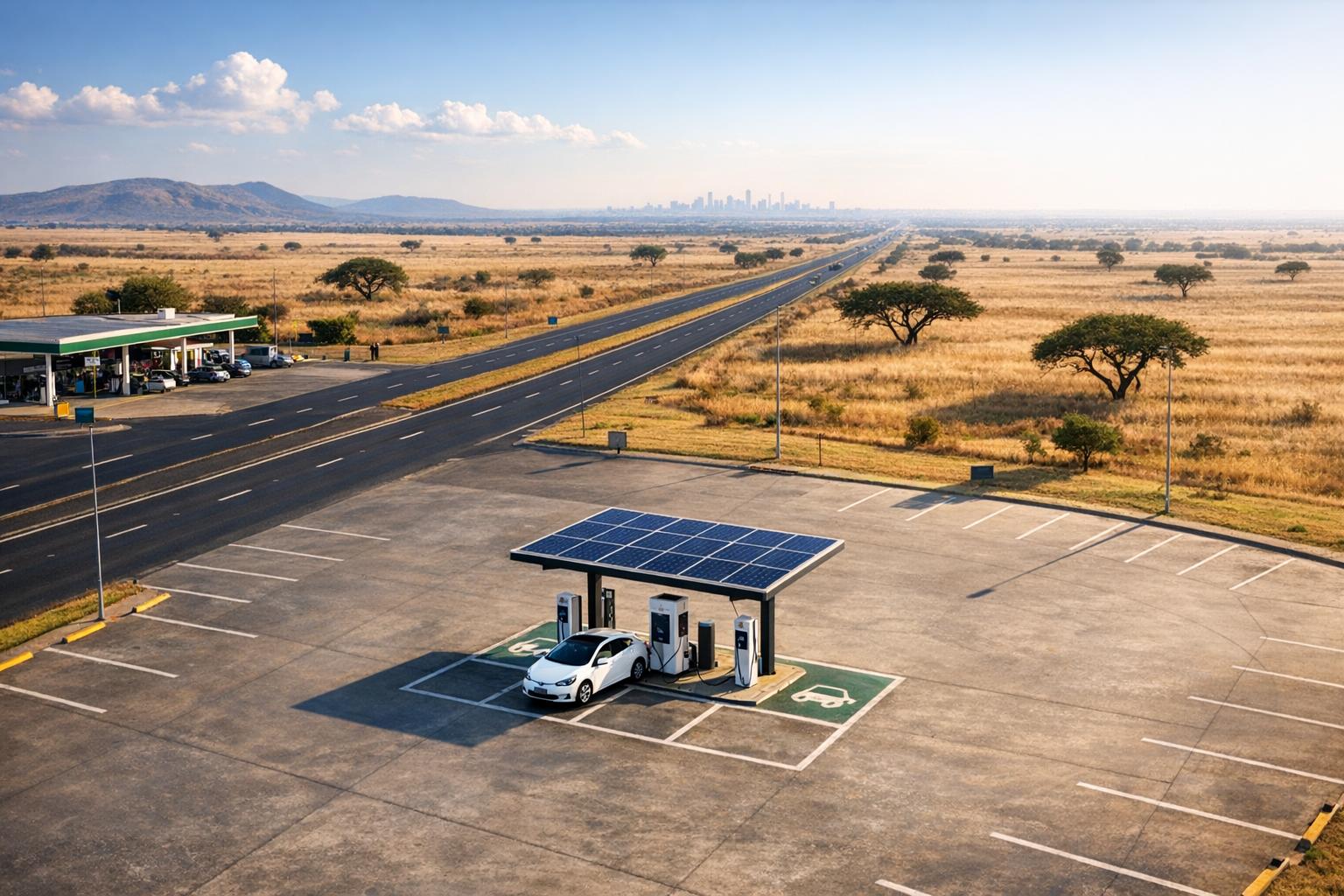
South Africa is making progress in electric vehicle (EV) adoption, but challenges like limited infrastructure, high costs, and policy gaps are slowing growth. Here’s what you need to know:
- EV Sales Lagging: EVs accounted for just 1.2% of new car sales in 2025, compared to 17 million EVs sold globally in 2024.
- High Costs: Most EVs cost over $50,000, while 74% of buyers seek cars under $28,000.
- Infrastructure Gaps: Fewer than 400 public charging stations exist, compared to 4,800 petrol stations.
- Energy Issues: Grid instability complicates charging, but solar-powered stations offer alternatives.
- Policy Challenges: Import duties and luxury taxes on EVs make them expensive, despite government incentives for local production.
Efforts like solar-powered charging stations, used EV markets, and government tax incentives aim to address these issues. However, without lower costs and stronger infrastructure, mass adoption remains a long-term goal.
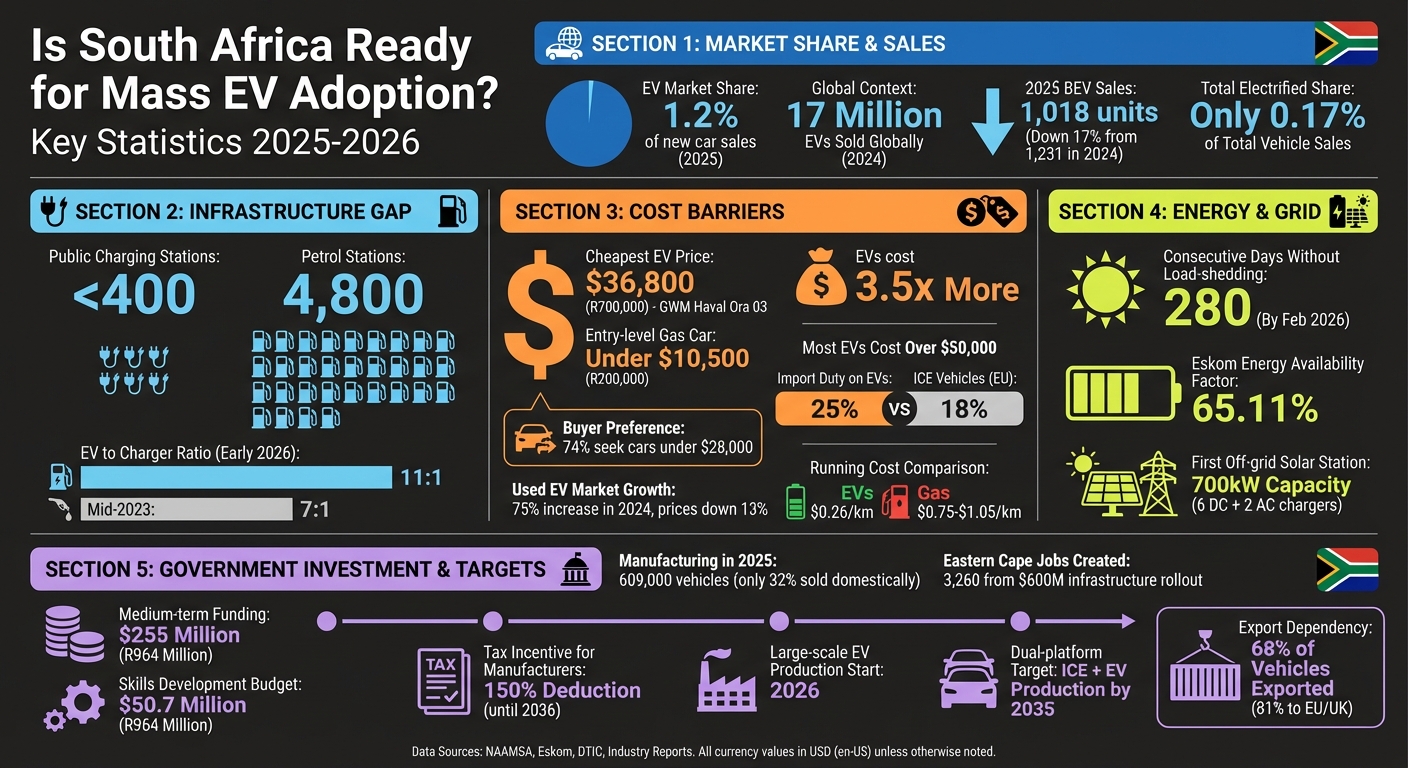
South Africa EV Adoption Statistics: Infrastructure, Costs, and Market Share 2025-2026
EV Infrastructure Challenges
Lack of Public Charging Stations
The shortage of public charging stations is a major hurdle for EV adoption in South Africa. With fewer than 400 public charging points compared to around 4,800 petrol stations nationwide, the disparity is striking. By early 2026, the ratio of EVs to public charging stations had grown to 11:1, up from 7:1 in mid-2023. This limited access feeds into range anxiety, discouraging potential EV owners from taking longer trips.
The slow pace of infrastructure development stems from high installation costs and hefty municipal fees, such as Tshwane’s "Basic Charge", which make operating in some areas financially unviable. For instance, Rubicon has avoided expanding in Tshwane due to these prohibitive charges. On top of that, regulatory hurdles, like SANRAL’s feedback process taking over 1,000 days and conflicting rural development guidelines in regions like the Western Cape, further delay progress.
Geographic disparities add to the problem. Most charging stations are concentrated in Gauteng and the Western Cape, leaving provinces like the Northern Cape, North West, and Limpopo with minimal coverage. In early 2025, Rubicon collaborated with the Automotive Industry Development Centre (AIDC) Eastern Cape to install 11 new stations, marking a milestone as the first government-backed investment in EV charging infrastructure. Hilton Musk, Rubicon’s Head of E-mobility, commented:
"DC expansion will likely pick up pace again next year as we start to see increased EV sales and utilization".
Despite these efforts, the current pace of development is insufficient to support widespread EV adoption. And beyond the lack of charging stations, South Africa’s energy challenges further complicate the situation.
Grid Instability and Energy Supply Issues
South Africa’s ongoing energy crisis adds another layer of difficulty. Although the country managed 280 consecutive days without load-shedding by February 2026, Eskom’s Energy Availability Factor (EAF) remains at just 65.11%. Grid-tied chargers, already burdening the fragile system, are vulnerable to localized outages and load reductions, especially in areas where electricity theft and infrastructure damage are common. This makes relying on the national grid a precarious strategy for the future.
Joubert Roux, Co-founder of CHARGE (formerly Zero Carbon Charge), highlighted this concern:
"Grid connected chargers are not a long-term solution in a country facing chronic electricity shortages. As electric vehicle uptake grows, grid-tied charging simply transfers additional pressure onto an already failing system".
In December 2024, CHARGE launched South Africa’s first fully off-grid, solar-powered EV charging station along the N12 between Klerksdorp and Wolmaransstad. This site, capable of delivering over 700kW through six DC and two AC chargers, relies entirely on solar panels and battery storage. However, the project faced a year-long delay due to local government requirements and tender processes. These challenges highlight how grid limitations and bureaucratic red tape continue to slow the rollout of EV infrastructure.
sbb-itb-99e19e3
Government Policies and Incentives
The 2023 EV White Paper and Production Targets
The 2023 Electric Vehicles White Paper outlines South Africa’s roadmap for transitioning its automotive industry toward electric vehicle (EV) production. The plan envisions a dual-platform manufacturing approach, where both internal combustion engine (ICE) vehicles and EVs will be produced by 2035. Large-scale EV production is slated to begin in 2026, aligning with the EU and UK’s bans on new ICE vehicle sales by 2035. This timing is critical since nearly half of South Africa’s auto production is exported to these regions.
The strategy is divided into two phases. Phase 1 focuses on EV production and exports, safeguarding an automotive sector that contributes 2.9% to GDP and accounts for 12.4% of the country’s exports. Phase 2 shifts attention to boosting local demand and sales, though there’s an expected delay of 7 to 8 years between these phases. Commenting on the White Paper, Virusha Subban, Partner and Head of Tax at Baker McKenzie, described it as:
"a decisive step in transforming South Africa’s automotive industry and laying the foundation for a domestic EV market".
These production goals pave the way for financial incentives aimed at encouraging both manufacturing and eventual consumer adoption.
Tax Benefits and Remaining Obstacles
To support EV production, the government has introduced tax incentives. Starting March 1, 2026, manufacturers can claim a 150% tax deduction on investments in facilities and equipment for producing new energy vehicles, including EVs and hydrogen-powered vehicles. This incentive will remain available until March 2036 and is projected to cost the government around $132 million (R500 million) in the 2026/27 fiscal year. Additionally, under Section 11D of the Income Tax Act, EV-related research and development expenses qualify for up to a 150% tax deduction. Over the medium term, the government has allocated approximately $255 million (R964 million) to support the transition to EVs.
However, while production incentives are robust, consumer-focused support is notably absent. Currently, electric vehicles face a 25% import duty, compared to 18% for ICE vehicles imported from the EU. EVs are also classified as luxury goods, which subjects them to additional ad valorem taxes, further driving up their prices. Joubert Roux, Co-Founder and Chair of CHARGE, highlighted this contradiction:
"You cannot incentivise EV production on one hand and penalise EV adoption on the other".
This policy imbalance is evident in recent sales figures. Battery electric vehicle (BEV) sales dropped by 17% in 2025, with only 1,018 units sold compared to 1,231 in 2024, making up just 0.17% of total vehicle sales in South Africa. Without addressing these tax barriers or introducing consumer subsidies, the government’s ambitious production targets may fail to stimulate the local demand necessary for long-term success.
Market Demand and Affordability
High Purchase Prices and Import Duties
The price difference between electric vehicles (EVs) and traditional gas-powered cars is a major barrier to adoption. For instance, the cheapest EV, the GWM Haval Ora 03, is priced at $36,800 (R700,000), while entry-level gas-powered cars start at under $10,500 (R200,000). That means the most affordable EV costs about 3.5 times more than its gas-powered counterpart.
Adding to the challenge, import duties make EVs even less affordable. Classified as luxury goods, EVs are subject to additional ad valorem taxes, which can more than double their price compared to similar gas models. Andrew Kirby, CEO of Toyota South Africa, summarized the issue:
"We don’t have competitive new-energy vehicles. We have some but we don’t sell many locally and we haven’t localized those components."
While EVs promise lower running costs – $0.26 per kilometer (R0.50) versus $0.75–$1.05 per kilometer (R1.43–R2.00) for gas vehicles – their steep upfront prices put them out of reach for many South African consumers. Compounding this, the government has stated that import duties will remain unchanged for the next 7 to 8 years as they focus on local production. This pricing structure not only discourages buyers but also keeps domestic EV sales stubbornly low, as explored further below.
Slow Domestic Sales and Export Market Influence
The combination of high prices and limited incentives has led to sluggish EV adoption in South Africa. In 2025, only 1,018 battery electric vehicles were sold, making up a mere 0.17% of total vehicle sales – a 17% drop from the 1,231 units sold the previous year. Even when including plug-in hybrids and other electrified models, the total share reached just 1.5% by 2023.
Meanwhile, local production tells a different story. In 2025, South Africa manufactured 609,000 vehicles, but only 32% were sold domestically. The majority were exported, with 81% of these exports heading to Europe and the UK, where gas-powered vehicles are being phased out. This reliance on export markets is driving manufacturers to shift toward EV production, even though local demand remains weak. The lack of policy adjustments – such as unchanged import duties – continues to stifle interest among South African buyers.
The market dynamics are further complicated by the growing presence of affordable Chinese vehicles. By 2024, Chinese imports accounted for 22% of all vehicle imports, a staggering 368% increase since 2020. In response, the government is considering raising import tariffs from 25% to as high as 50% to safeguard local manufacturing. Peter van Binsbergen, CEO of BMW South Africa, highlighted the broader challenge:
"Essentially, we need to make it viable for more brands to come to South Africa and then they become part of the solution."
This creates a tough cycle: without enough local demand, manufacturers struggle to achieve the scale needed to lower production costs through localized component manufacturing. And without lower prices, consumer interest remains limited – stalling the development of a sustainable EV market in South Africa.
Current Solutions and Initiatives
Solar-Powered Charging Projects
South Africa is addressing its energy challenges with off-grid, solar-powered charging stations. Zero Carbon Charge is leading the way by planning a nationwide network of 120 ultra-fast charging stations for passenger vehicles and another 120 for electric trucks – entirely independent of Eskom’s unreliable power grid. In November 2025, the company began construction on its first two stations along the N3 highway corridor between Johannesburg and Durban: CHARGE N3 Roadside in the Free State and CHARGE N3 Tugela in KwaZulu-Natal. These projects received a $5.26 million (R100 million) equity boost from the Development Bank of Southern Africa (DBSA) and are expected to be operational by June 2026. Joubert Roux, the company’s Executive Chairman, highlighted the significance of this development:
"The argument that electric vehicles cannot handle long-distance travel no longer holds. With dedicated, solar-powered highway charging becoming operational, EVs are now a practical, everyday choice, rather than a future concept."
Additionally, a $600 million rollout in the Eastern Cape is creating over 3,260 jobs, addressing both infrastructure needs and unemployment. On January 15, 2026, a demonstration at the Wolmaransstad station showcased the system’s capabilities, charging two SANY electric trucks and four passenger EVs simultaneously. This proved the infrastructure’s ability to support both heavy-duty and daily-use vehicles. These charging stations are designed to go beyond functionality – they’re envisioned as "tourist destinations", featuring amenities to make the charging experience more enjoyable.
While infrastructure projects are expanding EV access, building a skilled workforce is equally important.
Training and Education Programs
To support the EV industry’s growth, the South African government has allocated $50.7 million (R964 million) over the medium term for skills development as part of the 2023 Electric Vehicle White Paper. This funding focuses on training technicians, engineers, and factory workers, enabling domestic manufacturing and maintenance of EVs. By addressing the skills gap, these programs aim to strengthen local production capacity.
Online Marketplaces for EV Access
Digital platforms are making EV ownership easier and more accessible. In April 2025, Africar Group and AUTO24.africa launched EV24.africa, a platform offering buyers across 54 African countries access to over 200 EV models from 25 global brands, including Tesla and BYD. The platform takes care of vehicle certification, logistics, and financing, removing common barriers for buyers. CEO Axel Peyriere shared the platform’s vision:
"Africa is ready for electric vehicles, and EV24.africa is here to make the transition smooth and accessible. Our mission is to provide a trusted, transparent and competitive EV marketplace for buyers across the continent."
The used EV market is also gaining momentum as a more affordable option. In 2024, sales of used EVs surged by 75% compared to the previous year, while average prices dropped by 13%. These vehicles, typically just two years old with 10,563 miles (17,000 km) on the odometer, offer buyers nearly-new options at attractive prices. George Mienie, CEO of AutoTrader, noted:
"As more affordable EV models enter the market and charging networks expand, the barriers to EV ownership will steadily be dismantled."
Future of Mobility in South Africa: EVs, Policy & Reality Check
Conclusion: South Africa’s Path to Mass EV Adoption
South Africa’s journey toward widespread electric vehicle (EV) adoption hinges on a few key elements: updated policies, better infrastructure, and greater market accessibility. The road ahead is challenging, with hurdles like limited charging stations, an unstable power grid, and steep upfront costs for EVs. However, progress is visible. Initiatives such as the expansion of solar-powered charging networks, a significant budget allocation of $50.7 million (R964 million) to support EV adoption, and platforms like EV24.africa, which are boosting awareness and availability, are paving the way forward.
Government intervention will play a pivotal role. Reducing import duties and introducing meaningful tax incentives could make EVs more affordable and encourage local manufacturing. As Joubert Roux, Co-founder of Zero Carbon Charge, explained:
"If we announce a tax holiday (for a period of five to six years), electric vehicles will immediately be cost competitive".
Additionally, simplifying regulatory processes for private infrastructure projects could accelerate the development of charging networks, which are often delayed by bureaucratic hurdles from agencies like SANRAL. These policy changes would directly support the infrastructure and market efforts already underway.
Meanwhile, private companies are stepping up with innovative solutions. For example, Zero Carbon Charge is leading efforts to deploy solar-powered charging stations, bypassing the limitations of the national grid. Partnerships and creative off-grid solutions are also expanding access to charging infrastructure, complementing government reforms.
Ultimately, consumer adoption will be the deciding factor. The growing market for used EVs is offering nearly-new models at competitive prices, making ownership more accessible. George Mienie of AutoTrader highlighted this shift:
"As more affordable EV models enter the market and charging networks expand, the barriers to EV ownership will steadily be dismantled".
Reaching a target of 2,000 EV sales per month – around 5% of total new car sales – could create the momentum needed for a self-sustaining transition.
The pieces are falling into place. With coordinated efforts from policymakers, industry leaders, and consumers, South Africa has the potential to overcome its challenges and embrace mass EV adoption. The tools and strategies are already available; now it’s about taking decisive action to make it happen.
FAQs
When will EV prices in South Africa drop?
EV prices in South Africa are set to drop as the country gears up for local production and government incentives come into play. With plans to manufacture the first locally produced EV by 2026, the reliance on costly imports could shrink, paving the way for more affordable options for consumers.
Can EVs charge reliably during load-shedding?
Charging electric vehicles (EVs) in South Africa during load-shedding presents a significant challenge. Power outages disrupt home charging routines, leaving EV owners in a tough spot. While some public charging stations in cities manage to stay operational, their reliability can vary. The limited access to dependable charging infrastructure remains a pressing issue for those considering EVs in the country.
What policy change would boost EV adoption fastest?
Reducing import duties and taxes on electric vehicles (EVs) could play a big role in increasing their adoption in South Africa. Right now, EVs are hit with a 25% import duty – higher than the 18% applied to traditional vehicles. On top of that, there are extra taxes on batteries, which only adds to the cost. Lowering these charges would make EVs more affordable for everyday buyers.
Additionally, offering consumer incentives like tax rebates or subsidies could speed up adoption even more. These measures would not only make EVs financially appealing to buyers but also create a more inviting market for manufacturers looking to invest in the region.