
 Thabo Nkosi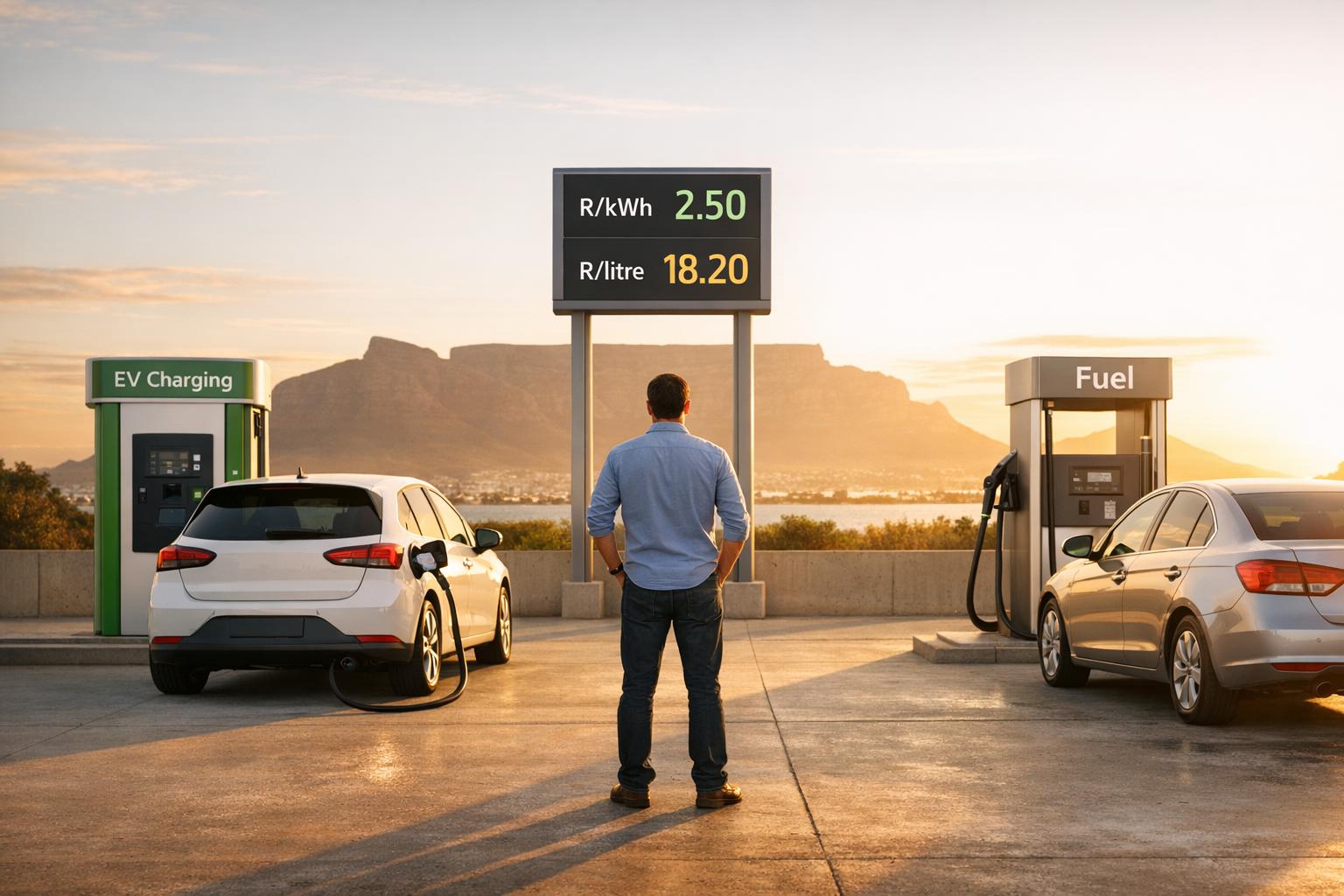
Deciding between electric and petrol cars in South Africa boils down to costs, convenience, and driving habits. Electric vehicles (EVs) are cheaper to run – 61% less per kilometer – and save up to R26,900 annually on energy costs. However, they come with a higher upfront price. For instance, the BYD Atto 3 EV costs R627,900, compared to R569,900 for a Toyota Corolla Cross petrol car. Without government incentives, South Africans must rely on long-term savings in fuel and maintenance to offset the initial expense.
EVs excel in performance with instant torque and lower upkeep costs – just R12,000 over five years compared to R45,000 for petrol cars. Yet, limited charging infrastructure (350–400 public chargers) makes petrol cars more practical for long trips or rural areas. South Africa’s coal-heavy power grid also dampens EVs’ environmental benefits unless paired with home solar systems.
Quick Comparison
| Criteria | Electric Cars | Petrol Cars |
|---|---|---|
| Upfront Cost | Higher (e.g., BYD Atto 3: R627,900) | Lower (e.g., Corolla Cross: R569,900) |
| Running Cost (per km) | R0.93 | R2.40 |
| Annual Fuel Cost | R16,973 (electricity) | R43,800 (petrol) |
| Maintenance (5 years) | R12,000 | R45,000 |
| Charging/Refueling | Home charging essential; 400 public chargers | Petrol stations widely available |
| Driving Range | ~400 km per charge (varies) | ~500 km per tank (consistent) |
If you drive mostly in cities and can charge at home, EVs offer long-term savings. For frequent long-distance travel or rural living, petrol cars may be a better fit. Your lifestyle and access to charging are key factors in choosing the right option.
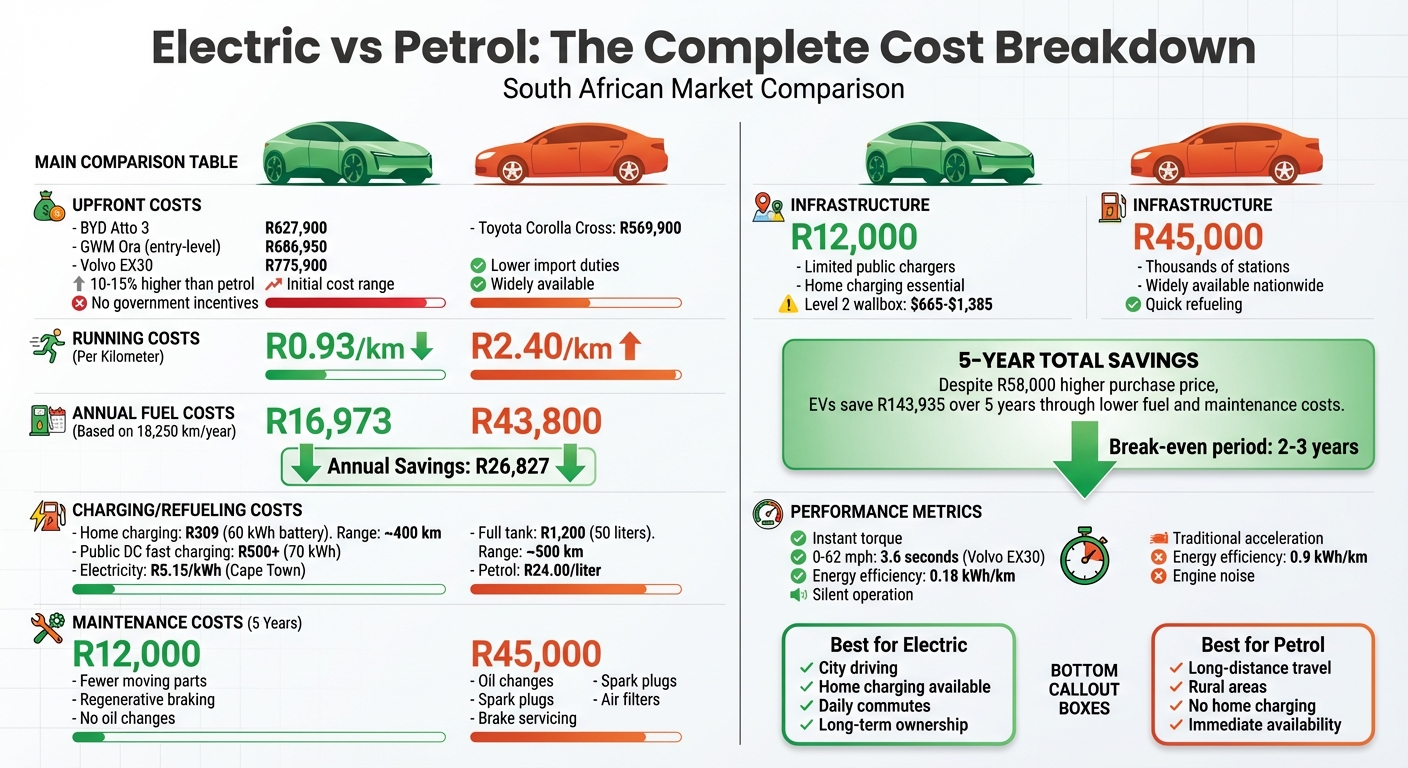
Electric vs Petrol Cars Cost Comparison: Purchase Price, Running Costs, and Maintenance
Electric Cars Don’t Make Sense In South Africa
Purchase Price: Electric Cars vs. Petrol Cars
The upfront cost is a significant barrier for South African buyers considering electric vehicles (EVs). On average, EVs are priced about 10-15% higher than petrol cars, largely due to elevated government import duties. It’s essential to weigh these initial costs against long-term savings in fuel and maintenance.
Prices of Popular Models
For instance, the BYD Atto 3 electric SUV is priced at R627,900, while a comparable petrol model like the Toyota Corolla Cross 1.8 costs R569,900. Looking at entry-level EVs, the GWM Ora starts at R686,950, making it the most affordable EV available in South Africa. On the premium side, the Volvo EX30 begins at R775,900.
As technology journalist Nafisa Akabor points out, the price gap between EVs and petrol cars persists, primarily due to import duties. While this difference can feel daunting at the time of purchase, the equation shifts when factoring in operational savings. Many buyers find they recoup the extra upfront cost within 2-3 years, thanks to lower fuel expenses.
Tax Credits and Rebates
Unlike in the U.S., where federal tax credits help reduce the cost of EVs, South African buyers receive no government incentives or rebates to offset the higher purchase price. This lack of support adds to the financial challenge. TechCentral‘s William Kelly observed:
If you exclude the higher cost you’ll pay upfront for an EV compared to an equivalent ICE model – thanks in large part to the higher taxes South Africans pay for EVs – the message is clear: electric wins hands down.
To ease the burden, some manufacturers include perks like home wallbox chargers with vehicle purchases. Brands such as Mercedes and Volvo have adopted this approach. While these extras are helpful, they don’t significantly change the fact that South African EV buyers face higher initial costs compared to petrol car buyers. This reality highlights the importance of examining operating costs and long-term benefits when making a decision.
Operating Costs: Fuel and Maintenance
Electric vehicles (EVs) might have higher upfront costs, but their operating expenses can lead to substantial savings over time. In South Africa, for example, the cost to run an EV averages around R0.93 per kilometer, compared to R2.40 per kilometer for petrol vehicles.
Fuel and Electricity Costs
When comparing fuel and electricity costs, the savings become clear. In Cape Town, electricity is priced at R5.15 per kWh, while petrol costs R24.00 per liter. An EV consuming 18 kWh per 100 kilometers is far more economical than a petrol car that burns 10 liters per 100 kilometers. Charging a 60 kWh EV battery at home costs about R309, providing a range of roughly 400 kilometers. In contrast, filling a 50-liter petrol tank costs around R1,200 and covers about 500 kilometers.
Home charging is the most cost-effective option, with electricity rates ranging between R3.00 and R4.00 per kWh. Public DC fast chargers are pricier, costing between R7.00 and R7.50 per kWh. For example, fully charging a 70 kWh EV battery at home costs about R245, while using a public fast charger can exceed R500. Over the course of a year, an EV owner driving 18,250 kilometers spends roughly R16,973 on electricity, compared to the R43,800 a petrol driver would spend on fuel.
But the savings don’t stop there – EVs also come with lower maintenance costs.
Maintenance Expenses
EVs are simpler machines, with fewer moving parts and systems to maintain. They also utilize regenerative braking, which reduces wear and tear on brake pads. Over five years, the maintenance costs for a BYD Atto 3 are about R12,000, while a Toyota Corolla Cross racks up approximately R45,000 in upkeep. Petrol cars require frequent oil changes, spark plug replacements, air filter swaps, and more brake servicing compared to EVs.
Even though the BYD Atto 3 costs R58,000 more than the Toyota Corolla Cross initially, its lower fuel and maintenance expenses translate into savings of R143,935 over five years.
Performance and Driving Range
Electric vehicles (EVs) offer more than just cost savings – they excel in performance too. One standout feature is their ability to deliver instant torque, meaning power is available immediately, without the delay you’d experience with a traditional engine. For example, the Volvo EX30, available in South Africa, can accelerate from 0–62 mph in just 3.6 seconds.
This instant power makes EVs particularly suited for city driving, where frequent stops and starts are common. Unlike petrol cars, which consume fuel even when idling, EVs use minimal energy and can even recapture power through regenerative braking. Andrew Blane, Senior Instructor at Jaguar Land Rover Experience Johannesburg, highlighted this efficiency after testing EVs in real-world conditions:
We knew going into this test that ICE cars simply cannot compete with EVs on energy costs and cost per kilometer.
Acceleration and Driving Feel
EVs not only accelerate quickly but also offer a smooth and quiet driving experience. For instance, the Volvo EX30 consumes about 0.29 kWh per mile, a stark contrast to the 1.45 kWh per mile typical of petrol models. However, this rapid acceleration and advanced technology come at a price – experts attribute the 35% higher insurance premiums for EVs partly to their performance capabilities.
These characteristics make EVs ideal for short trips and city driving, but how do they handle long-distance travel?
Range and Long-Distance Driving
When it comes to highway driving, real-world conditions often lead to lower ranges than what manufacturers advertise. For instance, the BYD Atto 3, with its 60 kWh battery, offers an estimated 250 miles of range. However, driving at sustained highway speeds of 75 mph can significantly cut into this number. AutoTrader CEO George Mienie pointed out:
The tests are based on South African conditions rather than the cooler European testing scenarios.
Real-world tests illustrate this point. At 75 mph with the air conditioning set to 70°F, the Mercedes-Benz EQA 250 achieved just 158 miles, far below its claimed 250 miles. Similarly, the GWM Ora 03 400 GT managed only 124 miles compared to its advertised 249 miles. In contrast, a Toyota Corolla Cross Hybrid covered an impressive 334 miles on a single tank of fuel.
Another factor to consider is battery health. Experts recommend keeping EV batteries above 10% charge to preserve their longevity, which can further limit their effective range. Unlike petrol cars, which can run almost to empty, this practice adds a layer of planning for long trips. Despite these challenges, EVs still maintain an edge in overall efficiency, even under less-than-ideal conditions.
sbb-itb-99e19e3
Infrastructure: Charging Stations vs Gas Stations
When deciding between EVs and petrol cars, charging accessibility plays a major role alongside purchase price and operational costs. In South Africa, there are only about 350–400 public charging points across the country, which aligns with EV adoption rates of less than 0.5%. By comparison, petrol stations are everywhere, making them far more convenient for both urban and rural drivers.
Urban vs. Rural Access
Cities like Johannesburg, Cape Town, and Durban have a decent number of charging stations, but rural areas are largely left out, as highlighted by Anari Energy. This disparity creates significant challenges for anyone traveling long distances or living in less populated regions.
To address this, some strategic highway networks, such as the Jaguar Powerway, have installed fast chargers along major routes like the N1, N2, and N3. These stations are spaced roughly 124 to 186 miles apart. Winstone Jordaan, Managing Director of GridCars, emphasizes the role of DC chargers:
DC chargers have two purposes: speed and convenience… suited for when you are far from home or doing extensive intercity travel.
However, for trips to remote locations, petrol remains the more practical choice due to the lack of charging infrastructure.
Home Charging Setup
With limited public charging options, home charging becomes a necessity for EV owners. Many opt for a Level 2 wallbox, which costs between $500 and $1,000. Add installation fees ($55–$140) and a Certificate of Compliance ($28–$83), and the total expense ranges from $665 to $1,385.
Charging at home is also cheaper than using public stations. Home electricity costs between $0.17 and $0.22 per kWh, while public DC fast chargers charge $0.39 to $0.42 per kWh. For a 70 kWh battery, a full charge at home comes to about $14, compared to $29 at a public station. Installation, which takes 4–8 hours, must be done by a registered electrician if the work exceeds 16 amps. It’s also wise to choose a charger with an auto-resume function to handle interruptions caused by load shedding.
Environmental Impact: EVs vs Petrol Cars
Carbon Emissions
Electric vehicles (EVs) stand out for their lack of tailpipe emissions, which is especially important in South Africa’s crowded cities. Petrol cars, on the other hand, continue to burn fuel even when idling. Andrew Blane, Senior Instructor at Jaguar Land Rover Experience Johannesburg, puts it simply:
ICE cars will continue to burn fuel whether they’re moving or not, where EVs will consume minimal energy use when stationary.
From an efficiency standpoint, the numbers speak volumes. The Volvo EX30 consumes just 0.18 kWh per kilometer, while a typical petrol car uses around 0.9 kWh for the same distance. That makes EVs about five times more energy-efficient. In South Africa, real-world tests of the Jaguar I-PACE showed an average consumption of 22 kWh per 62 miles under varied driving conditions. Beyond reducing carbon emissions, EVs also contribute to cleaner air by using regenerative braking, which cuts down on particulate matter (PM 2.5) emissions.
However, the full environmental impact of EVs depends on where their electricity comes from.
Energy Source Factors
While EVs excel at reducing pollution in urban areas, their broader environmental benefits rely heavily on the energy source powering them. In South Africa, this becomes a complex issue due to the country’s heavy reliance on coal-fired power plants. As Africa’s largest greenhouse gas emitter and the 12th largest worldwide, South Africa’s coal-dependent grid affects the overall benefits of EVs. For context, the transport sector contributed 12.1% of South Africa’s total 466.92 Mt of CO₂ emissions in 2019.
Many EV owners in South Africa are addressing this challenge by installing home solar systems, enabling near-zero emission charging. This approach significantly boosts the environmental advantages of driving electric. William Kelly from TechCentral underscores the efficiency gap between EVs and traditional cars:
The Volvo is five times more efficient than the petrol car. Efficiency is where the big differences between internal combustion engine (ICE) vehicles and EVs lie.
Even with the current grid’s limitations, EVs provide immediate benefits by cutting urban air pollution. And as South Africa gradually increases its renewable energy capacity, the long-term environmental gains of EVs will only improve.
Practicality for American Drivers
While earlier sections focused on South African conditions, this part shifts to the United States, where differences in infrastructure and costs significantly impact how electric vehicles (EVs) compare to gasoline-powered cars.
Daily Commutes and Home Charging
In the U.S., many EV owners take advantage of overnight home charging, waking up to a fully charged battery each morning and cutting down on fuel expenses. On average, EVs cost about $0.41 per mile, while gasoline-powered cars run closer to $1.05 per mile. For a typical 31-mile daily commute, this adds up to $7,300 in yearly savings.
Charging at home is also more affordable. Rates range from $0.81 to $1.08 per kilowatt-hour, roughly half the cost of public DC fast chargers, which average $1.89 to $2.03 per kilowatt-hour. Some drivers further reduce costs by pairing their EVs with home solar systems, which can nearly eliminate charging expenses.
While home charging is ideal for daily commutes, road trips require a different strategy.
Road Trips and Highway Travel
Long-distance travel poses more challenges for EVs, even with the expansion of fast-charger networks. For context, South Africa has around 400 public charging points, including high-speed 200 kW DC chargers located along major highways like the N1, N2, and N3. These chargers can add up to 124 miles of range in about 20 minutes.
However, public charging comes at a premium. For instance, filling a 70 kWh battery at a public station costs over $135, compared to roughly $66 when charging at home. As Winstone Jordaan, MD of GridCars, explains:
DC chargers have two purposes: speed and convenience… suited for when you are far from home or doing extensive intercity travel.
Gasoline cars still hold the advantage in terms of refueling speed and the sheer number of stations available on highways. That said, for drivers who primarily stick to local commutes and only occasionally take long trips, EVs remain a practical choice. Home charging covers the bulk of their needs, while public fast chargers serve as a backup for those extended journeys.
Conclusion: Which Is Better in the U.S.?
For those who commute daily and have reliable access to home charging, EVs can offset their higher upfront price fairly quickly. Savings come from lower fuel costs and reduced maintenance – especially when combined with a home solar setup.
On the other hand, gasoline vehicles are often better suited for drivers who frequently take long trips, lack consistent home charging, or need quick and easy refueling. While public charging networks are expanding, they’re still less dependable than the widespread network of gas stations, particularly in rural areas. These practical differences mean your lifestyle plays a key role in the decision.
If most of your driving is local and you can charge at home, the long-term savings of an EV can outweigh its initial cost. But if you regularly embark on long journeys or lack home charging options, a gasoline vehicle might be a more practical choice.
Your parking situation also matters. Homeowners with the ability to install a Level 2 charger can fully benefit from EV ownership. However, apartment residents or those without dedicated parking may find it challenging to make EVs work for their needs. This factor is a crucial part of the equation when deciding between the two.
FAQs
How does the lack of government incentives in South Africa affect the affordability of electric vehicles?
The lack of government incentives in South Africa makes electric vehicles (EVs) harder to afford initially. Without financial rebates or tax breaks to ease the upfront cost, many buyers find EVs less accessible compared to the typically lower price of petrol-powered cars.
That said, EVs can still save money in the long run. Charging an EV is usually far cheaper than filling up a petrol tank, and maintenance costs are lower since EVs have fewer moving parts. Over a five-year period, these savings can help balance out the higher initial price, offering South Africans a more budget-friendly option over time, even without government assistance.
What are the biggest challenges of taking long road trips with an electric car in South Africa?
Traveling long distances in an electric vehicle (EV) in South Africa can be tricky due to a few key factors: charging infrastructure, range limitations, and charging times. While recharging an EV is generally cheaper than filling up a petrol tank, the limited availability of charging stations – especially in rural or less populated areas – means planning your route requires extra effort.
One of the biggest worries drivers face is range anxiety – the fear of running out of battery before reaching the next charging station. For example, models like the Hyundai Kona can cover over 300 kilometers (around 186 miles) on a single charge, but longer trips still demand careful planning to include charging stops. On top of that, even with fast-charging options, the time it takes to recharge is noticeably longer than the few minutes it takes to refuel a petrol car, potentially adding delays to your trip.
That said, EVs come with major perks, like lower running costs and reduced environmental impact. And as charging networks expand and battery technology improves, long-distance EV travel in South Africa is becoming more practical with each passing year.
How does South Africa’s reliance on coal power impact the environmental benefits of electric cars?
South Africa’s reliance on coal for electricity impacts the environmental benefits of electric vehicles (EVs). With roughly 80% of the country’s electricity coming from coal, charging EVs often depends on energy from high-emission sources. So, while EVs don’t produce tailpipe emissions, their overall carbon footprint is shaped by this coal-heavy energy mix.
That said, EVs still offer cleaner local air quality since they emit no pollutants directly. However, their potential to significantly cut greenhouse gases is currently limited compared to nations with cleaner energy grids. As South Africa gradually shifts toward renewable energy, the environmental advantages of EVs are likely to increase over time.